

A pivot manufacturing network should be evaluated through the actual route for the customer's kit, not by adding factories, lines or machines. Identify which activities are in-house, which use qualified partners and what condition and evidence move between them. Ask whether another site is an evaluated alternative or merely a possible resource. Final release and the delivery commitment remain specific to the drawing, BOM and agreement. PremFixer combines confirmed in-house fastener manufacturing with qualified partner operations and coordinates finished supply through an accountable project team. No unverified facility count, monthly output or worldwide delivery guarantee is established here.
Hero: concept illustration of example hardware and its application. It is not a factory photograph, tested component or approved production geometry.
Distinguish the commercial supplier from the producing roles
Identify the team responsible for the customer's order and the roles that make the specified hardware. A single point of contact can coordinate a distributed route. It does not imply that every operation occurs at one address or that all participating equipment belongs to the commercial supplier.
PremFixer's confirmed in-house scope includes cold heading, CNC machining, thread rolling and tool/die manufacturing. Relevant inspection, testing, heat treatment and surface treatment can use qualified partners. The agreed drawing and quotation determine which of those activities belong to a particular order.
Separate that manufacturing description from a current allocation. A capability discussion establishes the proposed route, while an order commitment identifies the quantity and timing being agreed. Do not turn a brochure's overall resource inventory into reserved output for an individual pivot kit.
Map each kit item to its relevant route
Begin with the bolt, axle, sleeve and other items actually required by the BOM. Each may use a different material, feature sequence or treatment. A network overview should explain their relevant operations rather than imply that every component follows a single universal path.
For each transferred item, identify the condition before the next operation. A machined shoulder before treatment is not the same supplied state as a finished shoulder ready for the agreed final check. Clear handoff language prevents a receiving operation from interpreting an intermediate result as final acceptance.
Use the manufacturing process discussion to establish the proposed sequence. Keep inspection and documentation linked to the state they represent. The one-stop supply guide addresses responsibility for interfaces; this network review addresses where and how the work connects.
| Statement | Useful meaning | Unsupported inference | Buyer review |
|---|---|---|---|
| One commercial contact | Order coordination role | All operations at one address | Identify producing and partner roles |
| Several producing locations | Potential route resources | Every site makes every part | Map operations for each BOM item |
| Work transferred for treatment | Intermediate processing handoff | Earlier inspection is final acceptance | Match condition, group and next check |
| Alternate machining location | Proposed recovery route | Automatic interchangeability | Review affected setup and evidence |
| Management-system certificate | Stated entity and site scope | All partners covered or slots reserved | Read covered activity and locations |
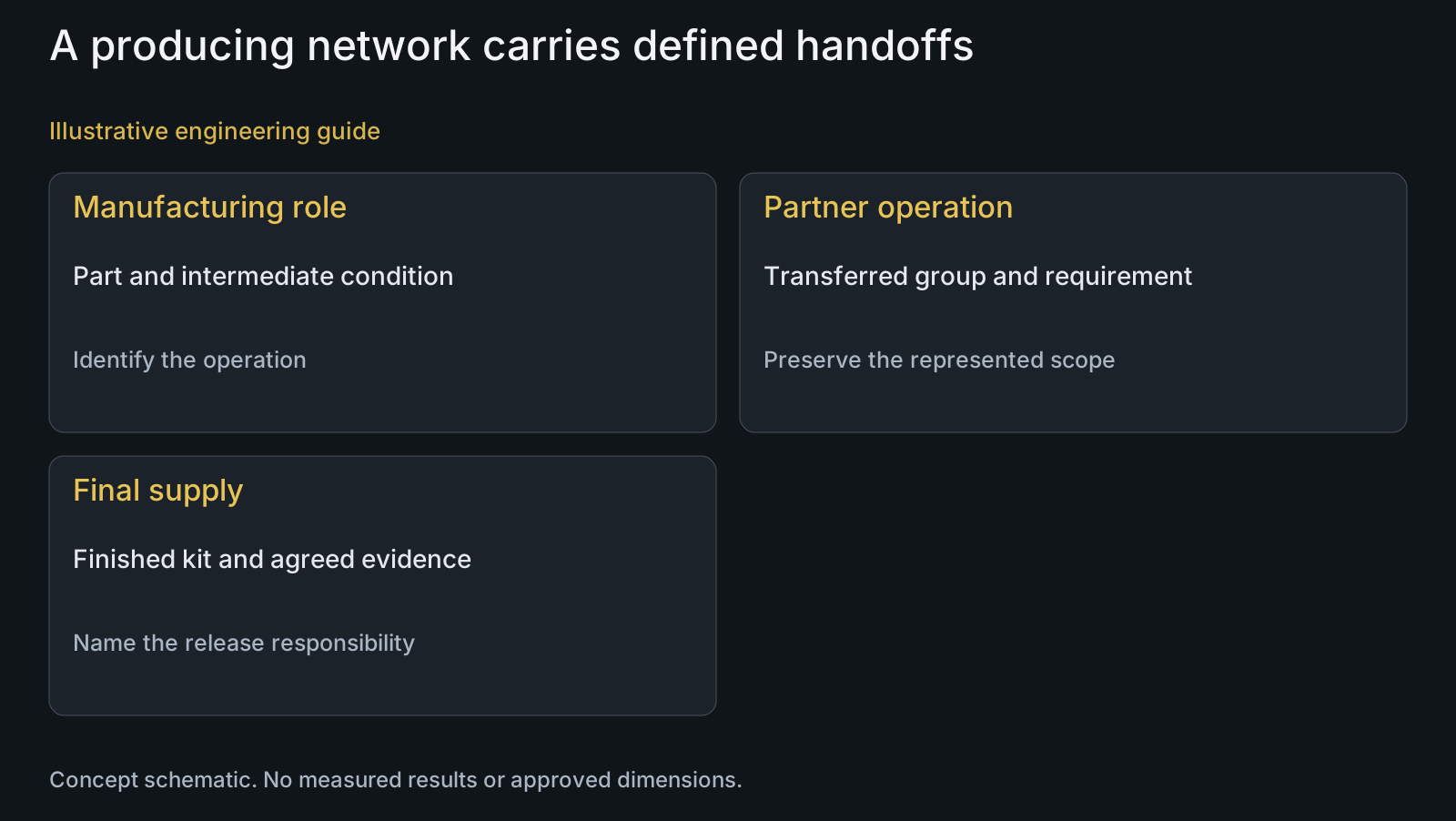
Review what must remain linked during an inter-site handoff
State the part identity, revision and represented group with the transferred work. Identify the next operation and any features that require protection. A carton containing visually similar axles does not establish that every item has the same treatment history or authorized disposition.
The receiving role needs enough context to perform its work without reconstructing the design from appearance. Relevant instructions can include the required treatment, protected surfaces and represented quantity. Agree the necessary scope instead of claiming that every project receives an identical universal record package.
Keep returned work linked to the corresponding processing information. A report for one represented group cannot silently cover another. The lot-traceability discussion explains those record relationships; a network diagram alone does not supply them.
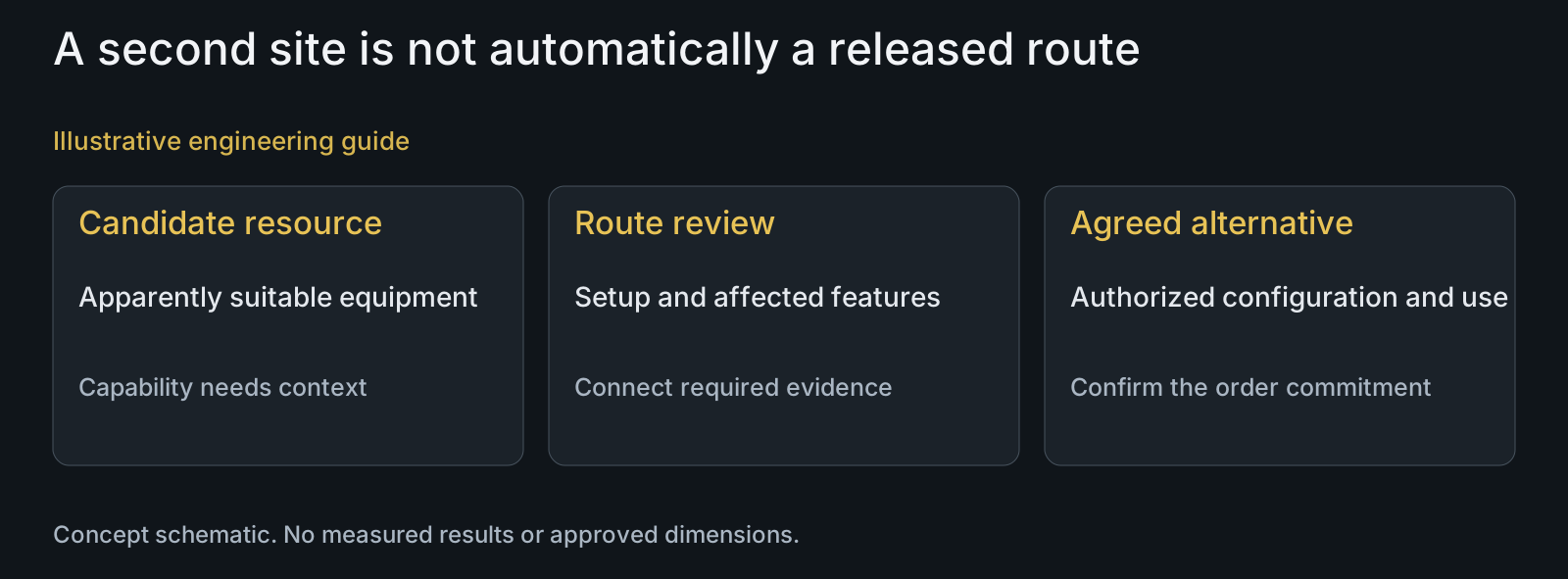
Treat a proposed alternate route as a change to review
Another location may have apparently similar equipment yet use a different fixture, operation sequence or partner route. Determine what actually changes before calling the move interchangeable capacity. The same drawing remains the requirement, but the proposed means of meeting it need their own review.
Ask which setup, affected features and evidence would support the proposed transfer. Avoid assuming a new site requires every possible test, but do not waive relevant review solely because the supplier name is unchanged. Tie the work to the actual change and customer requirements.
Confirm the applicable notification and authorization arrangement before relying on the alternate route for recovery. A location listed in a network overview is not automatically an approved backup. Separate a proposed recovery option from a route already evaluated for the intended configuration.
Keep management-system site scope distinct from route capability
If a management-system certificate is offered, examine its entity, activity and covered locations. IAF MD 1:2023 describes multi-site certification within a single management system and distinguishes a site's sub-scope from the wider scope. It does not establish that an independent partner is automatically covered by another company's certificate.
A covered location and a capable route are still different conclusions. A system certificate does not identify an available machining slot, show a particular pivot's conformity or establish universal interchangeability of sites. Use the certificate review for the document question.
Likewise, assess a social-report request against its own site and scope. Do not extend workplace evidence, material records or process results across the entire network by implication. Missing evidence should be described precisely rather than turned into either automatic approval or an accusation of nonconformity.
Review a proposed transfer for an unchanged pivot drawing
Illustrative engineering example: assume a supplier proposes moving machining of an unchanged pivot axle to another location while retaining the specified downstream treatment. No actual PremFixer transfer, available slot or conformity result is assumed.
The OEM identifies the new workholding and operation arrangements relevant to the shoulder and head relationship. It asks what review and evidence will support the proposed route and how the treatment handoff will retain the represented group. The unchanged part number cannot answer those route questions by itself.
The supply discussion can then distinguish the proposal from an authorized alternative. Required quantity and dates still need a separate commitment. Share the drawings, STEP, complete BOM and desired receiving window so PremFixer can discuss the relevant material and manufacturing route without using network size as a delivery guarantee.
Questions buyers need to confirm
Does PremFixer perform the entire route in-house?
No blanket all-in-house claim is appropriate. Confirmed in-house work includes heading, CNC machining, rolling and tool/die manufacture, while relevant testing and treatment use qualified partners. Agree the operations actually needed for your drawing and supplied condition.
Do headline factory and line counts guarantee my kit quantity?
No. Identify the resource scope and actual operations needed for the BOM, then discuss available allocation and the agreed period. This article does not confirm a current factory count or monthly output.
Can another network site automatically manufacture the same axle?
Do not assume interchangeability. Review the proposed setup, operation sequence, affected features and required evidence against the drawing and customer requirements. A listed location is not automatically an authorized backup route.
Does an in-process dimensional report cover the treated axle?
Only within its represented state and scope. Identify which features and condition were checked and which operations followed. Earlier measurements should not silently be described as final acceptance after a relevant processing change.
Does one management-system certificate cover every partner?
Do not infer that coverage. Read the entity, activities and listed locations, and distinguish independent partner evidence. The certificate also does not establish product conformity or an available slot for the order.
What should I send to discuss a supply-network route?
Provide drawing revisions, STEP models, complete kit BOM, material and finish requirements, quantity and desired receiving window. Identify any site, change-notification or evidence requirements so the relevant operations and commitments can be reviewed.
Technical references and scope
IAF MD 1:2023, Issue 3. Historical official document, scope and multi-site/sub-scope definitions read; not a claim of current supplier certification, automatic partner coverage or a complete certification assessment.
Explore related component, material and sourcing decisions in the customer decision knowledge center. For a drawing review, use the Drawing/BOM RFQ path.
Review the producing route for your complete pivot kit
Send the drawing or STEP, kit BOM, material and finish requirements, quantity and receiving window. Identify required route-change notifications and evidence so PremFixer can discuss the relevant in-house and partner operations, handoffs and project-specific supply commitment.
Discuss the drawing and BOM