

For custom pivot hardware, quotation expiry does not by itself explain what happens to an already agreed order. First identify the commercial state: an unaccepted offer, a confirmed order or a future release. Review its actual terms before treating a material-price movement as authority to reprice. Keep currency, material basis, drawing revision, quantity and delivery scope distinct. A new finish or sleeve requirement changes the work; a market indicator describes something else. No universal validity period or percentage trigger is assumed here. The purpose is a clear purchasing review, not legal advice or a promise of fixed prices for every future order.
Hero: concept illustration of example hardware and its application. It is not a factory photograph, tested component or approved production geometry.
Identify the offer, order or release under discussion
Record the quotation version, date, stated validity and included scope. Then identify what the parties have agreed and what remains a planning estimate. A spreadsheet carrying last year's price is not enough to show a current commitment for a revised pivot kit.
For a scheduled program, distinguish the committed release from later forecast quantities. Ask which quantities and dates the proposed change concerns. A discussion about a future purchase should not quietly be applied to an earlier release without examining the applicable agreement.
If the quotation has expired before the buyer proceeds, ask for confirmation of the current offer. Do not infer that expiry establishes either an automatic increase or indefinite price protection. Qualified commercial advisers should resolve contractual interpretation where needed.
Separate changed work from a changed cost basis
Compare the drawing revision, material specification and condition, finished features, BOM quantities, inspection and packing scope. A quotation for a different sleeve or treatment is not a like-for-like market adjustment, even if the bolt's nominal thread remains the same.
Ask the supplier to identify the specific difference. A newly required measurement report belongs to the evidence scope; an additional kit component belongs to the BOM; a changed release quantity belongs to batch planning. An unexplained combined increase prevents engineering and purchasing from reviewing the relevant decision.
Use price negotiation to explore genuine alternatives, but keep proposals apart from the released requirement. A cheaper revised configuration needs engineering authorization where appropriate. It is not simply a way to preserve an old quotation total.
| Situation | What changed | Main risk | Useful review |
|---|---|---|---|
| Offer validity expired | Availability of quoted offer | Assuming old terms remain current | Request confirmation of the offer |
| Existing committed release | Proposed commercial treatment | Applying a future proposal retrospectively | Examine affected release and agreement |
| Revised sleeve or finish | Engineering supply scope | Calling added work market inflation | Compare revisions and operations |
| Material adjustment proposed | Specified cost basis | Applying one input movement to whole kit | Identify baseline and affected portion |
| Budget currency moved | Buyer's conversion equivalent | Confusing FX with manufacturer repricing | Separate invoice price and conversion |
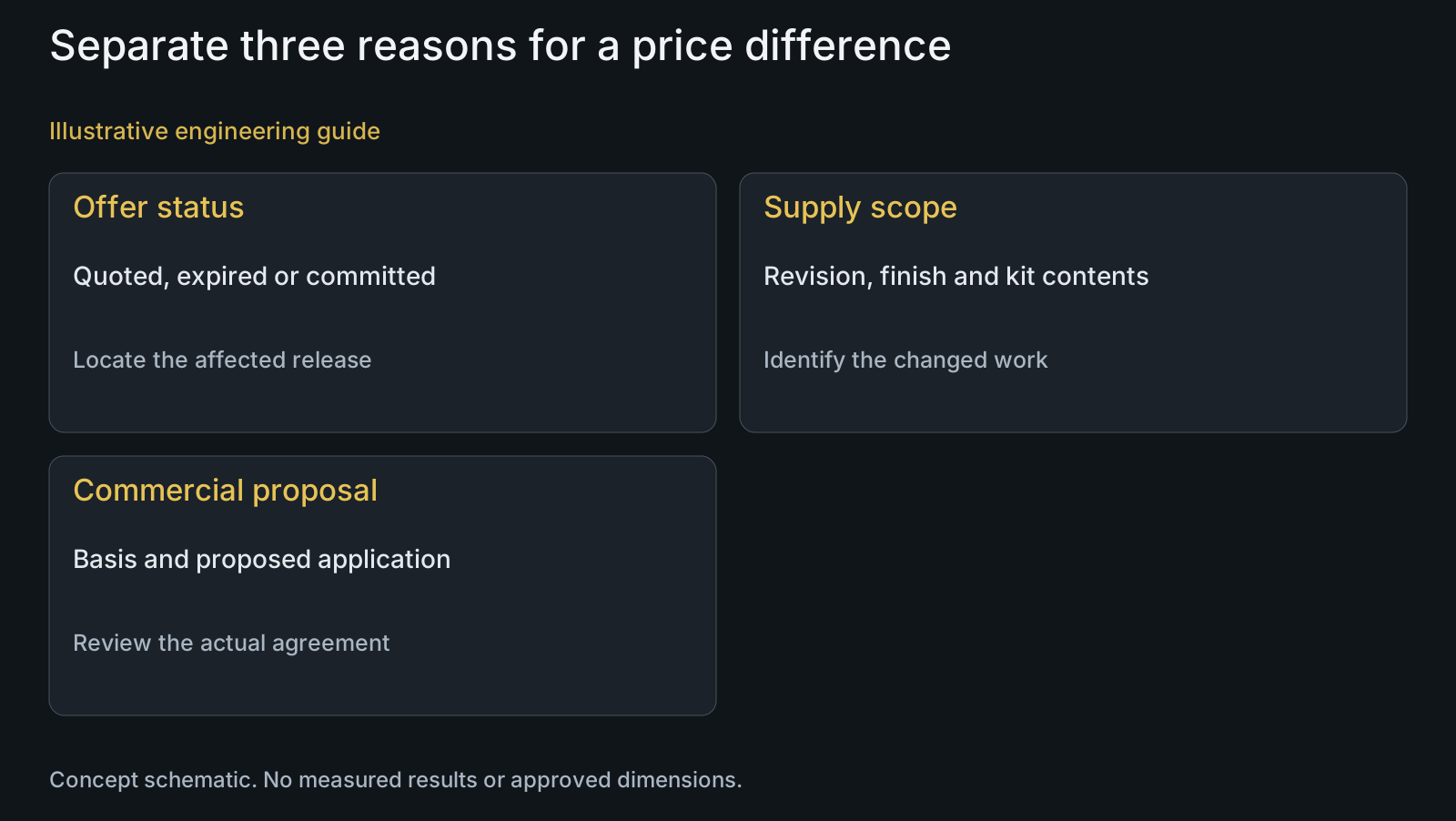
Use an identifiable adjustment basis without treating it as actual part cost
If the parties consider index-linked adjustment, the BLS contracting guide highlights the need to identify the series, base period, timing and calculation method. It also distinguishes producer selling-price indexes from a direct measure of manufacturing cost. This is guidance on index use, not a suitable index selection for a Chinese pivot order.
For the engineering review, ask what physical input the proposal concerns. A material-family label alone may hide a different grade, condition or product form. Match the discussion to the material requirement while keeping confidential cost information under the parties' agreed controls.
Do not apply a movement in one input to the entire finished-kit price without an agreed explanation of the affected portion. Machining, finishing, evidence and kit supply are separate work elements. Their treatment belongs in the actual commercial arrangement, not an assumption copied from a market headline.
Make a proposed adjustment reviewable at the release level
Ask which quotation or release is affected, what baseline is being compared and when the revised offer would apply. Keep the old and proposed versions readable so the buyer can distinguish unchanged requirements from new commercial conditions. A notice without an identified affected order is difficult to act on.
If a trigger is proposed, clarify whether it starts a discussion or invokes an agreed calculation. Those are different actions. A percentage in an email cannot establish its denominator, affected price portion or approval process. Do not invent a default threshold for PremFixer.
Consider the purchasing consequences of the proposed effective date, including already planned assembly supply. Resolve those effects through the actual agreement rather than imply that a familiar supplier can change any commitment unilaterally. The supply-contract guide separates engineering scope from wider commercial responsibilities.
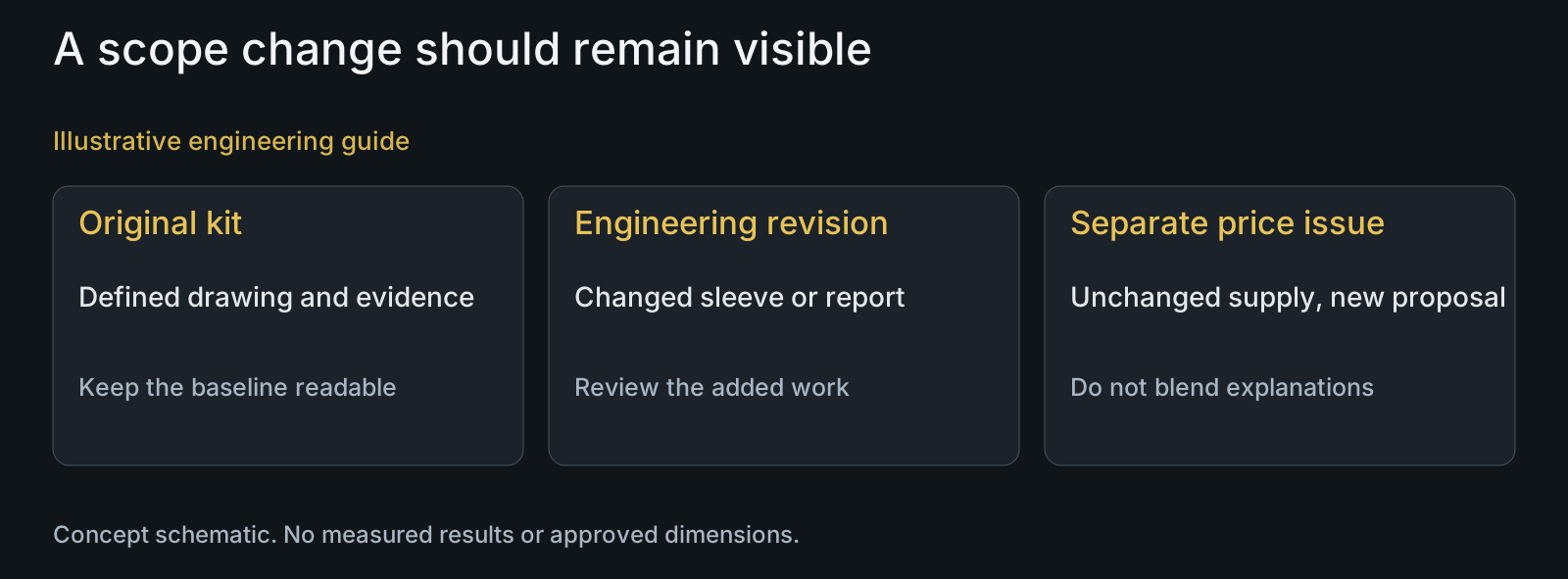
Review a drawing revision and a material discussion separately
Illustrative engineering example: assume an OEM requests a new sleeve geometry and an additional finished-feature report after the original kit quotation. At the same time, the supplier raises a material-market concern. No actual prices, index movements or order rights are assumed.
The team asks for two explanations: work affected by the revised kit and any separate proposed adjustment to otherwise unchanged supply. It identifies the drawing and evidence changes first. That prevents the entire difference from being described as raw-material inflation when part of it relates to newly requested work.
The outcome is a reviewable proposal, not a calculated saving or automatic entitlement. Engineering can assess the revised interface while purchasing examines the applicable commercial basis. If the original requirement is retained, the added-work portion cannot simply be carried into the comparison without explanation.
Request a quotation that can be compared later
Give PremFixer the drawing revision, STEP model where available, kit BOM, material and finish requirements, quantities and requested delivery arrangement. Identify whether the quantity is a firm request or a forecast. These inputs define the manufacturing task being priced.
Discuss validity and any proposed adjustment arrangement explicitly for the project. Keep currency and settlement questions separate: the buyer's conversion cost may change even when the invoice price does not. That does not explain a change in the manufacturer's supplied scope.
PremFixer's manufacturing review can address the requested custom parts and route. It does not create an automatic annual price guarantee. Preserve the agreed specification while resolving commercial questions, and involve qualified advisers when interpreting existing obligations.
Questions buyers need to confirm
Are all PremFixer quotations valid for thirty days?
Do not assume a universal period. Check the project quotation's date, validity and stated scope, then obtain confirmation if ordering later. No company-wide validity policy is established by this article.
Does a material-market increase automatically reprice my confirmed order?
Do not infer that result. Identify the affected order or release and review its agreed terms with the responsible commercial team. A market observation and contractual authority to change a price are separate matters.
Is a proposed percentage trigger enough to define an adjustment?
No. Establish what it measures, the baseline and comparison period, affected price portion and intended action. A trigger for discussion differs from a calculation already agreed by the parties; do not supply missing mechanics by assumption.
Should a new coating be included in a material-price adjustment?
Treat the changed coating as a scope question first. Identify the revised finish requirement, affected surfaces and evidence. Its manufacturing implications differ from a price movement for unchanged material supply.
Can a forecast quantity guarantee the old unit price?
Not by itself. Clarify the committed quantity, release pattern and quotation assumptions. A projected annual total may not represent the batch or obligation being quoted. Discuss applicable terms without treating forecasts as firm orders.
What should I send when questioning a revised pivot quotation?
Send the original and proposed quotation versions, drawing revisions, BOM, quantities and requested delivery scope. Ask which difference concerns changed work and which concerns a separate commercial proposal. Keep confidential agreements in the appropriate private channel.
Technical references and scope
BLS: PPI Guide for Price Adjustment. Index identification, timing and adjustment-basis limitations; not a required index, legal interpretation or PremFixer price policy.
Explore related component, material and sourcing decisions in the customer decision knowledge center. For a drawing review, use the Drawing/BOM RFQ path.
Compare the revised offer against a defined kit
Share the current drawing or STEP, kit BOM, quantities and relevant quotation versions. Identify changed geometry, material, finish or evidence requirements so PremFixer can review the manufacturing differences and discuss the applicable project quotation terms.
Discuss the drawing and BOM