

An annual quality-improvement plan for pivot hardware should select a manageable set of defined problems, assign feasible interventions and state how their effects will be evaluated. Use actual observations and programme needs to choose priorities instead of demanding that every metric improve by the same percentage. Identify owners, resource dependencies, affected configurations and an appropriate evidence window for each project. Quarterly meetings can organize review, but a calendar milestone does not prove effectiveness. Urgent nonconforming goods need their own immediate response. For purchasing and SQE, the useful output is a portfolio showing which engineering decisions are supported, blocked or still under evaluation, without inventing completed benefits.
Hero: concept illustration of example hardware and its application. It is not a factory photograph, tested component or approved production geometry.
Select projects without postponing urgent controls
Group candidate issues by their observed consequences, affected interfaces and recurrence. A recurring identification gap, final-seat concern and difficult receiving task may require different work and evidence. Choose projects that address defined needs rather than filling every available row in an annual presentation.
Keep active containment and product-disposition decisions outside the routine improvement calendar. An unresolved potentially serious departure cannot be deferred merely because the next review meeting is months away. The nonconforming hardware guide handles that immediate goods decision; this plan organizes longer-term work.
Resource the intervention, not just the promised outcome
For each selected project, explain what would change and why it could affect the issue. Name the responsible activity and required customer, manufacturing or partner input. A statement to improve quality has no resource meaning until the proposed work is identified.
Map dependencies across the portfolio. Two projects needing the same fixture review or partner evaluation may compete for availability. Sequencing them can preserve a meaningful baseline and avoid confusing concurrent changes. PremFixer's manufacturing review can clarify relevant operations; no reserved engineering capacity or guaranteed improvement service is implied.
| Project question | Intervention subject | Relevant evaluation | Dependency or side effect |
|---|---|---|---|
| Kit identity retained? | Packing handoff | Identified contents after opening | Restraint and usable labels |
| Finished seat controlled? | Defined route or method | Relevant final-state feature | Customer basis and other features |
| Historical report usable? | Permitted retrieval arrangement | Correct revision and context | Access and migration limits |
| Recurring issue prevented? | Supported causal intervention | Affected subsequent activity | Cause evidence and represented scope |
| Response reaches a decision? | Technical handoff | Defined resolution event | Missing essential customer input |
| Portfolio ready for adoption? | Authorized supported changes | Evidence and collateral review | Shared resources and open dependencies |
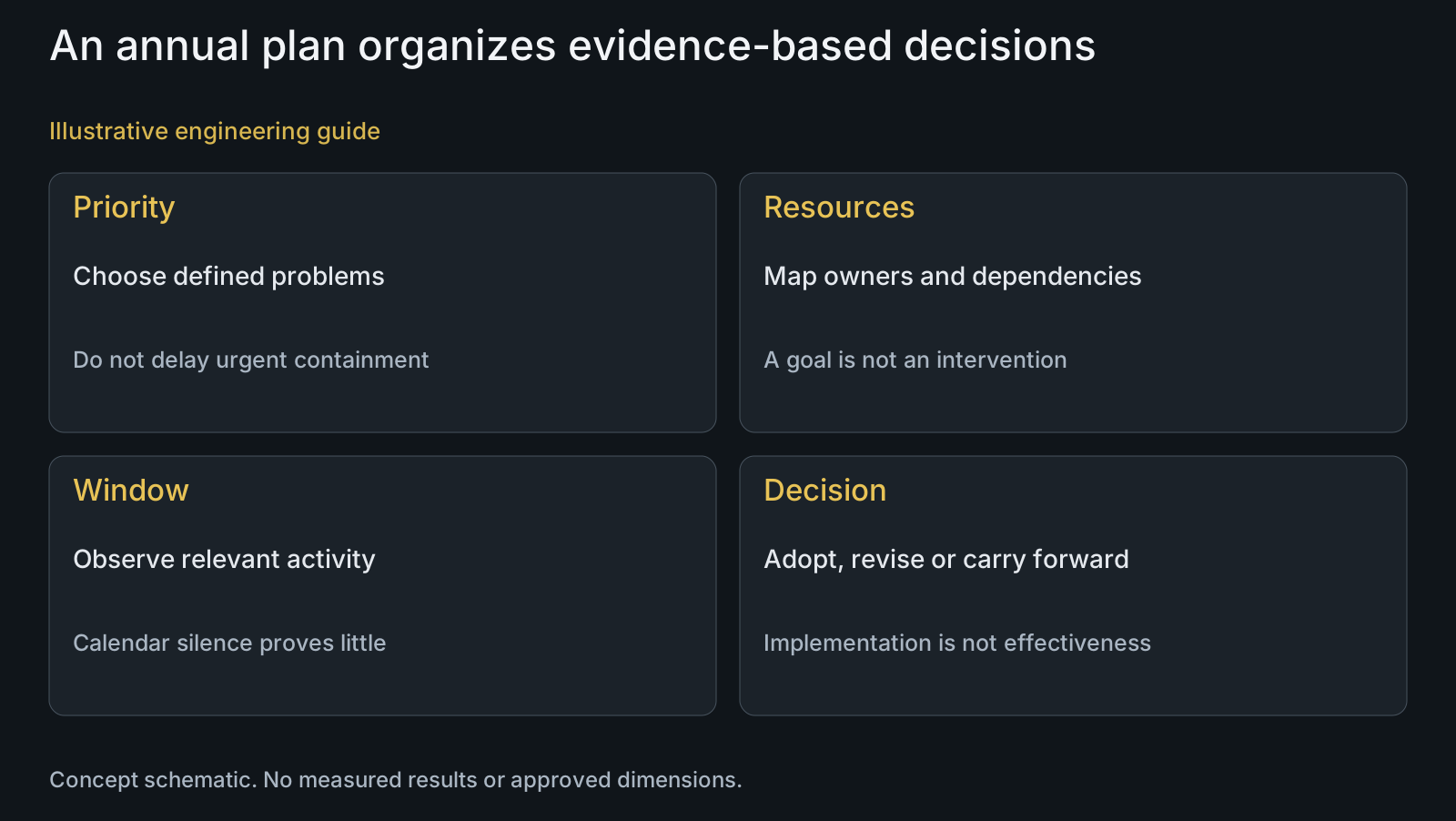
Choose evidence appropriate to each project
A label-identity problem may need an examination of the actual component-to-kit handoff. A functional-seat concern may need suitable final-state geometry evidence. A faster response task may need defined elapsed-event records. One generic lower-defect percentage cannot answer all these questions.
ASQ's PDCA explanation distinguishes testing a change, reviewing what was learned and acting on that learning. Use that general distinction without prescribing a universal trial or claiming a result. The serial-production improvement guide covers a single technical hypothesis; annual planning must also resolve priorities and dependencies among projects.
Match review timing to opportunities for observation
Identify when the affected configuration will actually be produced, processed or received. A quiet quarter with no relevant production cannot demonstrate reduced recurrence. If the programme is seasonal, schedule useful evidence collection around the represented activity rather than treating calendar silence as success.
Keep administrative progress separate from evaluation status. A fixture received, instruction issued or meeting held can establish implementation work, while the subsequent condition remains unevaluated. State the production scope and review window needed before extending a conclusion. No universal number of batches or fixed quarterly schedule is mandated here.
Review collateral effects and carryover explicitly
Examine what the proposed intervention could worsen. Greater restraint in packaging can affect unpacking; a holding-route change can affect another datum or surface; extra inspection can alter handling. Define the relevant collateral requirement rather than evaluating only the most convenient benefit.
At a portfolio review, distinguish supported adoption, incomplete evidence, rejected intervention and work carried forward. Explain the blocking dependency or unresolved consequence. Do not mark an unsuccessful project complete merely because its budget period ended. The quality-target guide separates desired outcomes from actual observations.
Review example: three projects compete for attention
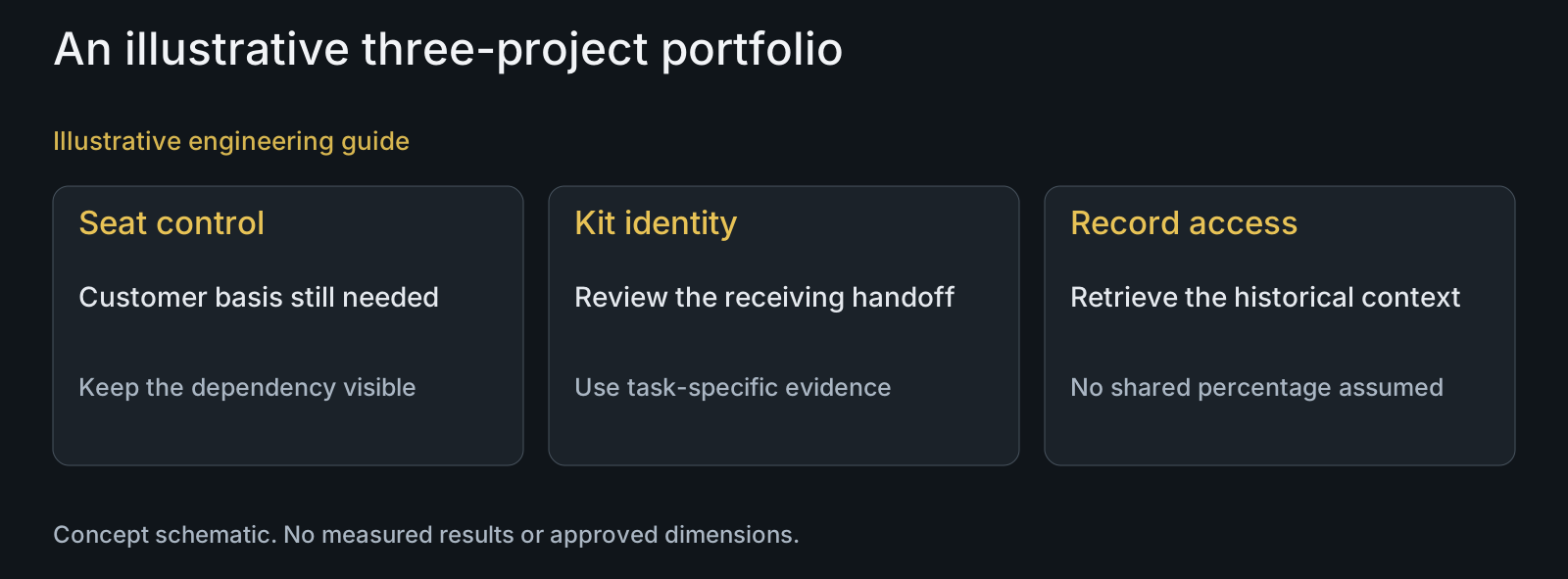
Illustrative engineering example: assume a hypothetical annual plan proposes kit-identity improvement, a finished-seat control change and faster document retrieval. The seat project requires an agreed customer measurement basis; the other two involve different handoffs. No actual resource allocation, measured improvement or project outcome is supplied.
The team separates any urgent affected-goods response, then identifies the seat project's open dependency rather than declaring it implemented. It defines relevant receiving observations for kit identity and an authorized historical retrieval task for records. Different evidence windows and collateral checks enter the review. The example produces a justified project map, not fabricated percentages or completed annual results.
Questions buyers need to confirm
Is an annual lower-defect target an improvement plan?
Not alone. Identify problems, interventions, owners, dependencies and evidence windows. A target states a desired result without explaining what work or decision will produce it.
Should every project report a percentage improvement?
No. Choose evidence matching the issue, such as retained identity or correct historical retrieval. Do not manufacture a common numerical benefit for unrelated tasks.
Are quarterly reviews always enough?
No universal frequency is established. Review urgent concerns promptly and align project evaluations with relevant production or receiving activity. A calendar meeting is not evidence collection.
Does a new instruction prove the improvement worked?
It shows an implementation step. Evaluate use and effect in the affected scope, including collateral requirements, before calling the project effective.
Can a quiet quarter prove recurrence was prevented?
Not if the relevant activity or observation opportunity was absent. State what configuration was actually evaluated and what evidence remains needed.
What should happen to an unfinished annual project?
Record the actual status, dependency and next decision instead of declaring success at year-end. Carryover, rejection and further evaluation are legitimate outcomes when stated accurately.
Technical references and scope
ASQ, Plan-Do-Check-Act Cycle. General distinction between change testing, reviewing learning and acting on it; original portfolio analysis is not completed production evidence.
Explore related component, material and sourcing decisions in the customer decision knowledge center. For a drawing review, use the Drawing/BOM RFQ path.
Define a practical improvement portfolio
Send the affected drawings and BOM, recurring observations, current evidence, proposed interventions and customer or partner dependencies through the Drawing/BOM RFQ path. PremFixer can discuss manufacturing scope and meaningful evaluation tasks without promising unsupported annual improvement results.
Discuss the drawing and BOM