

A useful quality target for a pivot supplier names the event or characteristic, counted population and reporting period, then separates the agreed goal from actual observations. Establish a relevant baseline before choosing a percentage. Lot acceptance, nonconforming pieces and reported complaints describe different subjects and cannot be merged into one unexplained quality rate. Review serious and recurring concerns alongside aggregates so high-volume success cannot hide an unresolved functional interface. No universal acceptance percentage or zero-incident guarantee is established here. For an OEM or SQE, the target should select a defined response when performance or evidence is inadequate, not merely produce an attractive dashboard.
Hero: concept illustration of example hardware and its application. It is not a factory photograph, tested component or approved production geometry.
Choose the quality decision the goal should support
Name the question: initial lot acceptance, examined-part conformity, recurring departures or issue-response effectiveness. Limit the population to the relevant parts and supplied conditions. A general supplier total may be unsuitable for a newly introduced shoulder geometry whose controls have not yet been demonstrated.
The supplier KPI guide explains denominator and event definitions across quality, delivery and cost. Here the narrower task is setting and interpreting quality goals. Avoid adding a target simply because another programme displays it; identify what action a departure from that goal should trigger.
Establish a baseline without turning sparse data into certainty
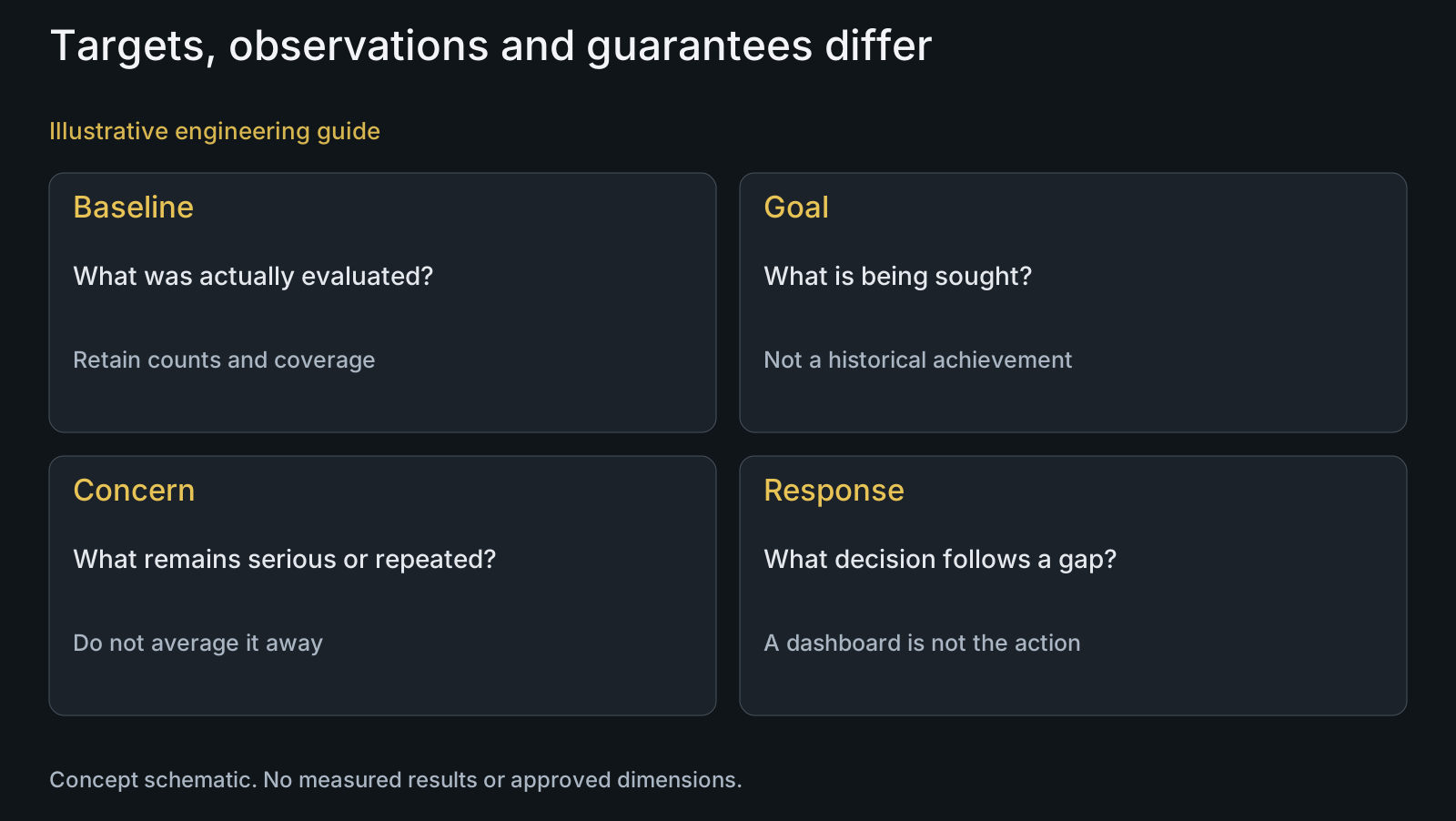
Record the available observations, scope, coverage and period. If only a small launch population or selected sample has been evaluated, describe that limit. A period with no recorded concerns is not proof that every characteristic or service condition was examined.
NIST defines a proportion nonconforming using nonconforming units and their represented population, and separately identifies sample proportions. That distinction supports retaining counts and coverage. Its statistical model has assumptions; this guide does not derive a target, control limit or whole-shipment prediction from an unexplained percentage.
| Review subject | Definition needed | Misleading shortcut | Action supported |
|---|---|---|---|
| Baseline | Observed scope and coverage | No reports means no risk | Identify evidence limits |
| Target | Agreed goal and review period | Goal advertised as result | Compare defined observations |
| Initial acceptance | Original decision event | Rework erases the first finding | Review intervention needs |
| Serious concern | Consequence and affected scope | Aggregate cancels local risk | Independent technical review |
| Recurrence | Same-condition identification | Each occurrence counted as unrelated | Examine unresolved cause |
| Trend | Comparable scope and rules | Changed mix becomes improvement | Separate definition and process changes |
Agree the goal separately from the observed result
Label a proposed target, an agreed commitment and a reported result distinctly. The same number can appear in all three fields while having different meanings. Do not convert an aspirational goal into a historical PremFixer achievement or a contractual guarantee without the actual supporting record.
Discuss feasibility through the relevant route, characteristics and evidence scope, not a generic machine list. A newly introduced treated seat may need a different review emphasis from an unchanged appearance feature. Keep any goal revision visible with its reason rather than moving the target silently after a difficult period.
Protect serious and recurring issues from aggregate dilution
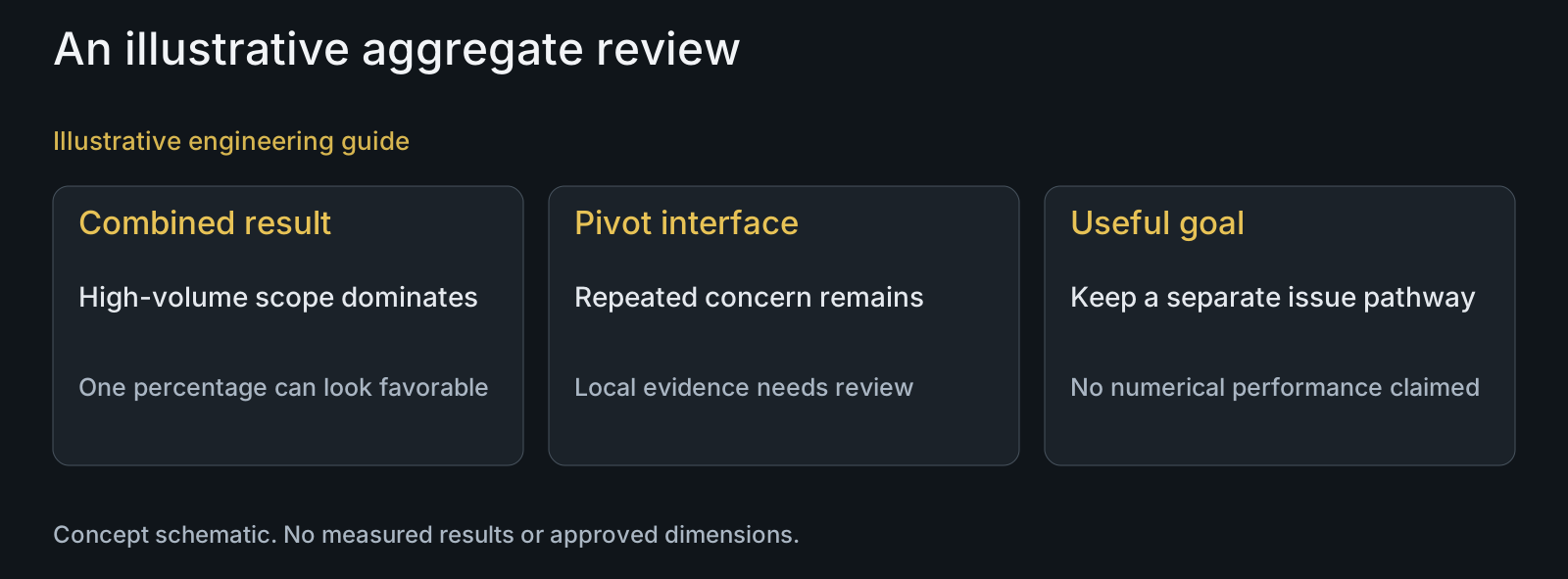
Maintain a separate review of the functional consequences and unresolved scope of important issues. A large population of unrelated acceptable screws can dominate the combined percentage while a lower-volume pivot interface repeatedly raises concerns. Do not allow the aggregate to settle that interface's acceptance.
Use consistent severity definitions and issue identities so recurrence can be recognized. Distinguish another observation of the same unresolved condition from a different event where evidence supports that distinction. The defect consequence guide addresses classification; a dashboard color does not replace that reasoning.
Keep initial performance and recovered supply visible
If sorting, rework or replacement makes goods usable, report the original observation and the recovered condition separately where relevant. Otherwise a favorable final acceptance number can conceal repeated intervention and the unresolved mechanism that made intervention necessary.
Define what happens when the goal is missed: which scope is reviewed, what investigation is needed and who can authorize a response. Also review definition changes, product mix and reporting delays before attributing every shift to manufacturing improvement. A lowered complaint count can reflect observation timing rather than a changed supplied condition.
Review example: the overall goal misses a recurring interface
Illustrative engineering example: assume a hypothetical programme combines high-volume accessory screws and lower-volume pivot spacers in one quality summary. The reported aggregate meets its proposed goal, but the spacer contact requirement repeatedly needs additional review. No counts, real performance or confirmed defect rate is supplied.
The reviewer separates the spacer scope, retains initial observations and identifies the recurring characteristic and unresolved action. The aggregate remains a description of its stated population, not permission to close the spacer issue. The example shows why goal design should preserve an independent functional-issue review instead of relying on one supplier-wide percentage.
Questions buyers need to confirm
Should every pivot supplier use the same quality percentage?
No universal target is established. Define the programme, characteristics, event and relevant baseline before agreeing a goal and the response to a departure.
Can an agreed target be shown as achieved performance?
Only with actual observations supporting that represented scope and period. Label goals and measured results separately; an aspirational percentage is not evidence.
Does zero recorded incidents guarantee zero future risk?
No. State the observation period and reporting scope. A goal or limited record does not establish all future products or unexamined service conditions.
Why review a serious issue when the overall goal is met?
The aggregate can be dominated by unrelated volume. Keep the affected interface and consequence under separate review so a favorable summary cannot authorize its acceptance.
Should reworked parts erase the original quality finding?
No. Keep initial observations distinct from recovered supply where relevant. Recovery shows a later condition, not proof that the original issue never occurred or its cause is closed.
What is needed to agree useful quality goals?
Provide part and revision scope, required characteristics, reporting events, coverage, available baseline and issue definitions. Include review responsibilities so each goal supports an actual decision.
Technical references and scope
NIST/SEMATECH, Proportions Control Charts. Population and sample proportion distinctions only; no statistical target or model-based inference calculated.
Explore related component, material and sourcing decisions in the customer decision knowledge center. For a drawing review, use the Drawing/BOM RFQ path.
Set goals around the supplied scope and actual evidence
Send the drawing and BOM, relevant quality characteristics, counting rules, reporting period and available baseline through the Drawing/BOM RFQ path. PremFixer can discuss manufacturing and evidence scope for programme-specific goals without inventing historical performance or universal guarantees.
Discuss the drawing and BOM