

Classify a pivot hardware departure by what it can change in the actual part and assembly, not just whether it is dimensional or visible. A mark on a nonfunctional exposed face and a mark crossing a bearing contact may need different review even when they look alike. Identify the location, required function and credible consequence, then apply the project's agreed severity definitions. Keep the uncertainty visible when the condition is not yet interpreted. A critical label does not establish that inspection can always detect the issue, and a minor label does not erase a specified requirement. Sampling and disposition need separate, justified decisions.
Hero: concept illustration of example hardware and its application. It is not a factory photograph, tested component or approved production geometry.
Start with the required function and affected location
Identify whether the region locates a bearing, supports clamping, engages a receiving thread, provides clearance or only has an appearance requirement. Describe the observed departure against that function. A drawing dimension is not inherently major simply because it is numeric; its role and consequences need review.
Connect the component to its mates and intended application. A burr near a moving clearance and the same burr on an isolated handling surface can have different implications. The full-suspension application provides system context, not a blanket safety approval for any visible condition.
Distinguish an observation, a failure mode and an effect
A visible line is an observation, not automatically a confirmed crack. A dimensional departure can be confirmed by suitable evidence while its assembly effect still needs investigation. State what is observed, how it was evaluated and which interpretation remains unresolved.
For suspected discontinuities, the penetrant and magnetic inspection guide explains method and coverage limits. Do not reduce a crack-like concern to cosmetic classification before appropriate evaluation, or claim a photograph establishes its depth and fatigue consequence. The classification must retain the evidence boundary.
| Observed condition | Relevant function | Possible unresolved consequence | Useful review |
|---|---|---|---|
| Mark on exposed face | Specified appearance | Appearance requirement unmet | Agreed visual criterion |
| Mark on bearing contact | Locate or support the mate | Contact condition changed | Geometry and surface requirement |
| Thread departure | Receiving engagement | Assembly or retention affected | Mating definition and evidence |
| Burr at clearance | Allow intended movement | Interference or contact | Actual surrounding geometry |
| Crack-like indication | Maintain integrity | Discontinuity not yet interpreted | Suitable examination and authority |
| Identity gap | Use correct part and condition | Wrong configuration introduced | Revision and material connections |
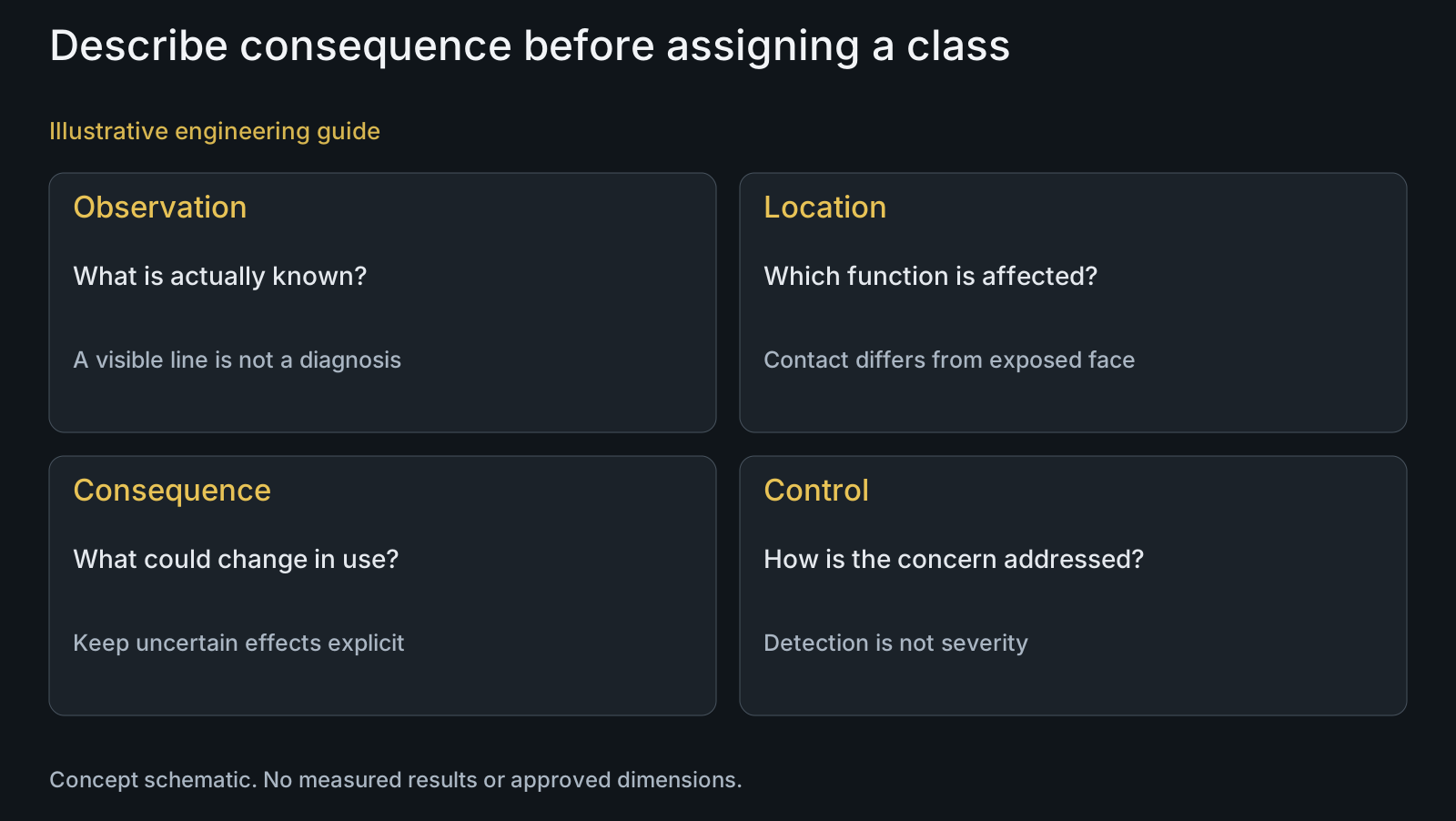
Keep severity separate from frequency and detection
ASQ's FMEA guidance distinguishes the seriousness of consequences, how often failures occur and how readily they can be detected. That distinction is useful here without importing a universal score table. An infrequent concern can still have serious consequences; an obvious defect can still require strong containment.
A more capable detector can change the chance of escape without changing what the failure would do if present in service. Conversely, reducing an actual effect through a design change is a different intervention. Do not lower the stated consequence merely because a revised inspection instruction has been issued.
Use agreed classes without inventing universal thresholds
Critical, major and minor need definitions agreed for the project and applicable requirements. Record the reasoning, not just a colored cell. Identify who resolves uncertain interpretations and which information is needed before the classification can be finalized.
Do not translate a class into a universal AQL value or a promise that no defective parts can escape. The AQL sampling guide addresses populations, plans and acceptance decisions separately. A label such as AQL zero does not describe a complete detection and prevention system.
Connect classification with proportionate control and authority
Where the consequence is unresolved or potentially serious, control the affected scope while the appropriate team evaluates it. Define the detection task around the actual characteristic and supplied state. Inspection coverage should not silently exclude the region that drove the concern.
Keep disposition authority separate from classification. A minor appearance departure may still require agreement under a strict appearance specification; a severe functional departure is not made acceptable by urgent demand. Use the nonconforming hardware guide to compare feasible responses without assuming a class authorizes concession.
Review example: similar marks on different surfaces
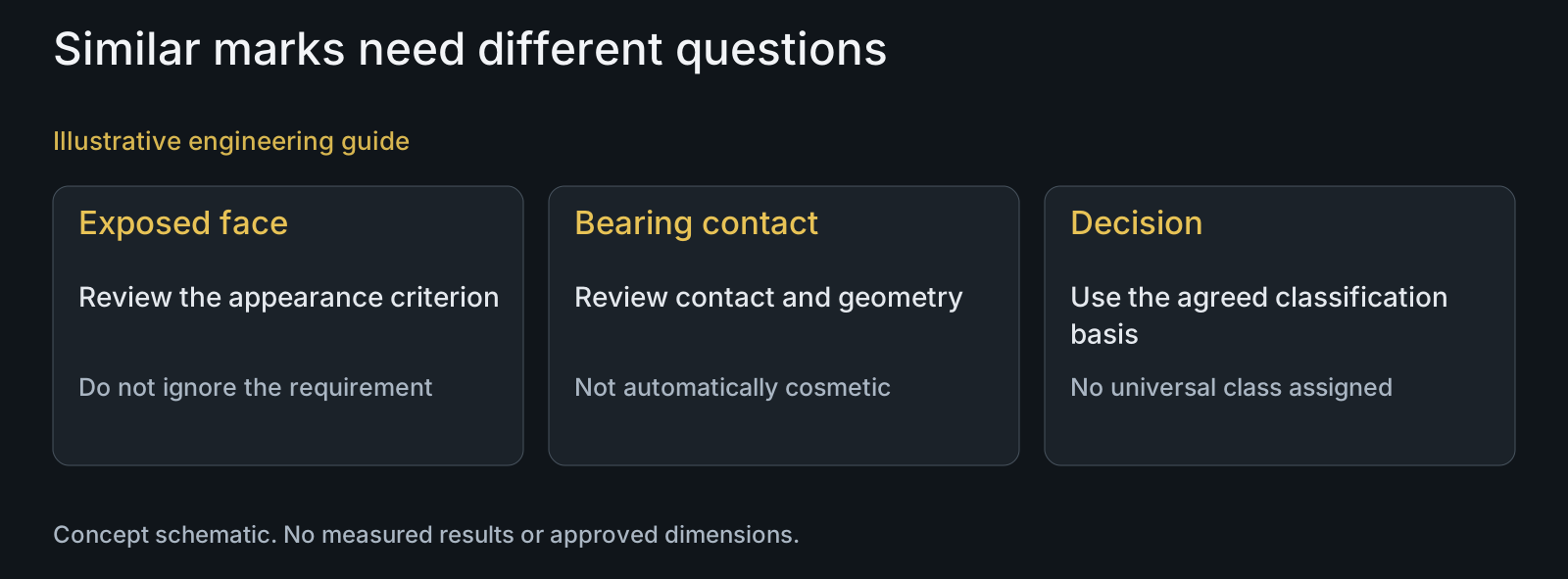
Illustrative engineering example: assume two hypothetical spacers show a similar visible mark. One mark lies on an exposed noncontact face; the other crosses the specified bearing-contact face. No actual depth, measured departure, customer incident or inspection outcome is supplied.
The reviewer compares the appearance requirement for the first region and the geometry and contact requirements for the second. The second needs suitable evaluation of its functional consequences rather than automatic cosmetic acceptance. Both observations remain linked to their requirements. The example does not assign a universal severity class; it shows why location and function change the questions needed for a justified decision.
Questions buyers need to confirm
Is every out-of-tolerance dimension a major defect?
No universal class follows. Identify its function, mates and credible consequence, then apply the agreed definitions. Keep the departure recorded even if the resulting severity is lower.
Is every appearance issue minor?
No. First determine whether the region is functional or the indication may represent a discontinuity. A visible condition cannot be classified solely from its appearance category.
Does critical mean the part will always fail?
No such probability follows from a severity label. Severity addresses consequences under the defined basis; occurrence and uncertainty require separate evidence.
Can improved inspection reduce severity?
Detection can reduce escape risk without changing the consequence of a failure that remains present. Distinguish detection improvements from design or process changes that demonstrably alter the effect.
Does AQL zero guarantee no critical defects?
No. Define the actual prevention, detection and acceptance arrangements. A shorthand number is not a complete sampling plan or proof that inspection detects every relevant condition.
What should a classification review include?
Provide the drawing requirement, observed condition, location, relevant mates, supplied state and agreed class definitions. These inputs connect the departure to its function and make unresolved consequences visible.
Technical references and scope
ASQ, Failure Mode and Effects Analysis. Distinction between effects, severity, occurrence and detection; no rating scale, AQL assignment or completed FMEA claimed.
Explore related component, material and sourcing decisions in the customer decision knowledge center. For a drawing review, use the Drawing/BOM RFQ path.
Connect the observation with the functional requirement
Send the drawing, relevant mating definitions, photographs or suitable observations and your defect-classification criteria through the Drawing/BOM RFQ path. PremFixer can discuss manufacturing and inspection questions; the responsible team retains classification and acceptance authority.
Discuss the drawing and BOM