

A social-audit statement does not by itself approve a custom pivot bolt, the bicycle application or every site involved in the order. Ask which program, legal entity, factory location, date and assessment scope the available information covers. Review findings and follow-up rather than rely on a logo or the word passed. Then connect the evidence to machining, treatment and other relevant sites in the proposed route. Social-responsibility information and product-conformity evidence answer different questions. PremFixer's specific report availability must be confirmed for the request; this guide does not claim a BSCI audit, Sedex membership or SMETA report for the company.
Hero: concept illustration of example hardware and its application. It is not a factory photograph, tested component or approved production geometry.
Translate the buyer requirement into a specific evidence request
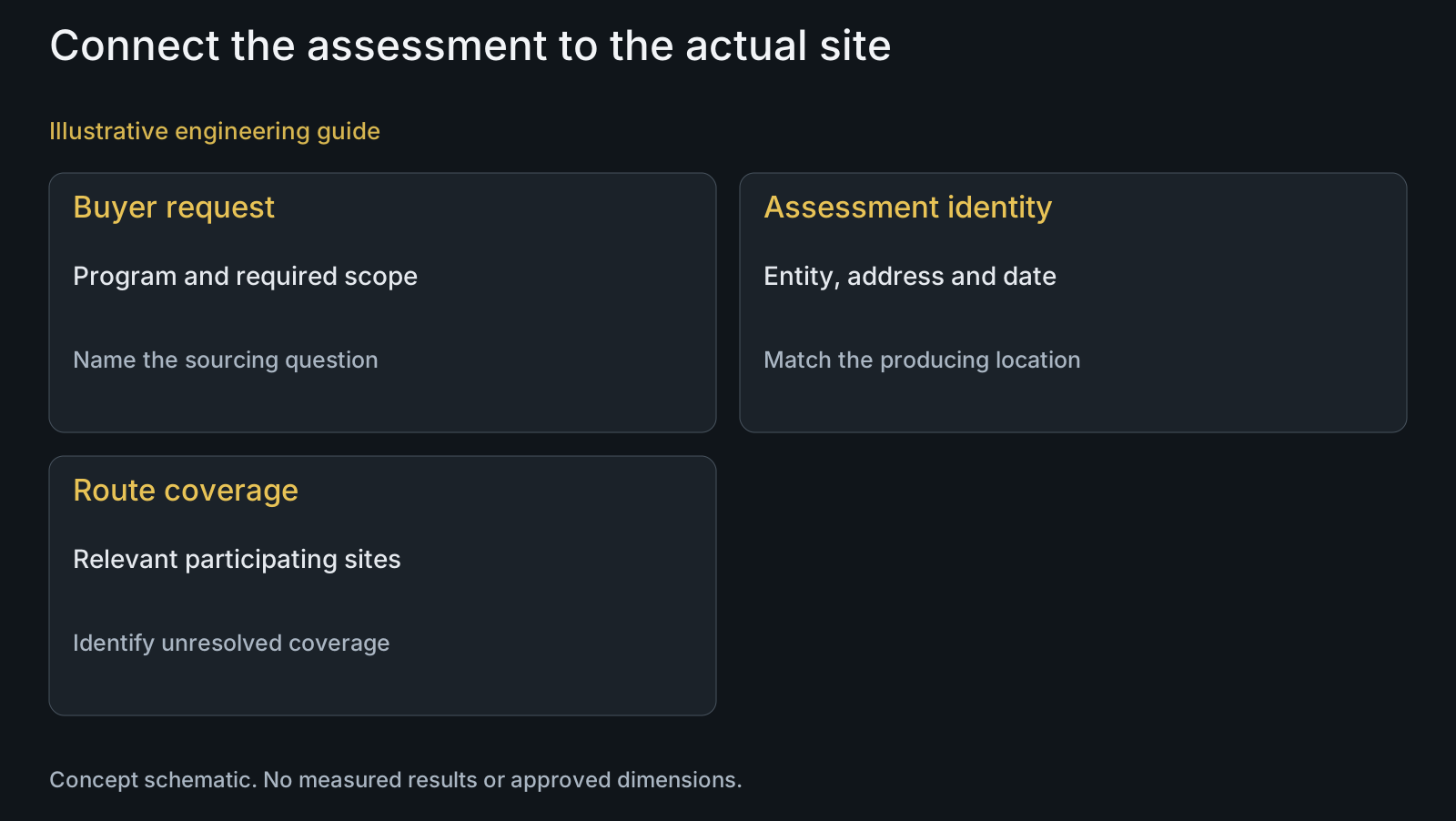
Identify whether the OEM seeks a supplier questionnaire, a particular audit program, site information or follow-up evidence. A general request for ESG certification is ambiguous. Ask the buyer's responsible-sourcing team what it needs to evaluate and which acceptance criteria apply to that request.
Separate the commercial supplier identity from each site performing relevant work. A brand name on a quotation may differ from the entity and address on an assessment. Clarify the relationship instead of assuming that one familiar company name establishes coverage of all locations.
Keep the request proportionate to its purpose. A broad sustainability narrative cannot supply a missing site report, and a report's existence cannot replace the buyer's evaluation. Identify unresolved information without fabricating a report number, rating or current approved status.
Distinguish the program, membership and assessment scope
Sedex describes SMETA as a social-audit methodology rather than certification. Its two founding pillars concern labour standards and health and safety; the four-pillar scope adds environment and business ethics. Sedex identifies approved audit companies as the organizations conducting the assessment.
Those distinctions matter when purchasing receives the phrase Sedex certified. Ask for the actual evidence and scope rather than treating that phrase as a product certificate. Membership, an audit method and a particular site assessment should remain separately identifiable.
For an amfori BSCI request, amfori's producer guidance directs producers to the responsible member arrangement for requesting an audit. Confirm the applicable program process with the buyer. Do not promise that PremFixer can issue a requested assessment or share a report before availability and authority are established.
| Information | Useful purpose | What it does not establish | Buyer check |
|---|---|---|---|
| Program or membership statement | Identify a claimed participation context | A completed site audit | Request actual assessment identity |
| Site assessment report | Review the covered location and scope | Coverage of every partner location | Match address and producing role |
| Follow-up information | Evaluate response to identified issues | Automatic closure or buyer approval | Review the evidence and status |
| Dimensional report | Evaluate specified part characteristics | Social-responsibility performance | Connect result to drawing and condition |
| Material or substance information | Review its defined material scope | Whole-route ethical certification | Keep the document purpose distinct |
Map site evidence to the pivot manufacturing route
Identify where the relevant machining, treatment and other requested operations are performed. Connect each site to its role in the proposed supply, without publishing confidential partner details unnecessarily. The review concerns actual coverage, not how many facilities a supplier's brochure mentions.
If an assessment covers the machining location, ask whether the requested sourcing review also concerns a separate finishing provider. Do not extend the first site's evidence to another address merely because the finished part returns to the same supplier for delivery.
PremFixer's manufacturing scope includes custom fastener work and coordination of relevant processing. That company description is not proof of a social audit at each participating site. Ask what evidence is available for the actual route and keep unsupported coverage claims out of the sourcing decision.
Read findings and follow-up without inventing a pass result
Review the assessment date, scope, identified issues and available follow-up information against the buyer's request. A summary label may omit the details needed to understand an open issue. Ask the responsible sourcing team how those details affect its decision.
Sedex describes corrective-action planning as part of SMETA. That explains why follow-up information matters; it does not establish that any particular supplier has completed its actions. A proposed action, evidence of implementation and the buyer's acceptance are distinct information states.
Avoid claiming that an audit removes all labour or environmental risk indefinitely. Conditions, routes and sites can change. Define what changes the buyer expects to be notified of and which information it will need to reassess, without inventing a universal validity or re-audit interval.
Review a changed finishing site without changing the product conclusion
Illustrative engineering example: assume a buyer receives social-assessment information for a machining site while the proposed pivot route includes a separate finishing location. The drawing and kit BOM are unchanged. No real audit report, adverse finding or legal violation is assumed.
The team maps the assessment to the covered work and identifies the additional sourcing-information question. It does not infer that the finishing provider is unsuitable, nor that the machining report covers it. The buyer can request the relevant evidence through the agreed responsible-sourcing channel.
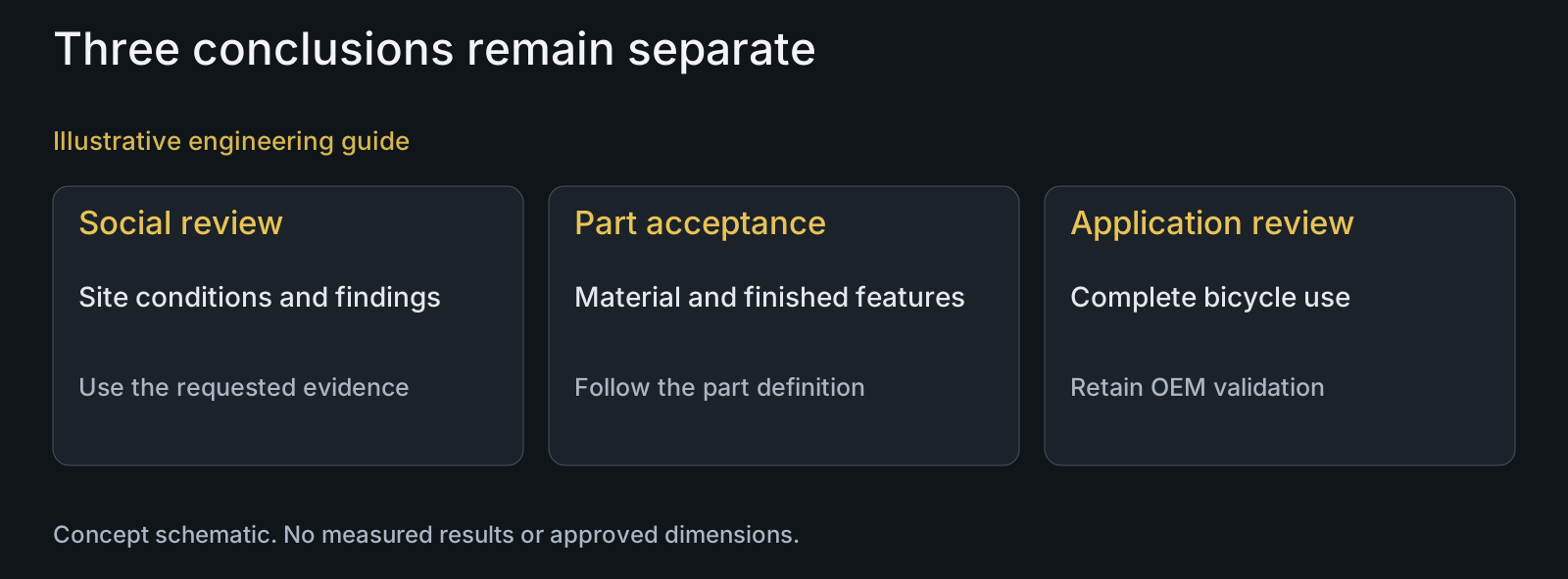
Meanwhile, finished dimensions and treatment requirements retain their own acceptance process. Missing social-scope information is not a measured dimensional failure, and conforming dimensions do not close that sourcing-information gap. Keeping the conclusions separate helps the team resolve the actual issue.
Keep social review separate from material and product evidence
Material identity, substance information, finished-feature inspection and bicycle validation do not become unnecessary because a site has social-assessment information. Each supports a different conclusion. Use the supplier audit questions for production controls rather than combining every document into one approval label.
Similarly, a responsible-minerals request addresses its own material and supply-chain scope. It is not automatically satisfied by a workplace assessment. Specify the buyer's requested document rather than rely on a generic compliance bundle.
Send the required program or questionnaire, intended producing scope and sharing expectations with the drawing and BOM. PremFixer can discuss the manufacturing request and applicable information availability. No unconfirmed social report, blanket legal compliance or certified ethical status is promised here.
Questions buyers need to confirm
Does PremFixer have a BSCI or SMETA audit report?
Availability and scope must be confirmed for the actual request. This guide does not establish a report, rating, membership or approved status. Send the requested program and site-scope requirement so the relevant information can be discussed without an unsupported claim.
Is SMETA a certification for pivot bolts?
No. Sedex describes it as a social-audit methodology, not certification. A site assessment does not certify the bolt's dimensions or the bicycle application. Request product evidence separately against the drawing and validation scope.
Can a machining-site report cover a separate finishing partner?
Do not assume it does. Match the assessed entity, address and scope to the work being reviewed. Identify the finishing site's role and request any additional information required by the buyer; absence of coverage is not itself proof of wrongdoing.
Does a corrective-action plan show that every finding is closed?
No. A planned response is different from evidence of implementation and acceptance of follow-up. Review the particular issue and available status with the responsible team rather than infer closure from the existence of a plan.
Can social-audit information replace a material declaration?
No. They address different questions. Identify the material, treatment and substance-information request separately from workplace or site assessment. A single document bundle should not be described as approval of every product and sourcing obligation.
What should an OEM send for a social-responsibility review?
Provide the program or questionnaire, relevant supplier and site scope, required information and sharing expectations. Add the kit BOM and manufacturing request to identify the route being considered. Keep confidential reports and personal information in an appropriately controlled channel.
Technical references and scope
Sedex: SMETA Audit. Methodology, pillars, approved audit companies and corrective-action context; not a PremFixer report or membership claim.
amfori: How to request an audit as a producer. Program request responsibility; not confirmation of supplier participation or rating.
Explore related component, material and sourcing decisions in the customer decision knowledge center. For a drawing review, use the Drawing/BOM RFQ path.
Connect your sourcing request to the manufacturing route
Send the drawing or STEP, kit BOM and required social-responsibility program or questionnaire. Identify the relevant production scope and information-sharing requirements so PremFixer can discuss the custom-parts request and applicable evidence availability without promising unconfirmed audit coverage.
Discuss the drawing and BOM