
Integrated surface finishing does not mean that every pivot treatment is performed on a PremFixer-owned line. PremFixer's confirmed model combines in-house cold heading, CNC machining, thread rolling and tool/die manufacturing with qualified-partner testing, heat treatment and surface treatment. One accountable project team coordinates the finished fastener. For an OEM buying axles, caps and spacers, the useful question is how the required final interfaces and part identities survive the complete route. Specify treatment by BOM item, distinguish pre-treatment geometry from delivered acceptance, and define responsibility for changes or reprocessing. A one-stop label alone does not settle those requirements.
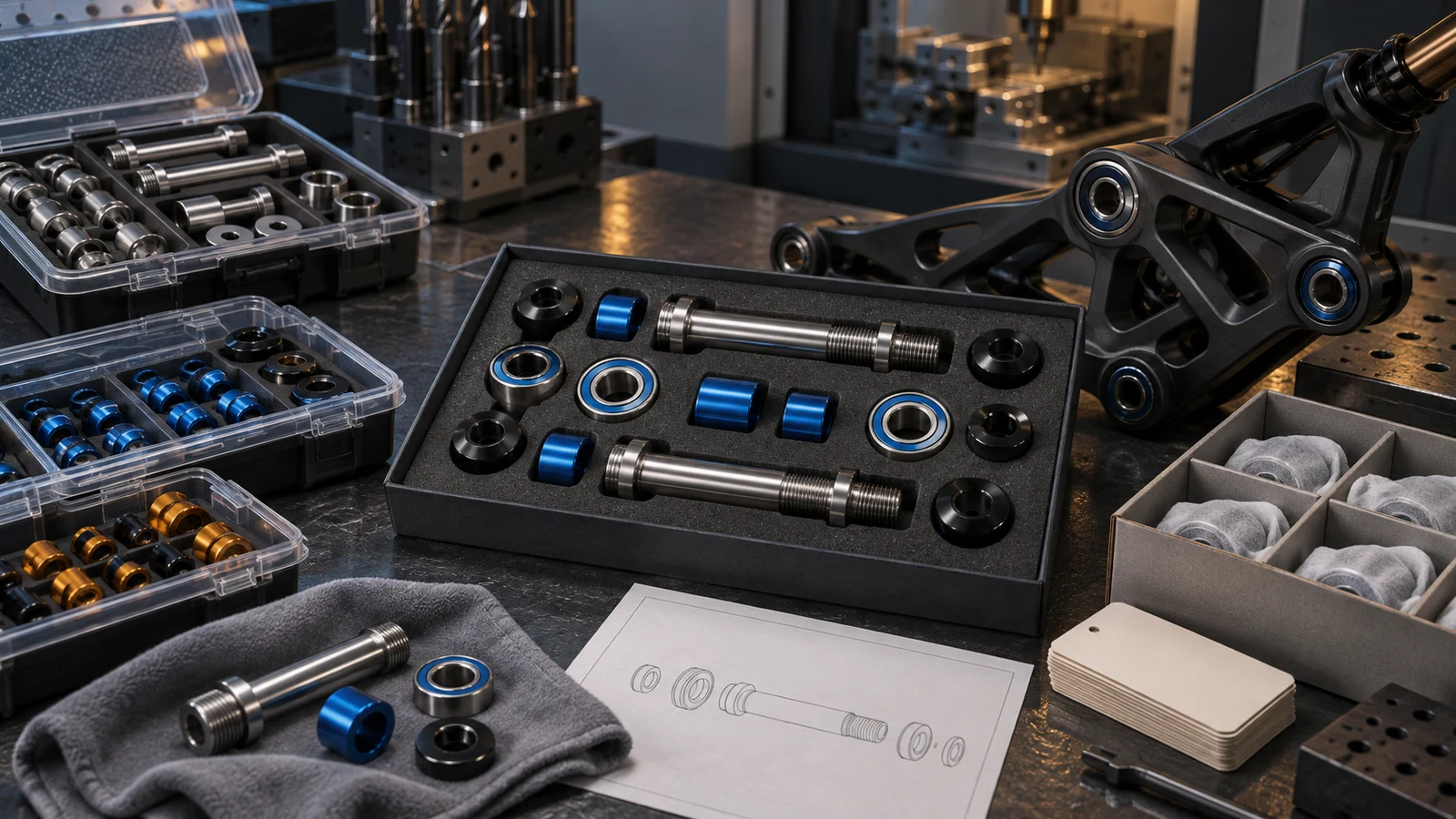
Hero: concept illustration of example hardware and its application. It is not a factory photograph, tested component or approved production geometry.
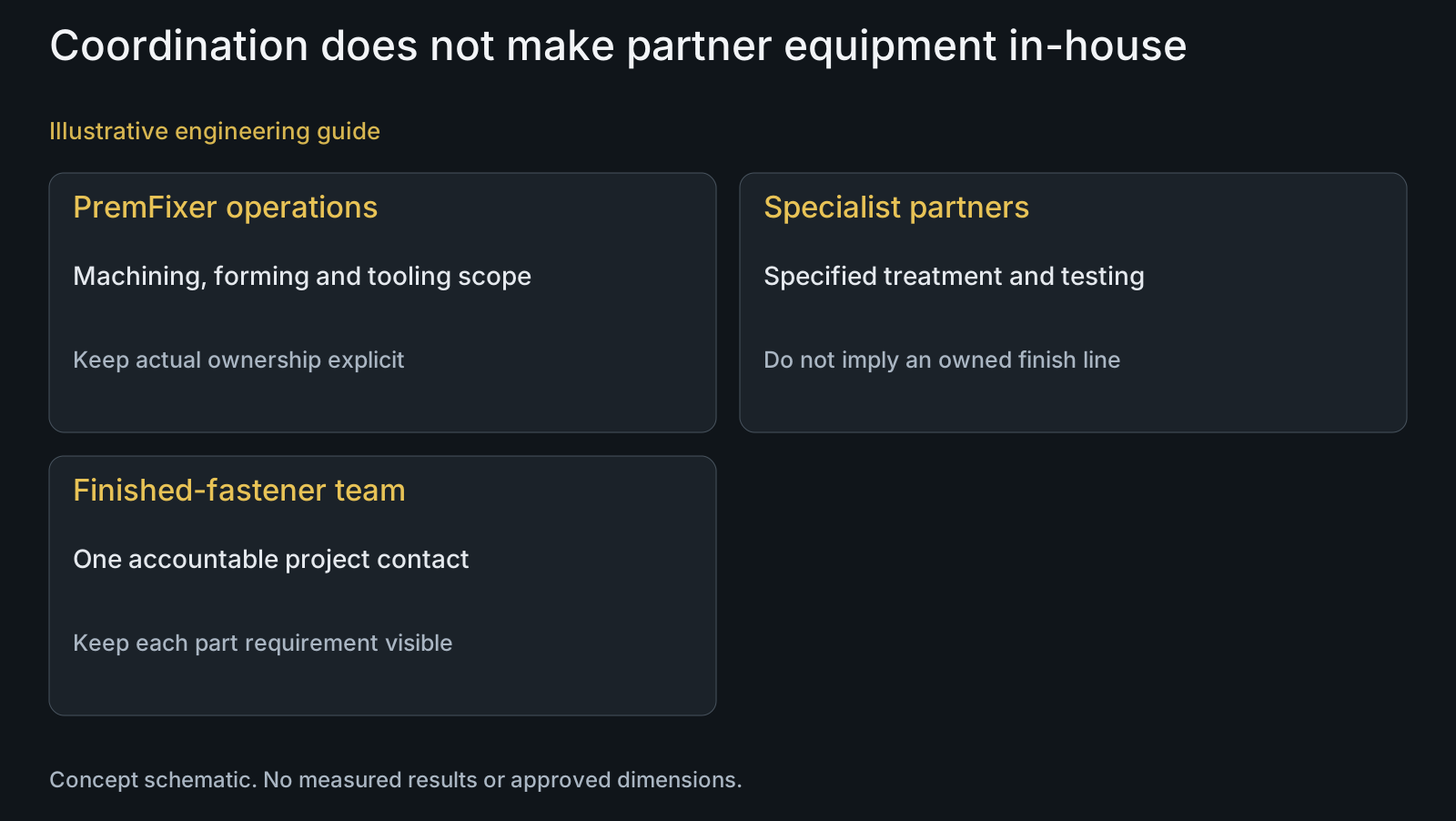
Separate the project contact from ownership of each operation
PremFixer's manufacturing scope connects customer drawings, samples, interfaces and BOM to manufacturing review. In-house machining and forming operations can be combined with specialist partner operations without describing those partners' lines as owned equipment. The scope should identify the route relevant to the requested parts.
For finishing, the confirmed partner model includes operations such as passivation, anodizing, plating and specified coating systems. Availability and the exact proposed route remain order-specific. Neither an equipment photograph nor a broad service list establishes a released process for every material, shape or requested finish.
Ask who answers the customer's project questions, who performs the specialist work and who evaluates the delivered requirements. Those roles may be connected through one team, but they are not identical. Responsibility needs to remain clear when a supplier proposes a different treatment or reports a discrepancy.
Give each BOM item its own finish and final interface requirements
A stainless axle, aluminum spacer and titanium cap may require different routes even within one kit. Identify material condition, treatment identity and the relevant visible or functional surfaces for each item. A shared color objective does not make their treatments or evidence interchangeable.
Use the pivot surface-treatment comparison to separate process families, then return to the actual drawing. A locating bore, working thread, sliding region and exposed head can have different acceptance requirements. The finished-kit description should retain those distinctions rather than reduce the order to one finish name.
State whether a dimension applies before or after the complete treatment and any permitted final operation. That prevents the machining drawing from being interpreted as permission to accept a different delivered interface. The target remains a finished part that meets its defined requirement, not merely a successfully completed process step.
| Buyer question | Useful scope distinction | Risk in a label | Order confirmation |
|---|---|---|---|
| Who makes the geometry? | Relevant in-house machining/forming scope | Entire route called all in-house | Actual operations and part requirements |
| Who performs the finish? | Qualified specialist partner operation | Partner equipment described as owned | Proposed processor route and treatment identity |
| What does the kit contain? | Separate BOM items and material conditions | One finish assumed for every item | Item-level drawing and finished state |
| What survives the handoff? | Protected faces and treatment instructions | Quantity transfer called technical control | Identity, revision and returned condition |
| What if the finish changes? | Affected interface and evidence scope | Cosmetic agreement called full substitution approval | Defined change and customer decision |
| What is delivered? | Quoted parts or kits and acceptance evidence | One-stop label replaces delivery terms | Final requirements and accountable response |
Handoffs should preserve the technical requirement, not just the quantity
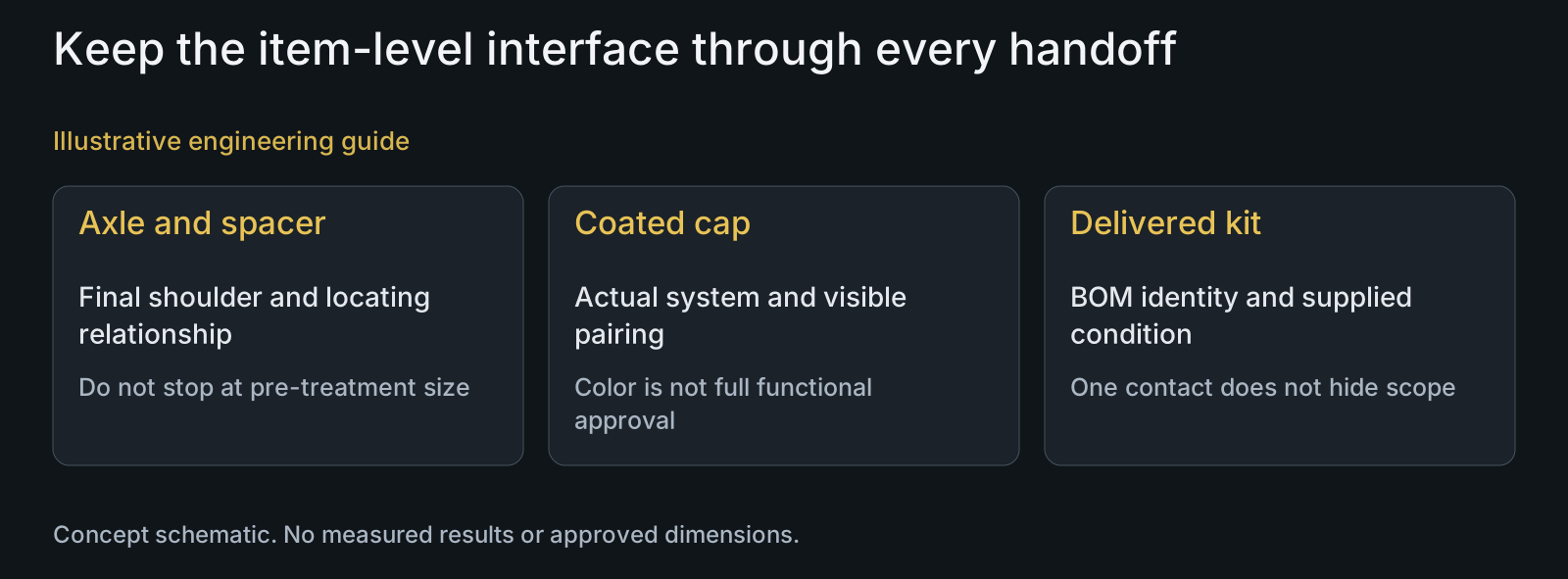
At a finishing handoff, part number and quantity are necessary but incomplete. Connect the drawing revision, material condition, finish instruction, protected features and relevant pre-treatment state with the parts. An axle blank for one route should not become indistinguishable from another item that happens to look similar.
Identify how the proposed arrangement preserves sensitive regions during handling and transport. Protection for a locating face or prepared surface is a practical project requirement, not a universal packaging claim. Ask how the returned condition will be related to the parts sent for processing when mixed quantities or split lots are involved.
The returned parts need to be assessed against the final-state requirements applicable to that order. A partner process record may support the assessment but cannot silently replace a dimensional or appearance criterion that it does not address. Define the evidence needed for the item rather than require one generic report for every finish.
A treatment change can affect more than the visible color
If a processor proposes an alternate system, identify whether material compatibility, treatment coverage, final fit or contact behavior changes. Approval of the cosmetic reference is not approval of all those changes. The coating-system guide explains why coating family labels alone may conceal different routes.
Reprocessing also needs a defined decision. Stripping, preparation and another treatment may change the delivered surface or geometry; assess the actual proposal rather than assume that repeat processing restores the original condition. The design owner must retain visibility of affected requirements before the parts are used.
A repeat order should identify the intended unchanged configuration and any changed inputs. Refer to the batch-color guide where parts must be visually paired. An accepted new lot does not automatically resolve mixing with retained kit inventory.
Compare supplier proposals at the finished-part boundary
A useful quotation identifies included operations, supplied condition and relevant evidence, not just a per-piece finishing charge. Check whether it covers complete kits or loose parts, which interfaces remain to be evaluated, and how specialist questions or nonconforming items will be handled under the agreed terms.
In-house processing can be relevant to logistics, while specialist processing can provide a defined route; neither model guarantees quality by its ownership label. Compare the actual proposal and its accountability. Do not infer a shorter lead time, lower cost or superior outcome without a relevant quotation or record.
Substance documentation also needs configuration-specific scope. The REACH and RoHS finish-document guide distinguishes the relevant declaration subjects. One project contact does not turn one finish statement into proof of every part or a company-wide regulatory guarantee.
A coordinated kit can contain several distinct acceptance subjects
Illustrative engineering example: assume an OEM orders a kit containing a passivated stainless axle, anodized aluminum spacers and coated caps. The spacers locate against the axle shoulder, and the exposed caps must be visually consistent. The purchaser asks for one coordinated delivered package.
The proposal separates the items' finish instructions, protected interfaces and final acceptance states. It keeps the spacer/shoulder relationship visible after partner processing and treats cap appearance as a distinct pairing question. If a coating substitution is proposed, that affected item is reviewed without silently rewriting every kit requirement.
No actual delivery, rejection or cost saving is claimed. For a full-suspension hardware project, this item-level clarity is the practical meaning of integration. One accountable team coordinates the package while the customer's design and application decisions remain explicit.
Questions buyers need to confirm
Does PremFixer own every finishing operation?
No. The confirmed model uses in-house cold heading, CNC machining, thread rolling and tool/die manufacturing with qualified partners for testing, heat treatment and surface treatment. The project team coordinates the finished-fastener scope; partner lines are not represented as owned.
Can one finishing callout cover the whole kit?
Only where it actually describes all affected items and requirements. Identify each BOM material, treatment and final interface. Mixed-material kits often need distinct instructions even when neighboring parts share an appearance objective.
Does a partner process record replace final-fit acceptance?
Not automatically. Determine what the record addresses and which delivered features it represents. The order's final geometry and other relevant acceptance requirements remain applicable unless their evidence is explicitly covered.
Can a similar-looking coating be substituted?
Not solely from appearance. Identify the changed system, affected material and interfaces, final condition and relevant evidence. Keep the customer's decision visible before treating the alternate route as the ordered configuration.
Is external processing inherently less controllable?
Ownership alone does not establish the outcome. Compare the actual route, specialist scope, part identity, protected interfaces and responsibility for discrepancies. No universal quality ranking between internal and partner processing is asserted.
What should an integrated-finishing RFQ include?
Send item-level drawings, STEP or samples and kit BOM with material conditions, exact finishes, protected surfaces and delivered-fit requirements. State quantities, pairing or replenishment intent, requested evidence and supplied package so responsibility and quotation scope can be defined.
Technical references and scope
Explore related component, material and sourcing decisions in the customer decision knowledge center. For a drawing review, use the Drawing/BOM RFQ path.
Define the finished kit and its partner-process scope
Submit item-level drawings, STEP or samples and BOM with materials, finishes, protected interfaces and final acceptance requirements. The review will connect in-house manufacturing with the proposed specialist route and identify responsibility for returned parts, changes and the delivered kit.
Discuss the drawing and BOM