

A useful quality commitment for custom pivot hardware identifies the requirement, supplied condition and evidence that supports acceptance. Separate a zero-defect objective from an inspection scope, a capability metric and a customer complaint record. They answer different questions. A thread check on every bolt does not establish every material property, while a low historical complaint rate does not accept a new locating interface. Discuss the applicable drawing, method and nonconformity response with PremFixer for the actual order. No supplier-wide capability threshold, universal each-unit test program or unlimited zero-failure guarantee is established by this guide.
Hero: concept illustration of example hardware and its application. It is not a factory photograph, tested component or approved production geometry.
Identify what kind of commitment is being made
An objective expresses a direction; an inspection scope identifies a check; a metric summarizes defined observations; an agreed order requirement states what must be supplied. The word quality can refer to any of these, so ask which meaning applies to the proposal.
For a pivot, anchor acceptance to the finished part and its interfaces. Identify the shoulder, thread, sleeve contact and material or finish requirements relevant to your drawing. Do not treat a general commitment as a substitute for the fields needed to manufacture and evaluate them.
PremFixer's confirmed service model combines in-house manufacturing with qualified partner operations where relevant. Agree the manufacturing and evidence scope rather than interpret one accountable team as proof that all checks occur in an owned laboratory.
Read inspection percentages by both units and characteristics
If a proposal refers to checking every unit, identify the characteristic and method. A thread limit check, dimensional measurement and visual appearance check have different scopes. A percentage without those fields leaves the buyer unable to tell what requirement has been examined.
Keep destructive tests and selected samples separate from nondestructive each-unit checks. For the detailed feature and final-condition discussion, use the final-inspection guide. The issue here is what the quality statement means, not an assumed universal inspection recipe.
The NIST acceptance-sampling handbook distinguishes the decision to accept or reject a lot from estimating its quality. A lot decision should not be converted into a claim that every unmeasured property has a demonstrated defect rate.
| Statement type | Necessary basis | Useful conclusion | Wrong substitution to avoid |
|---|---|---|---|
| Quality objective | Subject and intended direction | Goal for the defined work | Unlimited zero-failure warranty |
| Each-unit inspection | Characteristic, method and finished state | Coverage of the named check | Every property proven |
| Lot acceptance | Population and agreed acceptance plan | Disposition of the represented lot | Measured defect rate for all properties |
| Capability result | Feature, limits, route and data context | Represented process/feature assessment | Supplier-wide quality grade |
| Complaint statistic | Period, counted event and denominator | History on the stated reporting basis | Acceptance of a new interface |
| Corrective-action result | Issue, affected scope and effectiveness evidence | Support for the represented response | Automatic acceptance of changed parts |
Keep capability, defect counts and complaints on their own basis
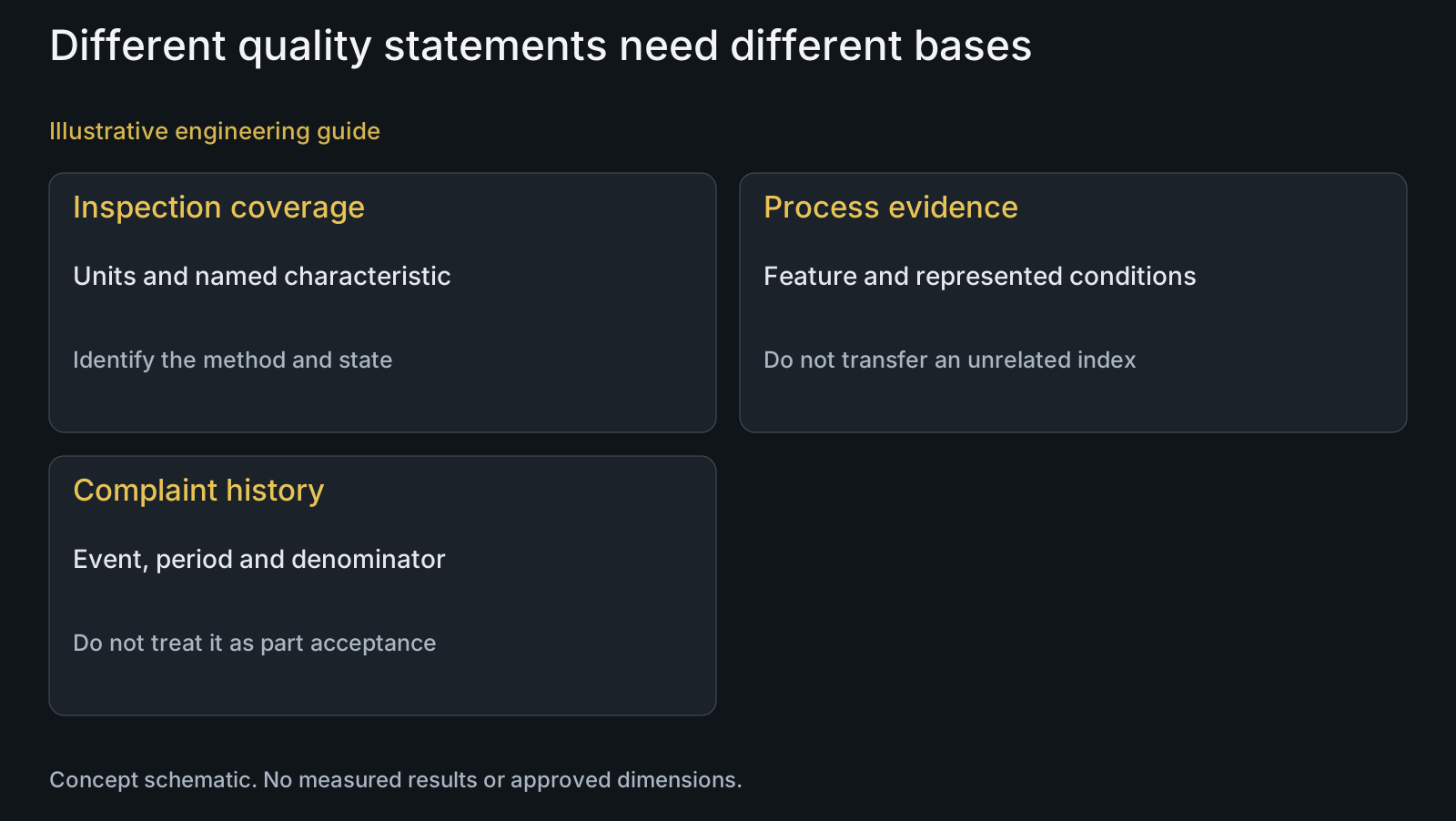
A capability result concerns a specified characteristic and represented process/data context. It is not a supplier-wide grade that can be transferred to any new drawing. Ask what feature, limits and production conditions it represents before using it in a sourcing comparison.
A nonconforming-piece count needs its population, observation method and defect definition. A complaint rate needs its reporting period and denominator, such as orders or recorded cases. These quantities are not interchangeable merely because both are expressed as a percentage.
A complete kit can be affected by a missing spacer even if all examined bolts meet their own criteria. Do not hide an assembly or supply problem inside an unrelated component statistic. The supplier performance guide addresses useful denominators for operating reviews.
Agree the response to a defined nonconformity
A commitment becomes practical when the team knows how to identify the represented part and affected population. Keep the requirement, observed issue and lot context connected. Avoid an immediate universal diagnosis when the available record describes only one feature or condition.
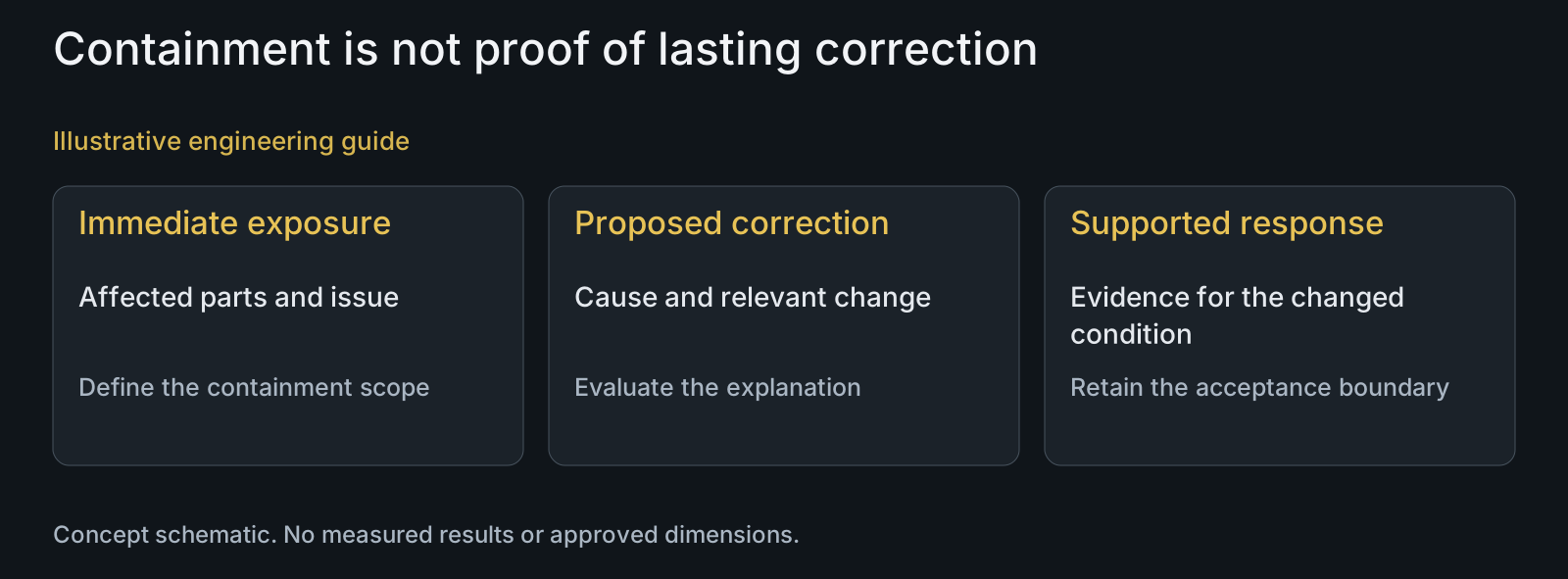
Separate containment from correction of the underlying cause. Sorting available parts can address a defined immediate exposure without demonstrating that future production has changed. Likewise, a proposed improvement does not itself accept reworked parts in a new condition.
For the order, clarify how disposition and any applicable recheck will be decided. Commercial replacement or credit terms are separate agreed conditions, not implied by a quality objective. The supply-contract guide covers that boundary without inventing a universal warranty policy.
Review two quality statements about a proposed lot
Illustrative engineering example: assume a proposal mentions each-unit thread gauging and a historical complaint statistic while the OEM needs evidence for a finished shoulder interface. No actual PremFixer inspection, complaint rate, accepted lot or failed part is assumed.
The thread check addresses its named characteristic; the complaint statistic describes its own reporting basis. Neither statement establishes the finished shoulder condition. The buyer should ask what evidence supports that requirement rather than add the two statements together as an overall quality score.
If the proposed shoulder evidence is then scoped, assess it against the required condition and coverage. This can make the offer reviewable without declaring every part property proven. The example illustrates a missing evidence link, not an actual defect or a claim of superior performance.
Keep manufacturing acceptance separate from application approval
Conformity to the agreed component requirement is not complete bicycle validation. A correctly manufactured pivot can still require review of the customer's mating interfaces, load case or assembly method. Keep the application context with the relevant OEM decisions.
Provide the material definition, finish, critical characteristics and requested evidence when asking for a quotation. An existing company quality-system record can support its stated organizational scope without independently demonstrating every new feature or use condition.
Use the response to establish the actual acceptance package and remaining questions. Do not infer an unlimited guarantee, identical coverage for every custom geometry or a generic complaint/capability value. The relevant commitment belongs to the part and supplied scope being agreed.
Questions buyers need to confirm
Does a zero-defect objective mean an unlimited guarantee?
No. Identify the actual requirements and agreed commercial terms. An objective does not establish performance for every design or service condition, and component conformity does not replace complete application validation.
Does each-unit inspection prove every requirement?
No. State the characteristic, method, supplied state and population. A thread check on every item does not independently establish material properties, finished shoulder geometry or the assembled joint's performance.
Can a low complaint rate accept a new pivot interface?
No. A complaint statistic needs its period, counted event and denominator, and describes that reporting basis. The new interface needs evidence connected to its own requirement and supplied condition.
Can one capability figure represent every custom part?
No. Identify the characteristic, specification limits, process and data conditions represented. Evidence for another feature or route cannot automatically establish capability for the requested shoulder or thread.
Is sorting a lot proof that the underlying issue is corrected?
No. Sorting can address an immediate defined exposure; correction and effectiveness evidence are separate. If rework changes the part condition, identify the applicable acceptance and recheck scope instead of relying on earlier results.
What should I provide when discussing a quality commitment?
Provide the released drawing, material/finish requirements, critical interfaces and requested evidence coverage. State any required lot identity and nonconformity/disposition conditions. These define the actual commitment more clearly than a broad quality percentage or slogan.
Technical references and scope
NIST/SEMATECH: What Is Acceptance Sampling?. Acceptance sampling as lot disposition rather than quality estimation; no mandated plan, actual PremFixer defect metric or universal sampling policy.
Explore related component, material and sourcing decisions in the customer decision knowledge center. For a drawing review, use the Drawing/BOM RFQ path.
Agree quality evidence for the supplied pivot condition
Send the drawing, material and finish definition, critical interfaces and requested inspection or test scope. Identify the acceptance and lot-evidence requirements so PremFixer can discuss relevant manufacturing, partner operations and the supported delivered condition.
Discuss the drawing and BOM