
Evaluate sustainable pivot manufacturing by asking which resource flow or waste is being addressed and what evidence represents the change. Incoming recycled material, machining losses, process-fluid management and packaging recovery are different subjects. None alone establishes a carbon-neutral finished kit. Preserve the specified material, finished interfaces and acceptance requirements while discussing alternatives with PremFixer. A proposed initiative is not a measured company result, and a useful local improvement need not prove every life-cycle impact. Start with the part and route involved, the accepted output and the actual information available. This guide presents review questions, not unverified factory programs or savings.
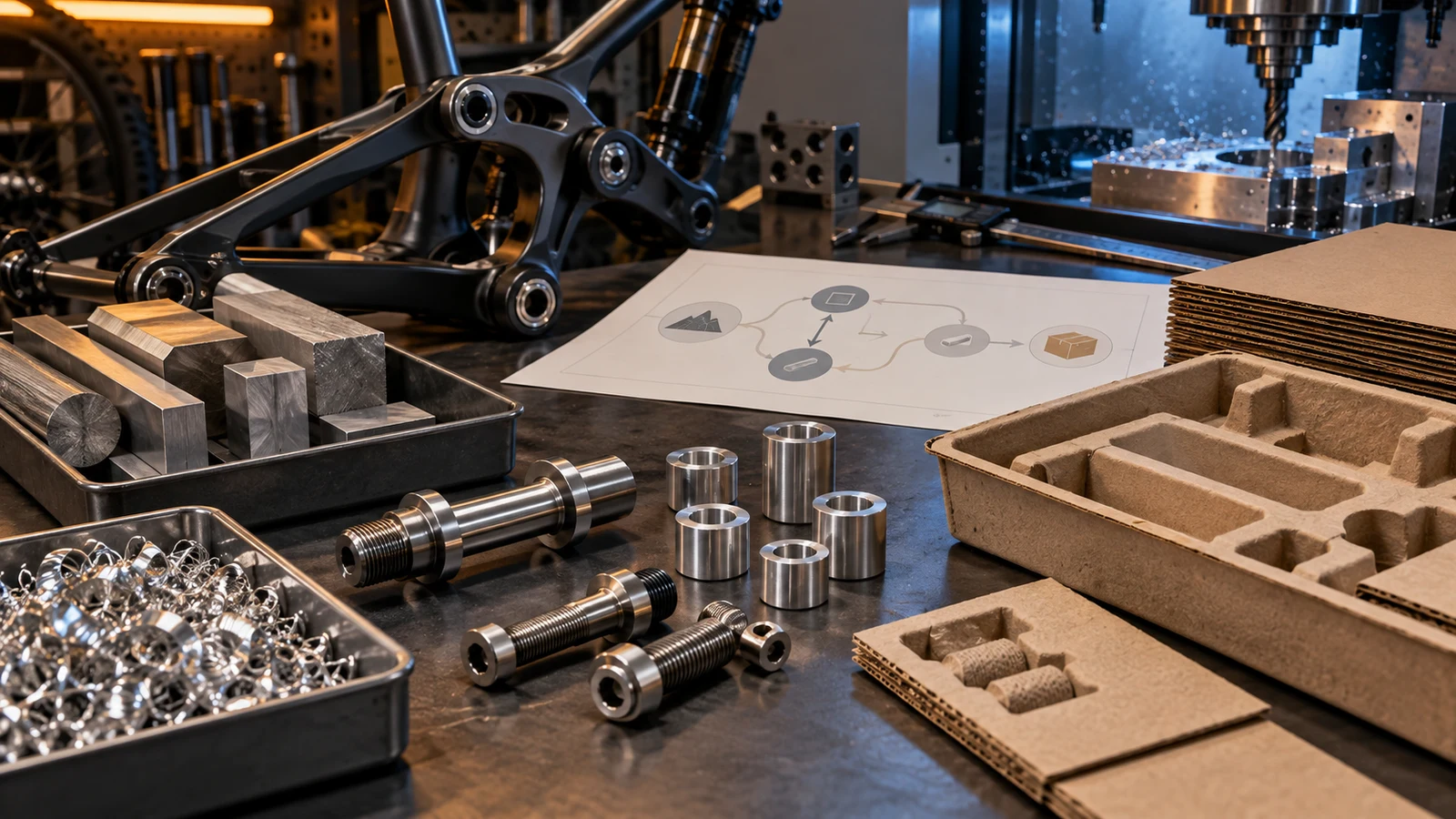
Hero: concept illustration of example hardware and its application. It is not a factory photograph, tested component or approved production geometry.
Name the resource question behind the request
An OEM sustainability brief may concern incoming material, process waste, energy, packaging or a product-footprint study. Do not answer those with one unqualified claim that the factory is green. State the subject and the decision the information will support.
The EPA sustainable-manufacturing overview connects the topic to reducing environmental impacts and conserving resources through manufacturing processes. It is general context, not a certification of PremFixer or evidence that a particular initiative has been implemented.
A proposed action, an operating practice and a measured result are distinct. Keep the represented site, route, period and output clear when information is supplied. Without those boundaries, a purchasing team cannot tell whether the statement applies to its custom hardware.
Separate incoming recycled content from outgoing scrap
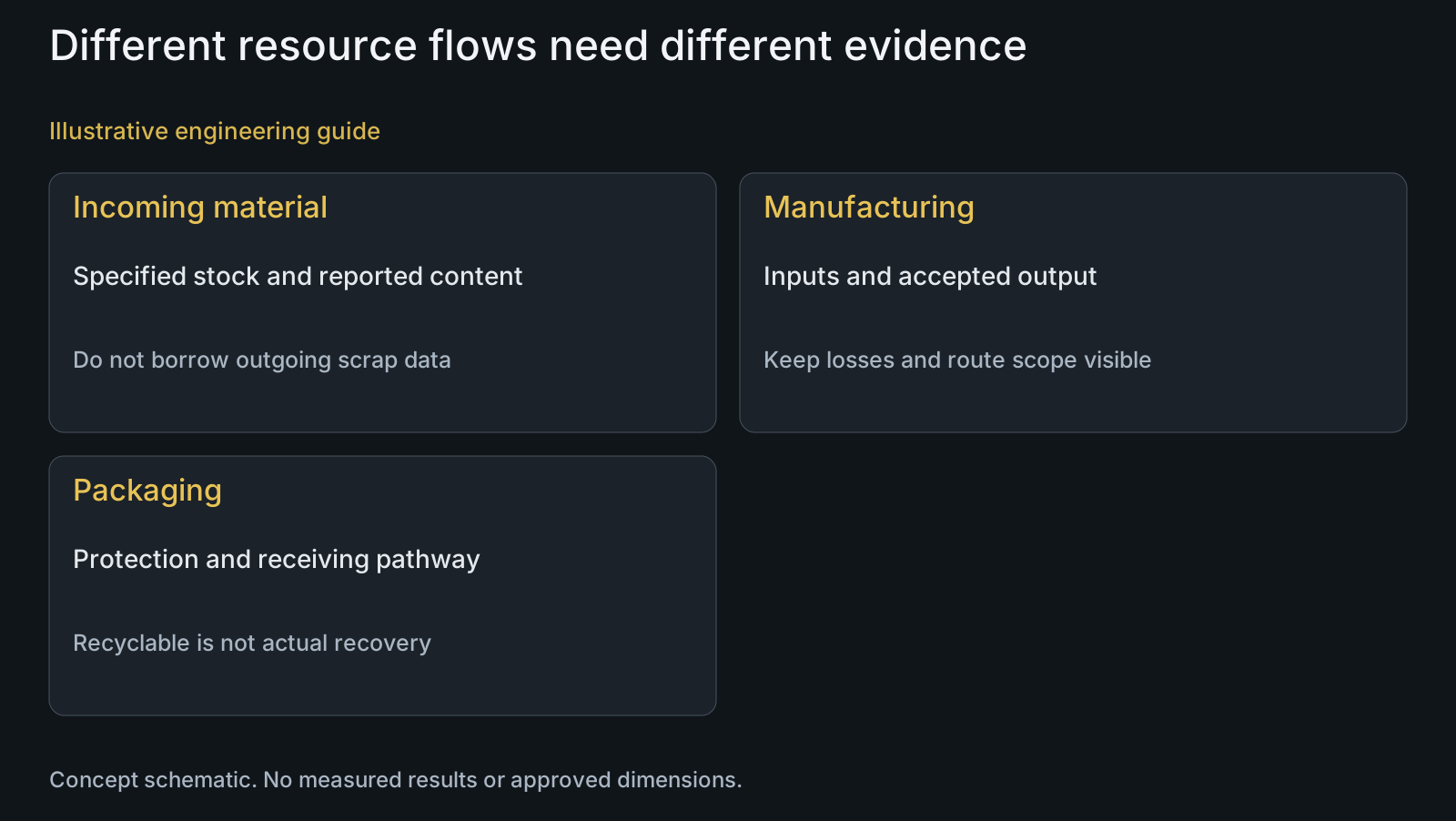
A claim about recycled content concerns the incoming material's reporting basis. A statement about recovered machining scrap concerns an outgoing stream. They can both be relevant without describing the same material flow or establishing the same product benefit.
If recycled content is requested, retain the governing alloy, product form and condition. A sourcing preference does not authorize a different material specification. Ask what evidence represents the supplied stock instead of infer its history from metal appearance.
For outgoing material, distinguish usable offcuts, machining chips and rejected components as relevant to the route. Recovery does not mean that no material was consumed or lost. No recycling percentage, closed-loop program or accepted stock claim is established here.
| Statement or proposal | Subject it concerns | Conclusion not established | Useful review basis |
|---|---|---|---|
| Recycled stock content | Incoming material reporting | Full-kit carbon neutrality | Specified stock and supporting scope |
| Machining scrap recovery | Outgoing material stream | Zero input loss or closed loop | Represented recovered/disposed material |
| Smaller manufacturing blank | Input per proposed route | Unchanged accepted yield | Geometry, route and accepted output |
| Process-fluid reuse | Named fluid use or waste | Whole-factory reduction | Practice, represented period and data |
| Recyclable packaging | Material and recovery pathway | Actual recovery at every destination | Separation and receiving arrangement |
| Reduced package material | Defined supplied pack | Entire product environmental ranking | Same contents and protection task |
Relate processing losses to accepted hardware
Compare the material and work needed to produce the defined accepted output. Reducing purchased stock can be useful only if the proposed route still meets the finished requirement. A smaller blank is not automatically appropriate for every geometry or manufacturing operation.
Keep rework and rejection visible in the discussion where data exist. A route that appears efficient at one operation may require extra downstream work. The analysis should not stop at a convenient local measure or omit partner finishing from the represented scope.
PremFixer's manufacturing-process discussion can address the actual custom work. It does not provide a universal yield or environmental ranking between machining and forming. Agree the proposed route and data scope without changing the customer's interface requirements silently.
Discuss process fluids and packaging without assuming outcomes
For process-fluid questions, identify the relevant use, maintenance or waste stream and what the reported practice covers. A reuse proposal is not proof of reduced total use or lower overall impact. No PremFixer coolant-circulation installation or measured saving is claimed here.
For packaging, discuss the protection task, material combination and destination recovery arrangement. A material described as recyclable may still need separation or a suitable receiving route. Do not infer actual recovery from a symbol or describe a sealed pack as environmentally superior without a basis.
A reusable tray also needs a use arrangement: who keeps it, whether it returns and what handling is involved. The packaging-mission guide addresses receiving and service needs. Preserve protection while evaluating the resource question.
Examine a lighter pack with the same supplied kit
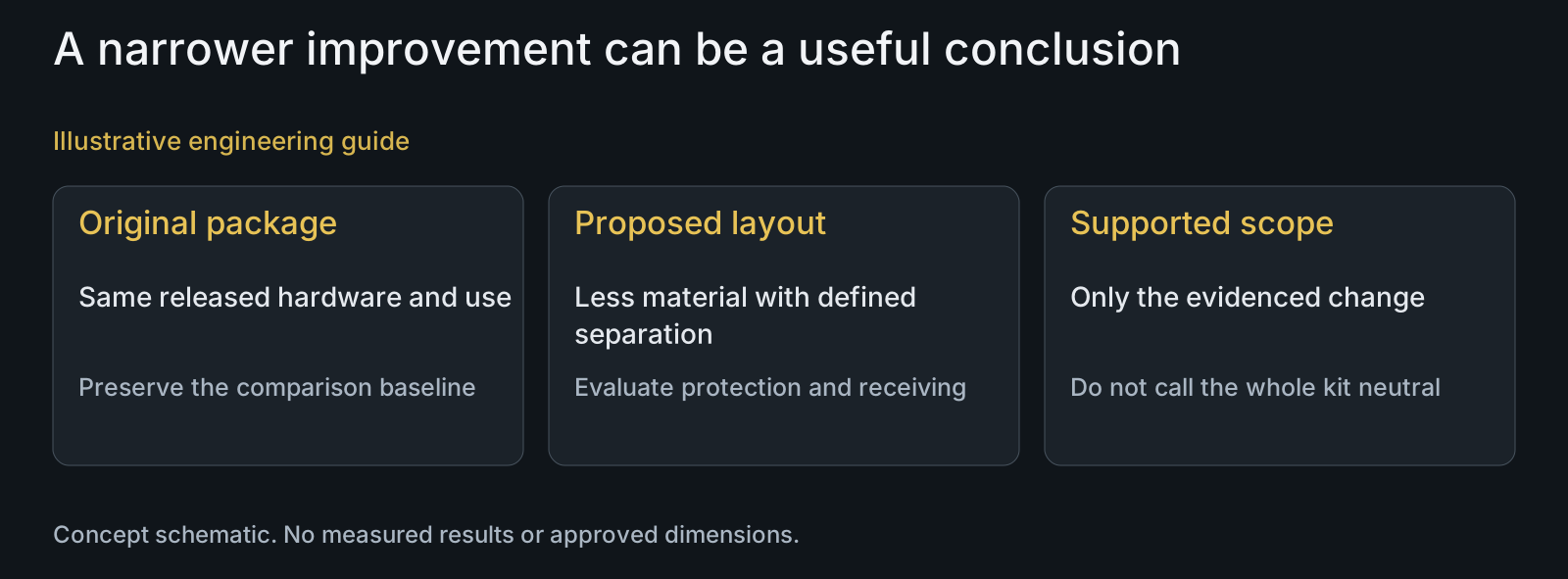
Illustrative engineering example: assume an OEM considers replacing a bulky insert with a smaller divided arrangement for the same released pivot kit. The aim is to discuss less packaging material while keeping parts separated. No actual pack mass, transport test or environmental result is assumed.
Review the receiving task and relevant surface protection before accepting the alternative. If the smaller arrangement permits contact at a locating surface or confuses similar spacers, that issue remains open. A presentation mockup cannot prove either protection or a quantified environmental improvement.
If appropriate evidence later supports the defined packing change, report that scoped result rather than call the entire company or kit carbon-neutral. The material and component design stay as the original baseline unless separately changed and authorized.
Keep environmental claims separate from other evidence
A material-compliance document answers its named substance or specification question; it is not a footprint result. Similarly, a lighter component answers a mass question unless an environmental assessment supports a further conclusion. Avoid borrowing one subject's evidence for another.
The product-footprint guide addresses comparable carbon boundaries. This article identifies concrete manufacturing resource questions before any broader study. A specific waste discussion can be useful without pretending that a complete life-cycle comparison exists.
For your bicycle application, provide the material requirements and intended manufacturing scope. State whether you seek supplier information, a proposed change or a separate measured assessment. Keep missing evidence visible rather than assign it a zero impact.
Questions buyers need to confirm
Does recycled material make a pivot kit carbon-neutral?
No. It addresses a particular incoming-material subject, not every included life-cycle stage. Preserve the material requirement and its evidence. A neutrality conclusion needs its own supported accounting and claim basis; none is established here.
Does recovering chips prove recycled content in our parts?
No. Chip recovery is an outgoing manufacturing stream, while recycled content concerns supplied incoming material. Ask what each statement represents instead of transferring one reporting basis to the other.
Can a more sustainable stock proposal replace the required alloy?
Not automatically. Retain the original specification, product form and condition while evaluating the proposed source or material change. The customer design decision remains necessary where the technical requirement changes.
Does fluid reuse prove total factory use has fallen?
Not by itself. Identify the process, represented period, output and actual data. A proposed or local practice does not establish a company-wide reduction. No PremFixer coolant-system or saving is asserted here.
Is a recyclable package always recovered after use?
No. The actual material combination, separation and destination recovery arrangement matter. Preserve part protection while evaluating the proposed packaging. A material label or illustration is not evidence of actual recovery.
Can we report a packaging improvement without a full footprint study?
A supported scoped result can be reported within its actual basis. Identify the pack, contents, comparison and evidence, and avoid expanding it into a whole-kit or company claim. No measured improvement is invented in this guide.
Technical references and scope
EPA: Sustainable Manufacturing. General resource-conservation and environmental-impact context; not company certification, emissions inventory or proof of implemented PremFixer practices.
Explore related component, material and sourcing decisions in the customer decision knowledge center. For a drawing review, use the Drawing/BOM RFQ path.
Identify the resource question and the unchanged requirements
Send the drawing or STEP and BOM, material/finish requirements, represented route, packaging use and the specific resource or evidence request. Add available records and known gaps so PremFixer can discuss the proposed manufacturing scope without replacing component acceptance or inventing environmental results.
Discuss the drawing and BOM