
TiN, CrN and DLC-type coatings cannot be ranked for a bicycle pivot from color, hardness or a single friction value. For a coated shoulder running against a sleeve, first define the counterpart, motion, lubrication and required final clearance. Then compare complete coating systems and evidence representing that interface. DLC covers different carbon-based systems, and even one named coating can have properties dependent on deposition and test conditions. A hard surface does not approve substrate compatibility, thread fit or assembly torque. Select the proposal that addresses the actual contact problem and can be evaluated in its delivered state, not the proposal with the most impressive isolated number.
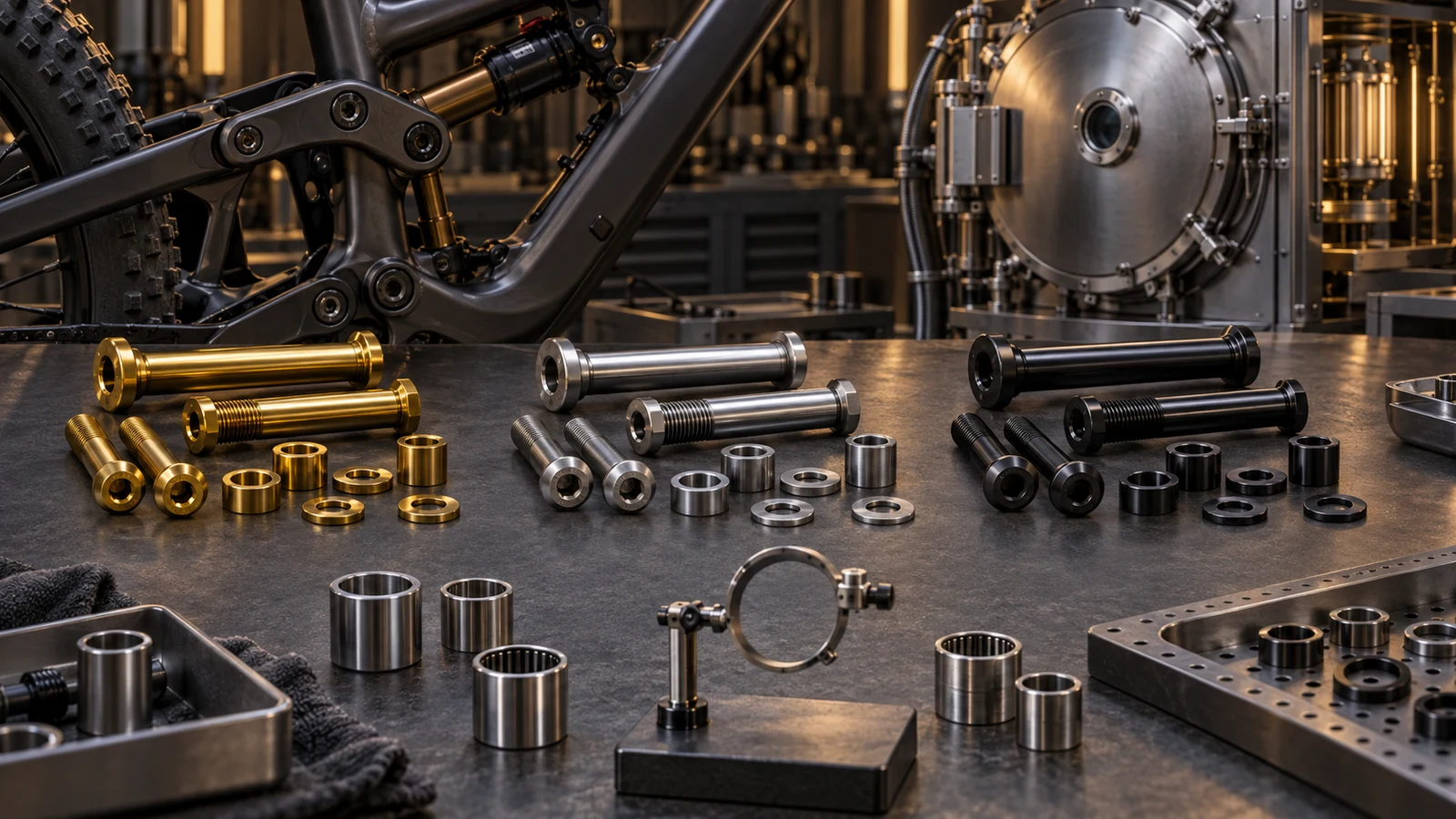
Hero: concept illustration of example hardware and its application. It is not a factory photograph, tested component or approved production geometry.
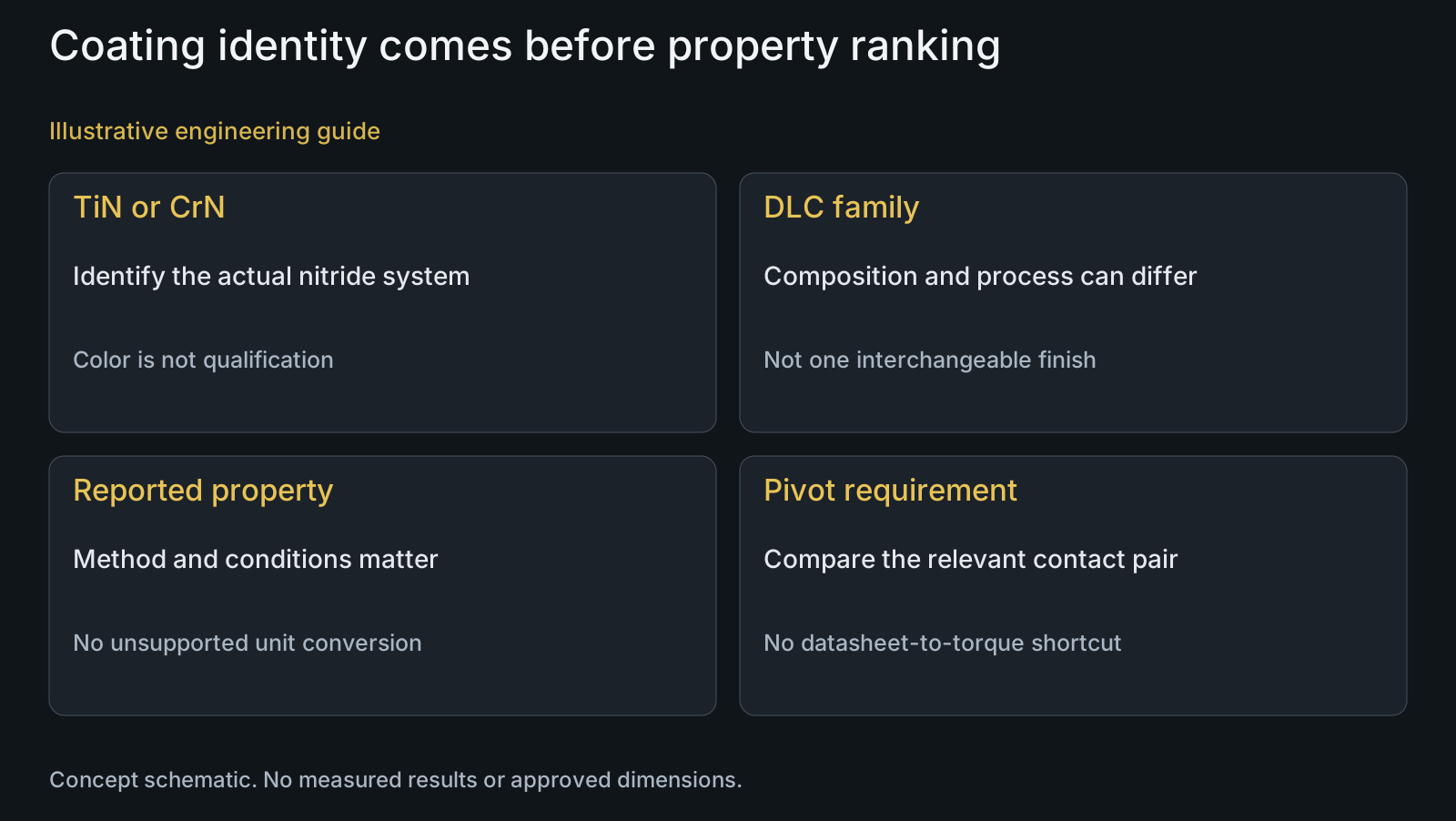
Identify the system behind the coating name
Oerlikon's carbon-coating overview distinguishes carbon-based systems by composition, hydrogen content and deposition route. It describes a-C:H commonly associated with PACVD and hydrogen-free ta-C typically associated with PVD arc processing. Calling every DLC proposal PVD therefore conceals a meaningful difference.
Request the proposed chemistry, named system, layer arrangement and application route. TiN, CrN and carbon layers may also occur within more complex systems; a family name is not a complete manufacturing specification.
The table compares examples of identifiable families, not approved PremFixer products. The titanium PVD guide addresses coating boundaries. Here the decision is whether the proposals and their supporting data describe comparable systems.
Read hardness with its method and units
The public specifications for BALINIT A, BALINIT D and BALINIT DLC identify indentation hardness with its measurement context. These named examples do not establish the behavior of an unnamed supplier's deposit.
Do not silently relabel a nanoindentation result in GPa as a Vickers hardness value or use an unsupported conversion. Ask whether reports describe the same method and relevant coating condition. An apparently larger number may answer a different measurement question.
As engineering assessment, also consider what the coating must withstand on its supporting part. Surface indentation resistance alone does not establish adhesion, edge integrity or the behavior of a shoulder under the intended contact load. Define those requirements separately instead of treating hardness as an overall quality score.
| Identified proposal | Meaningful distinction | Risk in a shortcut comparison | Required confirmation |
|---|---|---|---|
| TiN system, such as BALINIT A | Named titanium nitride example | Gold color treated as proof of chemistry or suitability | Actual system, substrate and relevant contact evidence |
| CrN system, such as BALINIT D | Named chromium nitride example | Silver-gray appearance treated as corrosion qualification | Exact deposit and exposure or contact requirement |
| Hydrogenated carbon, a-C:H | DLC family example associated with PACVD | All DLC assumed to use the same process | Composition, layer system and process exposure |
| Hydrogen-free carbon, ta-C | Different carbon system, typically PVD arc | An a-C:H result transferred by the DLC label | Identified provider system and matching evidence |
| Any quoted hardness result | Measurement method and units matter | GPa relabeled as HV or overall wear performance | Method, represented coating and intended conclusion |
| Any quoted sliding friction result | Counterpart and conditions define the result | Dry sliding value used as assembly torque data | Relevant pair, lubrication, motion and separate tightening review |
A dry friction test does not set the assembly torque
The named manufacturer specifications state a dry sliding friction context against steel and caution that conditions and running-in affect the result. A coated shoulder against a lubricated bushing is a different comparison. Identify the counterpart material, surface state, motion and lubricant before using a published friction value.
For engineering comparison, separate sliding contact from threaded tightening. A report describing one sliding pair does not establish thread friction, bearing-face friction or bolt preload in the actual assembly. Avoid converting a favorable tribology number into a torque instruction.
Use the specified counterpart and relevant operating condition for the agreed interface assessment. The aluminum coating-selection guide considers substrate and treatment choices; a supplier datasheet remains supporting context, not a tested pivot joint.
Separate deposition temperature from service temperature
The named coating specifications distinguish process temperature from maximum service-temperature information. A service limit does not tell the design owner whether the substrate can tolerate the coating operation without an unacceptable change in its required condition.
Provide the material grade and condition, prior heat treatment and critical final features. Ask the provider to identify the proposed process exposure and substrate compatibility. Do not assume that all systems within a family use the same temperature or that a low-temperature variant is automatically supplied.
Review heat-treatment callouts where the manufacturing sequence is relevant. For a thermally sensitive part, compatibility is an input to selecting the coating route, not a conclusion drawn from the coating's operating-temperature column.
Specify final interfaces without inventing a universal allowance
State which shoulder, thread, seat and recess surfaces are included or excluded, together with final acceptance requirements. Do not apply a generic thickness range and conclude that thread fit is unaffected. The actual proposal must address deposition distribution and the delivered features.
Ask how adhesion and local integrity are to be assessed for the specified coating and part. An attractive gold, silver-gray or black surface does not identify the chemistry, prove uniform coverage or demonstrate a qualified bond. Appearance may be a requirement, but it is a separate acceptance question.
PremFixer can review the drawing and coordinate the proposed surface-treatment scope. Availability of a named coating, the responsible provider and any application-specific validation require confirmation. No owned PVD line or universal coated-pivot compatibility is claimed.
Compare two proposals against one decision objective
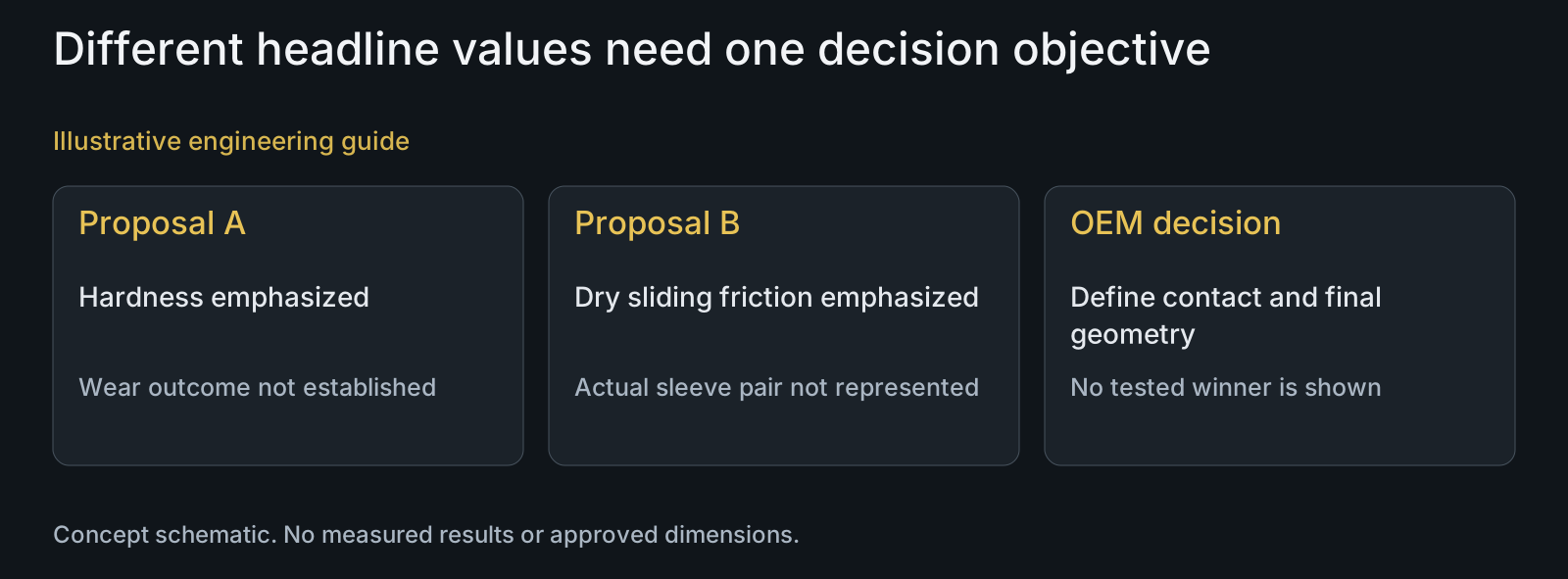
Illustrative engineering example: assume an OEM receives a TiN proposal emphasizing indentation hardness and a DLC proposal emphasizing dry sliding friction. The intended shoulder runs against a lubricated sleeve, and both quotes omit the represented test pair and final clearance assessment.
Neither headline value establishes the better choice. The reviewer first defines whether the concern is wear at that sleeve, friction during motion or another failure mechanism, then requests evidence for that objective and compatible final geometry. Coating identity and substrate condition remain part of the comparison.
The result is a better-defined review, not an asserted winner. No actual customer test, measured wear reduction or approved torque is presented. The example shows why different datasheet strengths should not be treated as evidence for the same unresolved interface question.
Questions buyers need to confirm
Is every DLC coating deposited by PVD?
No. Carbon-based systems differ in composition and deposition route. Identify the actual system; a-C:H and ta-C labels should not be treated as interchangeable processing instructions.
Does the highest coating hardness identify the best pivot finish?
No. Hardness describes a measurement, not the entire interface. Compare the method and units, then assess the relevant contact behavior, substrate compatibility and local integrity requirements.
Can coating color identify TiN, CrN or DLC?
Not reliably enough for acceptance. Obtain the specified coating identity and relevant conformity evidence. An appearance sample cannot replace the manufacturing specification.
Can a low published friction coefficient justify lower tightening torque?
No. A sliding-test value does not establish thread and bearing-face friction in the joint. Provide the actual tightening requirements and evaluate that assembly separately.
Will a thin coating always leave threads unchanged?
No universal assurance is justified. Identify coated features, proposed distribution and final thread requirements. Accept the delivered feature rather than assume a generic thickness has no effect.
What information is needed to compare coating quotations?
Supply drawing and STEP, substrate condition, final interfaces, counterpart material, motion, lubrication and the problem being addressed. Request each complete coating system, process compatibility and evidence supporting the same decision objective.
Technical references and scope
Oerlikon: DLC and other carbon-based coating families. Composition and deposition-family distinctions; no universal DLC property, pivot qualification or numerical claim.
Oerlikon: BALINIT A specifications. Named TiN example and measurement context. Not a PremFixer product, endorsement or transferred service result.
Oerlikon: BALINIT D specifications. Named CrN example and property-test context only; no universal corrosion or bicycle suitability claim.
Oerlikon: BALINIT DLC specifications. Named a-C:H example, indentation measurement, sliding-test caveats and separate process/service temperature fields. No numerical performance transferred.
Explore related component, material and sourcing decisions in the customer decision knowledge center. For a drawing review, use the Drawing/BOM RFQ path.
Compare coatings against the actual pivot interface
Send the drawing and STEP, material condition, marked coating zones, final thread and shoulder requirements, counterpart details and intended motion or lubrication. Include the complete supplier proposals and relevant reports. PremFixer will review manufacturing and treatment coordination without treating datasheet numbers as a validated joint result.
Discuss the drawing and BOM