

A proposed REACH-related change to a pivot bolt needs two separate reviews: one for the actual chemical concern and another for the replacement's engineering function. Replacing the alloy alone may leave the relevant substance in a coating or pre-applied compound. Removing a finish may change corrosion protection, fit or assembly friction even when the substrate stays unchanged. Start with the affected component, complete material and finish configuration, intended use and destination. Then compare alternatives against the applicable requirement and the pivot's functional needs. Do not release a substitute solely because its material name sounds safer or its sample fits the bearing.
Hero: concept illustration of example hardware and its application. It is not a factory photograph, tested component or approved production geometry.
Identify the mechanism before choosing a replacement
Candidate List identification, authorisation and restriction are different REACH mechanisms. The European Commission explains authorisation in relation to specified uses of Annex XIV substances and describes restrictions through Annex XVII. Do not read every Candidate List entry as an automatic ban on every finished component.
Establish what the concern actually refers to: the supplied article, a substance used in processing, a particular use or a specified restriction condition. Assign that assessment to the responsible supply-chain parties with the relevant jurisdiction and transaction scope. This guide does not decide an individual legal obligation.
The SVHC document guide addresses declaration scope and Candidate List coverage. Here the decision is different: what must change, and what evidence can support the replacement? A vague instruction to make the bolt REACH compliant does not identify either.
Locate the concern within the complete configuration
Separate the substrate from plating, conversion treatment, sealant, topcoat and any pre-applied assembly compound. Request information covering the actual supplied revision. A substrate certificate cannot resolve an unidentified constituent in an independently sourced coating.
Trace the proposed change to the identified concern. If the issue belongs to a finish constituent, substituting a different base alloy while retaining that finish may not address it. If the concern belongs to a process use, a finished-part material label alone does not establish how the alternative process is managed.
Ask the supplier to describe the replacement configuration and evidence coverage, rather than request a broad declaration for an unnamed safer option. Treat undisclosed formulation or scope as an unresolved input, not proof that the constituent is absent.
| Proposal | Potential benefit to assess | Engineering risk | Evidence needed |
|---|---|---|---|
| Change substrate only | May address a substrate-related concern | Different stiffness, thread behavior or manufacturing route | Applicable concern plus revised material and functional assessment |
| Retain alloy, replace finish | May address a finish constituent | Finished fit, friction or protection changes | Complete finish scope and affected interface evidence |
| Remove pre-applied compound | May remove the relevant compound source | Assembly or retention assumptions change | Compound identity and revised assembly assessment |
| Change the process or design | May avoid a use rather than exchange one chemical | New interfaces or process controls | Applicable-use assessment and altered-function validation |
| Reuse an old test report | May retain evidence for unchanged functions | A different surface invalidates the represented condition | A justified map from tested configuration to revised function |
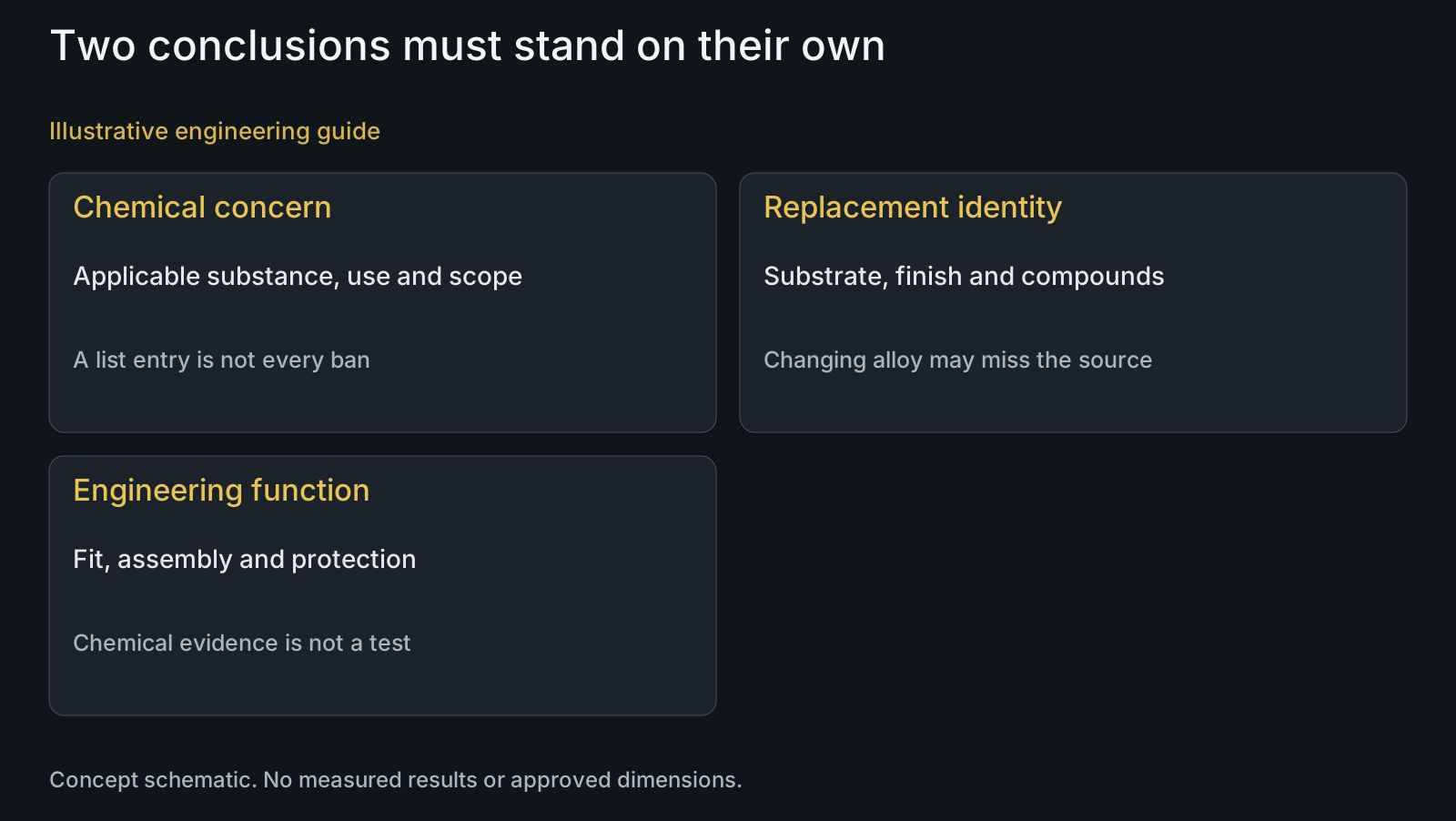
Compare alternatives by function, not just by chemistry
ECHA's substitution guidance considers chemical, production-technique and design alternatives, with technical performance and economic viability alongside hazard and exposure considerations. That is a useful starting point for engineering analysis, not a declaration that any named pivot alternative is acceptable.
A pivot surface can contribute to corrosion protection, bearing-interface dimensions and the friction conditions used during assembly. A changed coating thickness can move the finished interface even if the machined blank is unchanged. Different thread and under-head surfaces can alter the relationship between installation torque and clamp load.
An alloy change can affect stiffness, thread behavior and manufacturing choices; a finish change can affect the exposed joint differently. Compare the functions actually required by the drawing and assembly. Use the materials overview and surface-treatment scope as discussion routes, not approved substitution lists.
Decide which engineering evidence remains relevant
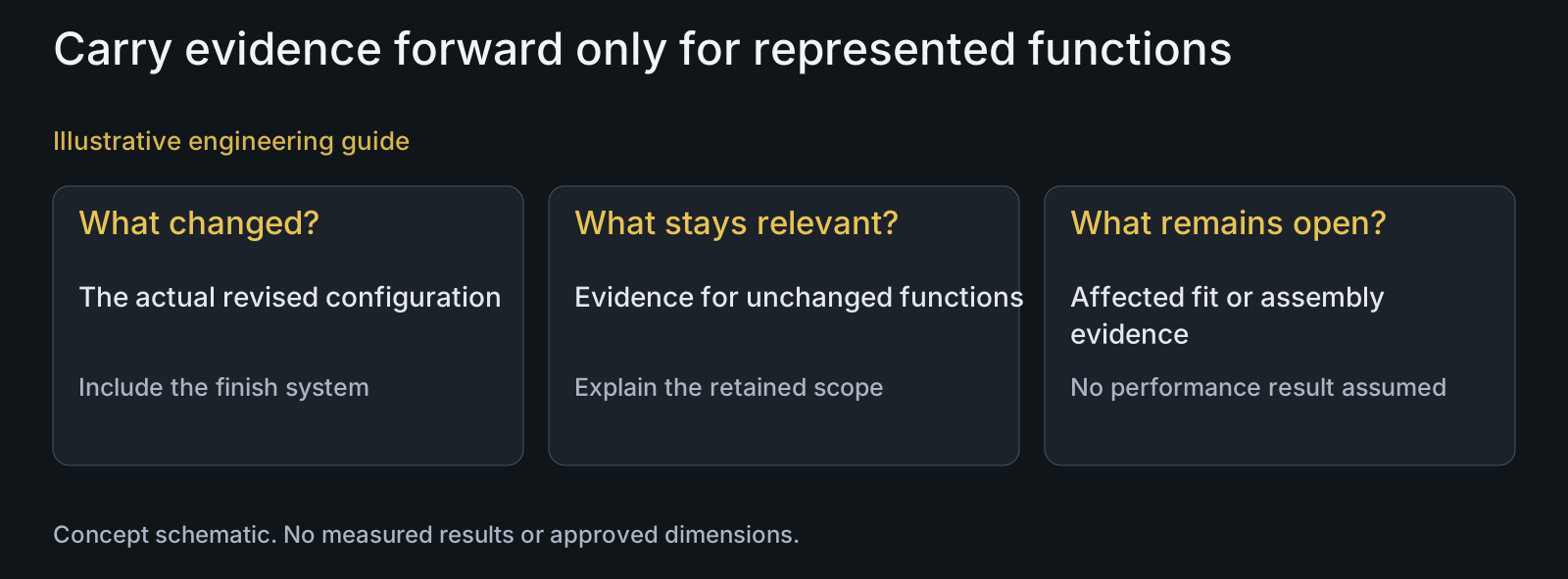
Map each prior result to its tested configuration and represented function. An unchanged drawing dimension may retain relevant dimensional evidence, but that does not preserve a corrosion or assembly conclusion made with a different surface system. Specify what is carried forward and why.
For finished fit, review the mating interface and measurement condition. For assembly, identify the thread treatment, contact surfaces, lubrication assumptions and installation method. The torque-development guide explains why a historical torque number is not a replacement-validation shortcut.
Keep chemical and engineering dispositions separate. One can be supported while the other remains open. Make the permitted project action explicit instead of collapsing both into a single approved-material label. No exact tolerance, torque, corrosion duration or service-life target is established here.
Illustrative engineering example: the finish changes, not the axle alloy
Illustrative engineering example: assume an OEM considers replacing a specified axle finish after receiving a substance concern from its supplier. The alternative retains the base alloy but uses a different surface system. Neither the original concern's legal applicability nor the replacement's suitability is presumed resolved.
The chemical reviewer identifies the affected constituent and obtains information representing the proposed finish, including associated sealants. The mechanical reviewer asks whether the new finished diameter fits the bearing interface and whether the changed thread and contact surfaces require another assembly assessment.
A sample that slides into the bearing answers only a narrow fit question. A supported chemical statement answers only its stated scope. The review therefore records two outcomes and the evidence still needed for each. This is an assumed decision scenario, not a real customer substitution, passed test or improvement result.
Put the replacement scope into the RFQ
Provide the old and proposed configurations, affected drawing revision, reason for the substitution and functions that must be preserved. Include mating-component details and assembly assumptions where they influence the change. Identify who will determine the applicable chemical requirements and acceptance evidence.
Ask PremFixer to discuss manufacturability and component evidence within the agreed manufacturing scope. Do not assume an alternative is available, chemically qualified or mechanically validated before the review. A quotation should describe the proposed work without implying universal REACH certification.
Retain the two review conclusions with the revised configuration so later purchasing does not silently return to the old finish or mix variants. The customer decision knowledge center connects materials, assembly and procurement decisions without treating them as one interchangeable approval.
Questions buyers need to confirm
Does a Candidate List entry automatically ban a finished pivot bolt?
Do not infer that from listing alone. Identify the applicable mechanism, substance, use and article scope with the responsible reviewer. Candidate List, authorisation and restriction questions must not be treated as identical.
Can changing from steel to titanium resolve a coating concern?
Not if the relevant constituent remains in the retained finish. Establish where the concern occurs and what the proposed configuration contains. The alloy change also needs its own functional review.
Can we delete a coating without changing the drawing dimensions?
Do not assume the finished interface remains equivalent. Review the drawing's measurement condition, the removed surface contribution and the mating fit. Protection and assembly behavior can require separate evidence even when nominal dimensions stay the same.
Does a supplier declaration validate the replacement mechanically?
No. It supports only its represented chemical scope. Determine the revised interface, surface and assembly conditions, then agree the engineering evidence required for those functions.
Must every old inspection result be discarded?
Not automatically. Retain evidence only where the represented configuration and function remain relevant, with an explained scope. Do not carry a surface-dependent conclusion to a different finish simply because the alloy is unchanged.
What should an RFQ for a proposed substitute include?
Send both material and finish specifications, the substance concern and destination scope, revised drawings, mating interfaces and assembly assumptions. State the chemical reviewer and functional acceptance needs so manufacturing options can be assessed without implying approval.
Technical references and scope
European Commission: REACH authorisation. Public distinction between Candidate List and Annex XIV authorisation for specified uses. No individual legal determination or blanket finished-article ban asserted.
European Commission: REACH restrictions. Public Annex XVII restriction mechanism. No individual substance condition, threshold or deadline asserted.
ECHA: How to substitute. Public indexed guidance on chemical, production-technique and design alternatives and comparison considerations. No specific approved pivot substitute asserted.
Explore related component, material and sourcing decisions in the customer decision knowledge center. For a drawing review, use the Drawing/BOM RFQ path.
Review the complete replacement, not just its material name
Share the original and proposed drawing or STEP files, substrate and complete finish specifications, the identified substance concern, destination and assembly inputs. PremFixer can discuss manufacturing options and the component evidence needed for separate chemical-scope and engineering-function reviews.
Discuss the drawing and BOM