

A RoHS attachment does not automatically cover the finished pivot fastener your e-bike project needs. First establish whether the relevant equipment is within the legal scope and what your purchasing specification asks suppliers to provide. Then compare the document's represented materials and substance coverage with the actual delivered configuration. An alloy result, a finish statement and an equipment declaration answer different questions; none should silently stand in for another. The practical decision is whether the evidence supports the requested component statement, leaves a defined gap or requires further evaluation. PremFixer can discuss evidence for specified parts without claiming universal RoHS approval for every bicycle application.
Hero: concept illustration of example hardware and its application. It is not a factory photograph, tested component or approved production geometry.
Separate applicability from evidence completeness
Use the e-bike RoHS scope guide to distinguish the equipment classification and applicable restriction from the component information request. The Commission describes RoHS as a restriction framework for electrical and electronic equipment, with exclusions. An e-bike label alone is not a sufficient classification decision.
After that decision, put the exact purchasing question in writing. Is the supplier being asked for a statement about named fasteners, data supporting a finish revision, or information for the equipment manufacturer's technical documentation? A broader contractual information request should be identified as such, not presented as proof that every mechanical bicycle part independently needs the same legal declaration.
Keep that established scope at the top of the review. This article addresses completeness within it, not a new legal classification of the bicycle.
Map materials before collecting more attachments
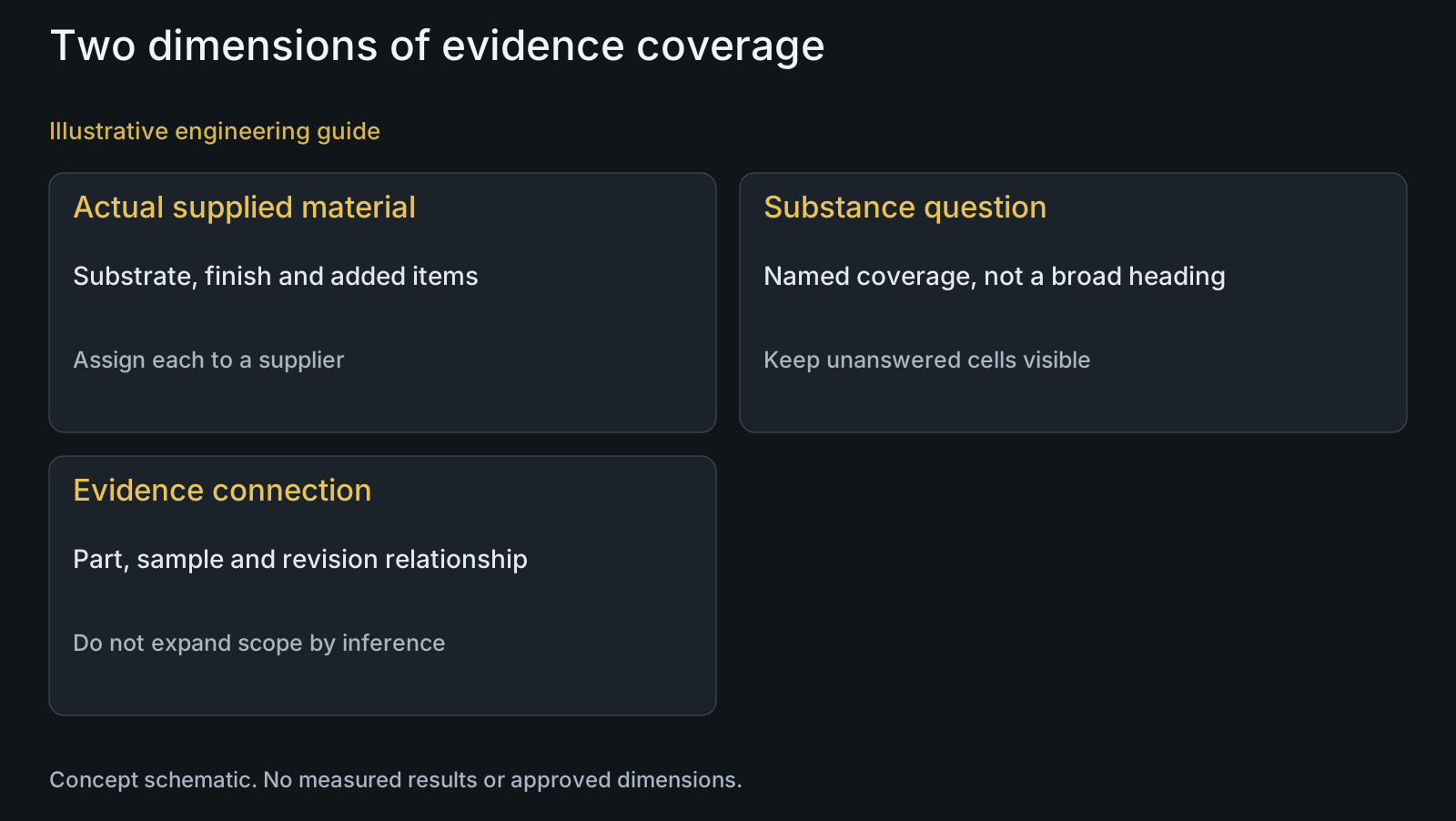
List the delivered substrate, specified finish layers and any separately supplied seal, locking material or insert relevant to the request. Mark which items are actually in PremFixer's supply and which belong to another kit supplier. A component photograph cannot define those boundaries.
Give each material entry an evidence reference and a stated represented product. If a report names a finish coupon, ask how the supplier connects that coupon to the ordered finish process and part revision. If it names only a metal grade, do not extend its scope to an added polymer by inference.
The surface-treatment page provides manufacturing context. It is not a chemical assessment of every treatment shown. Establish the requested evidence for the actual selected process before relying on a generic capability description.
| Restricted substance named in the Commission overview | Question for the represented material | Risk if unanswered | Useful clarification |
|---|---|---|---|
| Lead (Pb) | Which material and product revision does the evidence represent? | A base-material statement may be extended to another supplied material. | Request the represented material and evidence reference. |
| Mercury (Hg) | Does the document address this substance explicitly? | A partial substance list may be read as comprehensive. | Identify the applicable statement or result. |
| Cadmium (Cd) | Which supplied material is covered? | A result for a different sample may be reused without a connection. | Explain sample-to-order coverage. |
| Hexavalent chromium (Cr VI) | Does the identified analyte match this question? | A report label may not identify the substance being assessed. | Request the exact analyte and represented finish. |
| Polybrominated biphenyls (PBB) | Where is this question answered for relevant added materials? | A metals-only attachment may leave this row unexplained. | Reference the material statement or further evaluation. |
| Polybrominated diphenyl ethers (PBDE) | Is this separately addressed in the stated coverage? | One family entry may be assumed to cover another. | Confirm the named substance coverage. |
| Bis(2-ethylhexyl) phthalate (DEHP) | Which actual polymer or added material is represented? | An unrelated seal revision may be treated as the delivered material. | Identify material revision and evidence. |
| Butyl benzyl phthalate (BBP) | Does the evidence include this named question? | A generic plasticiser heading may hide a missing response. | Locate its statement or result. |
| Dibutyl phthalate (DBP) | What coverage is stated for the supplied material? | A broad conclusion may exceed its listed substances. | Confirm the declared or evaluated scope. |
| Diisobutyl phthalate (DIBP) | Is this distinguished from other phthalate entries? | An abbreviated list can leave an unexamined gap. | Request an explicit coverage reference. |
Use the substance list to locate missing questions
The European Commission's overview lists ten restricted substances. The table below preserves their names so a buyer can reconcile the requested scope with a report or declaration. Its review prompts are an engineering procurement aid, not test findings or a prescribed laboratory plan.
For each relevant material, distinguish a supplied statement, reported analytical result, documented exclusion from the represented scope and unanswered question. Use the substance identifier actually addressed by the evidence. A heading that says metals is not an explanation of every organic-substance question.
Do not demand ten separate tests solely to make the matrix look complete. Select the further information or evaluation needed to resolve a particular gap. Equally, do not interpret a blank row as a passing result. Record who will provide the clarification and what decision it supports.
Read the report boundary, not just its conclusion
Check the named sample, component revision, included materials, substances evaluated, method identification and result interpretation. If a document uses a limit or exemption, request the exact referenced basis and the explanation for this application. This guide provides no universal numerical limit or exemption approval.
Keep a supplier statement and an analytical report distinguishable. Their coverage can be compared, but one document's confident wording cannot expand the other document's sample or analyte scope. A request for clarification may be more useful than another copy of the same report.
IEC 63000:2016+A1:2022 addresses technical documentation compiled by a manufacturer for applicable substance restrictions. Its public abstract supports that documentation purpose; it does not establish that any particular attachment or PremFixer order complies with its full requirements.
Illustrative engineering example: a partial report in a kit
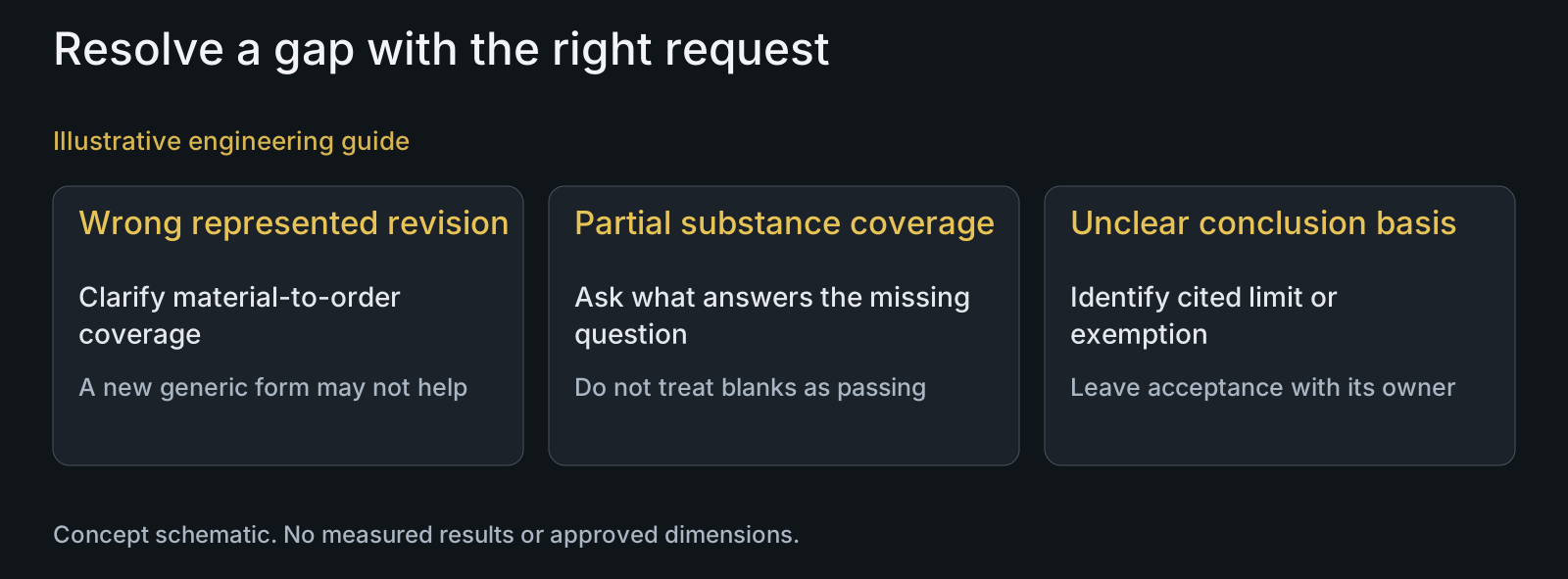
Illustrative engineering example: assume an OEM orders a finished axle with a separately sourced seal. The axle supplier provides a report naming a metal sample and selected substances. The seal supplier provides a declaration, but it identifies a different material revision. No test result or customer outcome is assumed.
The buyer first keeps the established equipment scope unchanged. Next, the review matrix assigns the metal report only to its stated material and substance coverage. The changed seal remains unresolved until its supplier explains revision coverage. Neither document is discarded merely because it is incomplete for the whole kit.
The next action is a specific request: identify the represented finish configuration and clarify the seal revision, then evaluate any remaining substance gaps. Asking every supplier for a new generic RoHS certificate would obscure those two different information problems.
Carry the evidence boundary into the component request
Establish the supplied part numbers, included materials and document purpose in the RFQ. If the OEM has a material declaration format, attach it with its required basis. Avoid asking a component manufacturer to sign an equipment-level conclusion it has not evaluated.
Keep unresolved entries visible when materials, finishes or kit sources change. A newer document date is useful only with explained configuration and coverage. The REACH change-scope guide addresses a different substance-information framework; do not use its statement as a substitute for this one.
Use the customer decision knowledge center to connect the compliance information request with the actual custom manufacturing scope. Document evidence supports the defined decision; it does not replace dimensional or functional acceptance of the parts.
Questions buyers need to confirm
Does every e-bike pivot fastener need the same RoHS declaration?
No. Establish the relevant equipment scope and the buyer's component information requirement. Then define the named part, delivered materials and document purpose; a mechanical fastener's use on an e-bike does not independently settle the equipment classification.
Can a report for the base metal cover a finished axle?
Only within its stated and explained coverage. Check the represented material, sample and finish revision. If added treatments are outside the report, request the information needed for them rather than silently extending the base-metal result.
Should I order a new test for every empty table entry?
Not automatically. First ask what existing statement or evidence addresses the named substance and material. Further evaluation should resolve a defined gap; a blank cell is neither proof of failure nor a passing result.
Can a declaration for an older seal revision be reused?
Only if its supplier explains coverage of the delivered revision. Provide the current material identity and requested scope. Similar appearance or a shared product name does not establish that the two revisions are represented by the same evidence.
Is a document labelled RoHS 3 enough?
No. Request its exact legal or purchasing basis, represented products and substance coverage. A familiar short label cannot identify the sample, finish revision or unanswered questions, and this guide does not turn that label into an independent approval.
What should the RFQ include for a focused evidence review?
Provide part numbers, drawings, finish requirements, included kit materials, equipment context and the requested document format or basis. Identify which supplies belong to each manufacturer so the review can resolve component evidence without asking one supplier to approve the entire equipment.
Technical references and scope
European Commission: RoHS Directive overview. Public equipment-restriction overview and the named list of ten substances; it does not classify this illustrative bicycle or certify an ordered part.
IEC 63000:2016+AMD1:2022 public abstract. Technical documentation purpose only; the paid normative text and any individual document's conformity are not asserted.
Explore related component, material and sourcing decisions in the customer decision knowledge center. For a drawing review, use the Drawing/BOM RFQ path.
Define the component evidence your project needs
Share the fastener drawings or STEP files, part revisions, finish specifications, BOM including added materials, equipment context and requested declaration format. PremFixer can discuss the supplied component scope and the evidence gaps that need clarification before the OEM makes its documented decision.
Discuss the drawing and BOM