
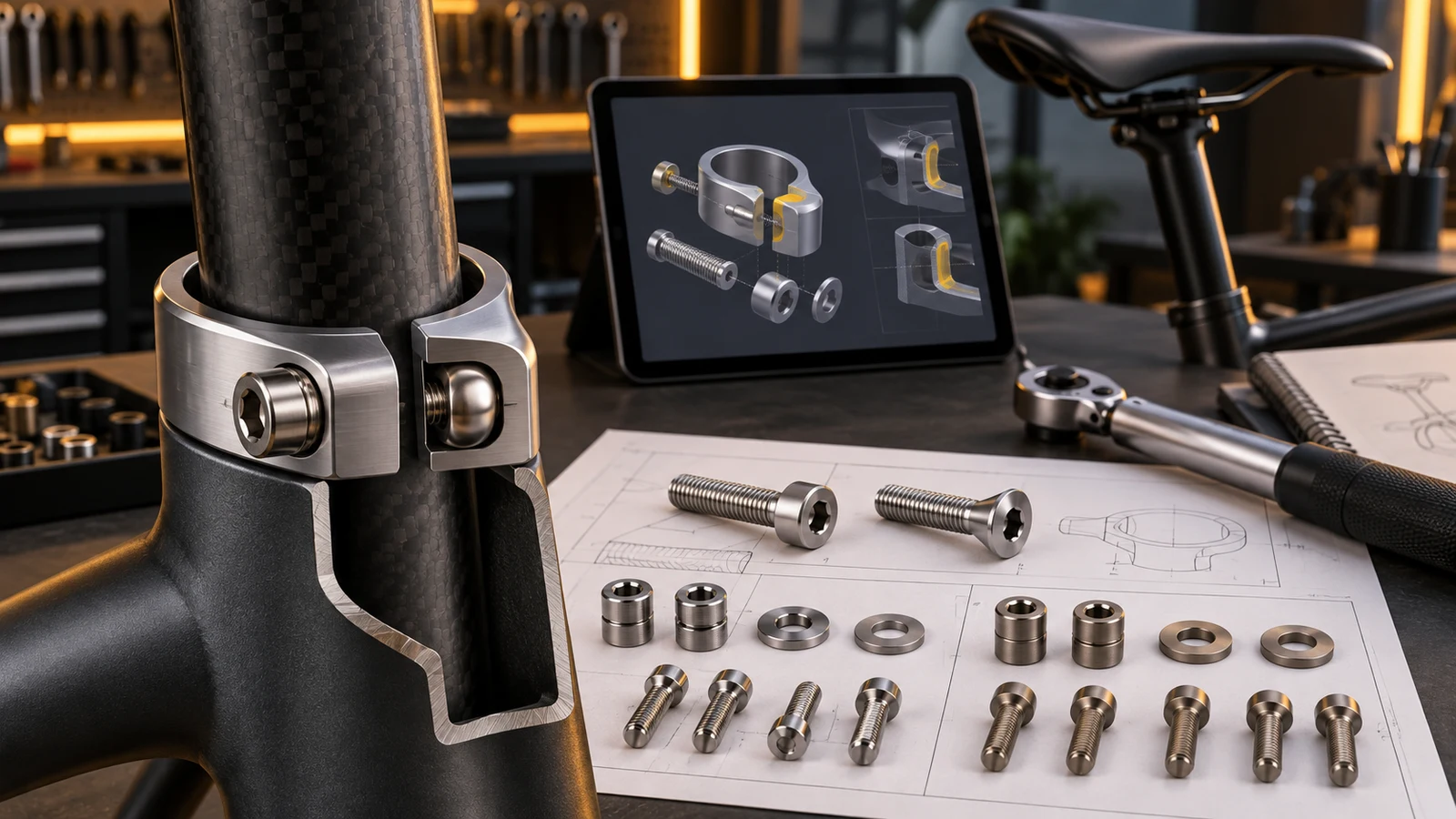
A custom seat-clamp bolt should retain an existing torque instruction only when the replacement has been assessed against the approved clamp, frame and post configuration. Stainless steel or titanium alone does not establish that equivalence. The OEM or buyer is deciding whether a new supplied fastener preserves head contact, effective engagement, mating-nut behavior and delivered surface condition. Mark the frame-level collar or binder clearly; the saddle-rail clamp and suspension pivots are different joints. For existing bicycles, follow applicable manufacturer instructions. For a supply change, compare the relevant interfaces and evidence before carrying over the setting, rather than assume that a screw which threads in is an approved replacement.
Hero: concept illustration of example hardware and its application. It is not a factory photograph, tested component or approved production geometry.
Define the replacement boundary precisely
Mark the fastener position and identify the collar or binder, post and frame versions. Include a separate nut, barrel or insert in the supplied-part boundary where relevant. The receiving member can determine contact and engagement even if it is absent from a sample photograph.
State whether the proposal changes only the screw or also the mating hardware. If the new screw requires a different nut or washer, compare the complete proposed arrangement rather than describe it as a bolt-only replacement. Similar color and nominal thread do not establish that boundary.
The seatpost-clamp specification guide addresses the frame/post contact and installation requirements. This review focuses on the custom supplied-fastener comparison and which parts of an existing assembly approval a supply change affects.
Compare the head contact before assuming equivalent loading
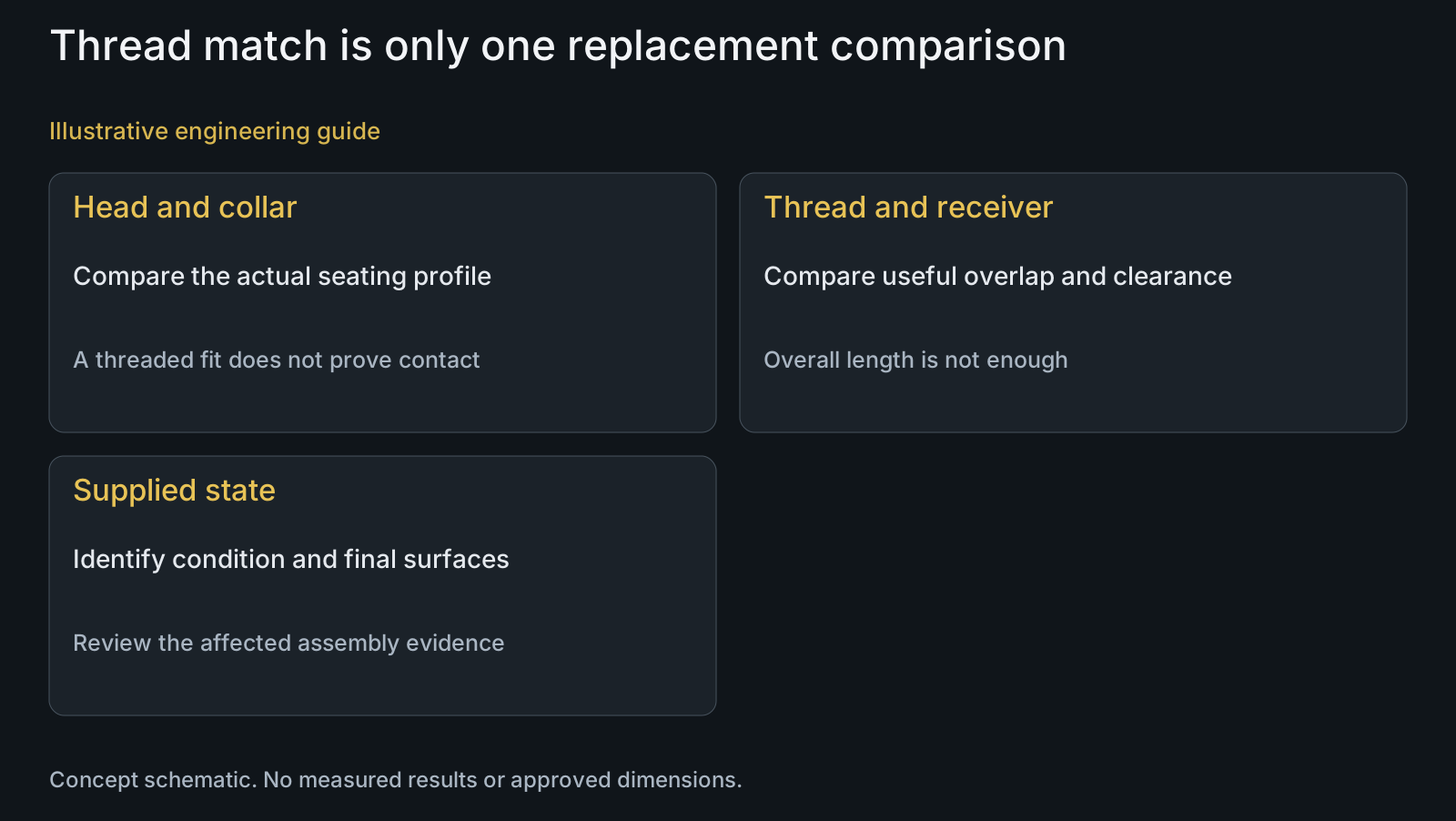
Identify the head underside, any washer and the collar's intended bearing surface. Compare the actual profile, contact diameter and seating relationship. A flat, curved or specially formed contact is not interchangeable simply because the threaded shank fits the receiver.
Show how any barrel or articulated receiving piece is intended to move or seat as the collar closes. Do not let an unintended edge contact become the substitute for the defined bearing surface. Assess the actual mechanism rather than presume that every external collar uses the same arrangement.
Engineering analysis: changing the fastener contact can change the way the collar receives load, even if the nominal thread and applied tool setting remain the same. The consequence must be evaluated in the represented assembly; no numerical contact-pressure limit is inferred here.
| Changed feature | When the difference matters | Shortcut risk | Review evidence |
|---|---|---|---|
| Head underside or washer | Contact profile differs | Threads in mistaken for correct seating | Collar contact geometry and assembled state |
| Usable thread or length | Receiver overlap or clearance changes | Overall length treated as engagement | Effective thread and bottoming comparison |
| Mating nut or barrel | Receiving piece is part of the proposal | Bolt-only approval hides changed mechanism | Complete proposed hardware arrangement |
| Material condition | Properties differ from approved hardware | Material name assumed to permit more tightening | Specified condition and joint requirements |
| Finish or assembly product | Delivered friction/locking state changes | Old setting transferred without review | Applicable tightening and preparation evidence |
| Post or frame configuration | Component requirements change | Collar marking treated as complete approval | Relevant manufacturer scope and clarification |
Separate thread engagement from overall screw length
Specify the under-head reference, usable thread length and receiver definition. Compare effective overlap in the intended assembled condition, including any unthreaded portion or incomplete thread near the head. Overall length alone cannot describe those relationships.
Check whether the proposed screw could bottom before the intended seating state or interfere with adjacent structure. Conversely, identify whether shortening it changes useful engagement. Do not prescribe a universal length-to-diameter ratio as acceptance for every collar receiver.
Use the receiver-engagement guide for the distinction between effective overlap and a nominal length rule. Its mechanism discussion does not transfer a suspension-pivot instruction or load limit to the seat collar.
Carry material and finish changes into the assembly comparison
Identify the supplied material grade and condition, not merely stainless or titanium. Compare the requirements of the external thread, head contact and mating member with the proposal. A material substitution should not be described as inherently safe for every carbon post or alloy collar.
Record delivered coatings, lubrication or locking features and any approved additions during assembly. Keep screw-interface preparation distinct from preparation at the post/frame contact. One instruction cannot be assumed to apply to both locations.
Review materials and surface treatment against these named features. PremFixer's manufacturing scope can address the specified component state, but it does not itself establish that the old tightening-to-assembly relationship remains valid.

Treat component limits as configuration requirements, not targets
RockShox's Reverb seat-clamp FAQ explicitly considers the post's collar limit together with a lower frame requirement and gives named contact-preparation guidance. The useful lesson is to retain both component scope and location, not to copy that product's setting or paste recommendation into another assembly.
Ritchey's Comp Carbon 2-Bolt page lists saddle-clamp and seat-collar requirements separately and identifies maxima. This demonstrates why the location and meaning of a published value matter. A maximum is not automatically a suitable target for an unidentified custom clamp.
If requirements conflict or no validated method covers the proposed replacement, obtain clarification from the responsible OEM or manufacturers. For development, use a configuration-specific torque review as a distinction between analysis and tightening evidence, not as a seat-collar prescription.
Review example: same thread, different head seat
Illustrative engineering example: assume an OEM proposes a titanium screw for a collar currently defined with a particular head-seat profile and barrel nut. The candidate has matching nominal thread and overall length, but its head underside differs. No torque, force, slip or damage result is assumed.
The reviewer compares seating geometry, effective engagement and clearance in the collar's intended closed condition. They then check material condition and delivered finish against the existing tightening evidence. The fact that the candidate engages the barrel nut does not resolve those comparisons.
If the changed contact is intentional, the proposal becomes a revised clamp-hardware configuration with defined validation questions. If it is unintended, the manufacturing drawing should preserve the required interface. Neither route is approved by appearance or an unchanged torque label alone.
Questions buyers need to confirm
What torque should a custom seat-clamp bolt use?
Use the approved instruction for the identified frame, collar, post and hardware state. A custom replacement needs an applicability review before inheriting it. Material or thread diameter alone cannot establish a universal setting.
Is matching nominal thread sufficient for a replacement?
No. Compare head contact, usable thread length, receiver, bottoming clearance and the intended assembled state. Also identify the material condition and delivered surface. A screw that engages can still differ at another functional interface.
Can titanium automatically replace stainless in a carbon-post clamp?
No automatic approval follows from that substitution. Assess the complete clamp arrangement, specified fastener properties, mating members and surface conditions. Carbon post material does not define the screw's requirements or authorize a higher setting.
Can a published maximum be used as the new target?
Not without the applicable configuration and instruction. A maximum describes a limit within its stated scope, not proof of adequate retention at that value. Resolve conflicting frame, collar or post requirements with the responsible manufacturer or OEM.
Should the sample include the mating barrel nut?
Include it or provide its complete controlled definition when it affects the interface. Identify whether it stays unchanged or belongs to the replacement proposal. Otherwise the comparison may omit the feature that governs engagement or seating.
What is needed for a replacement seat-clamp bolt RFQ?
Supply marked assembly views, baseline and candidate drawings or samples, mating-nut definition, material conditions, finished surfaces and existing assembly evidence. State which interfaces may change and which must remain equivalent so the quotation covers the actual proposal.
Technical references and scope
RockShox Reverb seat-clamp consideration FAQ. Named post and frame limit relationship and contact-specific preparation. Numeric settings and products are not generalized to another assembly.
Ritchey Comp Carbon 2-Bolt technical specifications. Saddle-clamp and seat-collar requirements are distinct and specified as maxima. No numeric setting or replacement compatibility transferred.
Explore related component, material and sourcing decisions in the customer decision knowledge center. For a drawing review, use the Drawing/BOM RFQ path.
Define a compatible custom seat-clamp hardware proposal
Send baseline and candidate drawings or STEP, a marked collar assembly, mating nut or insert details, material and finish requirements, and the applicable instruction through the Drawing/BOM RFQ path. PremFixer can compare supplied-part definitions and manufacturing implications while your team resolves assembly applicability and validation.
Discuss the drawing and BOM