
Do not add solution treatment to a cold-worked 304 or 316 pivot bolt on the assumption that its specified strength will remain unchanged. The proposed operation may remove effects that contributed to the required material condition. For a buyer addressing forming difficulty or reported property variation, first identify what must change and what the finished component must retain. A softer state may help a later forming operation, but it is not automatically the acceptable delivered state. Consider subsequent heading, thread forming and machining as well. The decision is whether the revised route preserves the design's property basis, not whether the phrase remove work hardening sounds beneficial.
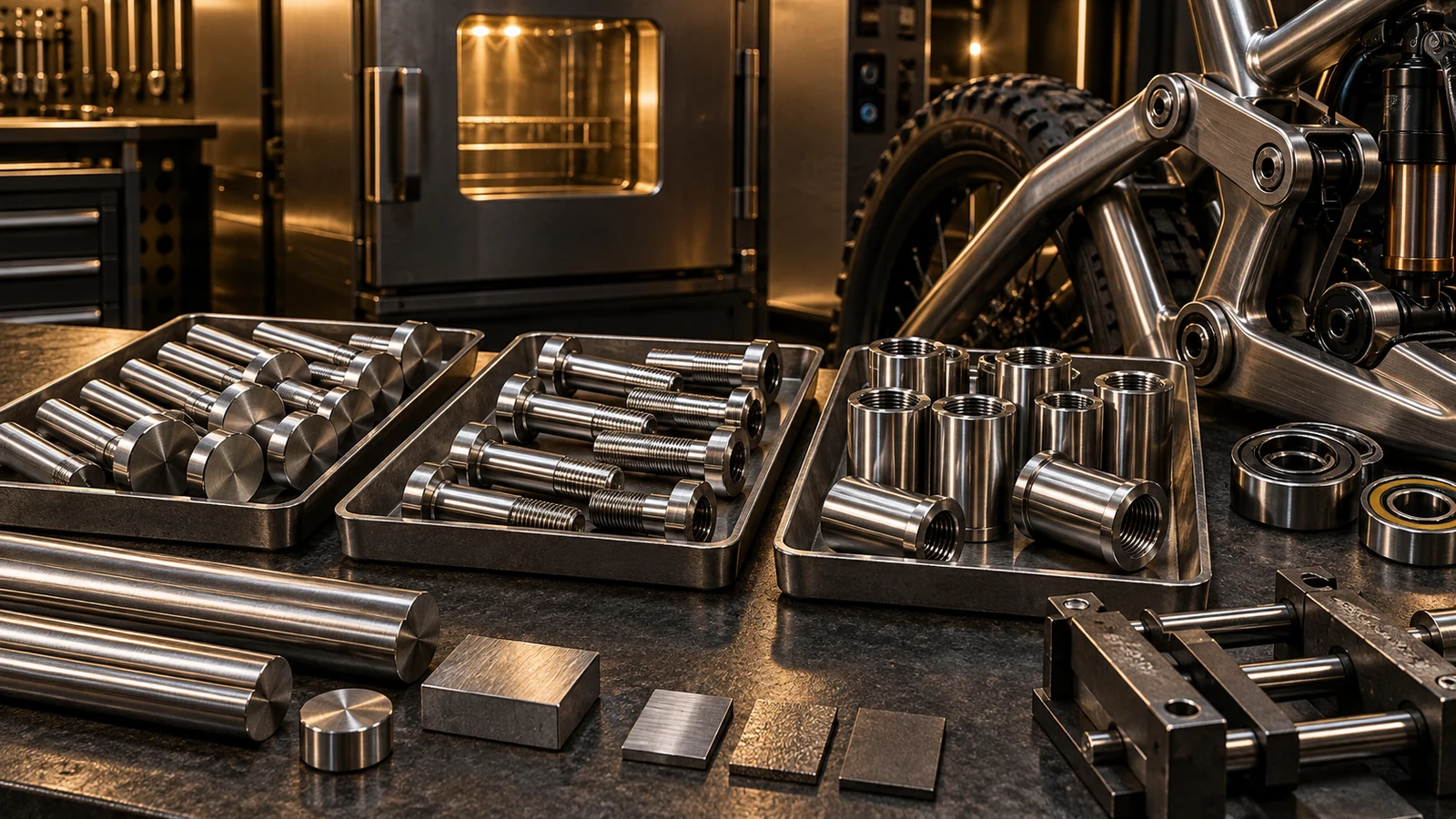
Hero: concept illustration of example hardware and its application. It is not a factory photograph, tested component or approved production geometry.
Identify whether cold work is a requirement or a problem
Start with the specified material condition and mechanical requirements. A drawing may require an annealed condition, a defined strengthened condition or component properties that depend on the approved manufacturing route. Those descriptions are not interchangeable just because the chemistry remains 304 or 316.
Outokumpu's stainless overview explains that plastic deformation can increase austenitic stainless strength. It also describes recovery and recrystallization during annealing after cold rolling. These general mechanisms explain why removing deformation effects deserves a property review; flat-product processing is not a pivot-bolt recipe.
If the reported concern is inconsistent behaviour, locate its subject before prescribing heat treatment. A forming problem, dimensional variation and property nonconformity need different evidence. The cold-work consistency guide addresses batch comparison; this article addresses whether the proposed annealing change remains compatible with the design.
Better formability does not establish an acceptable final bolt
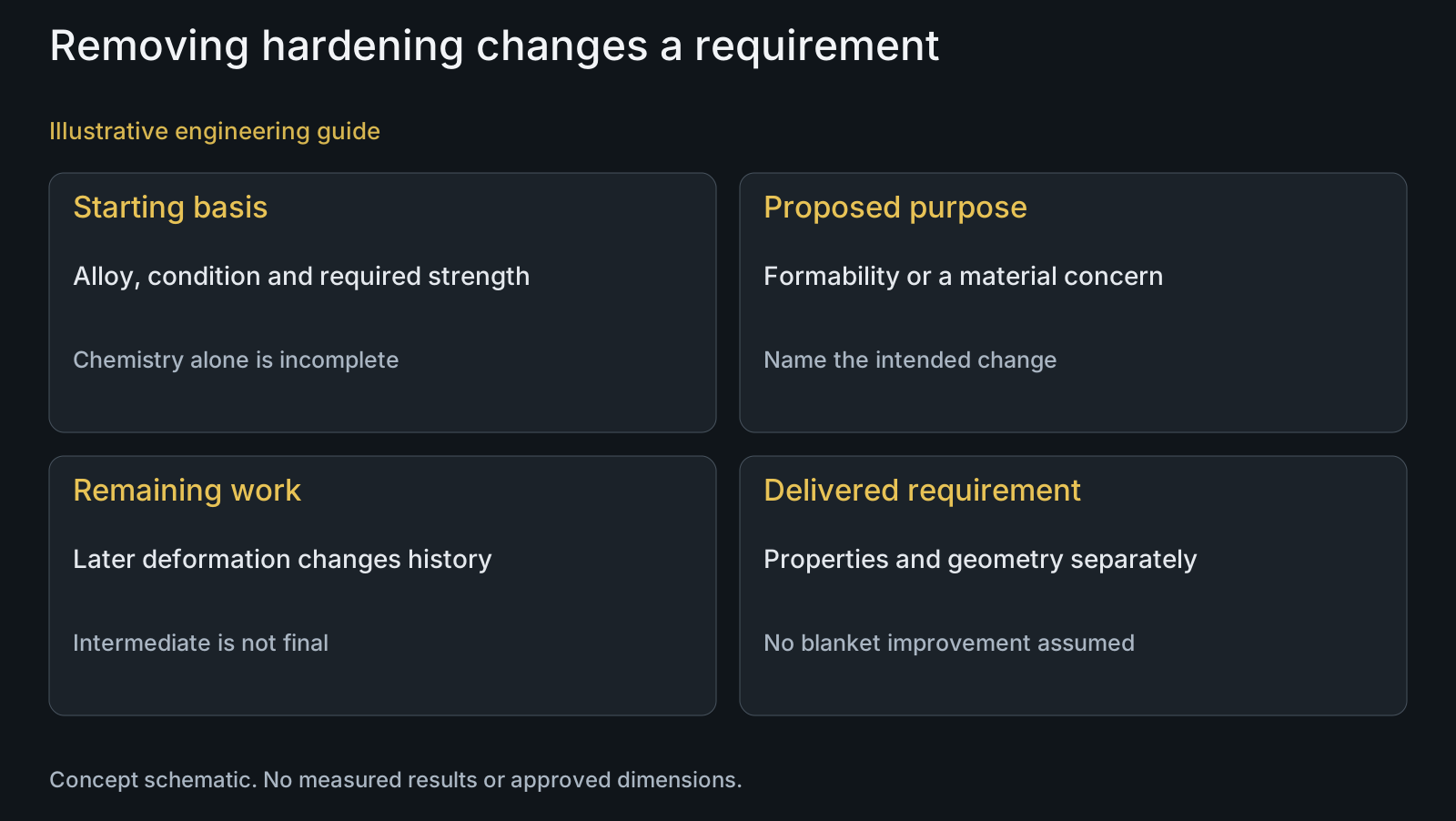
Removing a work-hardened condition can be useful when further deformation is required. That manufacturing objective is different from maintaining the strength basis of a supplied component. Ask which operation benefits and which finished requirements could change.
Do not frame ductility and strength as one universal more-is-better measure. A proposed softened intermediate state may be suitable for forming, while the final component still needs its specified mechanical condition. The quotation should show how the remaining route achieves that condition rather than present the intermediate benefit as finished-part acceptance.
The thermal-method comparison separates material-family mechanisms. In this 304/316 review, the specific issue is changing a cold-worked state. It is not an invitation to substitute a martensitic steel hardening route or to rank every annealed pivot below every formed pivot.
| Proposal | Potential purpose | Design risk | Verification question |
|---|---|---|---|
| Retain the agreed cold-worked route | Preserve the existing property basis | Reported concern remains unexplained | Does actual output meet the specified requirement? |
| Anneal before further forming | Provide a suitable intermediate state | Intermediate properties called final | What state results from the remaining deformation? |
| Anneal after final forming | Change the supplied material state | Required cold-work contribution removed | Does the changed component still meet its mechanical requirement? |
| Treat for a corrosion-related objective | Address the stated material concern | Mechanical and dimensional effects ignored | Are grade, environment and required final properties compatible? |
| Accept by chemistry or gauge alone | Check their defined subjects | Material-state change left unassessed | Which evidence actually addresses the changed property? |
A corrosion objective does not erase the mechanical question
The BSSA discussion of austenitic stress-relieving treatments identifies grade, cooling, corrosion sensitisation and distortion considerations. It describes competing process concerns, not one universally harmless heat treatment for every stainless component.
If the objective is a material-related corrosion concern, identify the grade, environment and processing condition to be addressed. Keep that question separate from the component's required strength. Neither the promise of a cleaner-looking surface nor a general statement about corrosion supplies the missing property assessment.
Outokumpu's Core datasheet gives grade-dependent treatment considerations in its product context. Do not transfer a listed temperature or cooling instruction to a custom pivot without its applicable material and process basis. Surface cleaning and passivation are separate operations, not proof that annealing preserved the required strength.
Later forming can change the state again
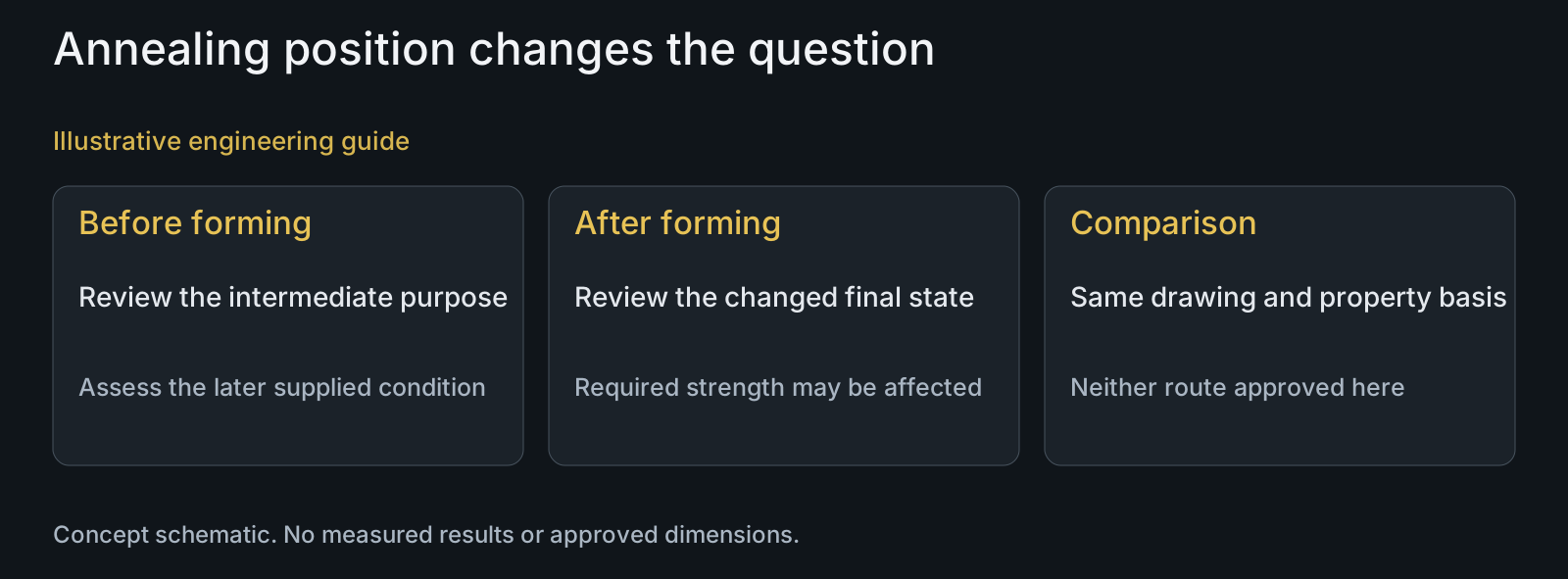
An intermediate anneal followed by further cold deformation is not the same route as an anneal after the final forming operation. The later operation changes the history on which the finished state depends. Identify its purpose and affected regions instead of labelling the whole component simply annealed.
For a headed bolt with a formed thread and machined shoulder, different features have different operation histories. The processor should explain which condition its evidence represents. This does not predict a specific hardness map; it prevents a stock or intermediate record from being called a complete description of the finished part.
When comparing proposals, locate the anneal relative to the last relevant deformation operation. Final geometry also needs its own acceptance basis after operations that can affect it. The treatment callout guide develops that dimensional endpoint without prescribing a universal heading, rolling and annealing sequence.
An added final anneal is not a clerical route change
Illustrative engineering example: assume a 304 shoulder bolt has an agreed finished mechanical requirement and a route that includes cold forming. A proposal adds solution treatment after the last forming step to address forming-related property variation. No test results, quantified softening or approved cycle are supplied.
The reviewer asks whether the proposed output still meets the mechanical requirement. A record showing unchanged chemistry or a passed thread gauge cannot answer that property question. If the proposal changes the required supplied condition, it needs the drawing owner's material review rather than only a revised process label.
An intermediate treatment before subsequent forming would be a different proposal and needs its own final-state basis. The example approves neither route. It shows why an operation described as removing variation can also remove a contribution on which the original component requirement relied.
Compare quotations on the same supplied condition
Ask each supplier to identify the incoming condition, annealing objective, remaining forming work and required delivered properties. Offers with different delivered conditions are not equivalent solely because their alloy designations and nominal dimensions match.
Agree what evidence is needed for the changed requirement. Identify the represented component or material, relevant property and applicable method rather than request all possible tests. An incoming-stock certificate, a process record and a finished-property report describe different subjects.
Share the drawing and manufacturing history through materials review and the manufacturing process scope. PremFixer can review custom forming and machining requirements with specified partner thermal work. No universal annealing requirement, in-house furnace or guaranteed property equalisation is implied.
Questions buyers need to confirm
Do machined 304 and 316 pivots always need solution treatment?
No. Identify the incoming condition, actual operations and required delivered properties. Machining alone does not establish a need to soften the component or alter its material state.
Can removing work hardening affect the required strength?
Yes, where that condition contributed to the specified property basis. Assess the actual proposed output against the requirement; unchanged chemistry does not prove unchanged mechanical properties.
Is an intermediate anneal equivalent to a final anneal?
No. Later cold deformation can change the condition again. Identify treatment position and the remaining forming operations, then establish the property evidence relevant to the delivered part.
Can a passed thread gauge approve the annealing change?
No. It checks its defined geometry, not the changed mechanical condition. Specify the relevant material-property requirement and evidence separately from final thread conformity.
Is a single temperature and water-quench instruction enough?
No. The exact grade, starting state, objective, applicable process and required output must be established. Manufacturer temperature examples are not a qualified recipe for an unidentified pivot.
What records help assess an added anneal?
Provide the drawing, exact stainless specification, stock condition, existing and proposed operation sequence, finished mechanical requirements, critical dimensions and finish. Include available property records and identify the concern the additional treatment is intended to solve.
Technical references and scope
Outokumpu: Stainless steel types and manufacturing. Cold-work strengthening and recovery/recrystallization during flat-product annealing. General mechanisms only; no stock data or line recipe assigned to pivots.
Outokumpu: Core range datasheet. Grade-dependent fabrication and treatment considerations. No numerical cycle, corrosion result or finished-pivot property adopted.
BSSA: Stress-relieving heat treatments for austenitic stainless steels. Distinct grade, sensitisation, cooling and dimensional concerns. Contextual guidance, not a universal annealing instruction or guaranteed improvement.
Explore related component, material and sourcing decisions in the customer decision knowledge center. For a drawing review, use the Drawing/BOM RFQ path.
Review the design impact of an added solution treatment
Send drawing and STEP, stainless specification and incoming condition, the proposed annealing position, later forming operations, required mechanical properties, final interfaces and quantities. PremFixer will compare the material-state assumptions and manufacturing scope so a formability or corrosion objective does not silently replace the supplied component requirement.
Discuss the drawing and BOM