
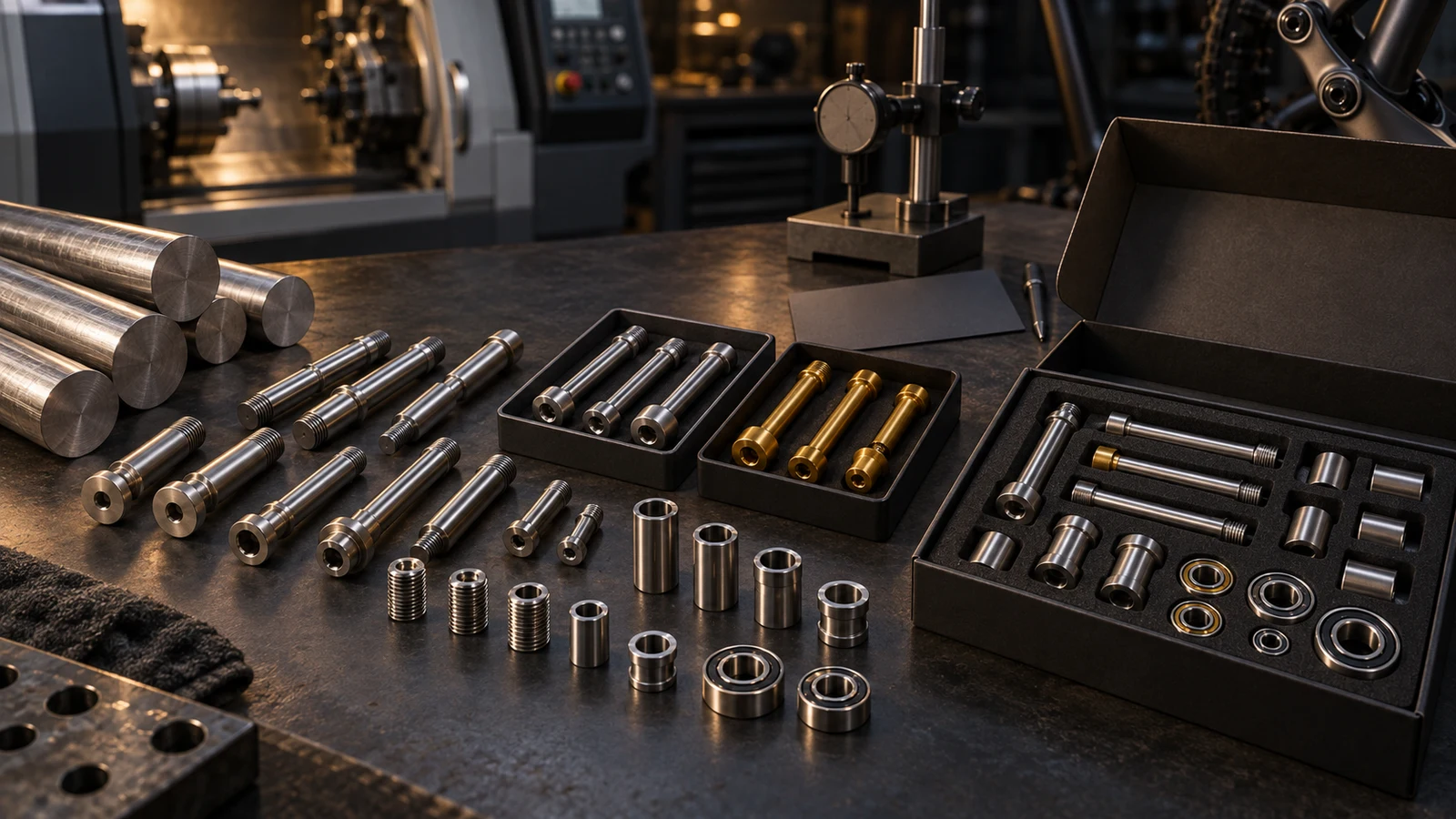
A complete TC4 pivot supply route should connect the specified titanium stock to the actual finished axle, matching parts and agreed records. It should not require every part to follow a universal machining, heating, rolling and finishing sequence. Define the incoming material condition and final component requirements, then select operations that serve those requirements. PremFixer combines confirmed in-house manufacturing with qualified-partner treatment and testing through one accountable project team. That coordination can cover an agreed finished kit, but it does not mean every operation is in-house or that a machining sample already represents the fully treated, packaged production configuration.
Hero: concept illustration of example hardware and its application. It is not a factory photograph, tested component or approved production geometry.
Start with the titanium condition, not a raw-bar label
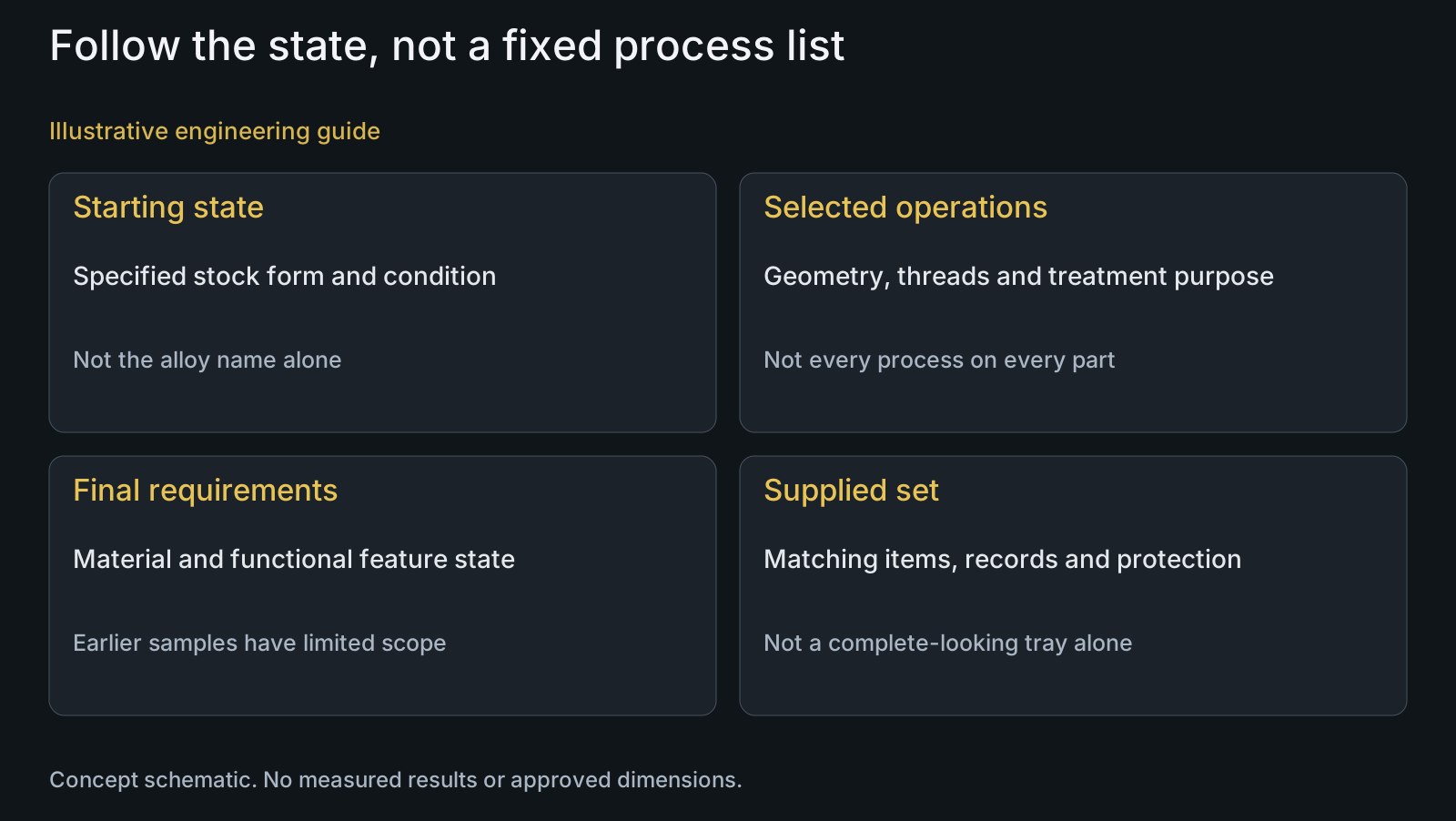
Specify the governing material grade, product form and supplied condition, with the identification and evidence the order requires. TC4 in a headline does not identify every stock history or final requirement. A bar's represented material record also does not prove the geometry or condition of every later finished part.
TIMET's TIMETAL 6-4 data sheet explains the relationship between this alpha-beta alloy, processing history and properties. Use that as a reason to keep condition explicit, not as current design allowables or a universal treatment schedule for a custom axle.
Do not add thermal processing merely to make a route sound complete. State its intended purpose and resulting requirement if it is proposed. The TC4 heat-treatment review separates incoming condition from a later operation and its sequence. Some project questions concern retaining a specified condition rather than creating a new one.
Select the geometry and thread route together
Identify the working shoulders, bores, head, drive and threaded interfaces on the component drawing. Their relationships determine what the machining route must deliver. A STEP model explains shape, while the dimensional drawing carries tolerances, material and acceptance requirements that may not be present in the model.
For the threaded feature, identify the form, location and supplied-state requirement before selecting a manufacturing method. Confirm whether rolling is appropriate for the proposed geometry and condition rather than making it mandatory for every TC4 part. The rolled titanium thread guide explains why process choice is not a blanket finished-component fatigue guarantee.
Show any operation that follows the thread or fit-controlling feature in the same route review. A later treatment should not be invisible to the person defining final conformity. No universal blank diameter, machine configuration, thermal limit or processing order is supplied by this article.
| Proposed operation or state | Question it should answer | Assumption to avoid | Relevant acceptance basis |
|---|---|---|---|
| Specified titanium stock | Which grade, form and condition enters manufacture? | TC4 label defines every property | Applicable material requirement and represented identity |
| Machined shoulders and bores | Which feature relationships serve the joint? | Shape alone defines fit and conformity | Drawing datums, tolerances and supplied state |
| Thread manufacture | Which method suits the geometry and condition? | All titanium threads must use one method | Thread definition, route and final requirement |
| Later thermal operation | What property or condition change is required? | Heat treatment is a universal improvement | Purpose, sequence and resulting component state |
| Selected finish or marking | Where is the treatment needed or excluded? | Head appearance approves every working zone | Coverage map and relevant final-feature checks |
| Packaged matched set | Which items and records are actually supplied? | One-stop means all in-house or fully validated | Item-level scope, represented evidence and responsibilities |
Treat finishing as a state change with a defined purpose
State what each surface operation is intended to achieve: appearance, a specified working surface or another explicit requirement. Do not prescribe blasting, passivation or a colored coating simply because those words appear in a generic titanium route. Each proposed operation needs applicability to the actual substrate, condition and feature.
Map the treated, excluded and protected regions. The thread, locating shoulder and visible head can have different requirements. A selected head appearance does not authorize the same treatment everywhere, and an excluded feature still needs a final requirement rather than disappearing from acceptance.
Keep the operation's sequence and delivered surface state visible in the quote. A sample made before the selected finish cannot answer every question about the finished part. The surface-treatment resource is an inquiry route; it does not by itself establish all finishes as suitable for the proposed TC4 axle.
Make the one-team boundary and finished set explicit
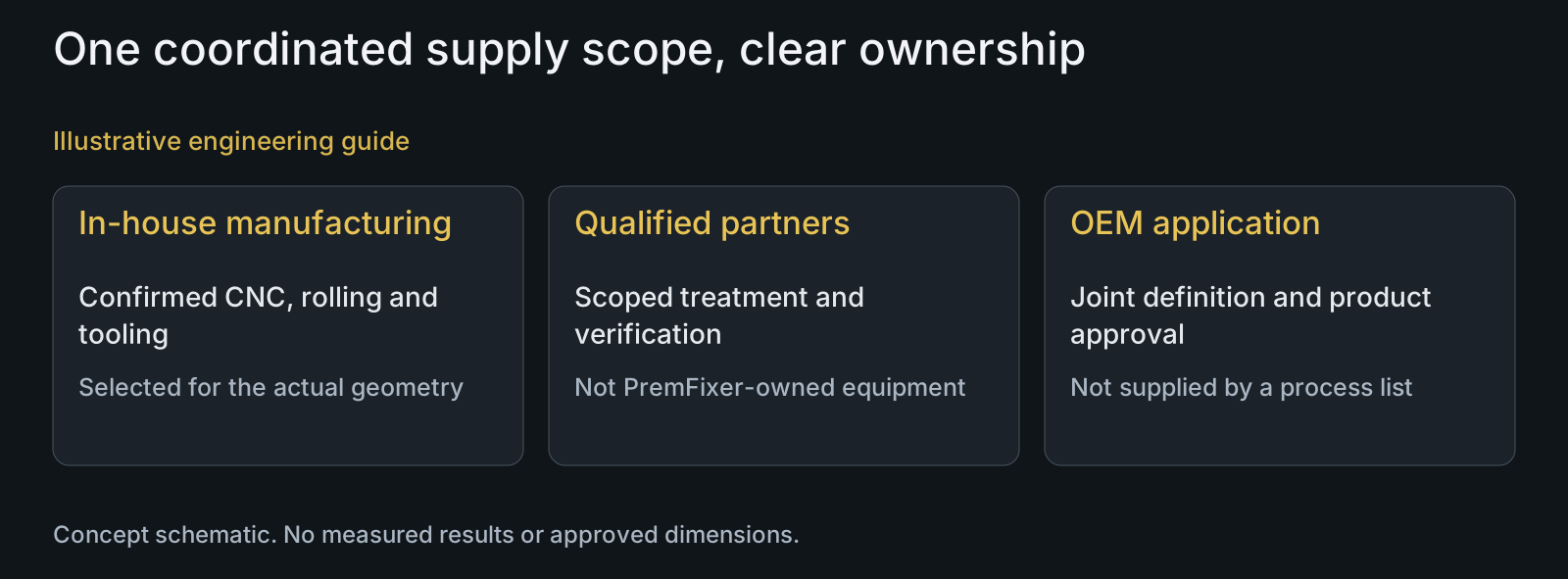
PremFixer's confirmed in-house capabilities include cold heading, CNC machining, thread rolling and tool/die manufacturing. Their applicability is selected for the actual part. Qualified-partner operations cover scoped treatment, inspection and testing. The CNC turning page describes this boundary without claiming every machine type or instrument is self-owned.
The integrated quotation should identify the supplied axle and each matching sleeve, spacer, washer or other kit item, including customer-supplied components where relevant. One team coordinates the agreed route; it does not replace item-level requirements or the OEM's design and application approval.
Define what the final records represent: material identity, named features in the delivered state, and any agreed component or set assessment. Protective packing should maintain identification and the supplied condition. A fitted tray illustrates organization, not evidence that all dimensions, material properties or assembly functions were verified.
Illustrative review: adding treatment changes the route question
Illustrative engineering example: assume an OEM has reviewed a machined TC4 axle in its specified stock condition, then proposes a later thermal operation and a decorative head treatment for the supplied kit. No treatment cycle, sample result or approved component performance is assumed.
The reviewer asks what the thermal operation is intended to change and which material and feature requirements must hold afterward. The head treatment is reviewed separately for its coverage and relationship to the protected shoulder and thread. Neither proposal is approved merely because the earlier machined sample looked correct.
The supply scope is then described in terms of the selected route and represented final state, with partner responsibilities and matching kit items identified. The example demonstrates a conditional route review, not a mandatory TC4 sequence or proof that more processing necessarily creates a better pivot.
Questions buyers need to confirm
Does every TC4 axle need the same complete manufacturing sequence?
No. Define stock condition, final material and feature requirements, then select operations and sequence for that component. A list of machining, heating, rolling and finishing is not automatically the correct route.
Does one-stop titanium manufacturing mean all processes are in-house?
No. PremFixer coordinates confirmed in-house manufacturing with qualified-partner treatment, inspection and testing within the agreed project scope. The quote should identify operations, deliverables and responsibilities.
Must heat treatment be added after machining?
Not as a universal rule. Identify its purpose and required resulting condition, with sequence and affected features reviewed. The supplied stock and component requirements determine whether a later operation is needed.
Are rolled threads mandatory for every TC4 pivot?
No blanket route is prescribed. Specify thread geometry and supplied-state requirements and confirm process suitability. A manufacturing-method label does not independently qualify the complete component.
Can a machined sample approve a later finished kit?
Only for the questions and state it actually represents. Proposed thermal or surface operations and matching items need their own relevant review; prefinish appearance is not complete final-state evidence.
What is needed to quote a complete TC4 pivot set?
Provide the dimensional drawings and STEP, material form and condition, thread and finish requirements, coverage exclusions and complete kit BOM. Identify quantities, final-feature checks, required records, marking and protective packing scope.
Technical references and scope
TIMET: TIMETAL 6-4 data sheet. Alpha-beta alloy and processing/condition relevance. No historical numeric design allowable or universal heat schedule adopted.
PremFixer: CNC turning for custom OEM components. Actual local page checked against owner-confirmed in-house/partner boundary. No universal route, machine configuration or inspection coverage added.
Explore related component, material and sourcing decisions in the customer decision knowledge center. For a drawing review, use the Drawing/BOM RFQ path.
Define the titanium route and complete supplied set
Send the TC4 axle drawing and STEP, stock specification and condition, matching-part BOM and final thread and surface requirements. Identify any proposed thermal operation, protected zones, required records, sample and batch quantities. PremFixer will review the selected manufacturing route and finished-kit scope with clear in-house and partner responsibilities.
Discuss the drawing and BOM