
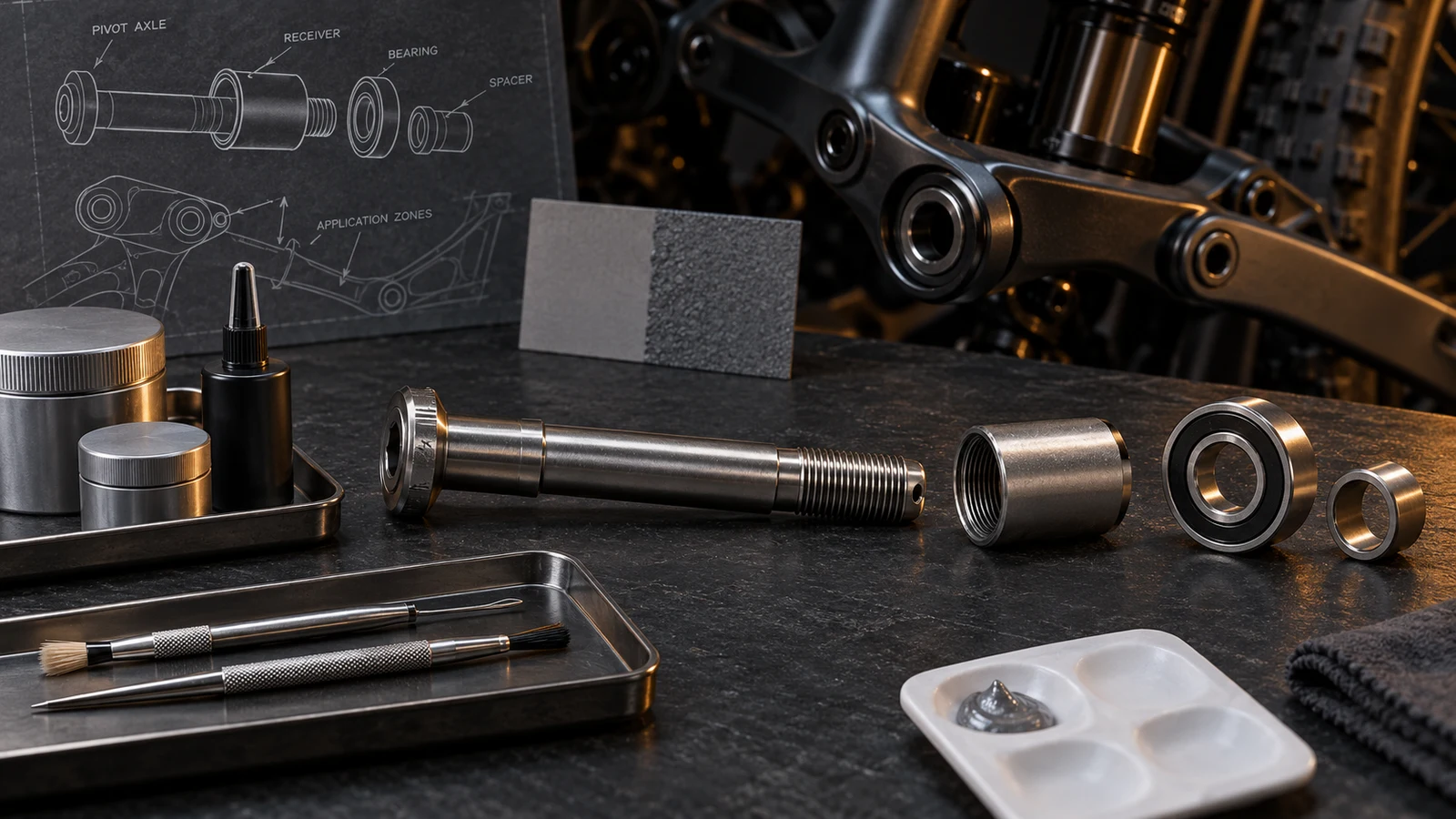
Ordinary grease is not automatically suitable for every titanium pivot thread, and copper or nickel anti-seize is not automatically mandatory. Start with the specific joint instruction and the function the product must perform. The threaded pair, clamping contact, coating, nearby seals or composite surfaces and retention method all matter. For an assembly engineer choosing a product, distinguish lubrication, seizure prevention and locking instead of treating them as one task. A proposed substitution also needs a defined application area and assembly review. No generic torque reduction or mixture of products establishes suitability for an unrepresented titanium pivot.
Hero: concept illustration of example hardware and its application. It is not a factory photograph, tested component or approved production geometry.
Select for a named function, not for the word titanium
A bearing lubricant, a threaded-contact preparation and a locking product may be discussed on the same drawing without being interchangeable. State whether the proposed product supports a moving contact, assembly or removal of a threaded pair, or the specified retention arrangement. A category name does not resolve all three tasks.
Identify the current instruction before proposing a replacement. If an approved joint calls for a particular locking preparation, adding another product is a configuration change rather than routine extra protection. If the instruction is unclear, resolve the intended preparation instead of guessing from a general titanium maintenance article.
The titanium galling review explains why seizure prevention concerns the complete pair and its condition. This page addresses product and location selection; no claim is made that every grease fails or that a single anti-seize eliminates all seizure risk.
A product data sheet describes a bounded capability
Read the actual product, formulation and relevant application information rather than a bottle color. Henkel's LOCTITE 243 technical data sheet describes a threadlocking application and tolerance of minor oil contamination. That description does not approve adding arbitrary grease or anti-seize to an OEM threaded joint.
Trek's lubricant and threadlocker guidance distinguishes lubricant preparation from threadlocker preparation and identifies locations where its carbon-part clamping guidance excludes lubricant. This OEM context illustrates why preparation belongs to a location and instruction. It is not an authorization to apply Trek's general advice to every custom titanium pivot.
Do not resolve a difference between broad oil tolerance and an assembly cleanliness requirement by ignoring either scope. Use the exact joint requirement and the product provider's relevant data to establish an approved preparation. A claim about tolerating residual contamination is narrower than permission for a deliberately mixed application.
| Proposed description | Question it may address | Risk or missing condition | Buyer action |
|---|---|---|---|
| Ordinary grease | A specified lubrication function | Name alone omits formulation and joint scope | Identify exact product, interface and approved requirement |
| Copper or nickel anti-seize | A proposed threaded assembly/removal aid | Metal filler treated as universal mandate | Review actual pair, neighbors and retention compatibility |
| Threadlocker | Specified threaded retention | Lubrication category mistaken for locking | Define product and applicable thread preparation |
| Pretreated dry film | Defined delivered surface state | Additional paste assumed harmless | Review whether the added product is part of acceptance |
| Different products on separate regions | Distinct interface functions | Uncontrolled transfer between application zones | Map locations and relevant handling requirements |
| Product substituted during service | Proposed reuse preparation | Old torque or reuse approval transferred automatically | Review assembly basis and actual component condition |
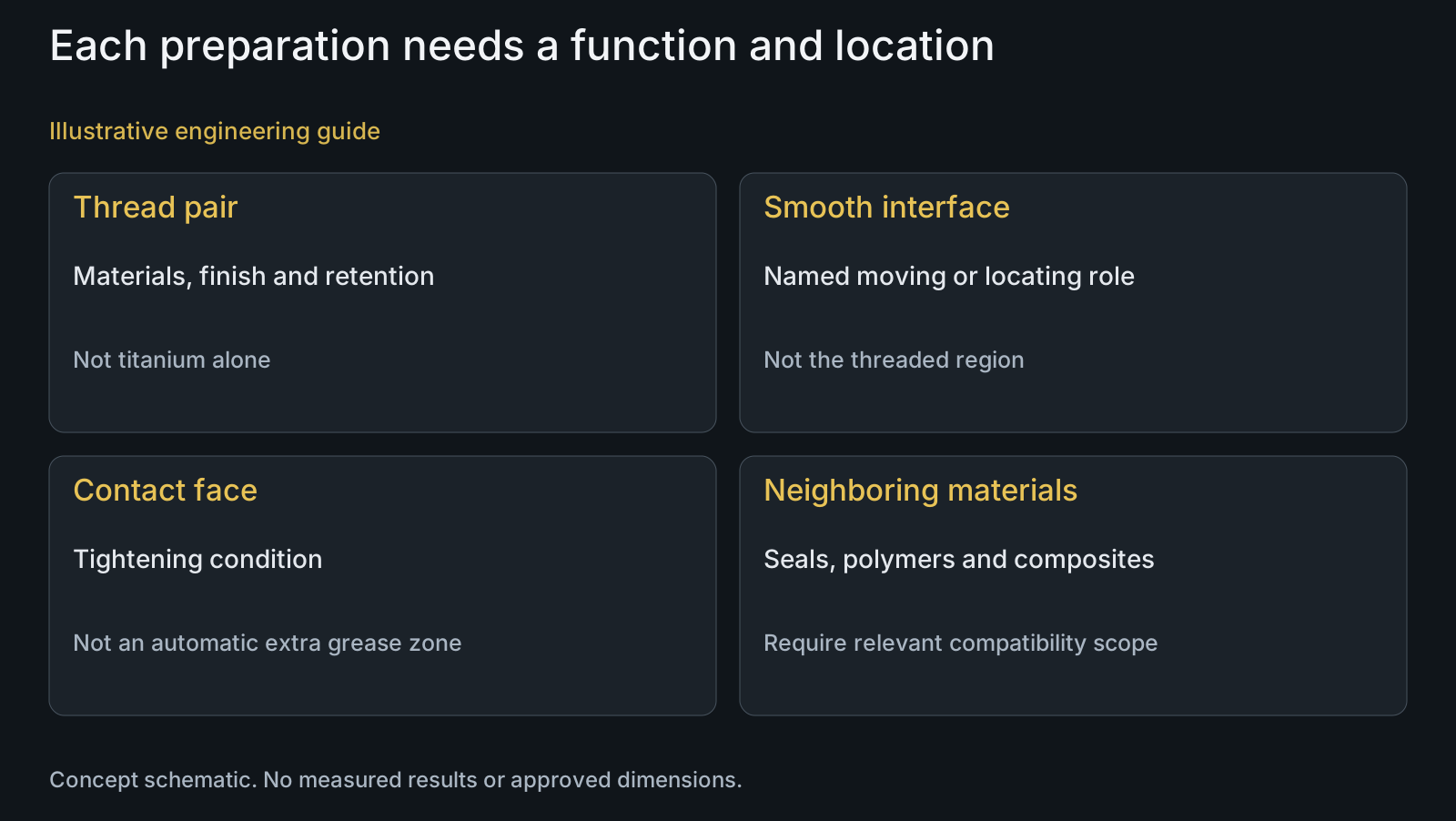
Map the product to its intended surfaces and neighbors
Identify the external and internal thread materials, coatings and contact faces. A titanium axle in an aluminum receiver is not the same contact as a titanium axle in a titanium receiver. The product choice needs the actual pair, not a label attached only to the visible bolt.
Show which surface receives the preparation and which adjacent regions must remain outside it. The smooth shaft, complete thread and under-head contact are distinct features. A preparation allowed on one cannot be spread to the others without checking their role. See the PVD feature-coverage review when a finish changes only selected regions.
List nearby seal, polymer and composite materials rather than assuming compatibility from metal suitability. A supplier's stated use on metal threads does not establish every neighboring material interaction. Ask for the relevant compatibility basis when unintended contact is possible, and keep carbon clamping guidance distinct from lubricated metal interfaces inside a carbon-frame assembly.
The preparation includes application and service state
Define the approved product, location, preparation and means of controlling application. More product is not a substitute for an instruction. Do not publish a universal amount, curing time or cleaning method for every joint when the selected product and component arrangement differ.
Identify whether the axle is delivered with a specified pretreatment or is prepared at assembly. An added product can alter that delivered state. The dry-film versus anti-seize discussion handles the distinction between a deposited film and an assembly-applied paste; neither is automatically approved by this selection guide.
Keep reassembly conditions visible. The service team needs to know which preparation is renewed or assessed according to the approved procedure, and which component condition prevents ordinary reuse. Additional lubricant cannot establish that a damaged thread is acceptable. Retain the affected parts for examination and use the applicable approved repair or replacement route.
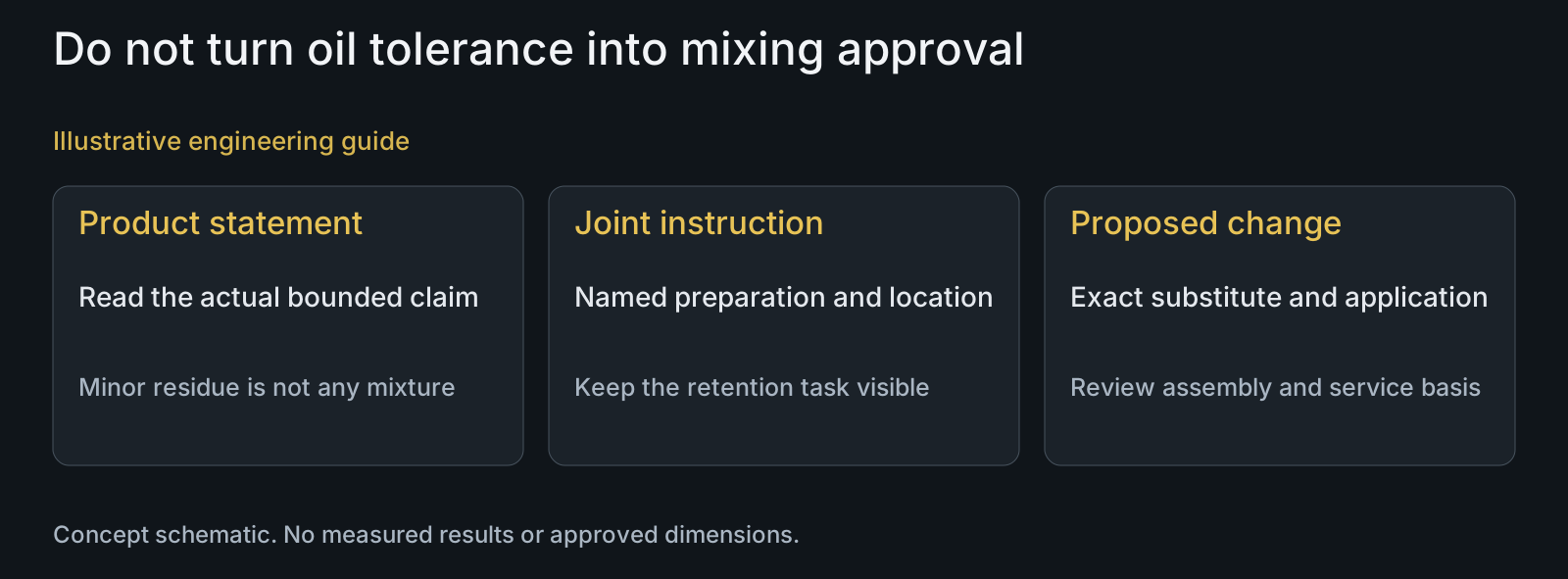
Illustrative review: two preparation zones, not a mixed thread
Illustrative engineering example: assume a pivot drawing specifies one preparation for a smooth interface and a locking product for a separate threaded engagement. A technician proposes using the available grease across the whole axle. The model and product choices are hypothetical; no successful installation or failed cure is reported.
The buyer maps the smooth interface and thread separately, identifies adjacent seals and checks whether transfer between the zones is possible during assembly. The proposal is not accepted simply because a locking product is described as oil tolerant. That phrase does not define an approved grease mixture or the permitted application boundary.
The review keeps the specified locations and asks what preparation and assembly evidence would support a substitution. If the tightening contact condition changes, the torque/clamp relationship also needs its applicable basis. The decision is a defined product-and-location scope, not a prescribed torque percentage or a claim that all products are chemically incompatible.
Questions buyers need to confirm
Can any ordinary grease be used on a titanium pivot thread?
Do not assume so. Identify the exact product and joint function, threaded pair, surface and retention arrangement. Follow the applicable approved preparation or review a defined substitution.
Must every titanium bolt use copper or nickel anti-seize?
No universal requirement is established. Review the proposed product against both mating members, neighboring materials and locking strategy; metal content alone does not approve the joint.
Does oil-tolerant threadlocker allow deliberate mixing with grease?
Not by that statement alone. Minor-contamination tolerance and an approved mixed application are different scopes. Resolve the actual product preparation and OEM joint requirement before use.
Can a pivot have different preparation products on separate regions?
It can have separately defined requirements. Identify their locations and relevant transfer or compatibility concerns; multiple zones do not authorize combining products on the same thread.
Can extra lubricant make a damaged thread suitable for reuse?
No. Establish the condition of both threaded members and follow the applicable service route. Lubricant does not prove that damaged geometry or an affected receiver is acceptable.
What is needed to review a lubricant substitution?
Provide the actual products, both thread members and finishes, application regions, nearby materials and retention method. Include existing assembly and service instructions so the change can be reviewed against their evidence basis.
Technical references and scope
Henkel: LOCTITE 243 technical data sheet, April 2025. Threadlocking purpose and minor oil-contamination tolerance only; no mixed-product compatibility or cure/torque value transferred.
Trek: Lubricants and threadlockers. Location and preparation distinctions in OEM context. Not a universal custom-pivot or titanium service instruction.
Explore related component, material and sourcing decisions in the customer decision knowledge center. For a drawing review, use the Drawing/BOM RFQ path.
Specify preparation by interface and product
Send the axle and receiver drawings, finishes, component BOM and existing assembly or service instruction. Identify the proposed preparation products and intended application regions, including nearby seals or composites. PremFixer will review the manufacturing and delivered-surface scope so unresolved product substitutions do not become unapproved assembly instructions.
Discuss the drawing and BOM