
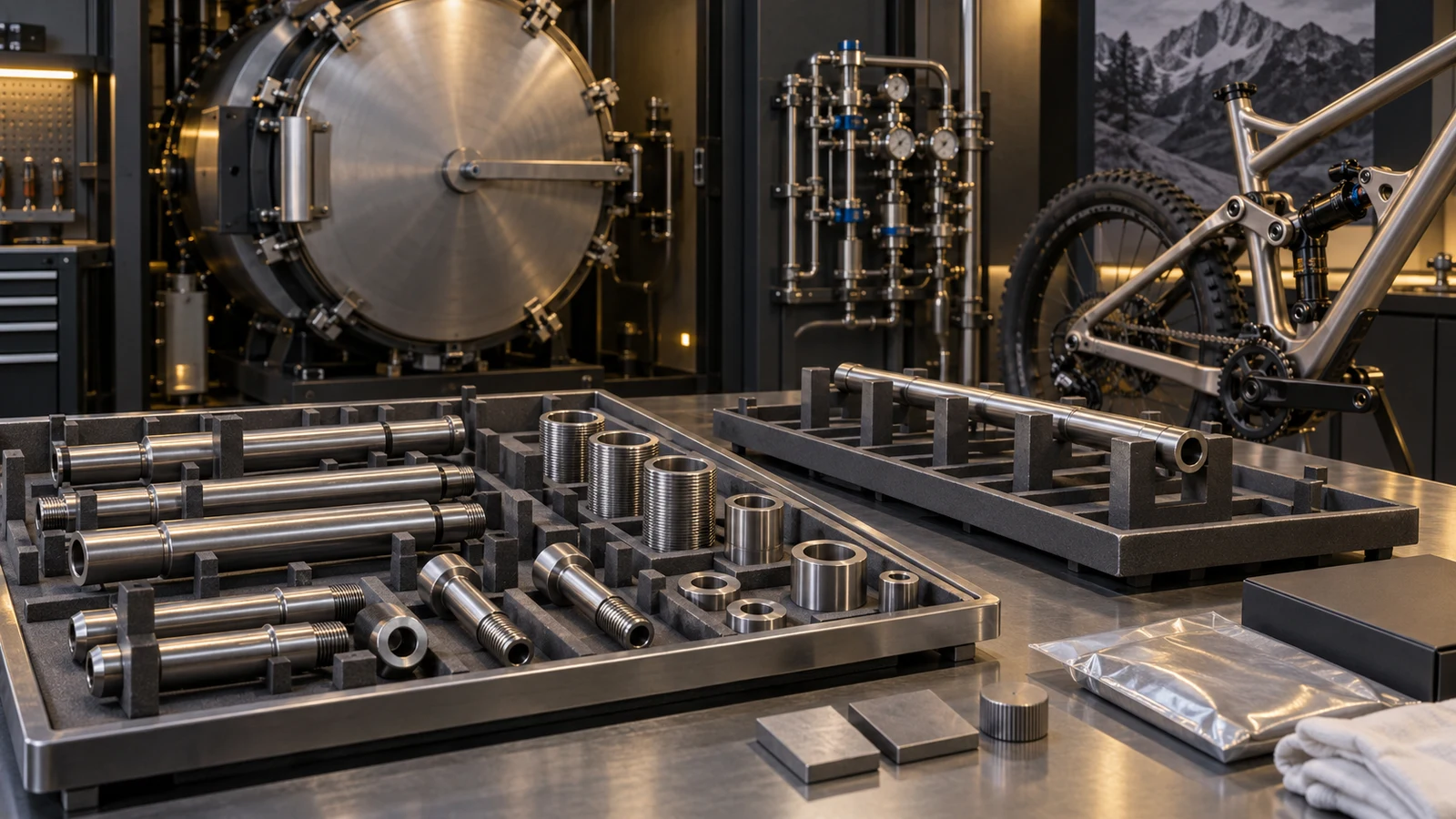
A vacuum-annealing proposal for titanium pivot hardware needs more than a temperature range and a holding time. Define the alloy, incoming condition and intended material change, then identify the atmosphere, temperature evidence, loading and cooling basis for the represented components. A hollow axle and a compact receiver need not have the same thermal response merely because they share a batch. Vacuum describes a process condition, not proof of the finished properties or unchanged geometry. For an OEM reviewing a bolt or axle order, ask what the cycle controls and what its records actually represent before accepting the word annealed as a complete requirement.
Hero: concept illustration of example hardware and its application. It is not a factory photograph, tested component or approved production geometry.
Name the atmosphere at the stage where it matters
A furnace marketed as a vacuum system can use gas during particular stages. Ipsen's process-gas explanation distinguishes evacuation, partial-pressure processing and gas-assisted heating. It supports asking about the actual stage conditions, not calling every gas-protected operation a vacuum hold.
If a proposal names both vacuum and argon, ask whether argon is used for a purge, heating stage, backfill or cooling. The descriptions may belong to different parts of a controlled cycle rather than be contradictory. The processor should identify the relevant pressure and gas requirements through the applicable specification, not an informal label.
The benefit sought is control of the relevant environment while obtaining the specified material condition. It is not immunity to contamination. TIMET's fabrication handbook warns about titanium contamination at elevated temperature and the suitability of the atmosphere. Its general fabrication guidance does not qualify a new pivot cycle or every available process gas.
A controller setpoint and load temperature have different subjects
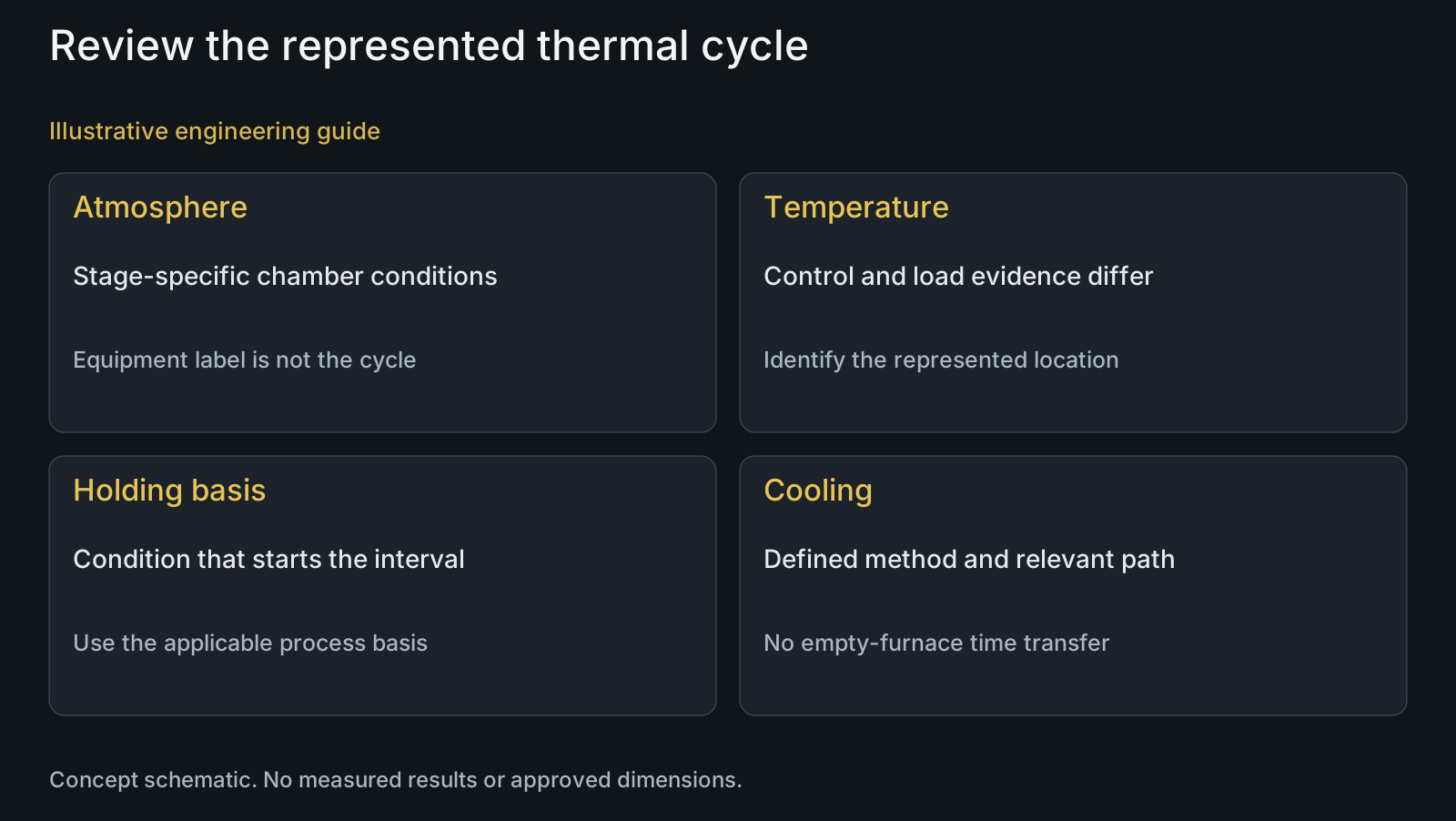
Ipsen's thermocouple guide distinguishes control, over-temperature, work and survey thermocouples. Their functions differ: controlling the furnace is not the same measurement task as representing conditions at a relevant workload location.
Ask what temperature record is provided and where its sensor measures. Do not assume that a displayed setpoint is a measurement of every pivot. Where the specified process uses load-temperature evidence, the represented location and arrangement must make sense for the components and batch.
Define what starts the required holding period under the actual process specification. A hold based on a control reading and one based on a required load condition are different descriptions. Do not choose a universal sensor count, location or timing rule from an equipment article; those requirements need their applicable process basis.
| Proposal detail | Meaning to clarify | Risk if assumed | Useful evidence |
|---|---|---|---|
| Vacuum furnace | Equipment and stage conditions | One atmosphere assumed for the whole cycle | Relevant evacuation, gas and pressure requirements |
| Specified setpoint | Furnace control target | Called every part's temperature | Applicable control and workload measurement scope |
| Nominal hold | Time counted from a defined condition | Start condition left ambiguous | Hold basis under the process specification |
| Shared batch | Components and support arrangement represented | Earlier load evidence transferred unchanged | Coverage for actual geometry and loading |
| Furnace cooling | Actual chamber condition and cooling mode | Empty-furnace time used as loaded-part result | Required path, range and represented record |
| Bright finished surface | Observable appearance | Called complete material acceptance | Separate process, material and geometry requirements |
Describe loading so the evidence has a physical context
As engineering analysis, identify the component arrangement that a process record represents. Include the relevant part families, batch loading boundary and support arrangement. A trace without that context can be mistakenly transferred from a different geometry or an unrepresented location.
A long hollow axle, a short receiver and a thick support fixture present different geometry. Ask the processor whether the chosen arrangement is covered by the required cycle and temperature evidence. This is not a rule that all unlike parts must be processed separately; it is a request to explain their shared process basis.
Separate thermal-history coverage from mechanical support. A support can affect which surfaces contact the fixture, while a temperature record concerns its defined measurement. Review sensitive shoulders, bores and contact regions against both questions. The broader TC4 material-condition guide covers whether another thermal operation is needed at all.
Cooling is part of the defined cycle, not unused time
Ipsen's cooling-method comparison distinguishes vacuum, partial-pressure, static-gas and forced-gas cooling. That distinction shows why cooled in the furnace is incomplete: the chamber condition and use of circulation can differ.
Specify the applicable cooling requirement and represented temperature range through the reviewed material process. A single average rate, if requested, needs defined endpoints and measurement location; it cannot reveal the complete time-temperature path by itself. No general cooling rate or preferred gas is prescribed here.
Keep equipment examples separate from production evidence. Cooling times quoted for an empty furnace do not establish the time or behaviour of a loaded pivot batch. Likewise, faster equipment cooling is not automatically the preferred material condition or proof of less component movement.
A changed load can leave an earlier trace unrepresentative
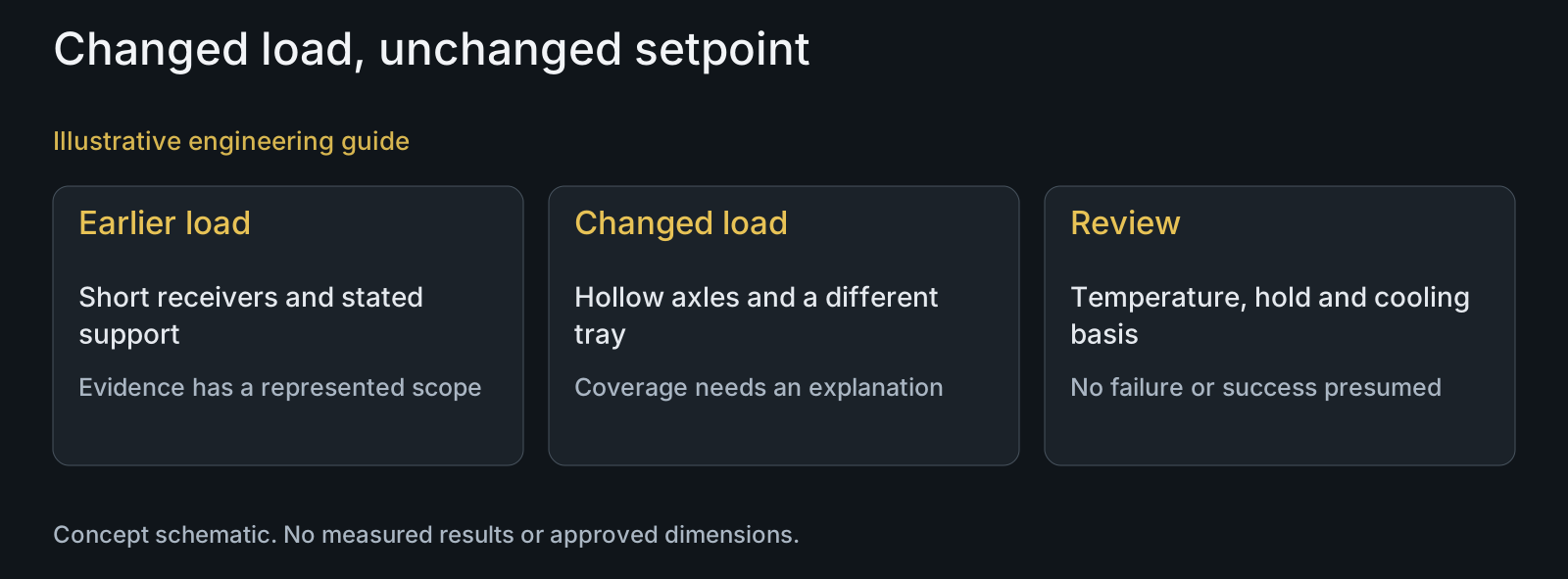
Illustrative engineering example: assume a proposed cycle previously represented short receivers on one support arrangement. The next order adds long hollow axles and a different support tray. The quotation keeps the same furnace setpoint and nominal hold. No load-temperature measurements, movement or property results are supplied.
The reviewer asks whether the old evidence covers the changed load, how the holding basis is established and whether the cooling requirement is still represented. The unchanged setpoint alone cannot answer those questions. A process specialist may justify the existing coverage or identify additional evidence needed.
No cycle failure or numerical distortion improvement is claimed. The example illustrates a representation gap caused by a load change, not a universal requirement for a different furnace, a longer hold or faster cooling. Actual final geometry and material acceptance remain necessary within the agreed scope.
Separate a process record from finished-pivot acceptance
Ask for the process information needed by the order: the represented component or batch, applicable cycle reference, relevant atmosphere and temperature records, holding basis and cooling scope. Avoid requesting an undefined heat-treatment certificate while leaving those subjects unclear.
A bright-looking titanium surface does not establish the complete material condition, internal chemical condition or every dimensional requirement. The hydrogen-processing guide addresses that separate chemical-risk question. Surface appearance and thermal-process compliance should not be used as substitutes for unspecified acceptance tests.
Provide the CNC turning review with the drawing and final interfaces, and connect the treatment to the manufacturing process scope. PremFixer can coordinate a defined partner-supported thermal requirement and subsequent manufacturing assessment. This does not claim furnace ownership, a standard titanium recipe or automatic treatment of all supplied hardware.
Questions buyers need to confirm
Can vacuum annealing include an argon stage?
It can, depending on the defined cycle. Ask whether the gas belongs to purging, heating, backfill or cooling and which conditions are specified there. The equipment name does not describe every stage.
Does the furnace setpoint prove every pivot reached that temperature?
Not by itself. Identify what sensor and location the record represents and what the specified process requires for the load. Control, work and survey measurement have different functions.
When should the holding time start?
Use the applicable process definition. Clarify whether the required interval is based on a control condition or represented load condition. Do not copy a generic start rule from a different alloy or furnace example.
Is the fastest available cooling method best for titanium axles?
Not automatically. The cooling path must match the required material process and represented component. An equipment speed comparison or empty-furnace time does not approve the loaded-part result.
Does a bright surface prove successful vacuum annealing?
No. It establishes an appearance observation, not complete material properties, chemical condition or final fit. Define the separate required evidence and its represented state rather than add tests without a stated purpose.
What should a titanium annealing RFQ include?
Send drawing and STEP, exact titanium specification and incoming condition, thermal objective, mandatory process reference, critical dimensions, finish and quantities. Include existing loading or cycle records where available and identify the atmosphere, holding or cooling questions still to be resolved.
Technical references and scope
Ipsen: Process gas. Evacuation, gas and stage distinctions in vacuum equipment. No gas suitability, pressure recipe or equipment benefit transferred universally to titanium pivots.
Ipsen: Vacuum furnace thermocouples. Distinct control, work and survey measurement functions. No sensor count, accuracy, interval or AMS requirement adopted for this order.
Ipsen: What cooling method should I use?. Different vacuum-system cooling modes. Empty-furnace times and numerical pressure examples are not loaded-pivot results.
TIMET: Titanium design and fabrication handbook. Treatment objectives and elevated-temperature contamination considerations in its fabrication context. No temperature, time, atmosphere recipe or dimensional gain prescribed.
Explore related component, material and sourcing decisions in the customer decision knowledge center. For a drawing review, use the Drawing/BOM RFQ path.
Review the titanium cycle and represented load
Send drawing and STEP, titanium specification and incoming condition, intended thermal change, mandatory process requirements, critical interfaces and quantities. PremFixer will review the defined partner-treatment scope, load and cycle evidence needed, and the machining and acceptance work that must represent the delivered components.
Discuss the drawing and BOM