
Insufficient pivot restraint can permit unwanted contact movement, but a low torque reading after service does not prove how the joint was originally assembled. First identify whether movement belongs to the intended bearing action or occurs at an interface that should remain restrained. A bolt, spacer, bearing ring and receiver have different functions in that distinction. Noise, staining or apparent play needs location and appropriate assessment, not an automatic tighter setting. For an OEM review, compare the actual stack and preparation with the released configuration and evaluate any affected contact. Keep a structurally uncertain assembly out of use pending the proper service decision.
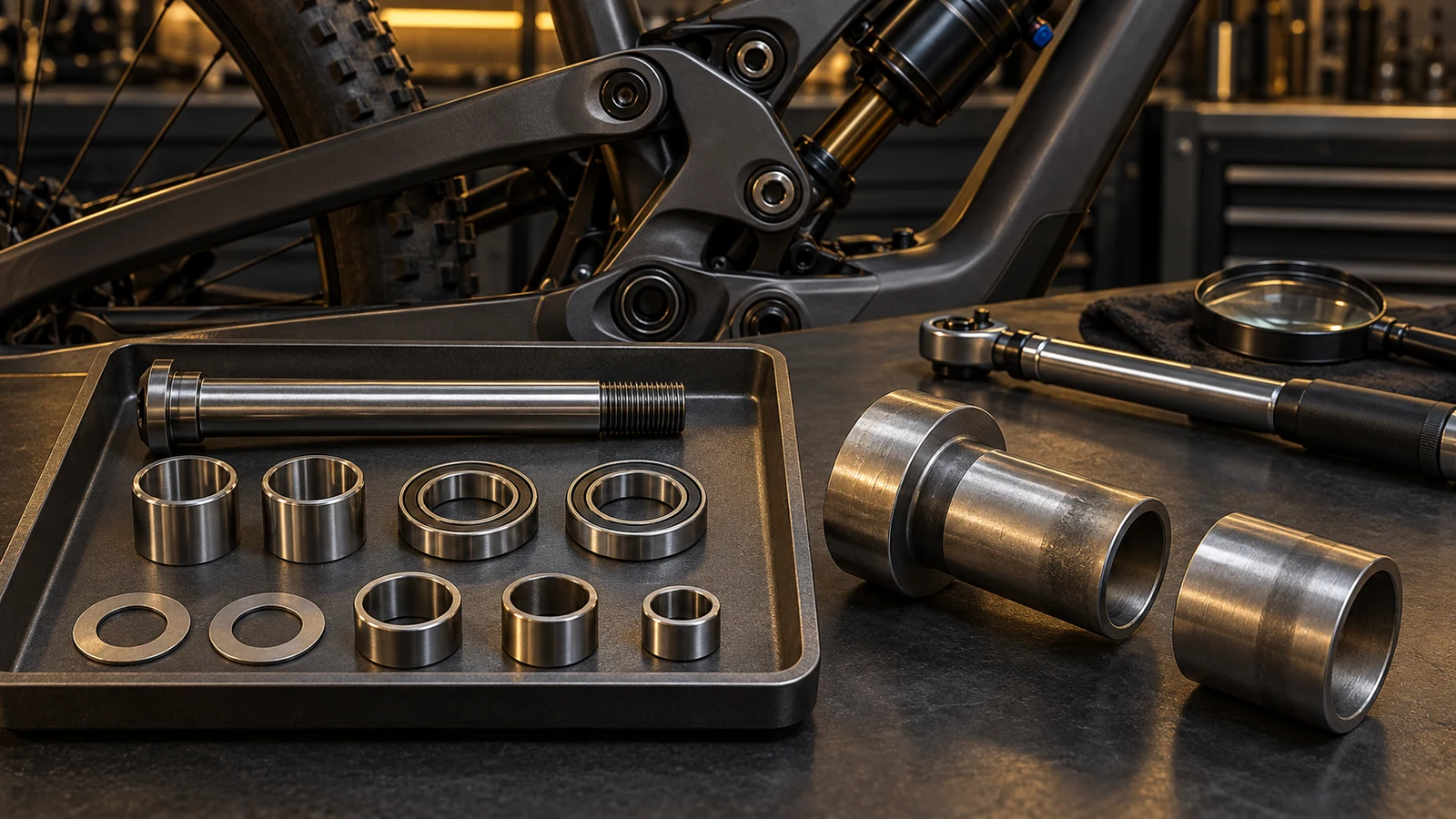
Hero: concept illustration of example hardware and its application. It is not a factory photograph, tested component or approved production geometry.
Find the stationary boundary inside a moving pivot
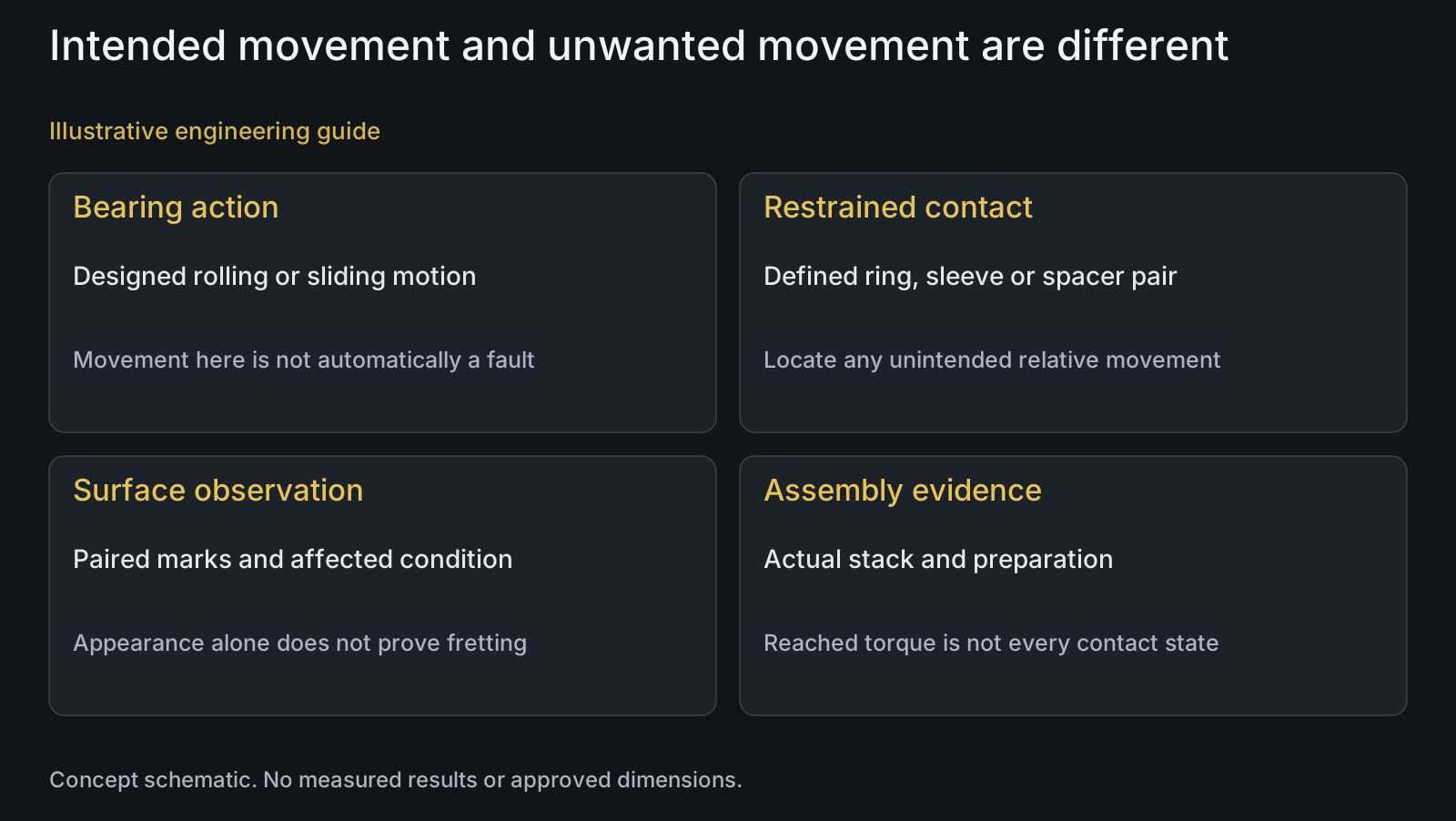
A suspension pivot is meant to allow defined movement, so movement alone is not a fault definition. Mark the intended bearing or bushing action on the assembly section and distinguish it from contacts that should remain restrained. The specific design determines which ring, sleeve or shoulder carries each function.
An axle locating an inner ring, a clamped spacer face and a moving bushing contact are not equivalent surfaces. Identify the questioned pair and direction of relative motion. Describing everything near the link as loose prevents the reviewer from selecting a meaningful inspection or manufacturing response.
Use the tolerance-stack article to connect shoulder and spacer geometry with the actual contact path. It does not impose one bearing arrangement on all pivots. Do not assume that bolt tension, bearing preload and correct interface restraint are interchangeable labels.
Explain the movement risk without declaring a diagnosis
Nord-Lock's preload overview identifies joint slip, separation and fastener fatigue among possible consequences of insufficient preload. Those are general joint risks, not proof that a particular bicycle symptom originated from a low installation input. The load path and actual retained condition still matter.
At a nominally stationary contact, small repeated movement can create a different wear question from the pivot's intended rolling or sliding action. The engineering review should ask what restrained the contact and whether that restraint was actually obtained, not merely whether the tool reached a setting.
A shoulder limiting travel, a missing or wrong spacer, or a damaged receiver can prevent the intended condition even when tightening resistance is present. The recurring-loosening guide addresses that broader diagnostic branch. Here the specific focus is the moving contact and its accumulated condition.
| Observation | Decision to resolve | Shortcut risk | Useful basis |
|---|---|---|---|
| Known missed tightening operation | What specified assembly state was not obtained? | Current symptom assumed to explain all damage | Applicable instruction and actual event |
| Low removal resistance | What does this removal event represent? | Original installation input reconstructed from it | Direction, lock, condition and history |
| Movement near a bearing | Which paired surfaces move? | Intended motion called joint looseness | Actual section and permitted assessment |
| Paired contact markings | What mechanism and severity are supported? | Color alone called fretting or a crack | Location, counterparts and appropriate examination |
| Tool reaches setting, restraint unclear | Is the intended stack actually closed? | Limiting shoulder contact ignored | Spacer, shoulder and receiver comparison |
| More torque proposed | Will the defined contact state be restored? | Wear or fit damage remains unresolved | Affected-member disposition and approved method |
Keep fretting distinct from other surface observations
SKF describes fretting corrosion as an interacting wear/oxidation process associated with microscopic relative movement between a bearing ring and its shaft or housing. Its explanation is in an industrial bearing context. It does not diagnose bicycle hardware from a stain or require every bicycle ring to have an interference fit.
Record paired contact locations, appearance and any suitable dimensional evidence before cleaning removes the observations. Distinguish ordinary contamination, environmental corrosion, intended sliding wear and a suspected fretting mechanism. Debris color alone is not a sufficient identification of the mechanism or its severity.
The affected counterpart matters too. Replacing a marked shaft without assessing its mating ring, sleeve or receiver can leave the contact question unresolved. Use the applicable inspection method and service criteria; no universal wear allowance, fatigue-crack prediction or acceptable debris quantity is assumed.
Ask what the low torque reading actually measures
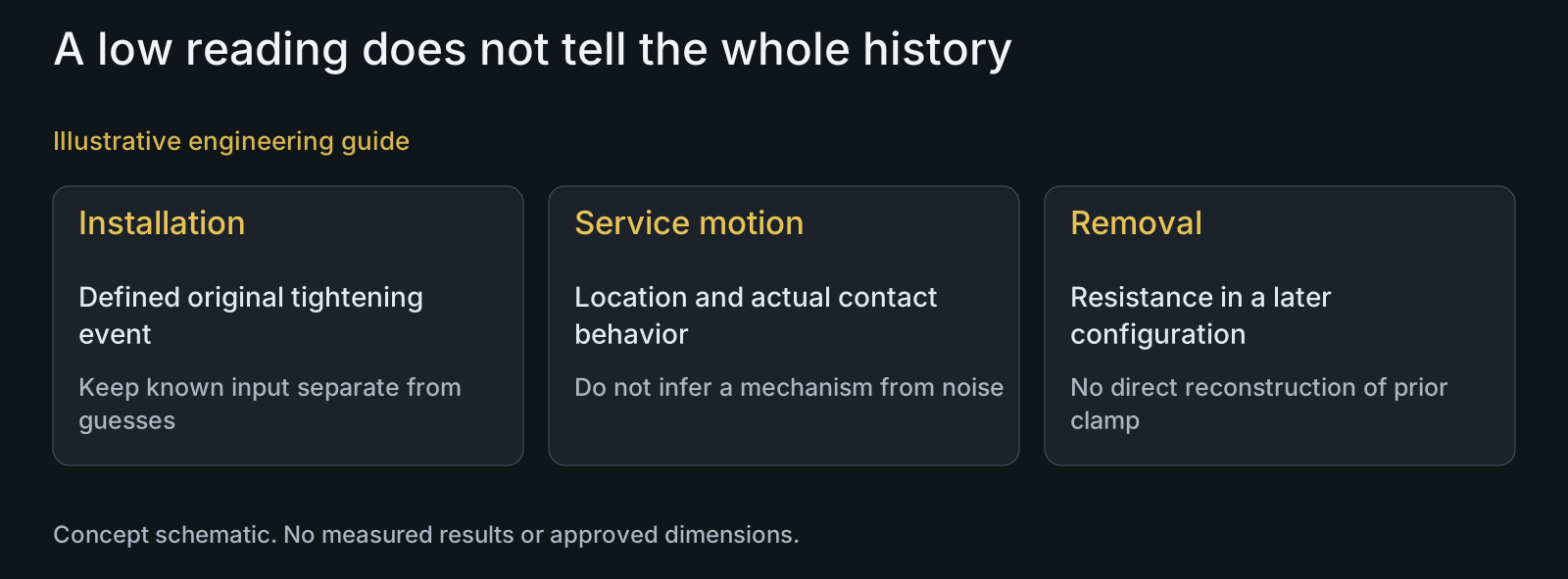
Installation input, subsequent forward movement and removal resistance are different events. Identify direction, locking system, surface condition and whether the fastener moved during the check. A later reading cannot reconstruct every earlier clamp state or establish the amount of contact motion that occurred in service.
Keep a known missed assembly operation separate from a retrospective low-reading hypothesis. Both deserve attention, but their evidence differs. Record any later tightening, lubrication, cleaning or part substitution so the reviewer does not compare observations from changed configurations as if nothing changed.
The assembly verification discussion distinguishes measured torque channels from clamp-force evidence. Do not assign a recovered preload or declare no prior wear from a torque-only result. A quieter joint after intervention is also not proof that an affected interface was restored.
Restore the defined contact condition, not just the number
If inadequate restraint is supported, the correction must address how the released assembly obtains it. Compare spacer quantity and orientation, shoulder position, receiver engagement and permitted preparation. Assess affected parts before reassembly rather than expect an added setting to remove previous wear.
Do not compensate for a damaged fit with unspecified adhesive, an extra washer or a changed bolt alloy. Such changes can create a different contact path or service requirement. The overtightening guide explains why escalating input can expose another limiting member.
For custom replacement manufacture, specify the final seat and contact features through CNC turning, including the relevant supplied surface treatment. Part conformity supports those defined features, not automatic acceptance of unexamined mating damage or complete bicycle performance.
Review example: a marked seat and an uncertain input history
Illustrative engineering example: assume a removed axle and mating sleeve show localized contact markings, while a service note reports a low removal reading. The original installation record is unavailable. No measured wear, confirmed fretting or field failure is supplied.
The reviewer does not equate the removal reading with original installation torque. It identifies the paired surfaces and whether the design intended them to remain restrained, then compares the actual shoulder and spacer arrangement with the released section. Possible mechanism and damage severity remain separate questions.
The resulting request targets the relevant contact inspection and correct replacement definition if required. It does not simply order a stronger bolt or erase the evidence with another tightening attempt. This example illustrates how interface location changes the decision without claiming a validated repair.
Questions buyers need to confirm
Does a low removal torque prove the pivot was installed too loosely?
No. Removal is a later event affected by its direction, locking system, surface and intervening history. Preserve a known installation record if available; otherwise keep the original input uncertain and assess actual movement and contact condition.
Is every movement at a pivot an undertightening problem?
No. Identify intended bearing or bushing motion and the contacts meant to remain restrained. State the exact paired surfaces and direction. Movement elsewhere, an incorrect stack or damaged fit can require a different response from changing the tightening input.
Can brown debris alone confirm fretting corrosion?
No. SKF's mechanism description concerns small relative motion and wear/oxidation at paired contacts, not color-only identification. Preserve location and counterpart evidence and distinguish contamination, environmental corrosion and other wear using a suitable assessment.
Will increasing torque remove fretting damage?
No such restoration is established. Existing wear and mating-part condition require assessment. First identify how the intended restraint is obtained and whether the correct parts are present. An arbitrary higher setting can load another member without repairing the affected interface.
Is bolt preload the same as bearing preload?
Not universally. The actual bearing, spacer and shoulder arrangement determines the relationship. Supply the section and contact path; do not transfer a generic bolt-tension requirement into a bearing adjustment or assume one setting defines every interface.
What information supports a pivot contact-wear review?
Send the assembly section, axle and mating-part drawings, BOM, final surface condition and service instruction. Identify the paired marked surfaces, observed movement and measurement direction/history. Include counterpart condition and flag an unknown original installation rather than invent it.
Technical references and scope
SKF Evolution: Wash and No-Wear, Fretting Corrosion and Creep. Manufacturer's mechanism explanation for microscopic movement at bearing ring/seat contacts. Industrial washer fit choices and performance outcomes are not applied to bicycles.
Nord-Lock: What Is Preload and Why Is It Important?. General insufficient-preload risks only. Product calculations, safety factors and simplified load-sharing or stronger-material statements are not used as custom pivot design rules.
Explore related component, material and sourcing decisions in the customer decision knowledge center. For a drawing review, use the Drawing/BOM RFQ path.
Locate the affected contact before specifying replacements
Share the axle and mating-part drawings or STEP, bearing/spacer section, BOM and supplied finish state. Include paired contact observations, the applicable assembly method and what is actually known about the input and later readings. PremFixer can review replacement manufacture and interface definition; the responsible OEM or service team assesses existing damage and assembly release.
Discuss the drawing and BOM