
For a custom bicycle pivot, choose UNJ, MJ or an ordinary metric thread together with its mating receiver, not as an isolated bolt upgrade. UNJ is an inch thread family; MJ and ordinary M threads use different metric profile definitions. A shared nominal diameter or a successful trial assembly does not establish interchangeability. Define the governing standard, diameter and pitch, tolerance class, receiver geometry, usable engagement and finished condition before manufacturing. A controlled root profile can be relevant to a stress review, but it does not prove fatigue life in the complete pivot. The first decision is whether the proposed thread pair serves the actual joint.
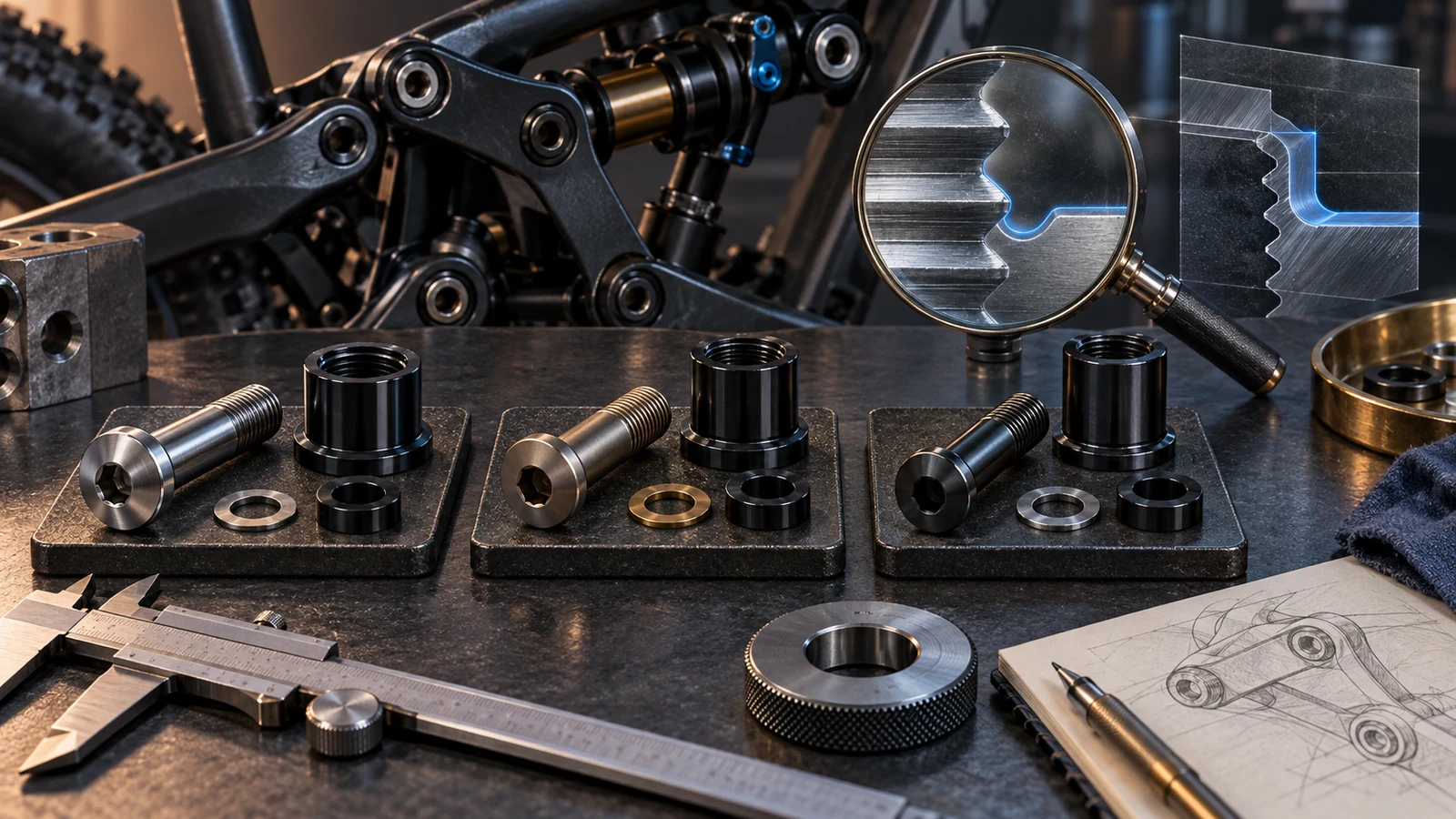
Hero: concept illustration of example hardware and its application. It is not a factory photograph, tested component or approved production geometry.
These are standardized families, not three names for a special thread
UNJ and MJ may be unusual in a bicycle BOM, but that does not make them undefined custom profiles. SAE AS8879E describes UNJ inch threads, including a controlled external root radius and minor-diameter provisions for its clearance. ISO 5855-1 defines the MJ system, while ISO 68-1 defines ordinary general-purpose M thread profiles.
The public standard descriptions establish different scopes, not an instruction to use aerospace hardware in a bicycle. Obtain the controlling edition and relevant detailed requirements for the drawing. Do not convert an inch designation to a nearby metric diameter or remove the J from an MJ callout because a familiar tap is available.
Keep family, size, pitch and tolerance requirements together. Our ordinary metric thread-class guide explains a different decision: fitting within the selected metric system. A class notation alone cannot identify every required profile feature or authorize transfer to another family.
Review the external root and the internal crest as a pair
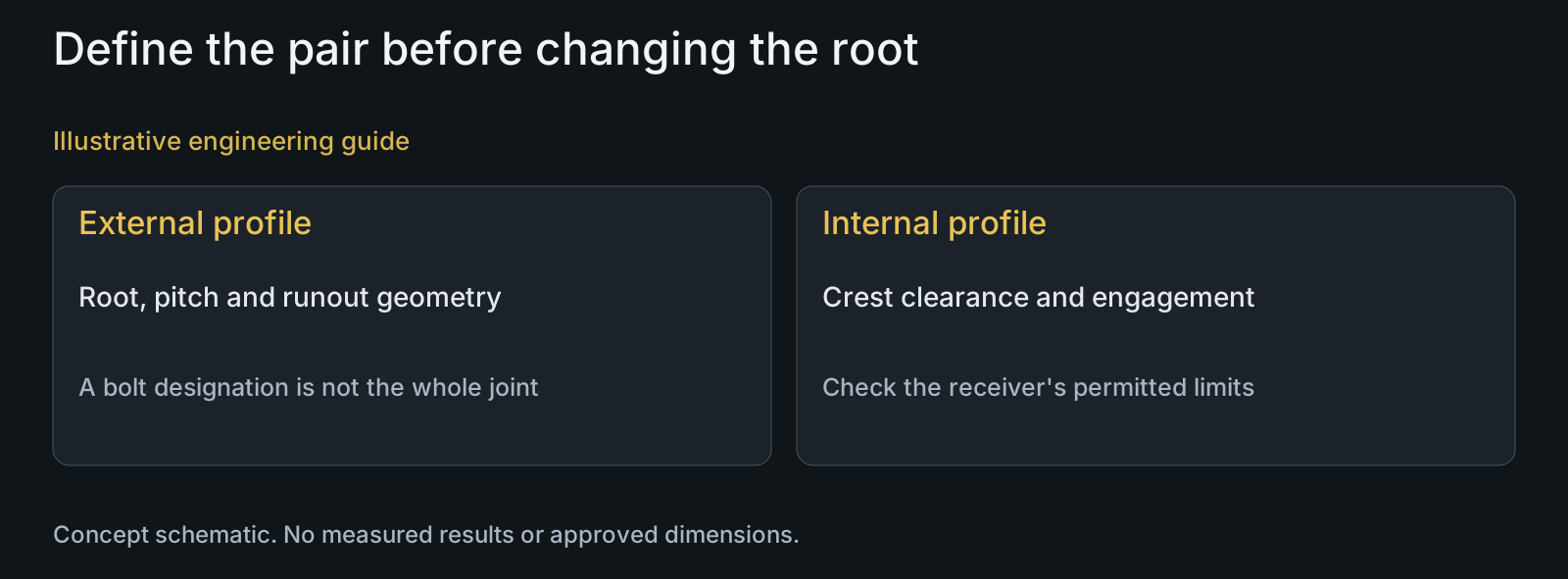
The bolt root occupies space close to the receiver's internal crest. A proposed root-profile change therefore requires checking the receiver's permitted geometry, not just the bolt's pitch diameter. SAE's UNJ scope explicitly connects the external root radius with the minor-diameter definition. Use the actual pair's dimensional limits rather than infer clearance from a sketch.
Separate profile compatibility from engagement strength. A thread pair can have the intended clearance yet still have insufficient usable engagement in the receiver material. Conversely, adding engagement does not resolve incompatible profiles. Review complete threads, entry chamfers, runout and blind-hole depth, as explained in effective receiver engagement.
Check where the bolt seats before deciding that the joint is clamped. A tip bottoming in a blind hole or a shoulder contacting the wrong face can produce resistance without the intended stack compression. These are assembly-geometry questions; changing the thread family does not automatically correct them.
| Proposed choice | When it merits review | Substitution risk | Required verification |
|---|---|---|---|
| Ordinary metric M | Established metric receiver and released interface | Changing class or finish without evaluating the mate | Complete designation, final limits and engagement |
| UNJ inch | A deliberately specified inch thread pair | Treating a nearby metric size as equivalent | Applicable UNJ profile and both mating definitions |
| MJ metric | A deliberately specified MJ bolt and receiver | Assuming an existing M receiver is interchangeable | MJ limits, root clearance and complete seated geometry |
| Bolt-only profile change | An engineering proposal under assessment | Trial assembly masking limit-condition incompatibility | Compare permitted bolt and receiver extremes |
| Fatigue-driven proposal | A defined load-path or failure investigation | Using a thread label as a life prediction | Actual geometry, material state and agreed validation |
A root-shape argument is not a fatigue qualification
As engineering analysis, smoothing a sharp local transition can change stress concentration. That qualitative mechanism is a reason to investigate the actual thread geometry, not a numerical life prediction. The material condition, manufacturing history, surface damage and position of the loaded threads also affect what must be evaluated.
For a pivot, ask whether the threaded region carries the relevant alternating load, whether the shoulder supports the intended interfaces, and how clamp load is maintained. A proposed change justified by root stress should be assessed against that load path rather than against an isolated thread label.
No universal fatigue advantage, life multiplier or acceptance test is claimed here. Use an agreed analysis and validation scope for the defined assembly; the pivot fatigue-test guide distinguishes specimen loading from a claim about the complete bicycle system.
Choose the manufacturing route after defining the profile
A familiar diameter and pitch do not mean existing tooling produces the complete specified root and crest geometry. Ask which profile features the proposed cutting or rolling tooling produces, what controls them, and what evidence will be supplied. Tooling availability is a route-specific question, not a blanket capability promise.
Keep process choice separate from profile identity. Rolling and cutting can be considered against material condition, access and the drawing, but selecting a process does not by itself establish compliance with a thread family. The rolling, cutting and grinding comparison covers that manufacturing tradeoff.
Define the state in which the dimensions apply. Coating, lubrication and locking features can change the assembly and inspection questions. Coordinate surface-treatment scope with the finished-thread requirements instead of inspecting an unfinished sample and extending its conclusion to a different delivered condition.

Specify what a gauge does and what remains to be checked
Identify gauges by the selected family, designation and acceptance requirements. A gauge intended for another profile is not a substitute simply because it can be threaded onto a sample. Nor does trial assembly with one receiver demonstrate all permitted production combinations.
Assign each required characteristic to a method that actually evaluates it. Functional gauging, diameter measurement and root-profile examination answer different questions. If the drawing controls a root radius or runout detail, ask how that feature will be verified rather than assume an unspecified GO/NO-GO statement covers it.
Record the profile evidence's limits: the inspected location, sample coverage and finished state. A section or optical view may reveal local geometry without establishing every thread around every part. PremFixer reviews manufacturing and inspection scope against the project; dedicated tooling, gauges and partner-supported checks require confirmation, not an assumed off-the-shelf service.
Review example: the receiver determines whether the change is viable
Illustrative engineering example: assume an OEM is considering an MJ thread on a new pivot bolt while retaining an existing ordinary metric receiver. The nominal diameter and pitch appear similar. No actual dimensions, fatigue results or customer project are assumed.
The reviewer first compares both complete thread definitions and the available root-to-crest clearance. The team then checks usable engagement and the seated stack. A sample that turns into one receiver is not treated as proof that the design's permitted extremes are compatible.
If the existing receiver cannot meet the intended pair definition, the options are to retain the established family or redesign and validate the receiver with the bolt. The useful outcome is an explicit interface decision before ordering special tooling, not a claimed improvement from changing the bolt name.
Questions buyers need to confirm
Is UNJ a metric thread?
No. The UNJ family addressed by SAE AS8879 uses inch designations. Provide the complete size, pitch and class under the controlling edition; a nearby millimeter diameter is not an equivalent callout.
Can an MJ bolt replace an ordinary metric pivot bolt?
Not on nominal size alone. Compare the complete external and internal profiles, dimensional limits, finished condition and usable engagement. Trial assembly with one receiver does not authorize substitution across the design's permitted extremes.
Does the J designation guarantee better fatigue life?
No application life is guaranteed by the designation. A profile-related stress argument must be evaluated with the actual geometry, material condition, surface state and loading. A bicycle pivot needs an assembly-specific validation basis, not a generic aerospace association.
Can I use my ordinary metric gauges for an MJ order?
Do not assume so. Specify the family and acceptance scope, then confirm the required gauges and any separate profile checks. A gauge that engages a sample may not evaluate every characteristic controlled by the selected thread definition.
Must a UNJ or MJ thread be rolled?
Do not infer the production process from the family name alone. Confirm the governing requirements and proposed tooling route against material condition, profile and verification. Manufacturing method and dimensional compliance are related decisions, not interchangeable descriptions.
What should accompany a special-thread RFQ?
Send both mating definitions, governing standards and editions, complete designations, engagement and blind-hole geometry, material condition, finishing scope and inspection requirements. Include the proposed change's purpose so the review can distinguish profile compliance from receiver compatibility and application performance.
Technical references and scope
SAE AS8879E UNJ thread scope. Public scope for inch UNJ controlled external root and minor-diameter provisions. Detailed paid tables are not reproduced; the drawing's controlling edition must be obtained.
ISO 5855-1 MJ general requirements. Public scope identifies MJ profile and designation requirements; no detailed radius limits or interchangeability rule inferred.
ISO 5855-2 MJ bolt and nut limits. Public scope identifies the separate limit-dimension document, not a universal bicycle acceptance specification.
ISO 68-1 metric profiles. Public scope for general-purpose M profile definition; no unstated tolerance-class or gauge requirement attributed to this scope.
Explore related component, material and sourcing decisions in the customer decision knowledge center. For a drawing review, use the Drawing/BOM RFQ path.
Review the bolt and receiver together
Send the pivot drawing and STEP model with the mating receiver definition, thread standard and edition, complete callouts, engagement, material and final surface state. Identify any profile or fatigue concern so the review can address compatibility, tooling and verification before substitution.
Discuss the drawing and BOM