
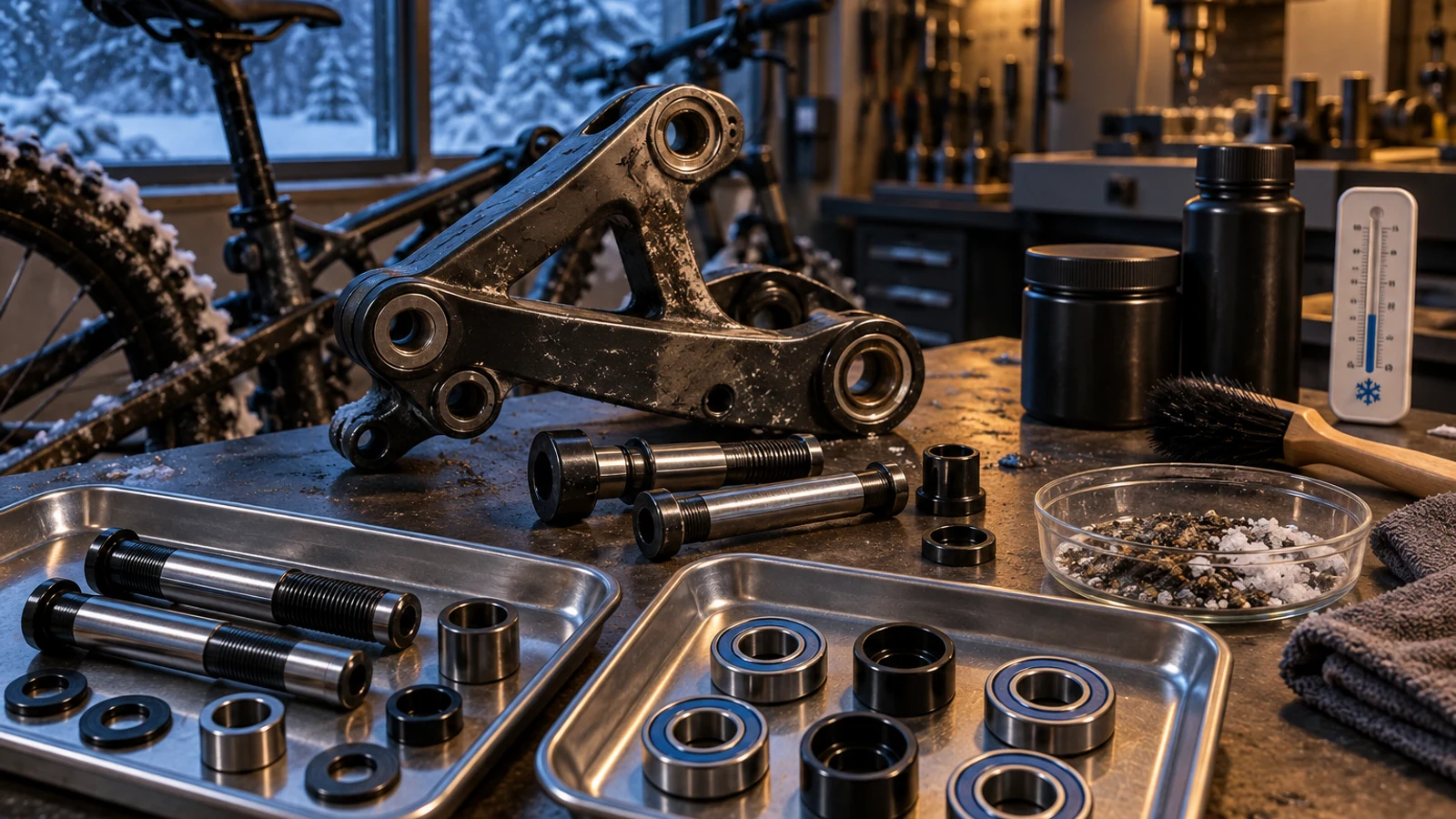
Winter pivot care should preserve the bicycle's specified assembly while addressing the actual cold, water and contamination exposure. Do not increase pivot torque or replace the lubricant simply because the season changes. First distinguish cold-start resistance from play, binding, corrosion or another service defect. Check the permitted temperature range and named products for the installed component, including bearings, seals and locking treatments. Salt carried by wet roads creates a different concern from low air temperature. An OEM winter review should connect those exposures to compatible cleaning and service instructions, rather than promise that a cold-rated grease or corrosion-resistant bolt makes the complete pivot winter-proof.
Hero: concept illustration of example hardware and its application. It is not a factory photograph, tested component or approved production geometry.
Describe the exposure that winter actually adds
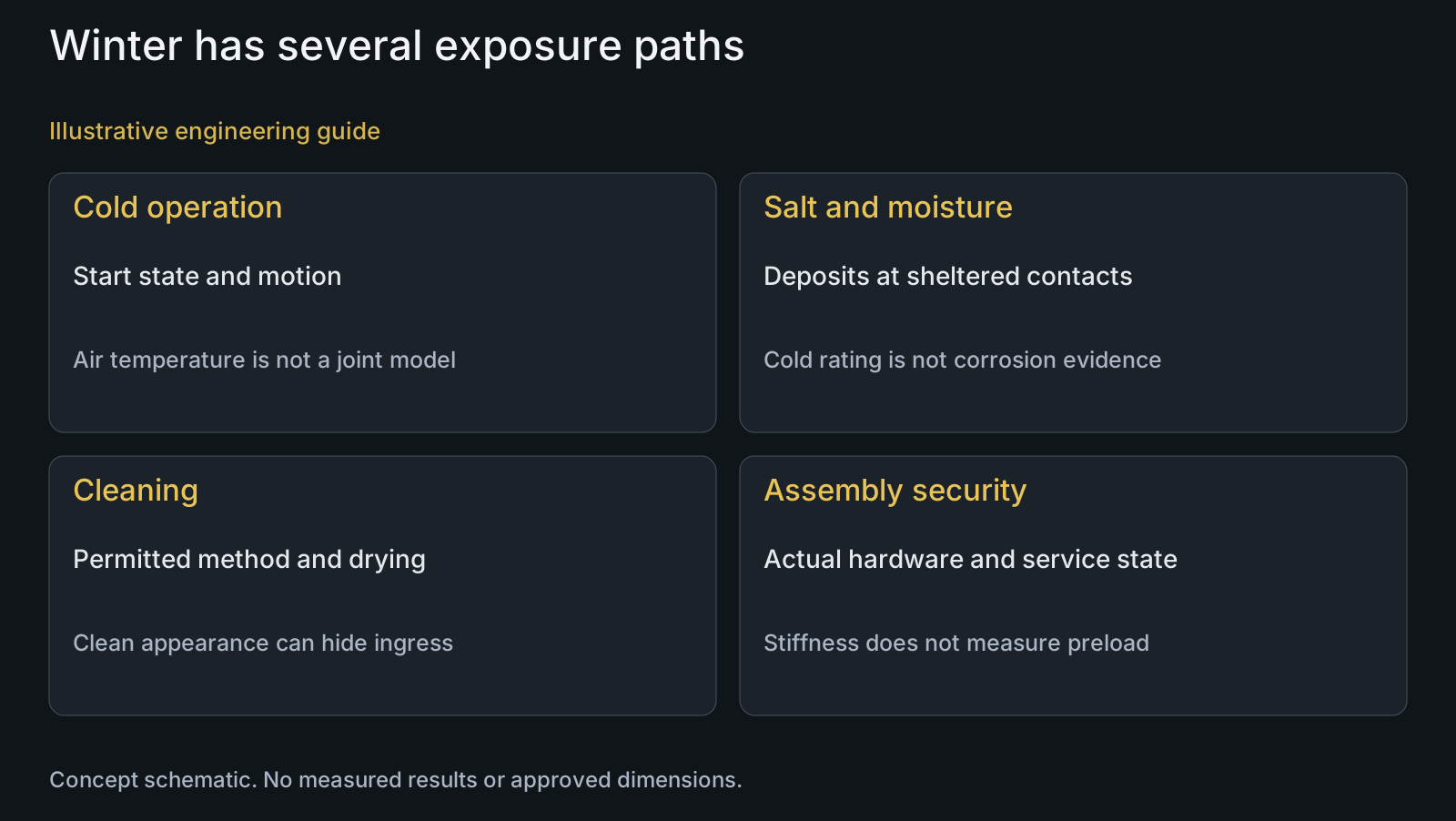
Record the lowest intended operating condition, cold-soak duration and whether the assembly starts moving while cold. Separate those conditions from storage in a heated room. Also identify wet roads, deicing treatment, grit and the cleaning method used afterward.
Two bicycles at the same air temperature can have different contamination histories and installed bearing products. A dry cold trail and a salted wet commute are not equivalent service inputs. A complaint described only as winter stiffness loses that distinction.
For a new OEM application, show sheltered contacts, drainage paths and neighboring materials on the assembly view. These details support anti-corrosion solution review without establishing a universal weather rating or service interval.
Read lubricant temperature claims in their application context
SKF's published low-temperature discussion explains that increased base-oil viscosity can raise bearing friction and affect lubricant availability. It also warns that too little viscosity creates a different lubrication problem. The conclusion is not simply to choose the thinnest product available.
The same discussion distinguishes viscosity index from actual viscosity at a given temperature and cautions against a single laboratory measure predicting every bearing's cold performance. Its railway experience is not a bicycle pivot test. Use these mechanisms to identify questions, not to copy a railway lubricant or improvement claim.
Ask which temperature limit the selected product states, under what test or operating definition, and whether the actual bearing and motion are represented. A broad catalog range does not by itself accept an oscillating linkage, its fill condition or seal arrangement.
| Condition or proposal | Possible decision | Risk of a shortcut | Useful confirmation |
|---|---|---|---|
| Resistance only at cold start | Lubricant and assembly cold-use review | Winter stiffness called preload loss | Installed product, soak and operating conditions |
| Wet deicing-road exposure | Contamination and corrosion-care review | Cold rating called salt protection | Deposits, contact materials and permitted cleaning |
| Warm indoor movement improves | Compare represented operating states | Smooth warmth called joint acceptance | Separate motion check from hardware condition |
| Pressure washing proposed | Component-specific care method | Clean exterior hides forced ingress | Actual manufacturer washing requirements |
| Different grease proposed | Application and compatibility change | Lowest viscosity called best overall | Bearing, seals, products and released method |
| Winter torque increase proposed | Joint-level technical review | Ambient temperature becomes correction factor | Stack geometry, materials and approved setting |
Keep salt and water separate from cold-start resistance
SSINA's salt-corrosion handbook describes deicing deposits and moisture as a corrosion exposure. Its architectural guidance supports taking salt contamination seriously, not predicting a bicycle fastener's corrosion life or declaring a visible pit harmless.
Locate deposits around recesses, washers and shielded contacts under the permitted inspection method. The outside may clean easily while an inaccessible joint retains contamination. Do not classify all staining as a failed bolt alloy, or dismiss affected mating parts because the bolt is stainless steel.
The wet and coastal material comparison treats material selection separately. Winter maintenance also needs a permitted way to remove exposure without changing seals, finishes or assembly products. Alloy substitution alone cannot define that care method.
Review cleaning without driving water into the assembly
Trek's general washing guidance warns against pressure washing because water can reach unintended locations. Treat that as a named manufacturer's care warning, not a pressure threshold or permission to wash every frame in the same way. The actual bicycle and component instructions remain applicable.
Plan cleaning, drying and storage together, including whether liquid can remain in a sheltered recess. Keep the cleaner's compatibility with paint, seals, coatings and pre-applied treatments distinct from its ability to remove visible grime. Do not spray an unspecified protective product across the pivot and neighboring brakes.
The surface-specific cleaning and lubrication article explains why shaft preparation and threaded-end preparation can differ. Winter does not erase that distinction or authorize lubricant mixing inside a sealed bearing.
Do not infer preload from temperature or movement alone
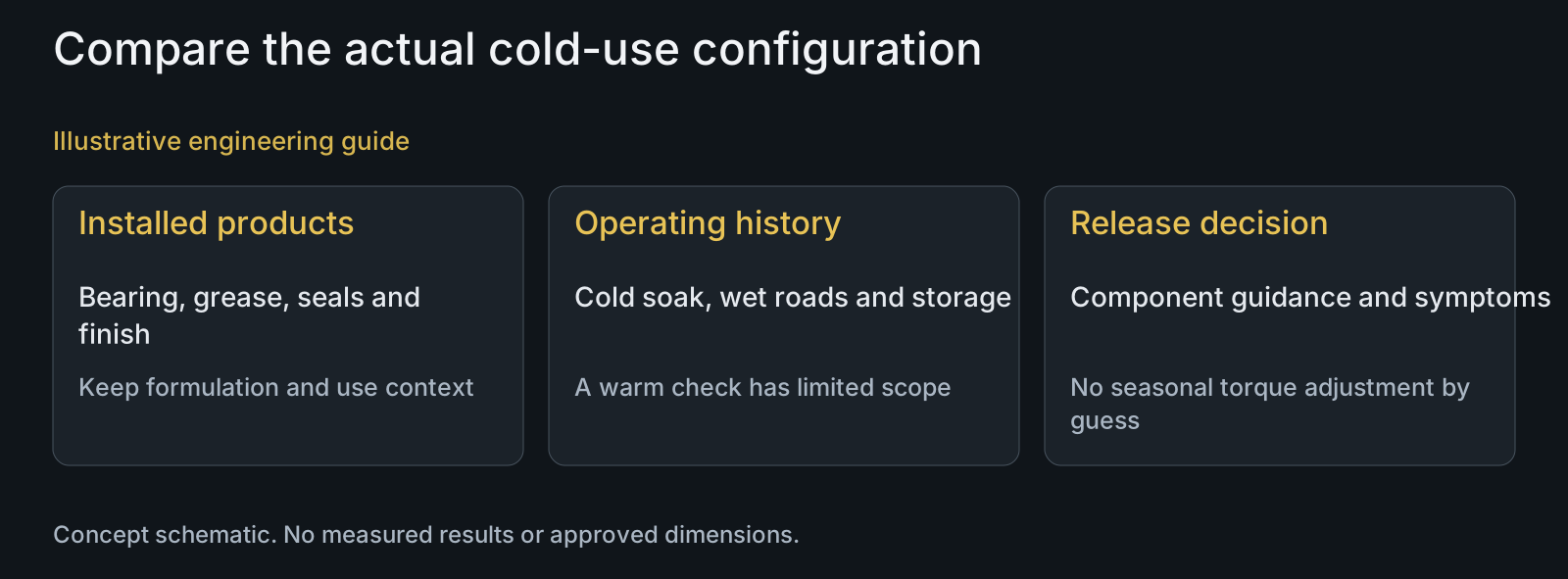
Temperature changes can affect a joint through relative dimensional changes of the bolt and clamped stack. The direction and magnitude require its materials, geometry, stiffness, contact state and temperature distribution. An air-temperature observation does not supply those inputs or establish a torque correction.
Cold movement resistance can involve lubricant and seals as well as alignment or damage. A pivot moving more easily indoors therefore does not prove correct clamp load, acceptable bearings or absence of corrosion. New play, damaged hardware or uncertain structural security requires the applicable service assessment.
Retain the model-specific torque and preparation. If the intended environment lies outside the released use, seek a component-level review; do not compensate by tightening until movement feels right.
Review example: a salted commute and a warm workshop
Illustrative engineering example: assume a full-suspension bicycle is used on treated wet roads and stored in a warm workshop. Its linkage feels more resistant at the first cold start. No measured bearing torque, preload loss, corrosion depth or service failure is supplied.
The reviewer keeps two questions open: whether the installed lubricant and bearing configuration cover the intended cold operation, and whether retained road contamination requires a revised permitted care plan. A warmer indoor check cannot answer the outdoor lubricant question or remove inaccessible deposits.
The resulting proposal retains the assembly setting while obtaining product and component guidance for cold use and cleaning. Any abnormal play or damage is handled through service assessment. This scenario distinguishes exposure mechanisms without prescribing a lubricant, temperature cutoff or safe continued-riding decision.
Questions buyers need to confirm
Should pivot bolts be tightened more in winter?
Not by a seasonal rule. Retain the released setting and preparation. Thermal joint behavior requires the actual materials, clamped geometry and temperature state; ambient temperature alone does not provide a correction. New movement or damage needs service assessment, not added torque.
Does a cold-rated grease make the complete pivot winter-proof?
No. Its stated range has a defined application and test context. Review bearing motion, fill, seals and other products separately, alongside water and salt exposure. Lubricant suitability does not establish corrosion protection or structural joint acceptance.
Is the lowest-viscosity lubricant always preferable in cold weather?
No. SKF explains competing friction and lubrication concerns rather than a universal thinnest-product rule. Obtain the selected bearing and lubricant requirements for the intended temperatures and motion; do not substitute a product on viscosity alone.
Can a pivot that feels normal indoors be cleared for cold riding?
That observation alone cannot clear it. It represents a different temperature state and does not establish preload, hidden contamination or component condition. Compare actual cold-use limits and investigate reported abnormalities through the bicycle's service method.
Can pressure washing remove winter salt from every pivot?
Do not assume that method is permitted. Trek's general guidance warns of unintended water entry. Follow the actual frame and component care requirements, including compatible cleaner and drying; washing performance is not permission to force liquid past protected interfaces.
What should an OEM winter-hardware RFQ include?
Send drawings or STEP, BOM, materials and finishes, bearing/seal and lubricant definitions, intended operating and storage conditions, wet/salt exposure and current care instructions. Identify any observed abnormalities separately. Those inputs support manufacturability and configuration review, not a universal winter rating.
Technical references and scope
SKF: Lubrication of Bearings at Low Temperatures, 2000. Viscosity, friction and lubricant availability; limits of single-property cold assessment. Historic railway examples and numerical outcomes not transferred to pivots.
Trek Bike Safety: Maintenance. Named general washing warning about pressure-induced unintended water entry, not a model-specific pivot service procedure.
SSINA: Stainless Steel for Coastal and Salt Corrosion. Deicing deposits and moisture as corrosion exposure. Architectural rankings, environmental thresholds and harmless-pitting claims not adopted for structural bicycle hardware.
Explore related component, material and sourcing decisions in the customer decision knowledge center. For a drawing review, use the Drawing/BOM RFQ path.
Define the winter exposure before changing the hardware
Share pivot drawings or STEP, BOM and the installed bearing, seal, finish and lubricant definitions. Add expected cold-start conditions, water or deicing exposure and current service instructions. PremFixer can discuss drawing-based hardware and specified finishing requirements; the component team retains environmental validation and service approval.
Discuss the drawing and BOM