
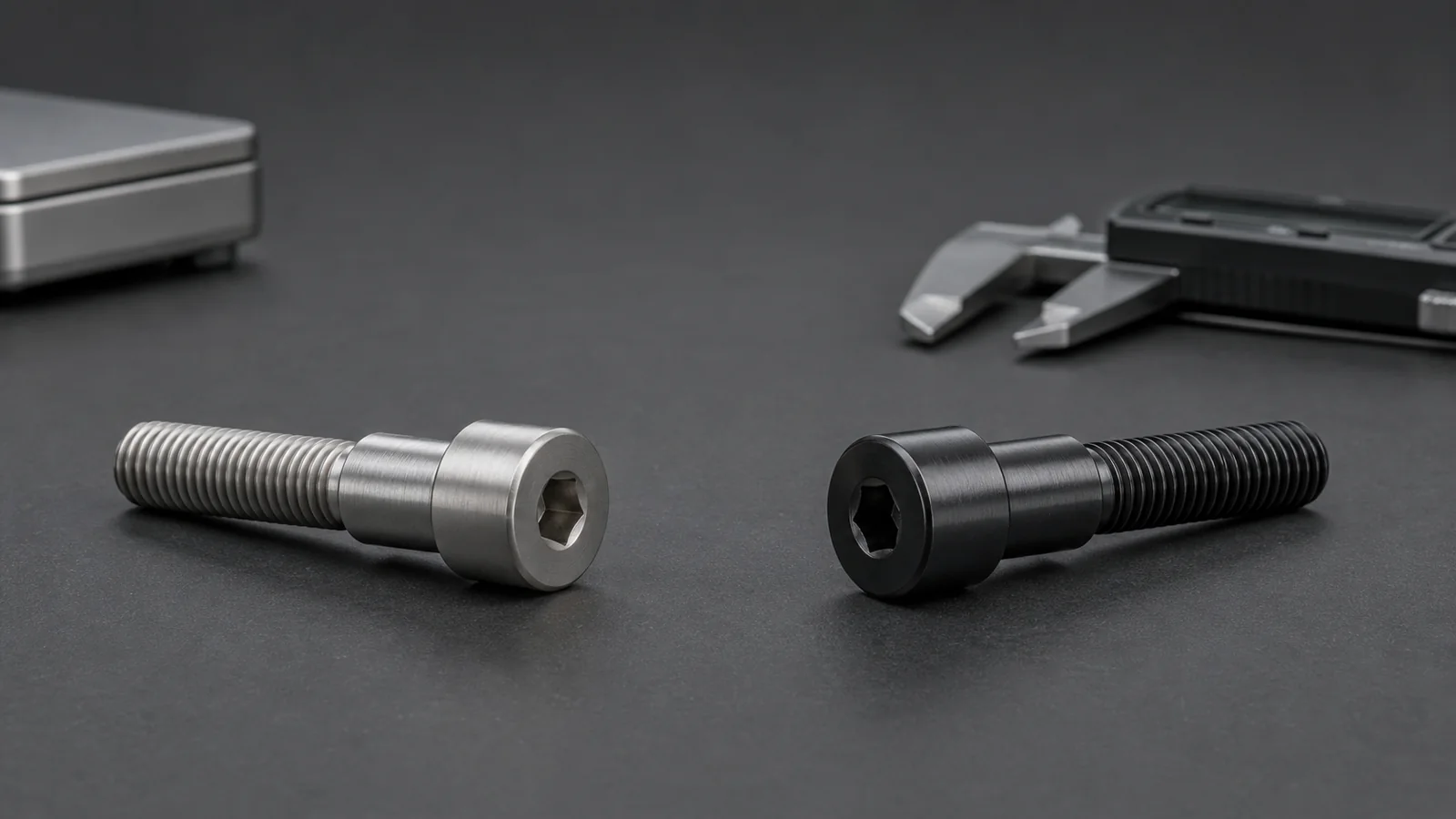
Methodology public; mass and durability data confidential. This page explains the review structure and evidence gates without presenting unapproved customer data as a proven result.
Project brief
The engineering decision in context
Engineering question
Which fasteners can be considered for titanium substitution without treating density or nominal strength as proof that the finished part and complete joint remain suitable?
The anonymized brief evaluates selected steel-to-titanium substitutions. The design review must consider thread engagement, shoulder diameter, bearing area, preload, galling risk, mating material, galvanic exposure, installation method, inspection access, and service replacement—not density alone.
The candidate alloy and delivery condition must be controlled by the purchase specification. Material designation and bar-delivery standards support traceability, but they do not qualify a finished bicycle fastener for a particular joint.
Verification matrix
Controls, records, and release gates
The acceptance requirement is fixed before testing. Each record must identify the drawing revision, sample, method, and decision owner.
| Control | Method basis | Record required | Release gate |
|---|---|---|---|
| Material identity | Approved alloy designation and condition informed by ISO 23515:2022 and applicable purchase requirements | Mill certificate linked to the incoming lot and finished-part traveler | Material and condition are traceable to the evaluated parts |
| Mass comparison | Same functional BOM scope, dry cleaned parts, calibrated balance, and defined uncertainty | Original and candidate part numbers, sample count, individual masses, and instrument record | No percentage statement unless the comparison scope and raw data are approved |
| Geometry and thread | Approved drawing, mating-thread inspection, engagement, shoulder, and bearing-area review | Dimensional report and complete joint-stack drawing | No interference, reduced engagement, or unapproved bearing-area change |
| Installation behavior | Project-specific torque, preload, and galling evaluation with the actual mating materials and lubrication state | Torque-angle or clamp-force data, procedure, tool record, and repeated-assembly observations | Preload window and service procedure are approved |
| System validation | Customer risk analysis and applicable bicycle requirements; ISO 4210-2:2023 and relevant methods may support the review | Customer-approved proof, fatigue, impact, or road-validation report as applicable | The specific application—not only the material coupon—meets its release plan |
Evidence chain
What makes the decision traceable
- 01
Trace the alloy, delivery condition, incoming lot, and finished-part traveler.
- 02
Compare mass within one controlled BOM boundary and retain raw measurements.
- 03
Validate preload, galling controls, geometry, and service instructions on the actual joint.
- 04
Keep safety-critical substitutions on the original material unless analysis and testing support release.
Claim boundary
What this public record does—and does not—establish
This public file does not claim a weight-saving percentage, strength equivalence, fatigue life, or race-proven performance. Those statements require controlled comparison data and application-specific validation for the finished part and joint.