
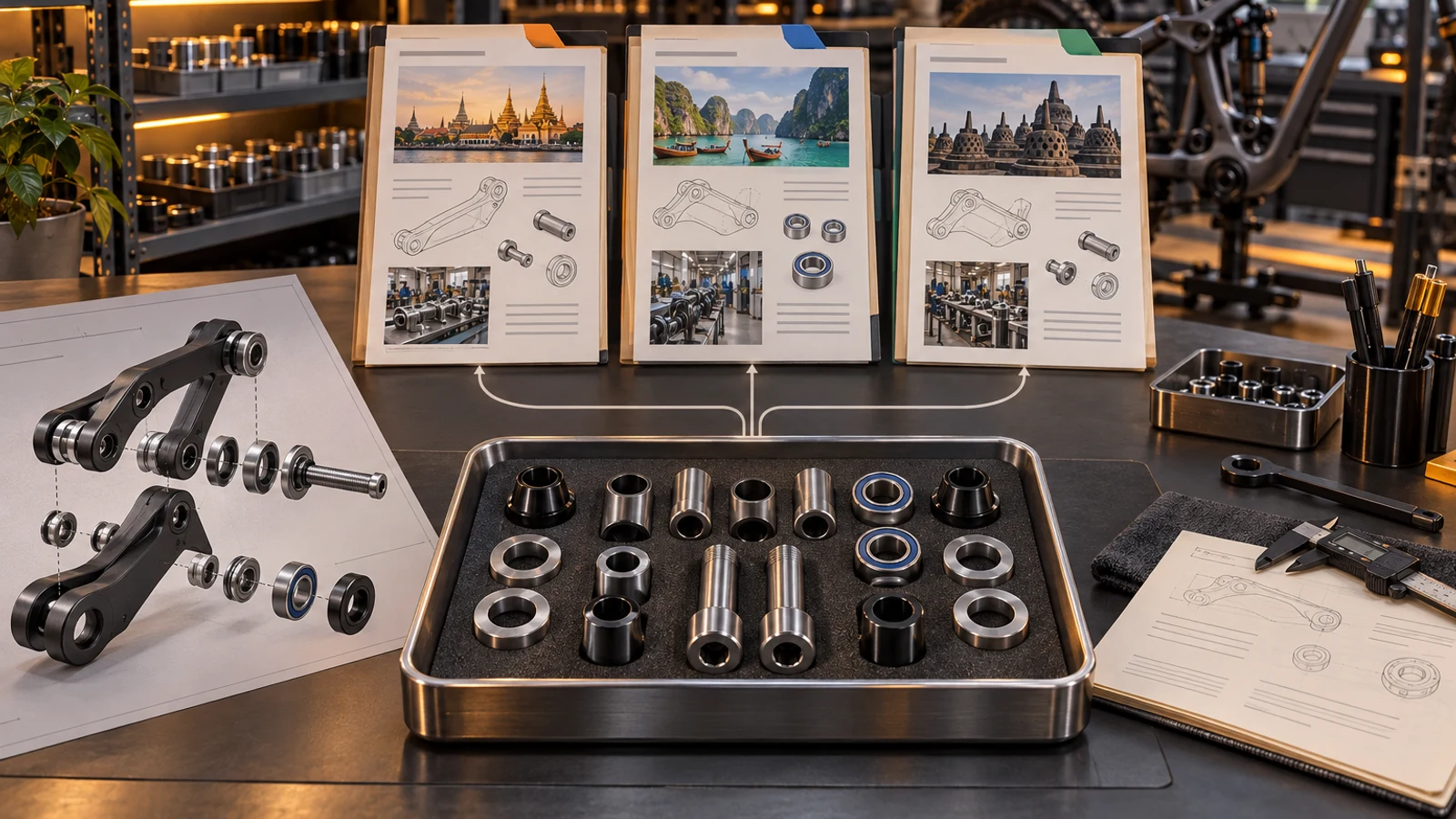
When one bicycle pivot kit is ordered for several ASEAN destinations, reuse its technical facts but review acceptance separately for each market. The same drawing, material record or inspection result can remain relevant if the represented part and supplied condition are unchanged. That does not mean a standard adopted in one country, a laboratory report accepted there or an import instruction automatically transfers elsewhere. Identify the actual goods, national reference, evidence purpose and responsible importer for every destination. Shared information should reduce repeated preparation; it should not hide a different product category, finish or assessment requirement behind a single ASEAN-compliant sentence.
Hero: concept illustration of example hardware and its application. It is not a factory photograph, tested component or approved production geometry.
Separate common evidence from a destination's acceptance
A material identity is a technical fact about the represented material. Acceptance is a decision that the evidence is sufficient for a named requirement and supplied configuration. Two destination reviewers can use the same fact without reaching the same acceptance conclusion.
Keep original records intact and identify what goods they represent. Attach the destination's purpose and review conclusion separately rather than edit a report to imply broader coverage. If a kit's finish or included spacer differs, the shared description needs an explicit boundary.
The export-document guide separates component evidence, product obligations and trade records. This guide focuses on the reusable-information boundary across destinations, not another universal certificate checklist.
Do not turn harmonisation into an assumed approval route
The ASEAN Trade Repository advises users to confirm national adoption of harmonised standards with the national standards bodies. A regional database entry therefore does not replace the destination's adopted reference or its actual application to the order.
ASEAN's published MRA-development guidance distinguishes the products and assessment results within an arrangement from other regulatory requirements. It also discusses national administrative conditions such as import licensing and product information outside the usual conformity-result recognition scope. This is guidance, not an approval of a particular pivot shipment.
If a quote claims mutual recognition, ask which arrangement, covered product, assessment body and result it means. Keep the answer with the particular destination review. Do not infer a bicycle-component arrangement merely from the existence of arrangements in other sectors.
| Review branch | What may be shared | What needs a separate answer | Risk and verification |
|---|---|---|---|
| Thailand order | Unchanged drawing and represented material | Actual national reference and local acceptance basis | TIS shorthand is not a complete route; obtain the responsible local review |
| Indonesia order | Same identified component facts | Current SNI reference and applicable regulatory basis | A catalogue adoption is not certification; verify edition and product scope |
| Another ASEAN destination | Evidence representing unchanged goods | National adoption, recipient and import instructions | Region name hides different acceptance; review the actual destination |
| Claimed MRA reuse | Original report within its represented scope | Arrangement, product and accepted body/result coverage | Unrelated sector recognition is overextended; confirm the named route |
| Finish or spacer differs | Only facts still representing both kits | Finished-interface and included-part evidence | Bare-part report is mislabelled; compare supplied configurations |
| Preferential-origin request | Identified technical description where relevant | Transaction-specific origin and trade basis | Market conformity is confused with tariff treatment; keep reviews separate |
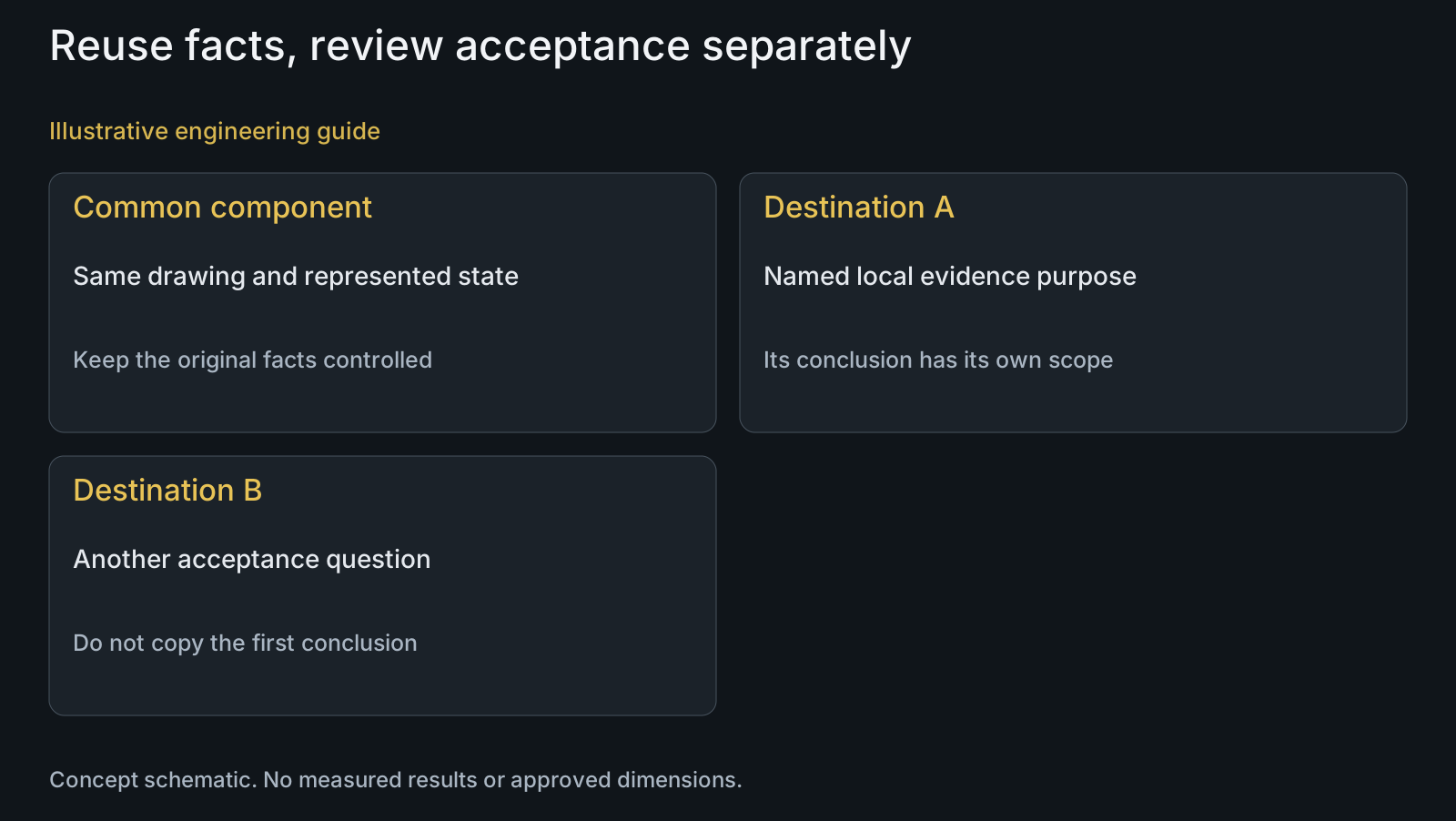
Check the national reference rather than copy a regional shorthand
Indonesia's BSN catalogue identifies the 2025 bilingual adoption of SNI ISO 4210-6:2023 as frame and fork test methods. That public adoption entry does not certify an individual pivot, establish every Indonesian import obligation or supply the complete test requirements.
The BSN catalogue also marks SNI 1049:2008 as no longer valid. An older number in a saved purchasing checklist should therefore trigger a reference review, not be silently reused as the current technical basis. Standards status and the requirements of a legal instrument still need their own checks.
For Thailand or another destination, obtain the actual adopted reference and regulatory basis from the responsible local team and authority. A TIS or SNI prefix alone does not describe a mandatory route for every loose bolt. Keep unresolved national questions visible rather than invent a complete regional rule list.
Compare destinations without duplicating the engineering record
Use one controlled component description when the configuration truly is common. Each destination entry should identify the imported form, applicable reference basis, intended evidence recipient and what remains unresolved. The table below compares review tasks; it is not a filled compliance matrix for actual shipments.
A shared material report can remain the source document while local reviewers clarify its required language, issuer or additional evidence. If a new test is requested, establish whether it covers a different requirement or configuration before assuming the first result is useless. Reuse needs a reason, just as extra testing does.
Do not let a shared technical folder absorb tariff or preferential-origin decisions. The origin-document guide and customs-classification guide address different transaction questions; none is a substitute for component acceptance.
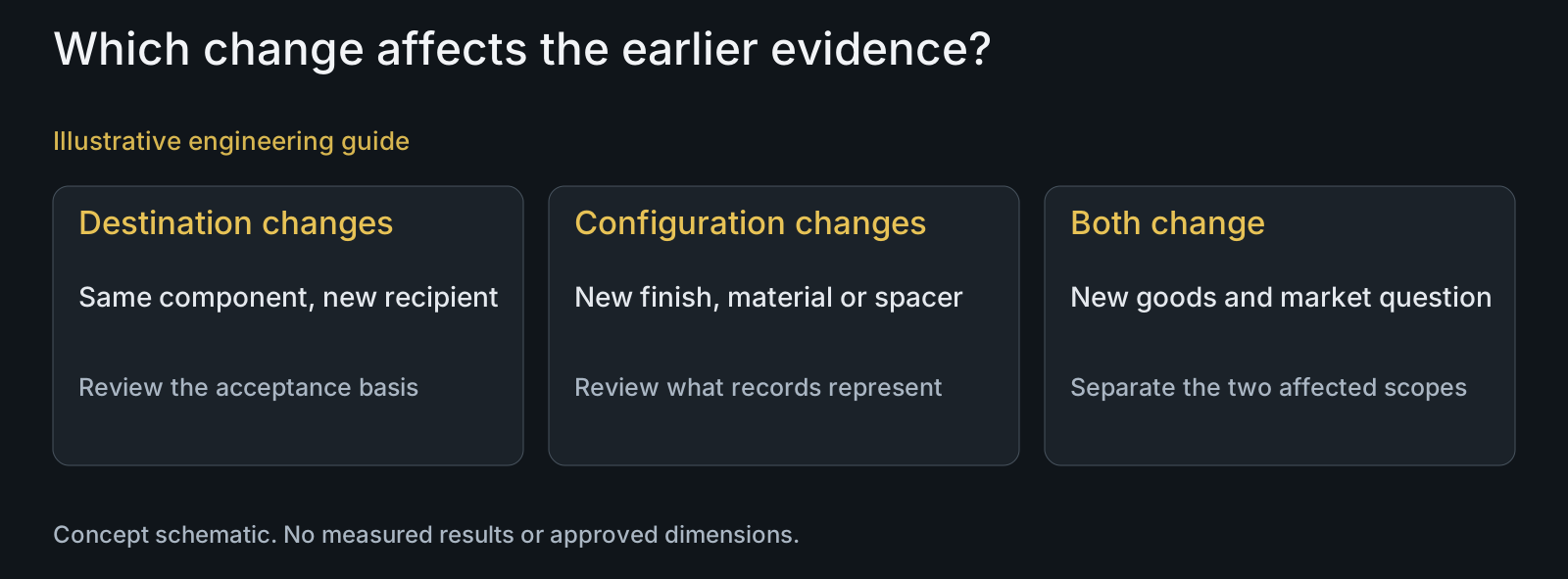
Illustrative engineering example: one drawing, different finishes
Illustrative engineering example: assume two buyers in different ASEAN destinations request the same pivot geometry. One order uses the specified bare-metal condition; the other adds a finish and a different included spacer. A common drawing folder initially describes both as the same kit. No actual importer instructions, accepted report or test results are assumed.
The reviewer separates unchanged geometry and represented material information from the different supplied configurations. The finished interface and spacer need appropriate descriptions and evidence; the original bare-part inspection must not be relabelled to represent them. Each local team separately resolves the applicable national and import questions.
This prevents two opposite errors: repeating all unchanged preparation, and claiming that one evidence package represents different goods. It does not prove that either destination requires a particular certificate. The scenario illustrates evidence coverage, not a successful clearance or quantified saving.
Revisit the affected scope when a destination or kit changes
A new destination can change the required recipient or acceptance basis even if the hardware is unchanged. A new finish, material condition or assembly form can change what the technical evidence represents even if the destination is unchanged. Identify which of those changes occurred before extending an earlier conclusion.
PremFixer can discuss manufacturing, materials and the supplied component records against defined customer requirements. No universal ASEAN certificate, automatic foreign-report acceptance or importer service is promised.
Provide the common drawing and the differences by destination with the Drawing/BOM RFQ inputs. The customer decision knowledge center connects material, finish and validation questions after the reuse boundary is clear.
Questions buyers need to confirm
Can one ASEAN declaration cover every bicycle hardware order?
Do not assume that. Identify each destination, actual goods and acceptance purpose. A common technical description may be useful, but a regional label does not establish the national route or acceptance of every report.
Does a harmonised standard establish national adoption?
Confirm it with the relevant national standards body. The ASEAN repository expressly advises that check. Also determine how the adopted reference is used for the actual order; adoption and product approval are different questions.
Does mutual recognition remove all importer requirements?
No such blanket conclusion follows. Confirm the particular arrangement and its covered results, while keeping other national requirements separate. ASEAN guidance distinguishes conformity-result recognition from additional administrative conditions.
What does Indonesia's SNI ISO 4210-6 adoption establish here?
The public catalogue identifies a national adoption concerning bicycle frame and fork test methods. It does not show a pivot's test results or settle every import obligation. Confirm the full ordered reference and applicable regulatory basis separately.
Can the same material report support two destinations?
It can be considered where it represents the same supplied material and condition. Each reviewer still decides whether its scope, issuer and supporting evidence answer the local requirement. A changed finish or included component may leave a coverage gap.
What helps PremFixer discuss a multi-destination RFQ?
Provide the common drawing or STEP, BOM and material, each destination and importer contact, supplied configuration differences and requested evidence purposes. Mark national-reference and acceptance questions still awaiting local review so a manufacturing quote does not imply regional approval.
Technical references and scope
ASEAN Trade Repository: harmonisation of standards. Regional harmonisation context and explicit advice to confirm national adoption. Not a bicycle-component approval or complete national-rule list.
ASEAN: guidelines for developing mutual recognition arrangements. Published guidance on product and result scope, differing regulations and additional administrative requirements. Not a particular operative MRA determination for pivots.
BSN: SNI ISO 4210-6:2023 adopted in 2025. Public frame-and-fork test-method adoption identity and bilingual edition context. No full purchased requirements or product test result supplied.
BSN: SNI 1049:2008 catalogue status. Public catalogue status used to flag an outdated technical reference. Not a conclusion about the status of every legal instrument referring to it.
Explore related component, material and sourcing decisions in the customer decision knowledge center. For a drawing review, use the Drawing/BOM RFQ path.
Separate shared hardware inputs from destination questions
Send the common drawing or STEP and BOM, material and finish, each destination and the differences in supplied kits. Include local reference documents, importer instructions and requested evidence purposes so PremFixer can discuss the relevant component manufacturing records.
Discuss the drawing and BOM