
An ASTM A276 material document does not approve the finished pivot bolt. It addresses the represented stainless stock within its specified scope; the manufactured shoulder, thread, head and supplied surface need their own drawing and acceptance requirements. For an OEM order, keep the bar identity connected to the actual pieces as stock is cut, allocated and machined. Do not assume one delivery number means one material heat, or one bar record covers every kit item. PremFixer can discuss the requested material and document scope, but the order must define its deliverables. No universal certificate entitlement or finished-property result follows from citing A276 alone.
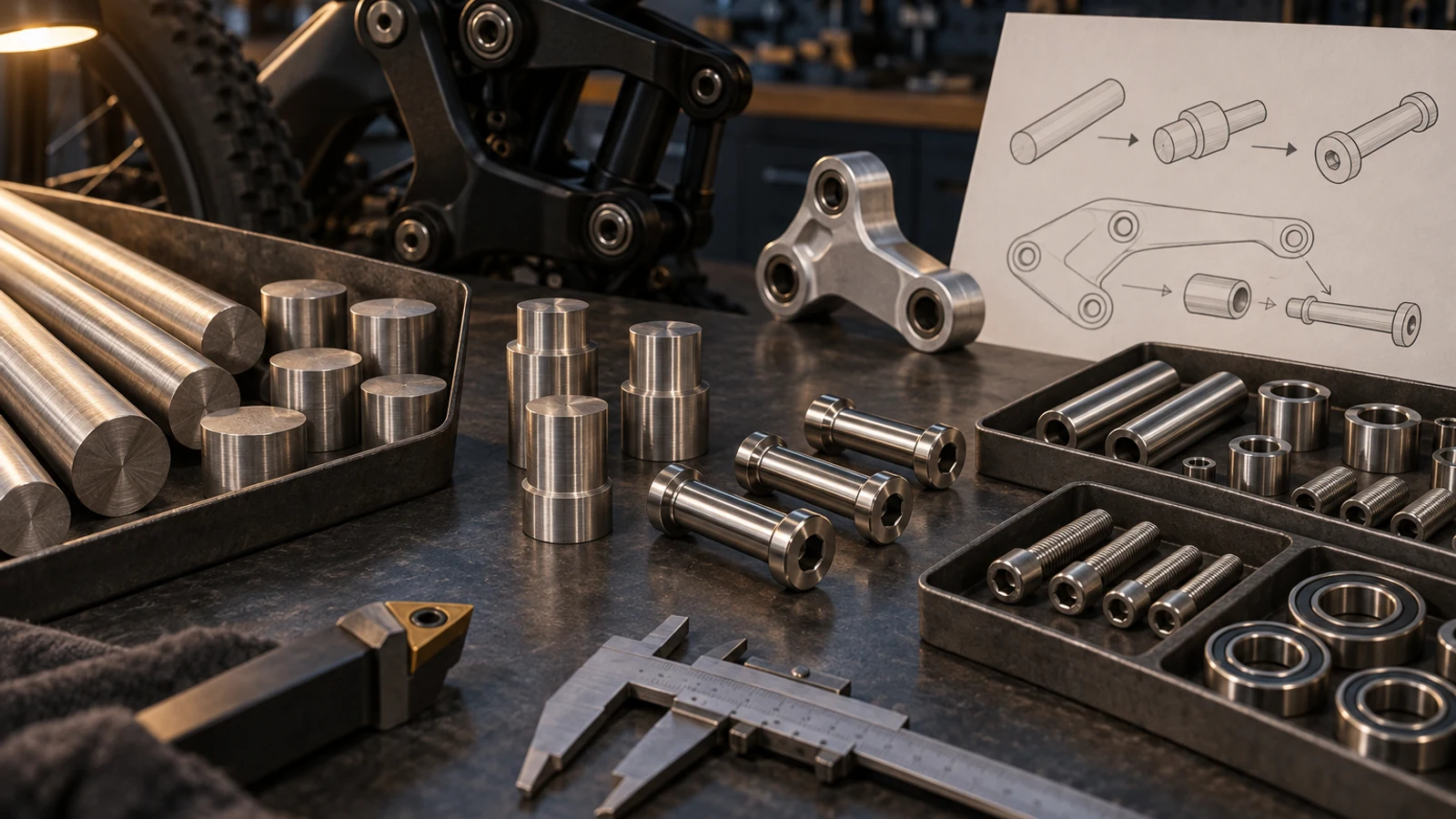
Hero: concept illustration of example hardware and its application. It is not a factory photograph, tested component or approved production geometry.
Begin with the bar requirement, not a generic stainless label
ASTM A276/A276M-25's public scope addresses specified hot- or cold-finished stainless bars and shapes, with stated exclusions. Identify the required grade, form, condition and edition for the allocated stock instead of treating the number as a universal stainless requirement.
Its public description distinguishes supplied conditions; it does not select the customer's grade and condition. Resolve those fields coherently with the finished drawing. A request for 304 or 316 shorthand should identify the actual governing requirement rather than let stock availability silently define the design.
The A276/B348 stock-form guide addresses selecting the relevant material form. This article follows the chosen stainless bar into the order: which evidence represents the material used for which finished pieces?
Preserve allocation when a bar becomes many blanks
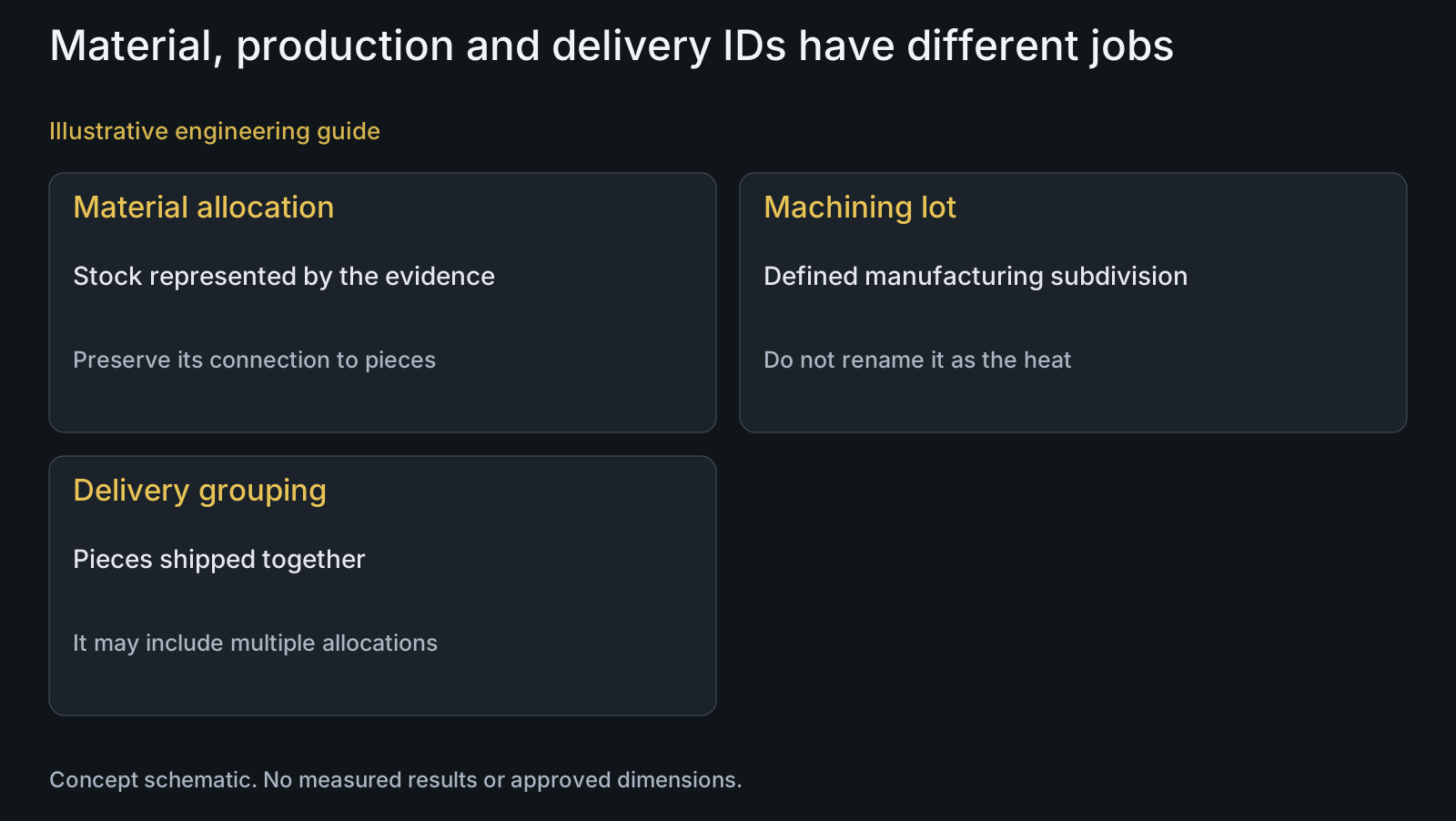
Cutting changes the physical form and can remove the place where a stock identifier appeared. The relevant question is how the intended identity remains associated with the cut pieces. A blank's familiar appearance cannot replace that connection.
If one allocation feeds several machining lots, keep the common stock relationship visible without calling them the same production lot. If different allocations feed one delivery, identify the affected pieces or controlled subdivisions. Manufacturing and shipping identifiers serve different purposes from a material heat identifier.
Ask for an appropriate segregation and identification method for the agreed traceability requirement. This need not mean marking every small finished part with a long code. Containers, controlled transfer records or other agreed methods must actually preserve the represented relationship; no universal method or serialized company practice is claimed here.
| Situation | Evidence connection required | Risk if collapsed | Useful review |
|---|---|---|---|
| One bar allocation, several machining lots | Each lot linked to represented stock | Heat and process-lot identity confused | Identify allocation for each subdivision |
| Several allocations, one delivery | Affected pieces mapped to their material | Delivery heading hides mixed history | Preserve agreed piece/container grouping |
| Incoming condition, later processing | Stock state and finished requirement separate | Mill record treated as process proof | Name relevant supplied-state evidence |
| Finished shoulder inspection | Named geometry and drawing basis | Dimension result called material identity | Keep stock and feature conclusions distinct |
| Mixed-material kit | Evidence assigned to each item | One stainless record extended to all parts | Compare item requirement and represented goods |
| Named certificate requested | Document type, subject and availability | Generic title promises all results | Confirm the actual order deliverable |
Keep material condition distinct from later processing
A record for the incoming bar describes its stated subject and condition. It cannot independently describe every later operation on the component. Identify relevant manufacturing and surface requirements separately rather than expand the mill document into a final processing report.
For a custom shoulder bolt, check whether the finished requirement concerns raw material, a fastener property class or both. A material document and a finished-component assessment can coexist in the same order without representing the same specimen or conclusion.
The finished-property specification guide treats that distinction. Use CNC turning and the material hub to discuss a defined route, not infer an unverified processing recipe or property gain from the bar specification.
Assign each record to the requirement it actually answers
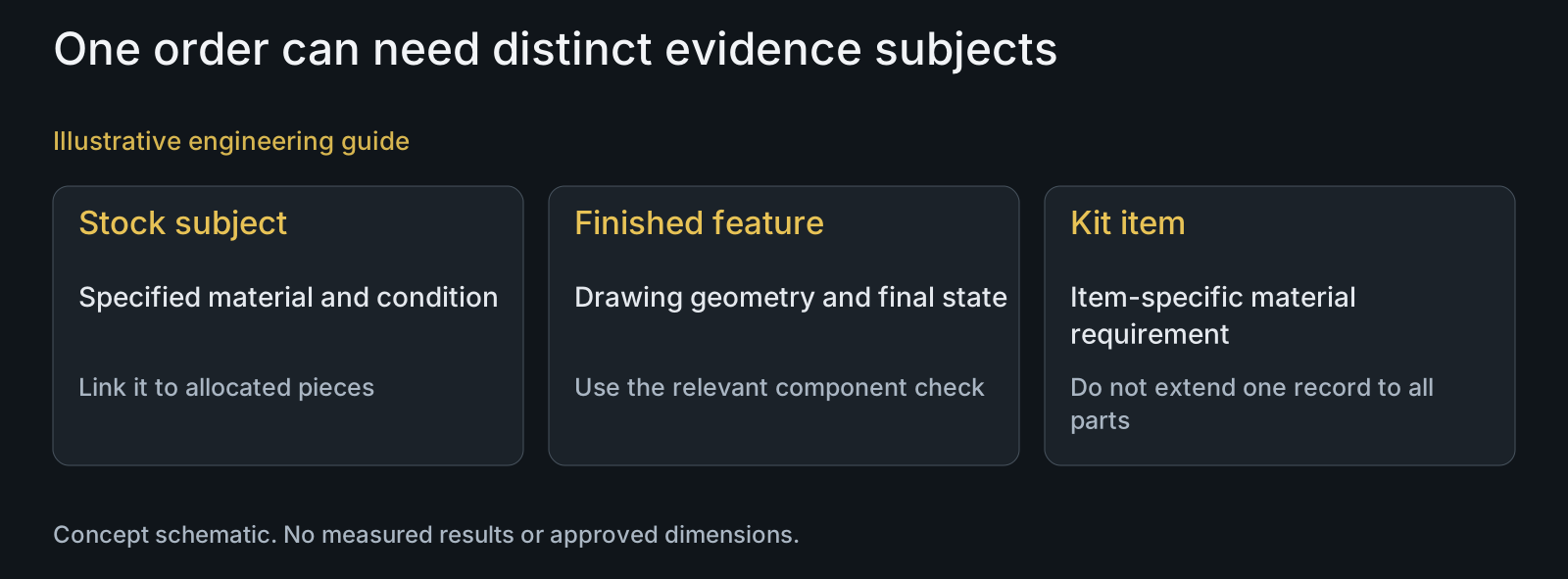
A stock document can address the represented material. A feature-inspection record addresses the named finished dimension or relationship. A surface record addresses its defined treated subject. Put those references beside the corresponding order requirements instead of attach them as an unexplained folder of 'quality papers.'
If an order requires a particular document type, name that deliverable and confirm its subject and availability during quotation. The material-document scope guide addresses document types. Do not assume every material batch automatically includes a 3.1 certificate; confirm the requested evidence for the actual order.
A chemical-composition entry alone does not establish every finished property or locating fit. Conversely, a finished shoulder measurement cannot establish the origin of the allocated bar. Identify what each result supports and which separate requirement remains open.
Check the kit item and subdivision, not just the delivery heading
A pivot kit can include an axle, sleeves, washers and a receiver with different material requests. One stainless bar record should not be extended to an aluminum or differently specified item simply because the components share a box or shipment number.
Even where two stainless items share a requirement, the record still needs a connection to their actual allocations. Shared alloy wording does not prove shared material history. Compare the item's specified material and the represented goods before deciding whether a document applies.
The mixed-material kit guide develops item-level definitions. For this bar-to-part review, request the allocation relationship needed by the order rather than use a delivery label to collapse all materials and production lots into one.
Review two machining lots supplied under one order
Illustrative engineering example: assume an OEM receives one delivery of stainless shoulder pivots produced in two machining lots. The material paperwork identifies a bar allocation, but the delivery pack does not show whether it represents both subdivisions. No real lot, heat number, property result or customer event is assumed.
The reviewer asks for the missing relationship, not a newly invented certificate. If both lots used the represented stock, the appropriate linkage should substantiate that. If another allocation was used, its evidence and affected pieces need identification. Neither possibility is settled by the matching finish or shared order number.
Finished-feature acceptance remains a parallel question under the actual drawing. Send the drawing and BOM RFQ pack with material/document requirements so the manufacturing discussion can define the intended evidence chain and component checks before supply.
Questions buyers need to confirm
Does A276 documentation approve a finished shoulder and thread?
No. It represents material within its scope, not inspection of every manufactured feature. Define the finished geometry and relevant checks separately while retaining their connection to allocated stock.
Is the material heat the same identifier as the machining lot?
Not necessarily. One allocation can feed several production subdivisions, and one delivery can combine them. Preserve the relationship rather than assume the identifiers mean the same object.
Does every delivery automatically include a 3.1 certificate?
No universal entitlement is claimed here. Specify the required document type, represented material and expected scope, then confirm the deliverable and availability in the order.
Can one stainless record cover the entire pivot kit?
Only within its actual represented goods and scope. Compare each item's material requirement and allocation. A shared delivery cannot extend a stainless record to an unrelated material or unrepresented item.
Must each small part carry a material heat mark?
Not a universal requirement here. Agree an identification and segregation method that preserves the requested piece-to-material relationship. The method must suit the actual order without assuming unconfirmed serialization practices.
What material fields belong in the bar-based RFQ?
State grade, applicable standard/edition, product form, condition and requested documentation. Include the finished drawing and kit BOM, plus the allocation/traceability scope needed, so stock evidence and component acceptance remain defined.
Technical references and scope
ASTM A276/A276M-25 public scope. Stainless bars/shapes, stated exclusions and supplied-condition context; no raw numerical limits, universal 3.1 provision or finished-pivot certification inferred.
Explore related component, material and sourcing decisions in the customer decision knowledge center. For a drawing review, use the Drawing/BOM RFQ path.
Specify which stock evidence must represent which parts
Send the drawing, STEP or sample reference and BOM with the required bar grade, form, condition, standard edition and document scope. Identify the needed material-allocation relationship and finished checks so PremFixer can discuss a defined manufacturing and evidence request.
Discuss the drawing and BOM