
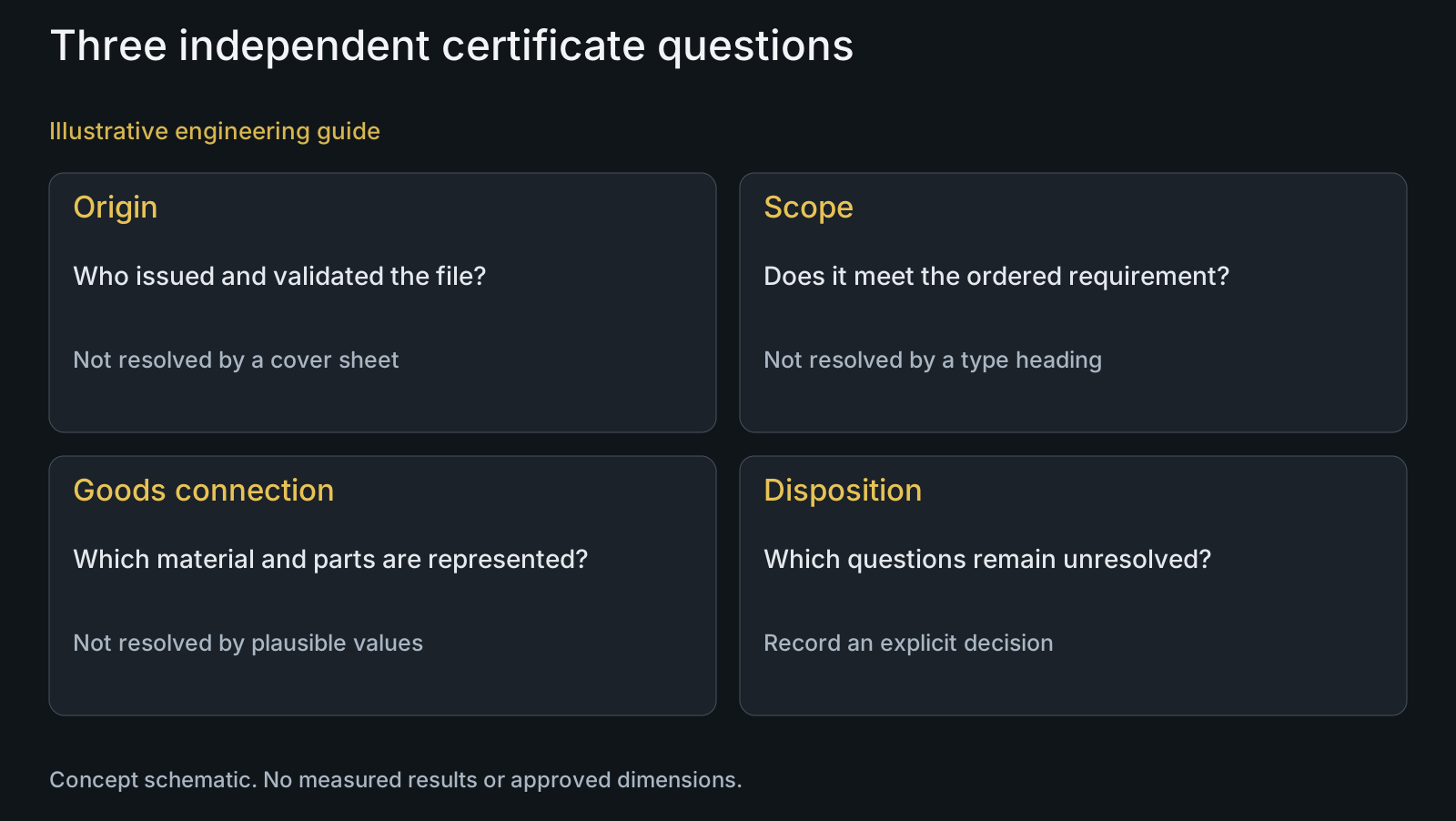
An EN 10204 3.1 certificate is not automatically an outside laboratory certificate. Its validation role is tied to the manufacturer's authorized inspection representative, independent of the manufacturing department. For a pivot buyer, that distinction matters when deciding whether received evidence satisfies an order or needs clarification. Check the document's origin, represented product and results before accepting its connection to the delivered hardware. A correct-looking title cannot resolve an unexplained issuer, altered result or conflicting identity. Equally, a mismatch is a reason to investigate, not proof that material is defective or that someone committed fraud. Keep the goods and document conclusions separate.
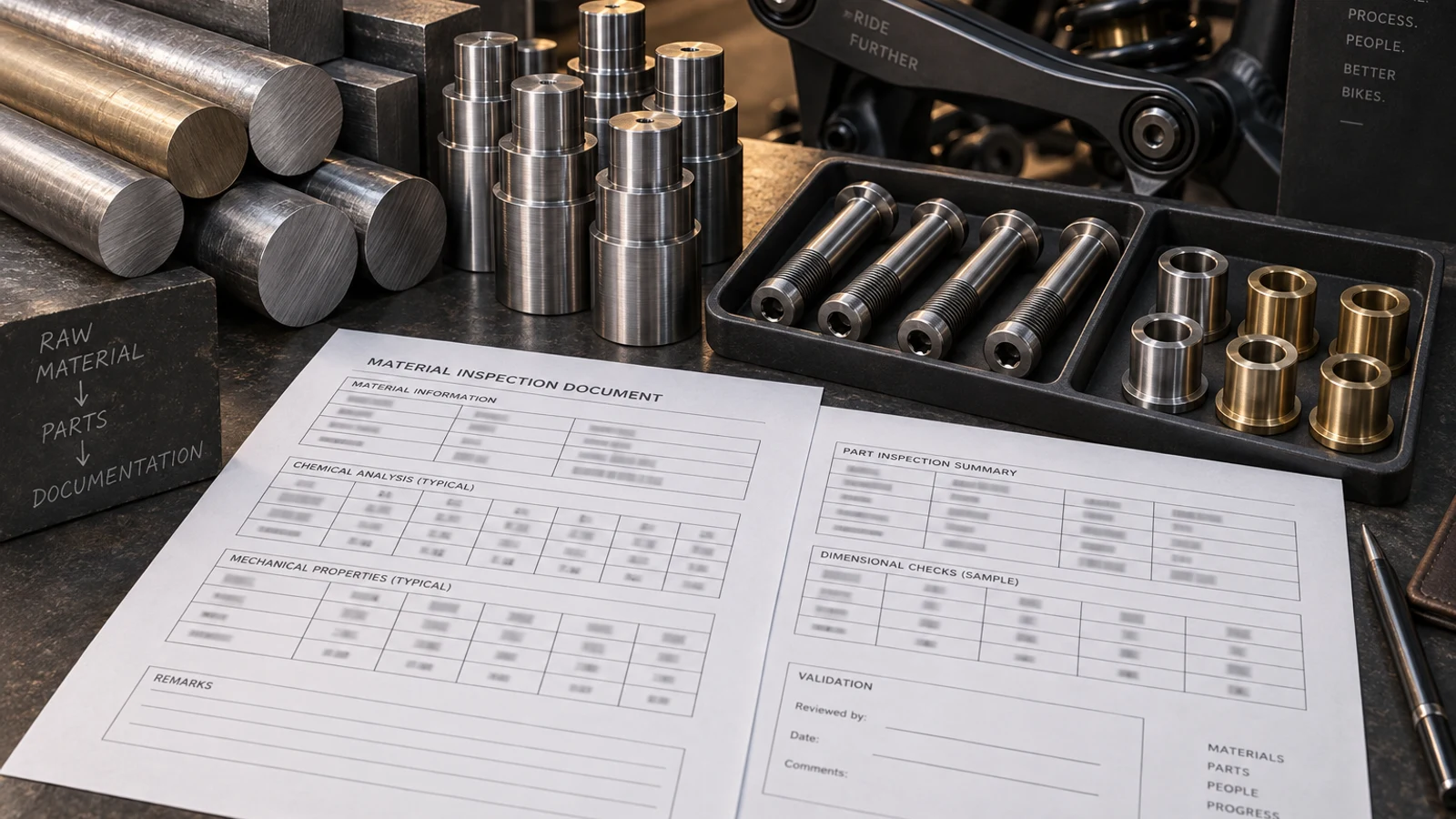
Hero: concept illustration of example hardware and its application. It is not a factory photograph, tested component or approved production geometry.
Establish whose inspection document you received
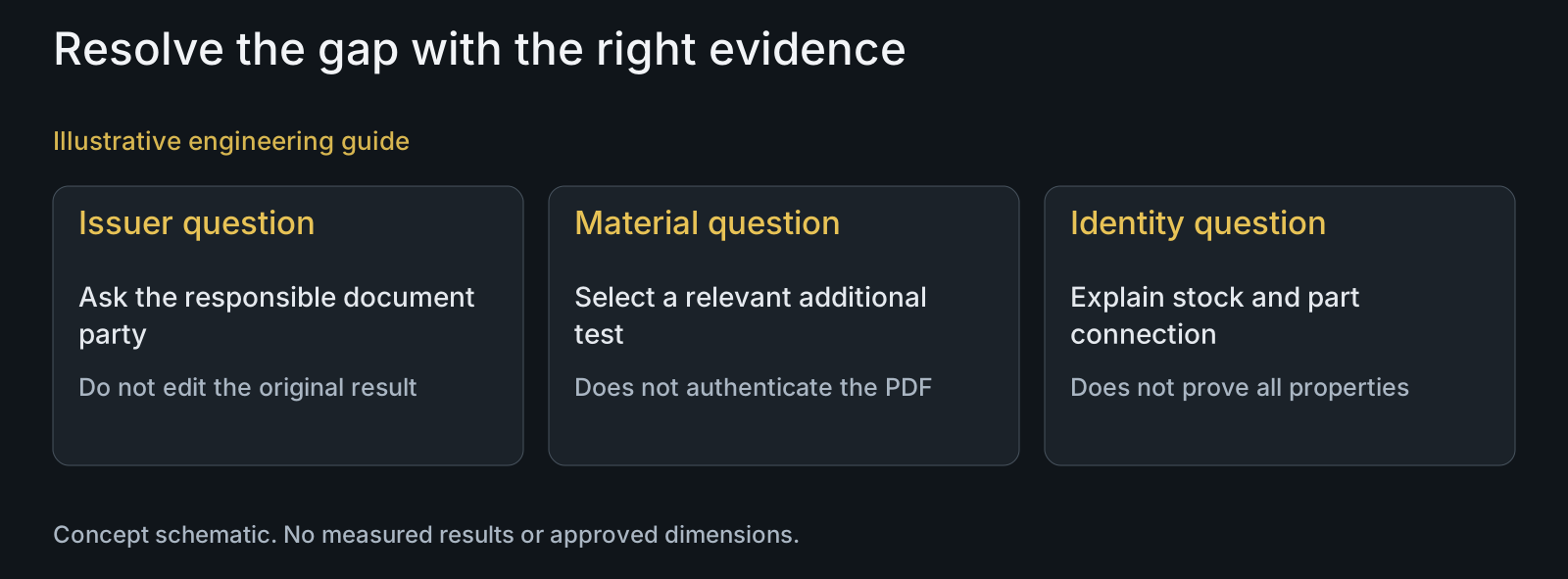
The issuing manufacturer may be the producer of the represented material, while the pivot manufacturer or distributor supplies the document with processed hardware. Identify each role instead of assuming that the company forwarding the PDF performed the reported material tests.
SSAB's published inspection-document explanation describes type 3.1 validation by an authorized manufacturer representative independent of production. Organizational independence from a manufacturing department is different from an unrelated laboratory issuing a report.
Check the actual validation identity and the represented product. An email from purchasing or a supplier cover sheet does not explain an absent validation role. If that role is unclear, request clarification rather than adding an assumed signature or declaring the document invalid from appearance alone.
Compare the requested document with the supplied category
The BSSA certificate-type explanation distinguishes non-specific inspection in type 2.2 from specific inspection in type 3.1. It describes the additional validation arrangement of type 3.2. The order requirement determines which category is needed; a larger type number is not a material grade.
If the purchase specifies 3.2, do not accept a 3.1 heading as though it represents the same validation arrangement. Likewise, an outside laboratory test is not automatically a replacement inspection certificate. State exactly what the supplied document demonstrates and what the order still requires.
For the underlying material-versus-finished-part boundary, use the MTC document-scope article. This review focuses on issuer and document integrity, rather than repeating a material-selection or shipment genealogy procedure.
| Question | Evidence to examine | Unsupported inference | Action if unclear |
|---|---|---|---|
| Who validated the document? | Manufacturer and authorized inspection role | 3.1 always means outside laboratory | Clarify issuer and validation identity |
| Is the requested category supplied? | Order requirement and actual document type | Any signed report substitutes for 3.2 | Resolve category and validation arrangement |
| What do results represent? | Product, condition and inspection unit | Every finished pivot was tested | Limit claim to represented scope |
| Does a discrepancy indicate fraud? | Original document and responsible explanation | A mismatch proves intentional misconduct | Preserve evidence and investigate |
| Will another test close the gap? | Named characteristic and residual requirements | Chemistry test authenticates the PDF | Separate test result from document identity |
Read the represented result, not only the certificate heading
Identify the product form, specified material condition and inspection unit represented by each result. A chemistry entry and a mechanical test can answer different requirements. Units, test identity and stated condition must be interpreted against the actual purchase specification, not a familiar-looking alloy name.
Do not infer that every result was measured on every finished pivot. A material inspection unit can represent supplied stock, while a later machining or treatment operation creates additional finished-part questions. A genuine certificate still needs appropriate scope for the claim being made.
Compare results only where the applicable product requirement makes that comparison meaningful. OES material identification and mechanical-property testing answer different questions; neither should be relabeled a complete document-validation exercise.
Investigate a discrepancy without rewriting the evidence
BSSA's document-misuse guidance highlights altered or misrepresented documents, missing traceability and confusion about document types. Its advice includes verifying origin and content and contacting the supplier when inconsistencies arise. Do not interpret that warning as evidence of misconduct by a particular supplier.
Describe the actual discrepancy: conflicting material identity, unexplained revision, incompatible product description or an unclear issuing role. Preserve the received file and related correspondence. Ask the supplier to connect the concern to the responsible issuer instead of editing a PDF to make it agree with the order.
Separate an explanation from corrected evidence. If the issuer provides a correction, retain the relationship between versions and confirm what changed. Do not invent a mandatory certificate layout, ink-signature rule or universal authenticity test that was not part of the requirement.
Decide what an additional test can and cannot resolve
Independent testing can investigate a selected material characteristic. It does not retroactively establish who validated the original certificate or restore a missing stock-to-part identity. Specify the actual question before ordering another analysis: material composition, property condition and document authenticity are not interchangeable targets.
Where document applicability remains unresolved, keep the receiving disposition explicit under the agreed quality process. Do not release material solely because one supplemental result looks satisfactory, or automatically condemn the material because a cover sheet contains a mismatch. The remaining acceptance requirements still need resolution.
The titanium traceability guide addresses material-to-part connections in depth. For this document review, request that connection as evidence without claiming that the certificate itself contains every machining and finish operation.
Illustrative review of a forwarded certificate and new cover sheet
Illustrative engineering example: assume a buyer receives an original material inspection document plus a pivot supplier's shipment cover sheet. The cover sheet uses a different material identity from the underlying file. No counterfeit document, failed material, customer or test outcome is assumed.
The reviewer identifies which organization issued each document and asks what the two identities represent. The discrepancy could concern an internal batch label, the wrong attachment or an unsupported connection. Those alternatives cannot be resolved by copying one number over the other.
The required response connects the original evidence to the ordered material and delivered parts, with any corrections attributable to the appropriate party. PremFixer's drawing-based manufacturing scope can be discussed alongside the document requirement, but this article does not promise a 3.1 certificate for every material or order by default.
Questions buyers need to confirm
Is a type 3.1 certificate necessarily issued by a third-party laboratory?
No. Its defined manufacturer validation role is independent of the manufacturing department, not automatically independent of the company. Identify the represented manufacturer and authorized role. A forwarding supplier or separate laboratory report does not explain that role by itself.
Can a 2.2 report replace a requested 3.1 certificate?
Not automatically. Their inspection categories differ, so compare the supplied document with the purchase requirement. Any alternative needs the responsible buyer's agreement, rather than a silent change justified by similar-looking results.
Does adding another signature convert a 3.1 file into 3.2?
Do not assume so. The required validation arrangement and represented evidence must be established. An added signature with no explanation of role or assessment does not demonstrate that the requested document requirement has been satisfied.
What if the certificate and shipment cover sheet use different identities?
Request an explanation connecting both to the actual goods before using the file as applicable evidence. The difference may be an internal label, wrong attachment or unsupported mapping. Preserve the originals and do not overwrite one identity to hide the discrepancy.
Can independent chemistry testing prove that the certificate is genuine?
No. It investigates selected composition evidence for the tested sample. It does not establish the original document's issuer, validation or material-to-part connection. Specify that separate question if document integrity remains unresolved.
Does PremFixer include 3.1 evidence in every pivot order?
No universal default is stated here. Confirm availability, represented material, validation arrangement and additional requirements in the actual quotation. Provide the material specification and required document type early so procurement compares the same evidence deliverable.
Technical references and scope
SSAB inspection-document explanation. Producer's explanation of type 3.1 manufacturer validation independence; not a claim about PremFixer supply defaults.
BSSA EN 10204 certificate types. Public industry explanation of inspection categories and validation differences; not complete normative clause interpretation.
BSSA misuse of material test certificates. First-party industry guidance on origin, alteration, traceability and discrepancy investigation; not evidence of an actual supplier incident.
Explore related component, material and sourcing decisions in the customer decision knowledge center. For a drawing review, use the Drawing/BOM RFQ path.
Specify the document and the question it must answer
Send the material specification, drawing revision, required document type, represented product and order identity, and any received file needing clarification. PremFixer can discuss the available material documentation and finished-part inspection scope. Identify whether your open question concerns issuer, results or goods connection before requesting additional tests.
Discuss the drawing and BOM