

A titanium pivot bolt can be an excellent upgrade. It can also be the wrong bolt installed with great care.
That is why “Is titanium stronger than steel?” is rarely the best opening question. A suspension pivot is a joint, not a material coupon. Its performance depends on the bolt, bearings, spacer, receiver, linkage supports, surface condition, clamp state and external load path working together.
Grade 5 titanium—Ti-6Al-4V—deserves its reputation as a high-strength, low-density engineering alloy. But an alloy name does not tell us whether a replacement bolt has the right shoulder length, transition geometry, thread engagement, surface finish or installation process for a particular frame. Those details decide whether the material advantage becomes useful hardware.
1. What the material data actually say
TIMET lists a density of approximately 4.42 g/cm³ for TIMETAL 6-4 and a Young’s modulus of 107–122 GPa at room temperature, with modulus affected by texture and heat treatment. For annealed bar covered by ASTM B348, the same producer sheet lists minimum tensile values of 895 MPa ultimate tensile strength and 828 MPa 0.2% yield strength, together with minimum elongation requirements for the stated product form and condition.[1]
These are meaningful numbers, provided their boundaries remain visible. They describe qualified material and product-form properties. They are not the tensile capacity, fatigue life or allowable load of a finished bicycle pivot bolt.
For comparison, an Outokumpu environmental product declaration gives a density of about 7.90 g/cm³ and an elastic modulus of about 200 GPa for its referenced hot-rolled austenitic stainless-steel group.[2] If two solid parts had exactly the same geometry, the Ti-6Al-4V part would contain approximately 44% less mass. That is a transparent density calculation, not a claim that a complete bike becomes 44% lighter or that titanium outperforms every fastener steel.
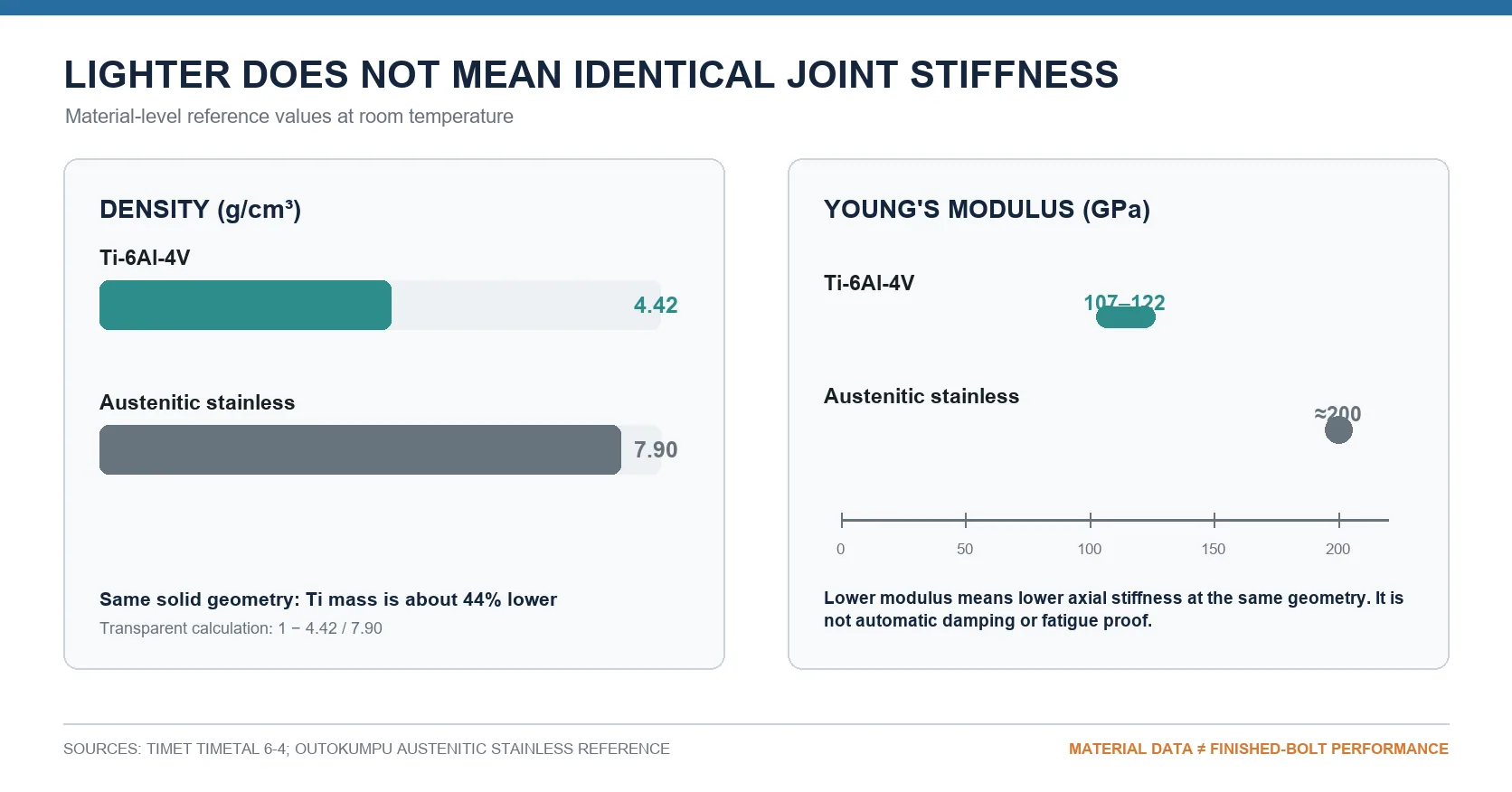
The comparison also explains why “lighter” and “stiffer” must not be treated as synonyms. Ti-6Al-4V has the lower density, while the cited stainless reference has the higher elastic modulus. A designer choosing between them is balancing properties, geometry, interfaces, corrosion and manufacturing—not selecting one universal winner.
2. Strength-to-weight is a starting point, not a release decision
Using the cited minimum tensile values and density, Ti-6Al-4V has an attractive material-level specific strength. This is one reason the alloy appears in aerospace structures, fasteners, pressure vessels and sports equipment.[1]
Yet a bolt does not fail as an ideal bar in a simple tensile test. Local stress can rise at the first engaged thread, thread root, under-head radius, shoulder-to-thread transition, drive recess or an unintended contact edge. A change in minor diameter, fillet, thread position or unsupported span can matter more than the headline alloy comparison.
The complete manufacturing route matters as well. Raw-material conformity, heat-treatment condition, grain structure, machining damage, burr control, surface contamination and final inspection all affect what the finished component can do. TIMET itself notes that Ti-6Al-4V properties are influenced by microstructure and thermomechanical history.[1]
This is why “Grade 5” should be treated as one controlled input. It is not a complete product specification and is not proof that two visually identical titanium bolts are equivalent.
3. Lower elastic modulus changes joint behaviour
Elastic modulus describes stiffness in the elastic range. At the same solid geometry, a Ti-6Al-4V bolt is less axially stiff than a bolt made from the cited austenitic stainless reference. Under the same axial stress, the titanium material undergoes more elastic strain.
That fact is sometimes turned into claims about vibration absorption, ride feel or fatigue immunity. The material data do not establish those outcomes. In a preloaded joint, load sharing depends on the stiffness of both the fastener and the clamped members. NASA’s threaded-fastener standard represents this explicitly through bolt and clamped-part stiffness terms when analysing how external tensile load is distributed.[3]
In the conceptual pivot stack reviewed for this article, the system includes two coaxial bearing inner races, a continuous through-spacer, a smooth shoulder, clamp faces and a terminal receiver. Depending on the real architecture, the shoulder may locate the stack, support shear, control a running clearance or serve several functions at once. In this reference stack, the thread engages the receiver outside the bearing support span rather than substituting for the smooth bearing interface.
Changing bolt material while copying only overall length and thread size can therefore change the joint without preserving its function. Compatibility requires the full geometry and stack, not merely a fastener that can be screwed into the hole.
4. “Titanium is brittle” is the wrong diagnosis
The statement that titanium bolts “easily snap” is too broad to guide a rider, workshop or engineer. Ti-6Al-4V has published strength and ductility requirements in defined conditions.[1] A real fastener failure may instead involve:
- a sharp transition or inadequate fillet;
- thread roots placed in a highly loaded or bearing-supported region;
- insufficient thread engagement or a weak receiver;
- bending created by clearance, spacer error or misalignment;
- surface damage, contamination or an unsuitable chemical process;
- loss of preload followed by higher cyclic bolt loading;
- galling during installation or repeated service;
- a replacement geometry that does not reproduce the original load path.
Failure analysis should begin with fracture location, surface condition, mating hardware, assembly history and the drawing—not with a slogan about the periodic table.
The opposite slogan is equally unsafe. “Grade 5 cannot break” ignores fatigue, overload, damage and joint design. A high-quality alloy can still be used in an unsuitable component.
5. Torque is an input; preload is the joint state
The most important installation distinction is that torque and preload are not interchangeable.
Torque is what the tool applies. Preload is the tension created in the fastener and the corresponding clamp force in the joint. Much of the applied torque is consumed by friction in the threads and under the rotating bearing surface. Changes in lubricant, coating, threadlocker, cleanliness, reuse and surface condition can change the preload produced by the same torque.
NASA-STD-5020B describes torque control as the least accurate of the common preload-control methods. It requires maximum and minimum preload analysis to consider installation variation, relaxation, creep and temperature. For critical work, the standard requires the relationship between the controlled installation parameter and preload to be supported by tests using representative fastening-system hardware and processes. It also notes that lubrication location can significantly affect the torque–preload relationship.[3]
This does not create a bicycle torque table. It establishes the engineering boundary: an OEM torque instruction belongs to a defined joint, hardware stack and surface condition.
Titanium also warrants attention for galling. NASA tribology work describes a severe galling tendency for Ti-6Al-4V in sliding contact and evaluates coatings or counterfaces as part of a tribological system.[4] An FAA/Transportation Safety Board investigation into titanium gearbox studs provides a real example of the mechanism: galling prevented the intended preload, reduced preload increased cyclic loading, and fatigue cracking followed.[5] That aviation event does not predict MTB failure rates. It demonstrates why a torque reading alone cannot confirm clamp load when the interface is damaged.
For this reason, riders and workshops should not independently add anti-seize, grease or a different threadlocker while retaining an old torque value. Lubrication may reduce galling risk, but it also changes friction and can raise preload at the same torque. Follow the frame or component manufacturer’s specified combination of hardware, lubricant or locking compound, application location and tightening procedure.
6. A practical upgrade review for riders and workshops
Before replacing an original pivot bolt, ask for answers to questions that relate to the joint:
- Exact application: Is the component approved for the frame model, model year and pivot location?
- Complete geometry: Do the head, drive, smooth shoulder diameter and length, fillets, terminal thread and overall grip reproduce the functional design?
- Bearing and spacer stack: Does the shoulder support the intended inner-race and through-spacer span without placing threads in that interface?
- Receiver compatibility: Are thread form, pitch, engagement, material and locking method correct?
- Material condition: Is “Grade 5” supported by a controlled specification, product form and condition rather than colour or seller description alone?
- Finished surface: Are coating, masking, roughness, burrs and thread condition appropriate to the actual contacts?
- Assembly instruction: Is the stated torque tied to a defined lubricant or threadlocker condition and tightening sequence?
- Service guidance: Are inspection, reuse and replacement limits defined after removal, contamination or a crash?
A part that cannot answer these questions may still look premium. It has not yet demonstrated that it is a suitable suspension component.
7. What a brand or OEM should specify
For product teams and purchasing managers, a useful titanium pivot-bolt package connects drawing requirements to finished-state evidence.
The drawing or controlled specification should define the alloy standard and condition, functional geometry, datum scheme, critical diameters and lengths, transition radii, thread location and engagement, surface treatment, masked interfaces, cleanliness and acceptance methods. The assembly specification should define the mating receiver, washer or head interface, lubricant or locking compound and where it is applied.
Validation should use the completed bolt in a representative joint. Depending on program risk, that may include dimensional inspection, torque–tension characterization, galling assessment, repeated assembly evaluation, static or fatigue testing and frame-level verification. The required tests and acceptance criteria belong to the responsible design organization; they should not be inferred from generic material data.
Supplier evidence should retain traceability to the applicable material lot, drawing revision, process route and inspection record. None of this makes titanium automatically necessary. It makes a titanium decision auditable.
Conclusion
Grade 5 titanium offers a genuine engineering advantage where high material strength and low density are useful. For the same solid geometry, its mass can be substantially lower than the cited austenitic stainless reference. Its lower modulus, however, also means different elastic stiffness, and its threaded or sliding interfaces require deliberate control.
The upgrade question is therefore not “Titanium or steel?” in isolation. It is whether the completed titanium bolt preserves the original joint’s geometry, load path, interfaces, clamp state and service procedure—and whether those decisions are supported by evidence.
The alloy name starts the conversation. The pivot system decides the outcome.
Author & Contact
Kang Wang
Senior Product & Technical Lead | Bicycle & Motorcycle Division
PremFixer (Guangdong Pinshang Hardware Co., Ltd.)
Website: https://premfixercnc.com/
WhatsApp: +86 15766506531
References
- TIMET — TIMETAL 6-4, 6-4 ELI & 6-4-.1Ru Technical Data Sheet
- Outokumpu — Hot Rolled Austenitic Stainless Steel Environmental Product Declaration
- NASA — NASA-STD-5020B: Requirements for Threaded Fastening Systems in Spaceflight Hardware
- NASA Technical Reports Server — The Tribology of PS212 Coatings and PM212 Composites for Ti-6Al-4V Components
- FAA — Sikorsky S-92 Lessons Learned and TSB Accident Board Findings A09A0016
Claim-to-Source Map
| Claim used | Source | Evidence type | Boundary |
|---|---|---|---|
| Ti-6Al-4V density is approximately 4.42 g/cm³ and Young’s modulus is 107–122 GPa at room temperature | TIMET[1] | Material-producer technical data | Material-level values; modulus depends on texture and heat treatment |
| ASTM B348 annealed bar has listed minimum UTS of 895 MPa and 0.2% YS of 828 MPa | TIMET[1] | Material-producer specification summary | Product-form minimums, not finished-bolt capacity or fatigue life |
| Referenced austenitic stainless group has density about 7.90 g/cm³ and modulus about 200 GPa | Outokumpu[2] | Producer environmental/technical declaration | One material group; not every stainless or fastener steel |
| Same-solid-geometry Ti mass is approximately 44% lower than the stainless reference | Calculation from [1] and [2] | Transparent calculation | Does not represent complete-bike or actual replacement-part weight saving |
| Bolt and clamped-member stiffness influence external-load sharing | NASA-STD-5020B[3] | Government engineering standard | General joint principle; no MTB service load or allowable is stated |
| The article’s reference stack uses a smooth shoulder across the bearing/spacer support span and terminal thread outside it | Defined conceptual pivot stack | Engineering inference | Architecture-specific illustration, not a universal MTB layout or product claim |
| Torque control has preload scatter and is sensitive to lubrication and configuration | NASA-STD-5020B[3] | Government engineering standard | Does not create a bicycle torque value |
| Ti-6Al-4V has a severe galling tendency in sliding contacts | NASA tribology study[4] | Government primary research | Application-specific tribology; not proof every titanium bolt will gall |
| Galling can prevent intended preload and reduced preload can increase cyclic fastener loading | FAA/TSB findings[5] | Government accident investigation | Mechanism example from aviation; not an MTB probability claim |
| Finished-part validation should reflect the actual joint and program risk | NASA-STD-5020B[3] plus engineering synthesis | Engineering recommendation | No default bicycle test plan, acceptance value or PremFixer test result is asserted |
Suggested Hashtags
#TitaniumBolts #Ti6Al4V #MTBEngineering #SuspensionDesign #BikeComponents #FastenerEngineering #MaterialsEngineering #BicycleWorkshop #ProductDevelopment #PremFixer
Start With the Actual Interface
Send the drawing or sample and the application context so the discussion stays tied to the approved part and its joint.
Send a Drawing or Sample