
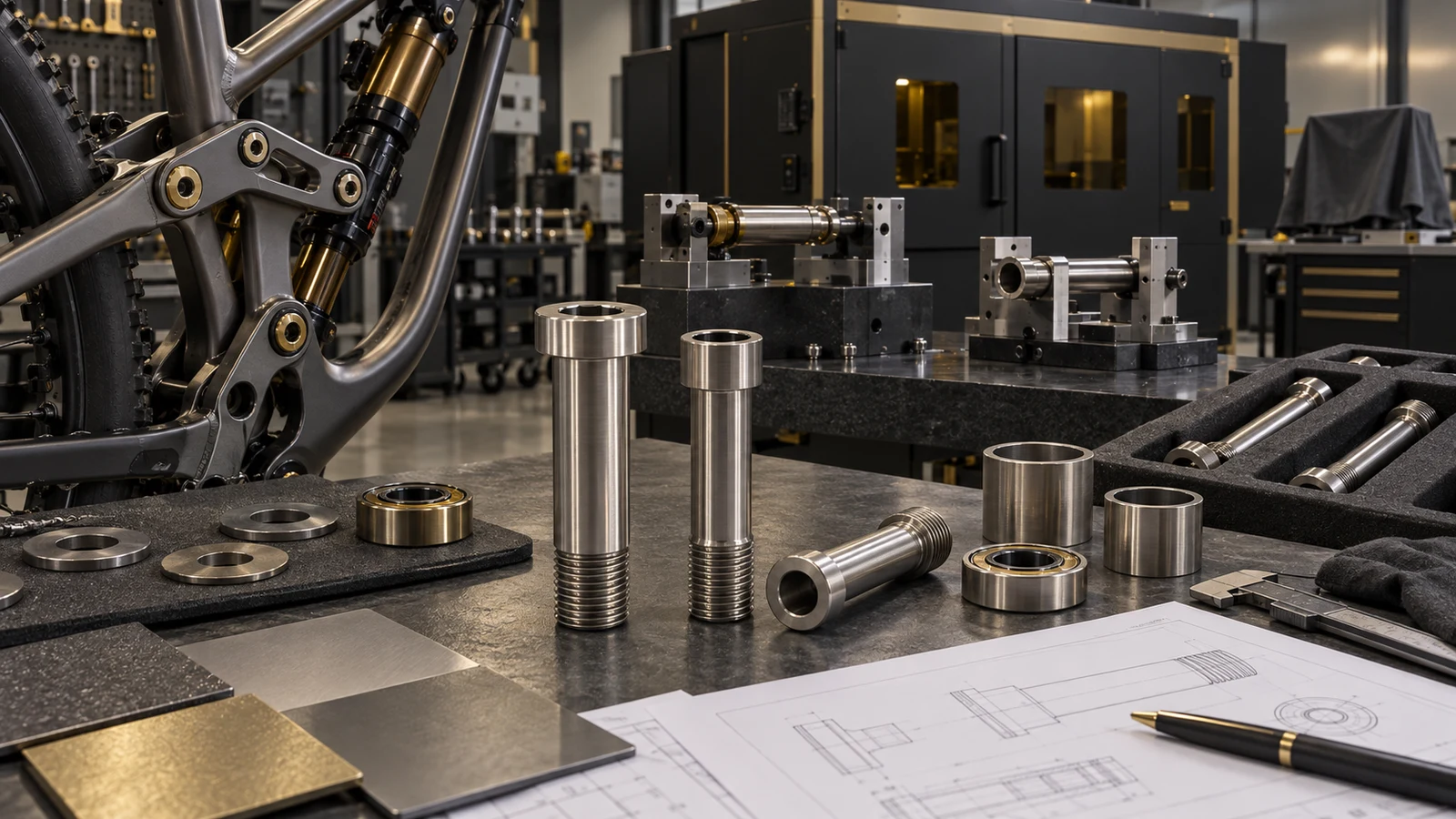
Laser shock peening is a development option for titanium hardware, not an automatic fatigue upgrade for every pivot bolt. For a hollow shoulder bolt, first identify the local fatigue concern and the geometry surrounding it. Treatment access, wall thickness, material condition and subsequent operations affect what a proposed route must demonstrate. Published results on other specimens can explain the mechanism but cannot approve this bolt or predict riding life. In particular, do not assume that a process intended to create deeper compression behaves identically in a thick specimen and a thin section. Review residual state, final geometry and relevant fatigue evidence as separate development outputs.
Hero: concept illustration of example hardware and its application. It is not a factory photograph, tested component or approved production geometry.
Start with the feature and failure mechanism
Identify whether the concern is the head transition, thread runout, a cross-hole or another loaded region. Describe the part's role in the joint and the available evidence for that concern. A request for 'maximum fatigue' gives the provider no defined region or comparison objective.
For engineering assessment, distinguish an observed failure from a proposed design concern. Preserve the relevant part and manufacturing history if a failure has occurred; do not diagnose its cause from a generic photograph or assume that a surface-enhancement route addresses every possible mechanism.
The pivot FEA scope guide helps define represented geometry and load assumptions. A structural model can identify questions for development, but its stress plot is not evidence that a particular laser treatment produced the desired residual state.
Understand the shock mechanism without copying a recipe
Curtiss-Wright's laser-peening overview describes laser-induced plasma pressure, confinement and plastic strain that can produce residual compression. It also identifies dependence on material, stiffness and processing parameters. This is mechanism context, not a qualified instruction for the ordered bolt.
Ask the specialist to describe the proposed process variant, surface preparation, treatment pattern and control scope. Do not prescribe energy, pulse duration, water-layer conditions or overlap from a general article. Those inputs belong to an application-specific development route.
Laser identification is a different operation: the marking guide concerns traceability and location. A supplier offering laser marking has not thereby established laser shock peening capability or fatigue validation.
| Proposed evidence or option | When it is useful | Unresolved risk | Relevant assessment |
|---|---|---|---|
| Published thick-specimen result | Background for the proposed mechanism | Hollow-wall boundaries not represented | Actual section geometry and support |
| Trial on an accessible flat surface | Initial process exploration | Critical recess or transition not addressed | Access and treatment pattern on required region |
| Residual-stress evaluation | Assessment of the represented final state | Measurement context or later processing omitted | Region, direction, depth and delivered state |
| Relevant component fatigue comparison | Evidence for defined load and endpoint | Different baseline or assembly state | Matched conditions and result interpretation |
| Final dimensional inspection | Checks thread and locating features | No fatigue benefit established | Independent fit and treatment acceptance |
| Whole-part treatment proposal | Only if its full scope is justified | Unneeded zones or geometry response overlooked | Specialist review of actual treated and excluded features |
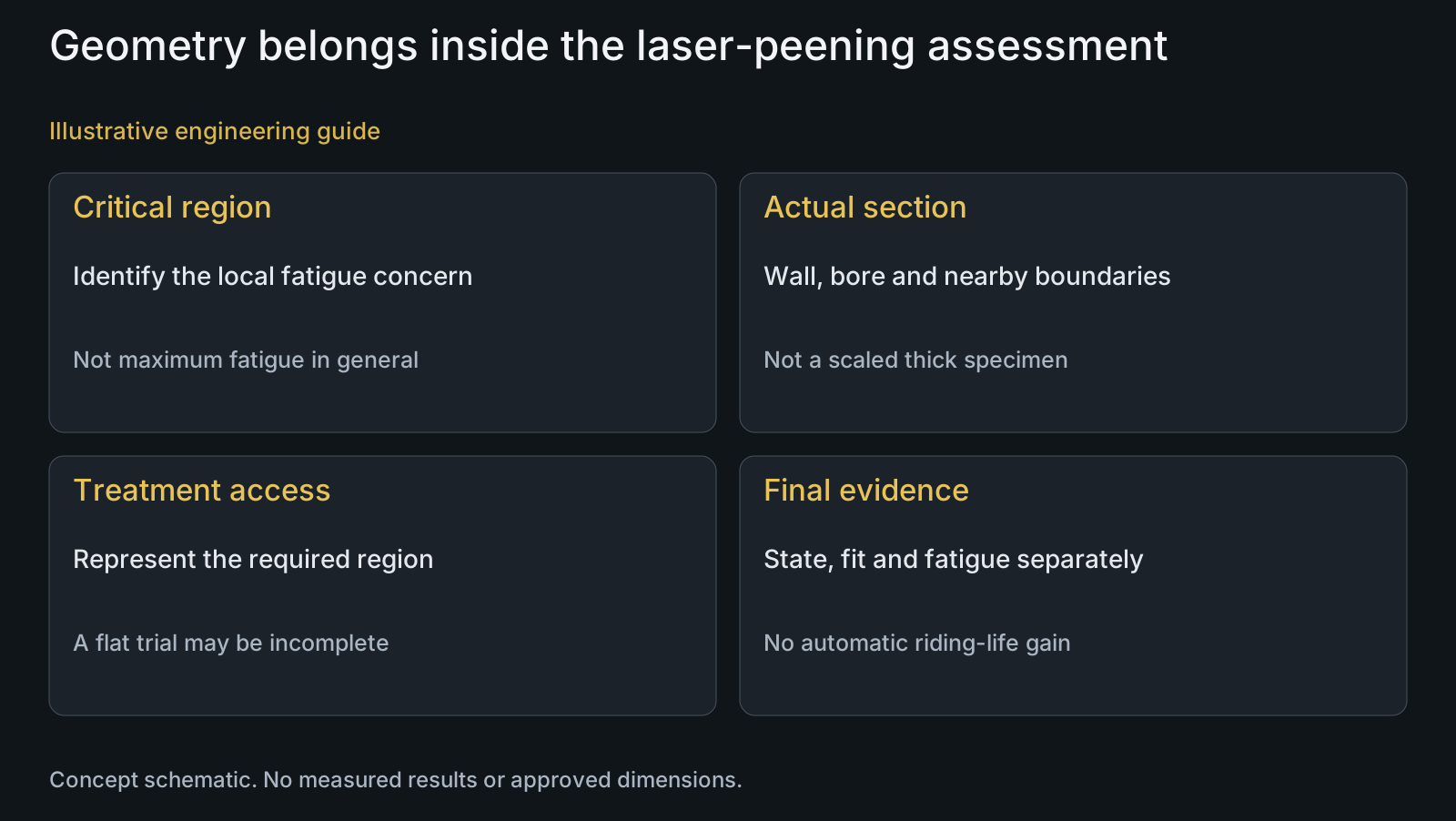
A hollow section is not a scaled thick specimen
Nie and colleagues' thin titanium-component study examines TC17 sheet through modeling and experimental stress evaluation. It shows that reflected stress waves and section boundaries can change the residual-stress outcome, including unfavorable tensile regions under the investigated conditions.
That finding does not predict that a particular hollow TC4 pivot will develop the same state. It supports a narrower engineering judgment: wall geometry and support conditions cannot be ignored when transferring a process from thick stock or another component.
Provide the actual wall, bore, transitions and recesses in STEP and drawing form. Ask how the development assessment represents those features and any support arrangement. Do not invent a universal minimum wall thickness or assume that stronger exposure always creates a more favorable final stress field.
Map access and downstream material changes
Identify the intended treatment region, adjacent excluded surfaces and available access around the part. A visible head face may be easy to address while a recessed transition or thread region presents a different setup question. Have the provider confirm the represented geometry rather than infer access from an exterior photograph.
As manufacturing analysis, include any later machining, finishing or thermal operation in the proposed route. Evidence describing an intermediate treated surface does not automatically describe the condition after additional material removal or processing. Agree the state at which the claimed benefit will be evaluated.
Keep delivered thread and shoulder requirements independent. The blasting and peening guide distinguishes appearance and controlled mechanical surface treatment; an acceptable texture does not establish the intended laser-peening outcome either.
Measure the intended state and compare relevant fatigue behavior
Define what residual-stress evidence must represent: region, direction, depth where relevant, measurement method and part condition. The titanium residual-stress guide explains why a reported value needs measurement context. No measured profile is supplied for these pivots.
A favorable residual-stress result is not itself a fatigue-life result. Define the compared component or specimen, material, starting surface, loading mode, baseline and failure or stopping criterion. Keep specimens reaching a stop condition distinct from those that failed; neither supports unlimited service life.
The development question is whether the proposed route helps the relevant mechanism without unacceptable feature changes. Do not turn a published gain, an open coupon result or a modeled stress field into a percentage improvement for a finished assembly. A generic cycle test is not a complete reproduction of riding.
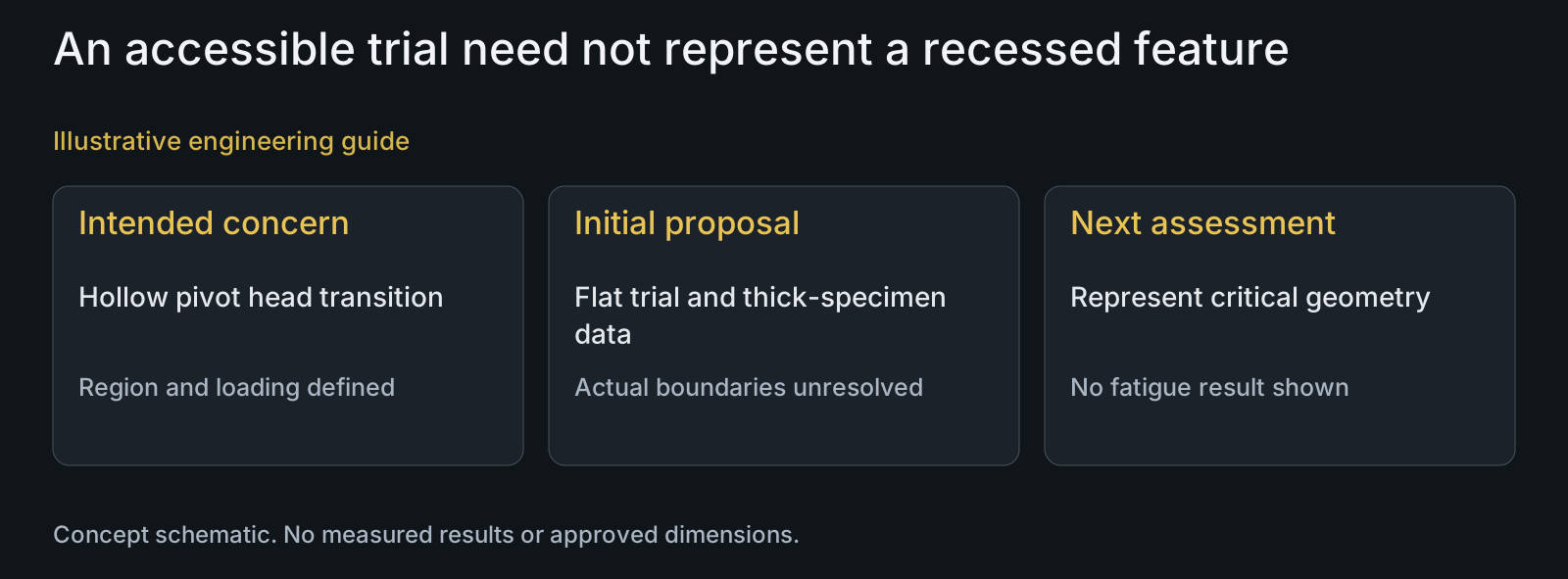
An open-head trial can leave the critical region unanswered
Illustrative engineering example: assume a hollow titanium pivot has a fatigue concern near a recessed head transition. A provider proposes a preliminary trial on an accessible flat surface and supplies general thick-specimen process data. No failed part or trial outcome is assumed.
The trial may help explore the route, but it does not yet represent the critical transition, wall boundaries or final assembly loading. The OEM asks the specialist to define the geometry and state represented by the next assessment, with separate final-fit and fatigue objectives.
No measured compression depth or life gain is asserted. PremFixer can review manufacturable geometry and discuss surface-treatment coordination, but specialist laser-peening provision and the validation responsibility need confirmation. No owned laser-peening cell, qualified pivot route or routine fatigue improvement is claimed.
Questions buyers need to confirm
Can laser shock peening be considered for titanium pivots?
It can be considered as a development option, not an already qualified finish for every bolt. Define the actual feature, material condition, proposed specialist route and evidence needed for the intended application.
Can a published fatigue gain be used in the quotation?
Not as a guaranteed result for a different pivot. State the represented specimen and conditions if discussing background research, and keep order-specific validation separate.
Does deeper compressive-stress potential always favor a hollow bolt?
No automatic conclusion is justified. Thin-section research shows boundary interactions can change the residual state. Review the actual wall, support and process rather than transfer a thick-specimen claim.
Does a stress measurement replace a fatigue comparison?
No. It evaluates a represented stress state. A fatigue claim needs relevant loading, baseline and endpoint evidence, while delivered dimensions remain a separate requirement.
Is a laser-marking supplier necessarily able to laser peen the part?
No. Marking and shock peening have different purposes and process requirements. Confirm the responsible specialist and application-development provision instead of inferring it from the word laser.
What should the development RFQ include?
Provide drawing and STEP with wall and critical-transition geometry, material condition, proposed zones, final features and subsequent operations. Include the fatigue concern, available load and failure information, comparison baseline and intended evaluation scope.
Technical references and scope
Curtiss-Wright: Laser-peening mechanism. Mechanism and dependence on material, stiffness and process context. No numeric depth, process recipe or supplier outcome transferred to pivots.
Nie et al.: Residual stress profile in thin titanium components. TC17 sheet modeling and experimental evaluation support geometry-sensitive stress-wave assessment. Not a prediction, numerical recipe or fatigue result for a hollow TC4 pivot.
Explore related component, material and sourcing decisions in the customer decision knowledge center. For a drawing review, use the Drawing/BOM RFQ path.
Define a geometry-specific laser-peening development question
Send the drawing and STEP, titanium condition, hollow-wall and transition details, marked treatment zones and final interface requirements. Include the known fatigue concern and available loading or failure evidence. PremFixer will review manufacturing interfaces and potential specialist coordination without promising a transferred life gain or an already qualified laser route.
Discuss the drawing and BOM