
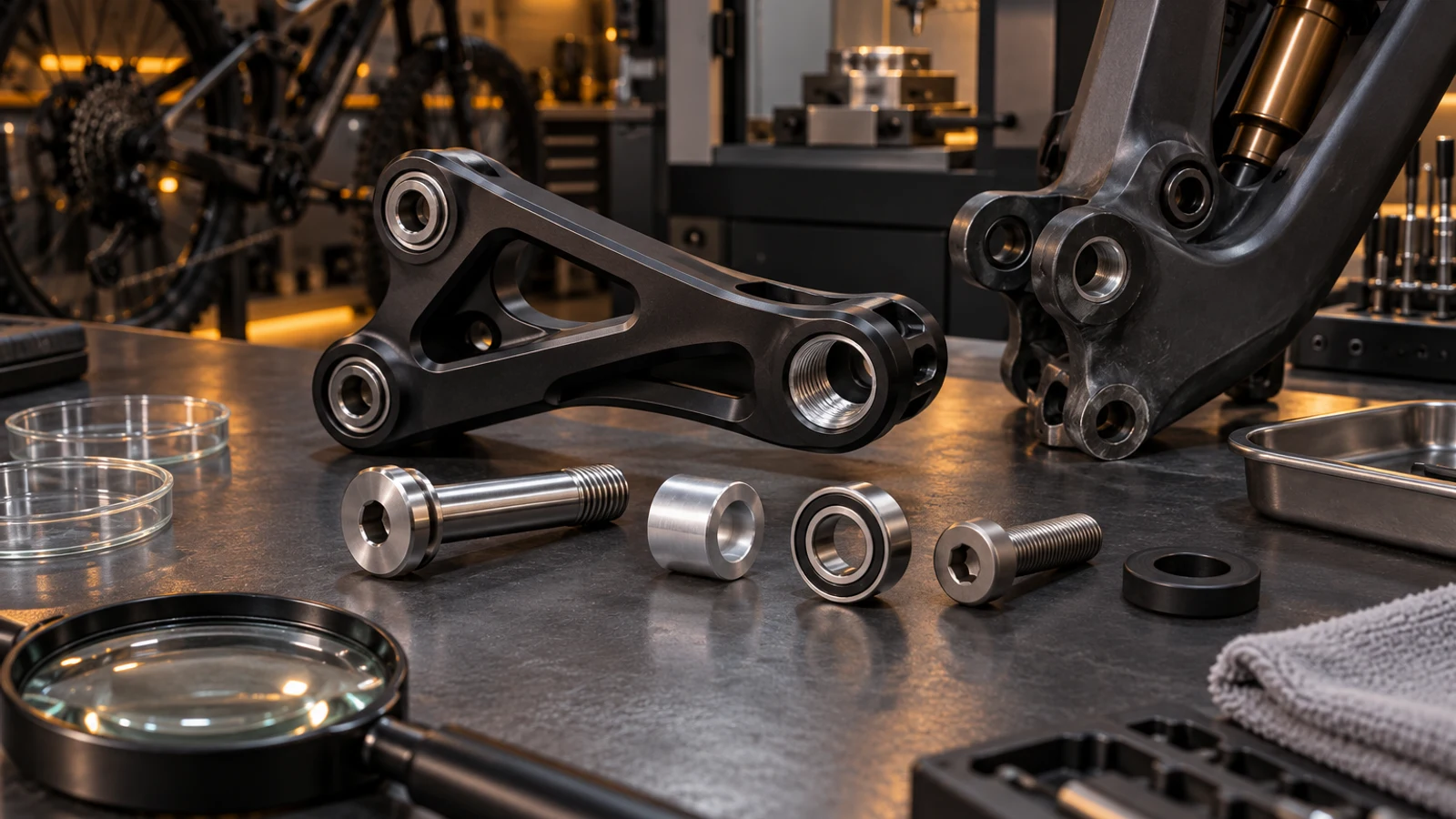
Stainless bolts in aluminum pivots are not automatically a forbidden combination, and a mark beside a bolt does not prove galvanic corrosion. For a service complaint, first identify which surface is affected and whether the observation is deposited material, coating change or substrate damage. Review electrical contact, wet exposure and any hardware or maintenance change. Galvanic effects, sheltered crevice conditions and contamination are different hypotheses, even when they occur near the same washer. Do not fit an insulating washer or substitute an alloy solely from a photograph. The damaged component's acceptance and the proposed corrective configuration both need a component-specific basis.
Hero: concept illustration of example hardware and its application. It is not a factory photograph, tested component or approved production geometry.
Identify the affected member before naming the mechanism
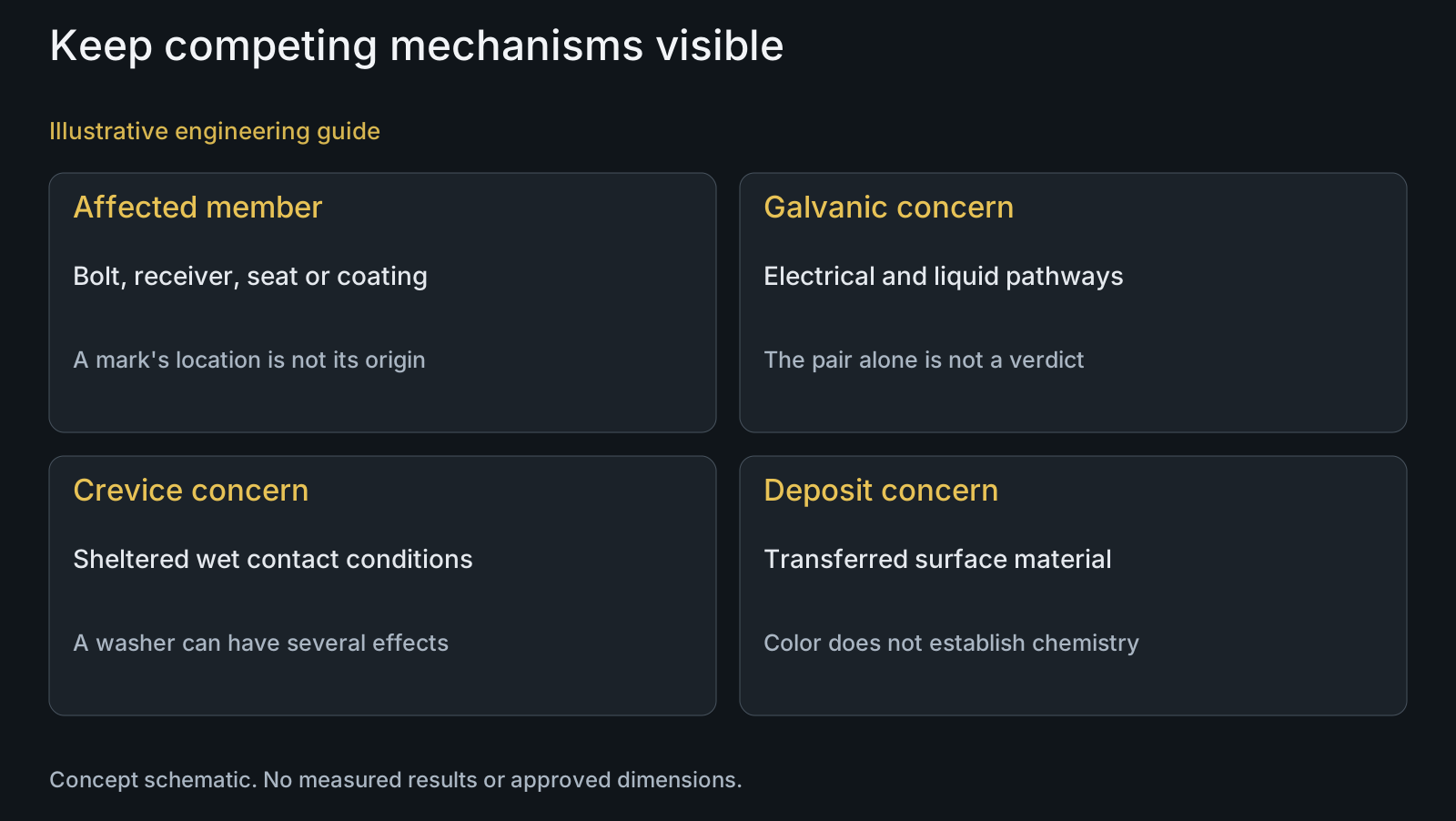
Locate the observation on the bolt, receiving aluminum, bearing ring, washer or coating. Keep part identity and the functional surface in the record. A deposit on a stainless head and material loss in an aluminum receiving thread are not interchangeable complaints.
BSSA notes that corrosion products from a coupled material can stain stainless surfaces. This supports separating where a mark appears from where the affected material originates. Color alone does not establish a chemical identity, corrosion depth or mechanical acceptability.
Record the condition before permitted cleaning changes the evidence. If there is pitting, loss of a seating feature, damaged thread or uncertain structural security, use the applicable component assessment rather than treating the task as cosmetic cleaning. The cleaner-compatibility article addresses a separate choice of permitted cleaning product.
Compare galvanic and crevice hypotheses rather than one slogan
BSSA's galvanic guidance requires electrical contact and a conductive liquid connecting the relevant materials, with area and environmental conditions affecting the result. The pair's appearance on a potential table identifies a review question; it does not determine the cause of this returned assembly's condition.
BSSA separately describes crevice attack associated with sheltered, oxygen-depleted wet regions and chloride accumulation. A washer or retained deposit can create that environment without making a dissimilar-metal explanation sufficient. Different mechanisms can also need assessment at different members of the same joint.
Do not classify a pit or stain by location alone. Ask what evidence supports each proposed mechanism and what observation would contradict it. This diagnostic task differs from designing stainless/aluminum isolation, which starts with the proposed interface rather than a service complaint.
| Observation or history | Possible concern | What it does not prove | Useful investigation |
|---|---|---|---|
| Mark on stainless head | Deposit or substrate condition | Receiving aluminum is acceptable | Locate source and inspect affected members |
| Attack near a sheltered washer | Crevice environment, finish or coupling | One mechanism from location alone | Contact condition, wet retention and treatments |
| Stainless contacts aluminum | Potential galvanic pathway | Every mixed-metal pivot is forbidden | Actual electrical/liquid connection and exposure |
| Complaint after bolt substitution | Configuration change worth reviewing | Timing establishes material causation | Before/after parts, preparation and exposure |
| Visible mark removed by cleaning | Changed exterior observation | Working geometry or integrity restored | Feature-specific component acceptance |
| Isolation washer proposed | One corrective interface option | Cause solved with unchanged mechanics | Supported pathway and complete stack review |
Reconstruct the service change without treating timing as proof
Compare the released configuration with the installed condition: exact hardware, finishes, washers, spacers and assembly products. Establish whether parts were substituted, treatments removed or a new cleaning method introduced. A missing specification field is an uncertainty, not evidence that an alloy was defective.
Also compare wetting, storage and maintenance exposure. A complaint first noticed after a bolt change may coincide with salted riding or a different wash routine. The sequence helps organize the investigation but does not by itself isolate causation.
Retain the original mating-member condition and installation history where available. The aluminum substitution review covers protection requirements when a material change is proposed. Here the immediate decision is which change, if any, is actually supported as a contributor to the observed problem.
Keep detection of corrosion separate from part acceptance
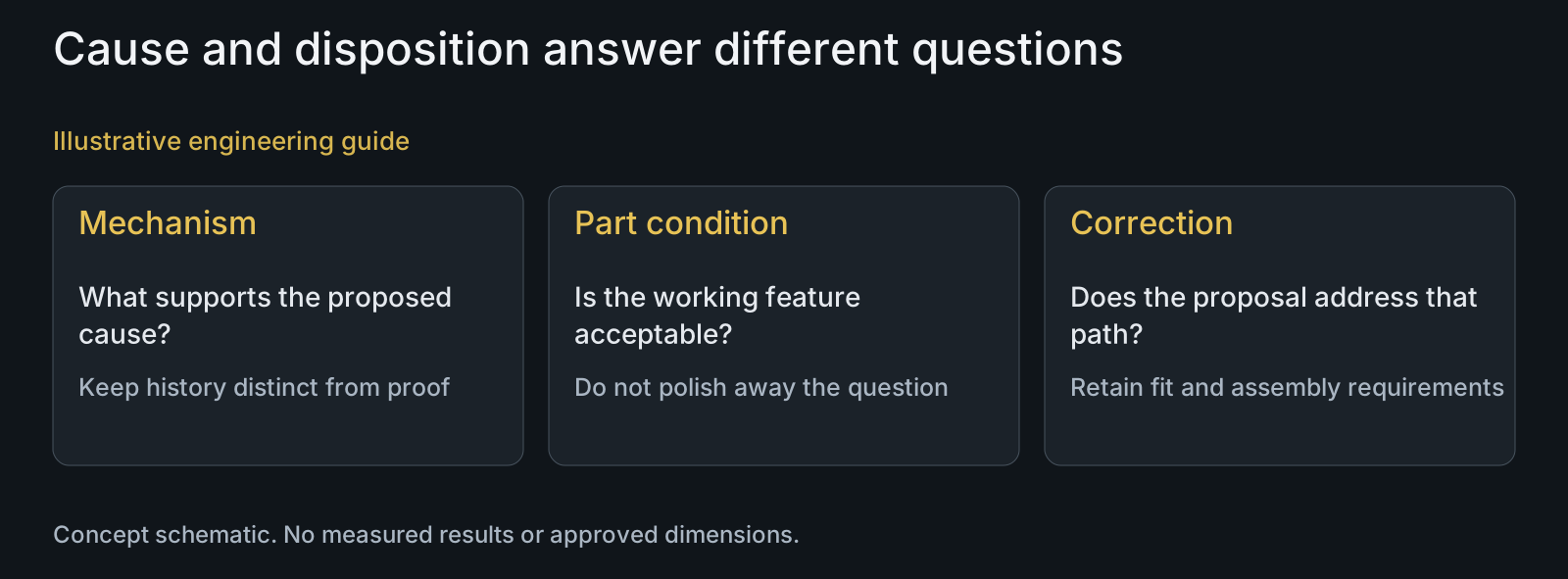
A corrosion mechanism explains possible attack; it does not provide an allowable defect for a receiving thread, locating diameter or loaded seat. Identify the affected feature and its drawing or service criterion. Architectural claims about superficial attack cannot clear a structural pivot's working surface.
Where the condition is uncertain, request the responsible inspection and disposition instead of polishing until the mark disappears. Removing material can change fit and erase the evidence being assessed. A visually clean bolt cannot accept a damaged mating receiver.
Replacement scope may include another affected member or an assembly condition, not only the visible fastener. Use drawing-based fit requirements to communicate functional features. This article supplies no allowable pit depth, universal reuse criterion or permission to continue riding a suspect joint.
Select a corrective action that addresses the supported pathway
If the supported concern is an electrical coupling with wet exposure, review an approved protection or interface change. If retained contamination and a crevice are central, the access, geometry and care method may need attention. If the observation is a transferred deposit, changing the bolt alloy may not address its source.
The proposal still has mechanical constraints. A washer or protective treatment cannot silently change seating, usable engagement or the released preparation. Do not add a generic soft isolator or grease and assume both corrosion and clamp requirements are solved.
Compare the proposed assembly with the same affected feature and exposure, not only the appearance of a loose replacement. Anti-corrosion manufacturing scope can support specified finishes and hardware; it is not a universal field remedy or a corrosion-life promise.
Review example: a mark after a hardware change
Illustrative engineering example: assume an aluminum pivot receives a replacement stainless screw, and a mark is later noticed near a washer after wet-road use. The prior washer contact, cleaner and finish condition are unknown. No chemical analysis, dimensional loss or confirmed galvanic failure is supplied.
The reviewer documents both members and reconstructs the installed configuration and exposure. It considers transferred deposits, a sheltered wet contact and galvanic coupling without declaring one proved. The receiving feature's service disposition remains separate from those hypotheses.
An insulating-washer proposal is not approved solely because stainless and aluminum appear together. The team first resolves the supported pathway and then reviews the mechanical and protection requirements of its corrective proposal. This scenario demonstrates disciplined cause selection without inventing damage measurements or a successful repair.
Questions buyers need to confirm
Does a mark beside a stainless screw prove galvanic attack on aluminum?
No. Establish the affected substrate and actual electrical and wet pathways. Deposited products, a crevice environment or a finish condition can require different investigations. Location and material names alone are insufficient to assign the mechanism.
Can corrosion products from another part mark the stainless head?
Yes, BSSA identifies transferred-product staining as a possibility. It is not proof in a particular case. Record both members and seek the appropriate assessment rather than infer substrate damage or its source from color alone.
Does damage under a washer have to be galvanic corrosion?
No. A sheltered wet region can also raise a crevice or retained-contamination question. Identify contact geometry, finishes and exposure and compare competing explanations. The washer's location does not determine which mechanism is active.
If corrosion starts after a bolt change, is the new alloy necessarily responsible?
No. The change is relevant history, not isolated causal evidence. Compare parts, treatments, installation products and wet/cleaning exposure before and after the event. Missing original-condition information must remain explicit.
Can cleaning or an insulating washer automatically restore the joint?
No. Cleaning changes the observation, not necessarily functional geometry. A washer proposal needs a supported protection purpose and mechanical review. The actual affected thread, seat or locating surface requires its component disposition separately.
What should a mixed-metal corrosion complaint include?
Provide part/model identity, installed and original BOM where available, materials/finishes, affected-location views, service changes and wetting/storage/cleaning history. Include component acceptance requirements. Keep suspected mechanisms separate from findings so a replacement quotation does not become an unsupported diagnosis.
Technical references and scope
BSSA: Bimetallic Corrosion. Electrical/liquid prerequisites, exposure dependence and transferred corrosion-product staining. Architectural safe-pair examples not adopted as bicycle approval.
BSSA: Corrosion Mechanisms in Stainless Steel. Distinction between crevice and galvanic mechanisms and limitations of potential-table inference. Architectural harmlessness claims, numeric crevice dimensions and chemical thresholds excluded.
Explore related component, material and sourcing decisions in the customer decision knowledge center. For a drawing review, use the Drawing/BOM RFQ path.
Quote the assessed replacement configuration, not a guessed cause
Share the approved drawings or STEP, original and proposed BOM, material/finish definitions and the affected-interface assessment. Add exposure and assembly requirements and specify the replacement scope. PremFixer can review custom hardware and specified protection; the component authority retains damage disposition, corrective-design approval and return-to-service responsibility.
Discuss the drawing and BOM