
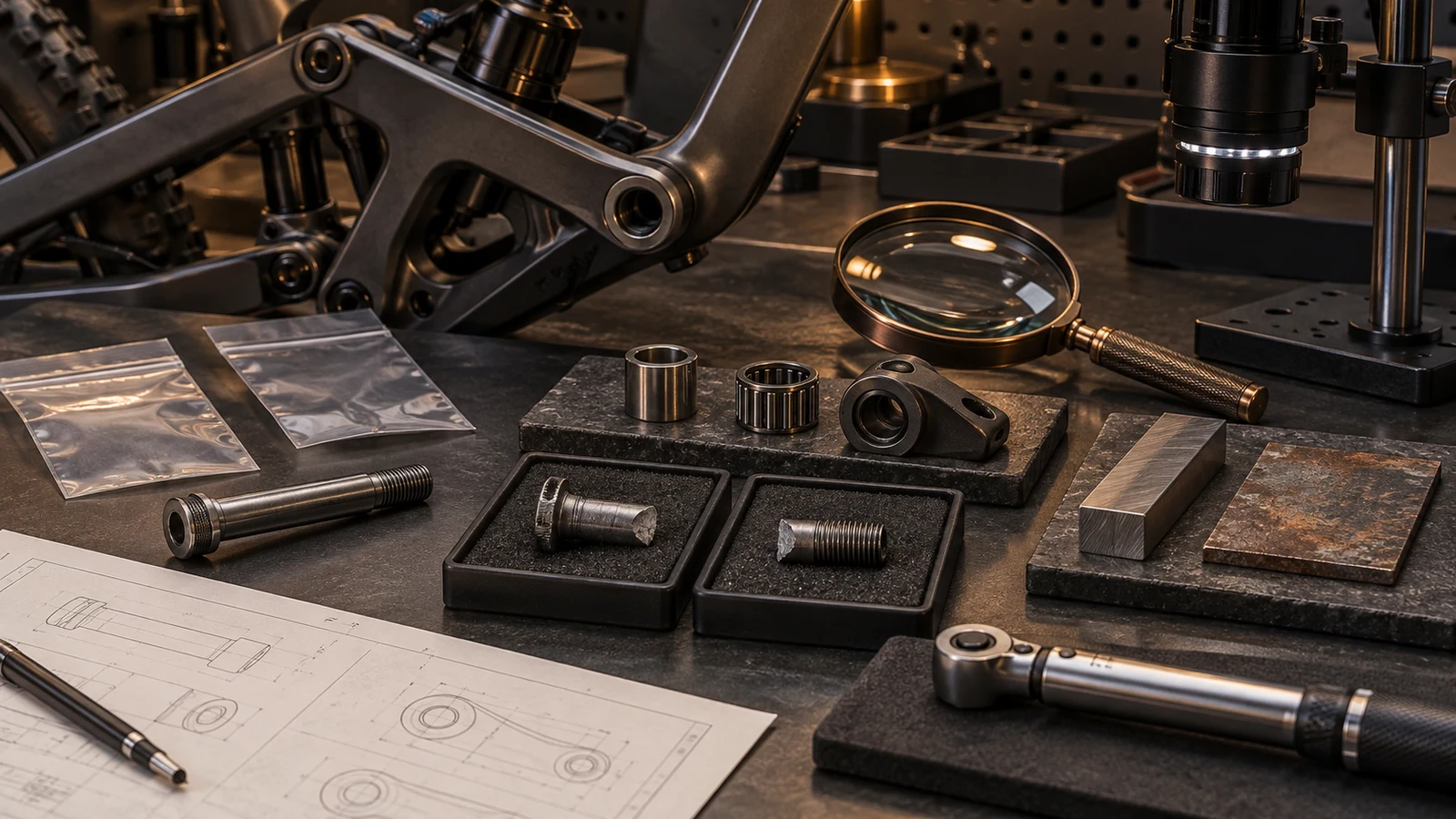
A broken bicycle pivot bolt cannot be assigned a cause from one photograph or the fact that it broke during tightening. Stop using the bicycle with broken or suspected structurally damaged pivot hardware and seek the responsible manufacturer's or qualified service assessment. Preserve the pieces and mating components. For an OEM investigation, compare five possible branches: assembly overload, cyclic damage, seizure-related damage, corrosion and material or process concerns. These are not ranked causes or an exhaustive list. Establish the damage chronology and select evidence that distinguishes the live explanations before changing material, geometry, assembly instructions or manufacturing controls.
Hero: concept illustration of example hardware and its application. It is not a factory photograph, tested component or approved production geometry.
Preserve the configuration and the sequence of events
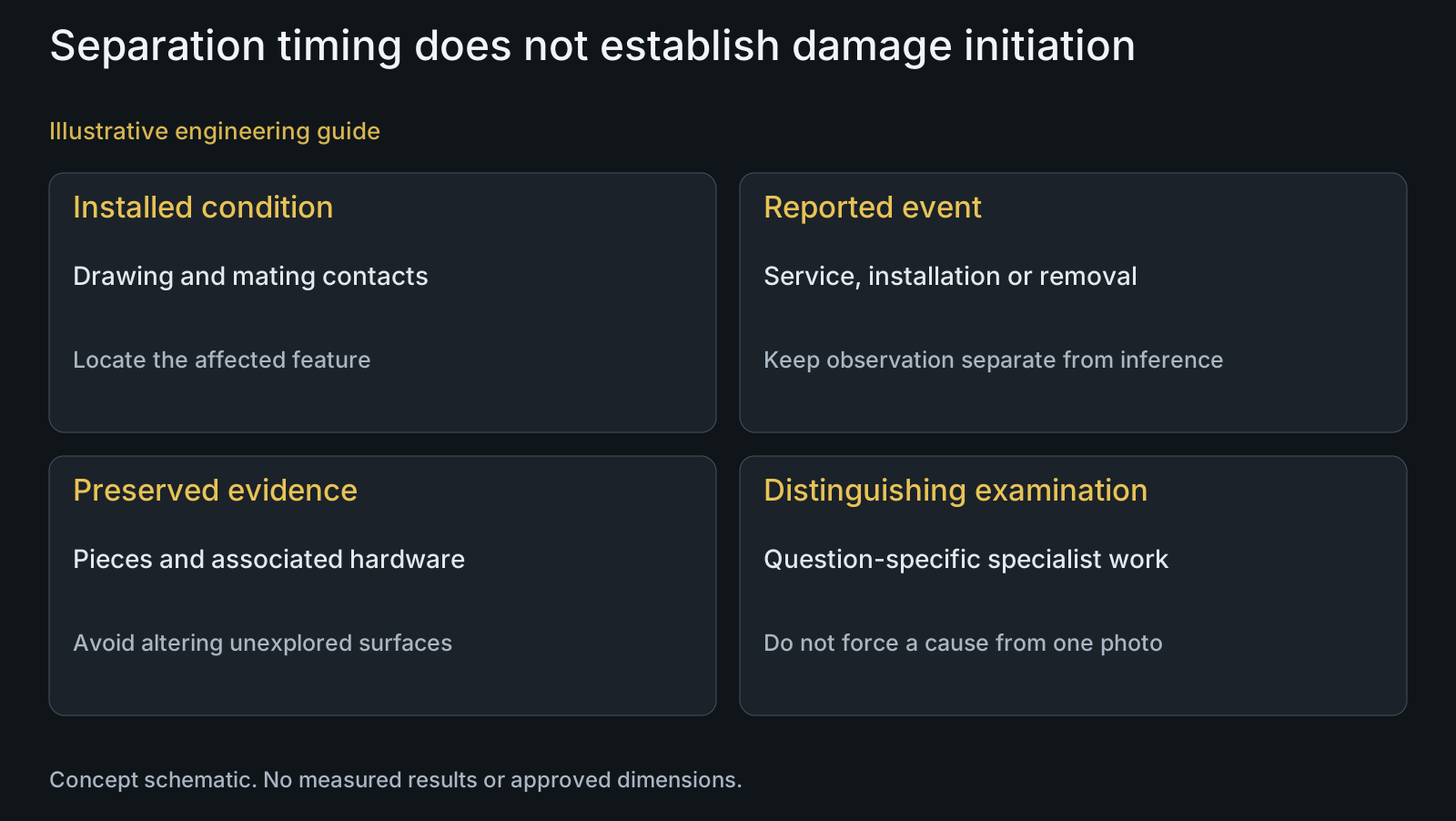
Record where the bolt was installed, its orientation and the drawing revision. Identify whether separation was noticed in service, during installation or during removal. Keep reported timing separate from the inferred time at which damage began; those can differ.
Retain the pieces, receiver, sleeve, washers and relevant bearing or bush information with their identities. Avoid bringing the broken faces together, polishing them or attempting a repair before the examining specialist sets the handling plan. Document any intervention already performed rather than hiding altered evidence.
ASM's public fracture-specimen preservation overview identifies care, observation, collection and preparation as relevant to examination. Its paid procedure is not reproduced here. The fracture-observation guide examines surface interpretation; this article compares five causal investigation branches across materials.
Separate assembly overload from earlier cyclic damage
For an assembly-overload hypothesis, examine the applicable instruction, intended surface condition, tool records and actual contact stack. A reported torque reading needs its units, tool identity and operation context. It does not directly establish the resulting bolt tension or prove that the intended contacts closed.
For cyclic damage, relate a possible origin to the drawing feature, support arrangement and service history. TWI describes fatigue crack initiation and growth followed by final separation of the remaining section. A final overload region therefore does not automatically exclude earlier cracking.
These branches need different comparisons. Assembly records help evaluate an installation event; preserved surface examination and loading context help evaluate progressive damage. The fatigue-test scope guide explains why a proposed test must represent the relevant loading rather than assign life from an alloy label.
| Possible branch | Useful distinguishing input | What is not proof | Correction question if supported |
|---|---|---|---|
| Assembly overload or over-torque | Instruction, tool/event record and contact stack | Break during tightening alone | Which assembly condition or control changes? |
| Cyclic damage | Located origin, growth interpretation and load/support history | One rough final separation region | Which repeated stress or local feature changes? |
| Galling or seizure-related damage | Both threads, material transfer and removal sequence | Difficult turning alone | Which contact, surface or service condition changes? |
| Corrosion involvement | Located attack, fracture relationship and exposure | Rust elsewhere on the bicycle | Which actual exposure or sheltered contact changes? |
| Material or process concern | Lot-linked condition and targeted examinations | Certificate or isolated image alone | Which established supplied feature or control changes? |
Investigate seizure with both mating threads
A screw that became difficult to turn and then separated during removal creates a different evidence question from a bolt found broken after use. Record the removal tools and operations, but do not assume that the final operation created all of the original damage.
BSSA describes galling as adhesive wear involving material transfer between loaded surfaces in relative motion; severe cases can seize. For a thread hypothesis, the male and female surfaces and supplied condition matter. Difficulty turning alone does not distinguish galling from corrosion, contamination, thread damage or another obstruction.
Review the mating materials, thread definition, finish, permitted consumables and service history. Do not prescribe extra force, heating or drilling as a general removal method. The responsible service team should control extraction and receiver assessment while preserving evidence useful to the investigation.
Keep corrosion and material/process concerns evidence-bound
Locate corrosion or deposits relative to the fracture, contacts and exposed surfaces. Record wet or contaminated service and cleaning history where known. Visible rust somewhere on the assembly is not proof that corrosion initiated the break, and its absence in a photograph does not settle sheltered-contact conditions.
For a material or process concern, identify the actual grade, condition, lot and delivered feature. Chemistry, hardness, dimensional assessment, microstructure and fracture examination answer different questions. Select the relevant specialist work rather than request every available test without a hypothesis.
A material certificate neither excludes every manufacturing issue nor proves that all parts in a population share one returned specimen's condition. Use the material-identification guide and metallographic review within their scopes. PremFixer does not claim an owned failure-analysis laboratory or a completed diagnosis.
Tie prevention to a supported mechanism, not a stronger grade
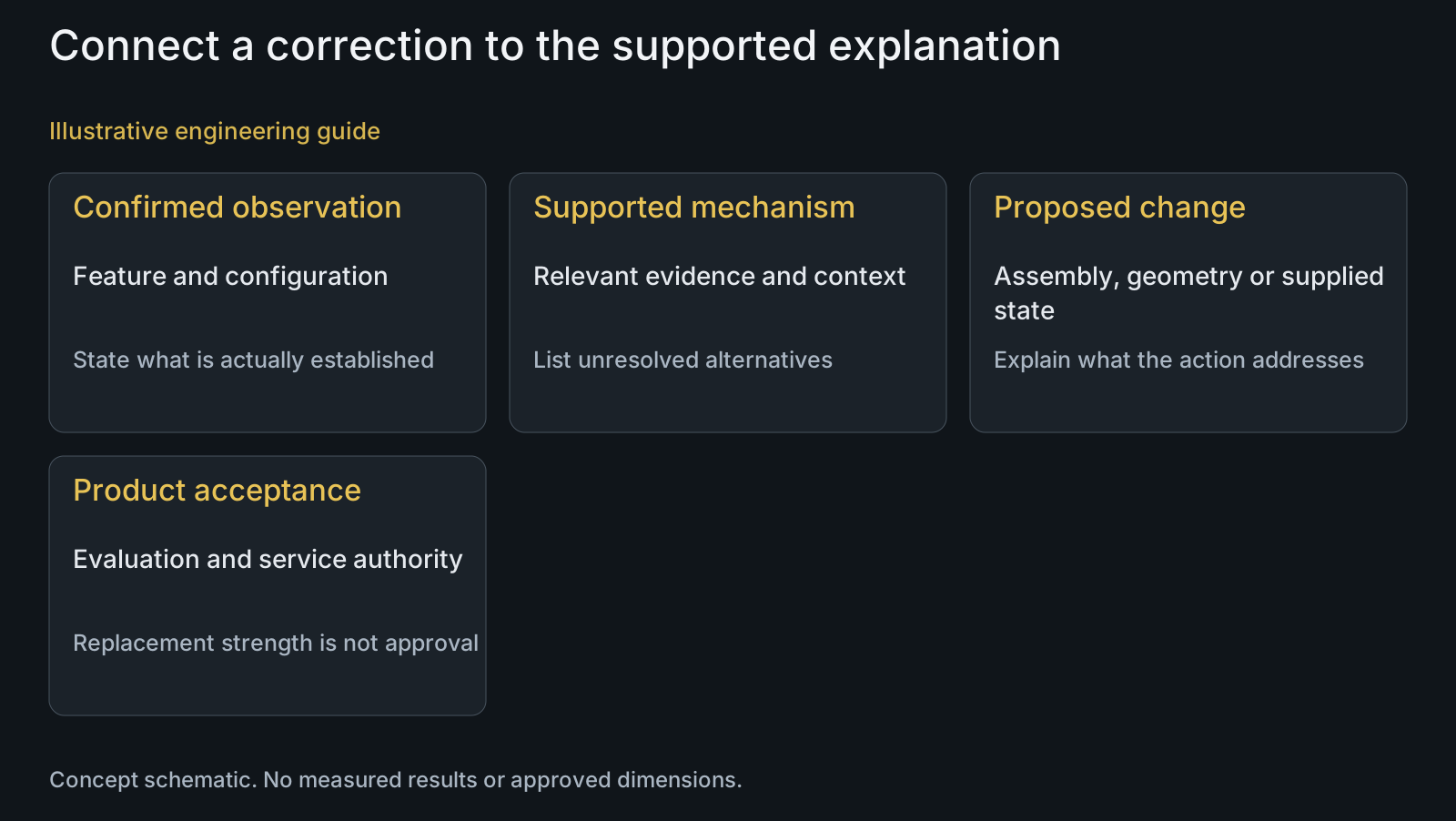
Engineering analysis: an assembly-condition correction, changed support, altered surface route and material change address different mechanisms. A higher-strength bolt cannot by itself resolve a seized receiver, uncertain clamp stack or local contact condition. State what the proposed action changes and which evidence supports that choice.
Discuss drawing-based changes through manufacturing and surface treatment only after the affected features are identified. The NASA Fastener Design Manual's official description includes torque, corrosion, lubrication and fatigue as separate design topics; it is not a bicycle repair instruction or proof of a cause here.
The responsible product team controls containment, replacement compatibility and return to service. The corrective-action guide distinguishes a reported problem from a supported correction and its evaluation. No recurring failure percentage, successful remedy or fleet-wide conclusion is established in this article.
Review example: separation during removal leaves two live branches
Illustrative engineering example: assume an OEM receives a pivot bolt that separated while being removed. The receiver was reported difficult to turn, and a close-up photograph shows an irregular face. No examination result, torque record or confirmed cause is supplied.
The reviewer preserves both threads and the separated pieces, records the removal sequence and locates the fracture on the drawing. It asks whether earlier crack growth was present and whether thread seizure or another obstruction contributed to the final operation. Neither the photograph nor the timing selects one explanation.
The proposed examination targets those alternatives before selecting a correction. If evidence supports a particular mechanism, the team can assess the corresponding geometry, processing or service change. The example reports a diagnostic decision structure, not an actual customer failure or successful repair.
Questions buyers need to confirm
Can a photograph tell us why the pivot bolt broke?
Not completely. It can guide where examination should focus, but needs the preserved pieces, installed location, mating components and history. Separate visible observations from supported mechanisms and unresolved causes.
Does breaking during removal prove excessive removal torque caused it?
No. Record the event, tools and receiver condition, then assess possible earlier damage as well as the final operation. Seizure, obstruction and prior cracking remain different questions until evidence distinguishes them.
Does a final overload region rule out fatigue?
No. A crack can grow before the remaining section finally separates. Relate apparent origins and regions through qualified examination and service/loading context rather than assign one label to the whole surface.
Do we need every material test to investigate a returned bolt?
Not automatically. Choose examinations by the live hypotheses and specimen condition. Chemistry, hardness, dimensions and microstructure establish different facts; an unfocused list can consume evidence without resolving the question.
Will a higher-strength replacement prevent another fracture?
Only a supported assessment can answer that for the actual joint. The initiating condition may involve assembly, support, surface, receiver or material. A stronger grade alone is not a demonstrated correction or compatibility approval.
What should accompany hardware sent for investigation?
Provide the drawing and assembly revision, marked location, mating parts, lot identity where known, event/service history and applicable instructions. Record all removal or cleaning already performed and agree specimen handling with the examiner. State the decision required without assigning an unconfirmed cause.
Technical references and scope
ASM fracture-specimen preservation, public abstract. Care, collection, observation and preparation overview only. Paid handling/cleaning procedure not read or reproduced.
TWI Fatigue Testing. General initiation/growth/final-separation mechanism only. No visual diagnosis, fatigue life or alloy-specific rule.
BSSA Galling resistance of stainless steels. Adhesive wear/material transfer and possible seizure mechanism. No proprietary pivot diagnosis or universal material/repair recommendation.
NASA Fastener Design Manual official record. Official scope includes torque, corrosion, lubrication and fatigue. No unreviewed formulas, repair settings or bicycle approval transferred.
Explore related component, material and sourcing decisions in the customer decision knowledge center. For a drawing review, use the Drawing/BOM RFQ path.
Connect returned hardware to a defined investigation question
Share the drawing, assembly and lot identities, photographs before intervention, mating-part information and event/service history. Contact the responsible service team for safety and specimen handling, and identify the evidence question for any manufacturing-record review. PremFixer can discuss drawing-based supply and relevant arranged specialist work without declaring an unexamined fracture cause.
Discuss the drawing and BOM