

Read an MTC's identity and represented product before its test numbers. Confirm the issuer, document reference, order relationship, material specification, grade, heat or lot, form and condition; only then compare the reported results with the actual requirement. The twelve fields below are a buyer's review aid, not a universal certificate layout or a demand for twelve tests. A missing NDT line or heat-treatment chart is not automatically a failure. Determine whether the information is required, non-applicable or unresolved for this order. Keep the material conclusion separate from the finished pivot's dimensional, surface and assembly acceptance.
Hero: concept illustration of example hardware and its application. It is not a factory photograph, tested component or approved production geometry.
Locate identity fields before interpreting values
Start with the issuer and document identity, then identify the represented goods and purchase relationship. A file name chosen by the sender is not necessarily the document's own identifier. Preserve the original reference so a question can be directed to the right record.
SSAB's inspection-document guidance describes order, product, material and result information in its context. It is useful background, not a requirement that every pivot MTC uses the same layout or includes every optional field.
A distributor, stock manufacturer and component manufacturer can be different parties. The titanium-origin guide develops those roles. In this review, locate what the actual document says rather than assume the sender is its original issuer.
Compare the requirement and reported result as separate entries
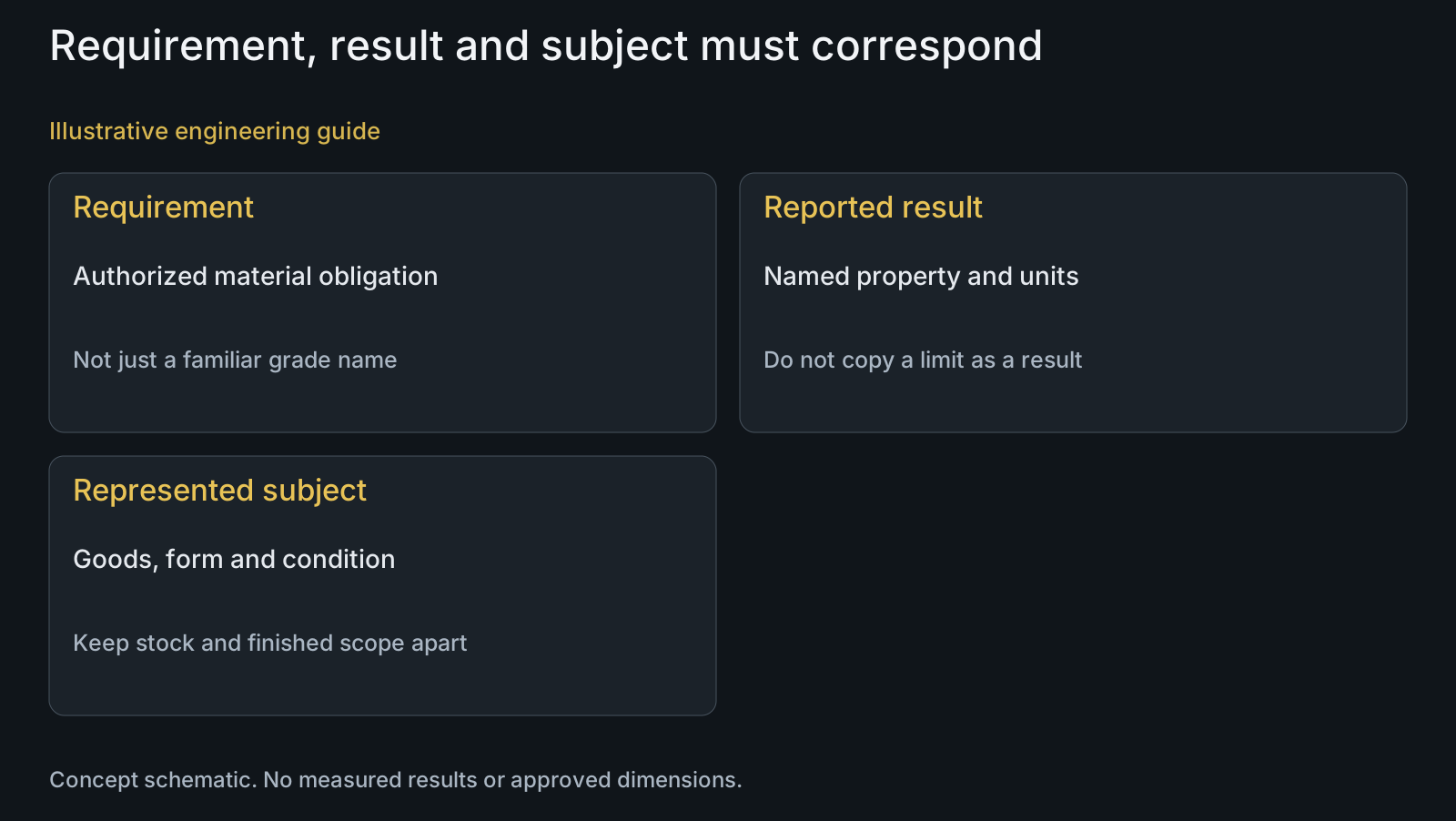
Identify the exact material requirement, edition, grade and represented form. A heading that repeats a familiar alloy label does not independently resolve whether the ordered form and condition are represented.
For chemistry, distinguish a stated limit from a reported result and retain the units and relevant subject. Check the applicable requested composition, not only one familiar element. An empty cell should not be converted into an assumed zero or a guessed conformity result.
Where the document quotes a requirement alongside a result, read both in context. If a value is only a specification limit or descriptive catalogue entry, do not call it a measurement of the supplied material. Ask for clarification of an ambiguous column before making the receiving decision.
| Review field | What to locate | Misreading risk | Useful comparison |
|---|---|---|---|
| 1. Issuer | Original named organization and role | Sender assumed to be material producer | Reconcile actual issuer and supply roles |
| 2. Document identity | Record reference and issue/revision | Attachment filename treated as certificate ID | Preserve original document reference |
| 3. Order link | Represented goods and purchase relationship | Correct-looking file used for unrelated order | Match actual ordered subject |
| 4. Material requirement | Specification and relevant edition | Bare number hides purchase basis | Compare exact authorized requirement |
| 5. Grade | Actual material designation | Alloy confused with fastener property class | Match material field on BOM |
| 6. Heat or lot | Represented material population | Shipment number treated as material heat | Check the required identity relationship |
| 7. Product form | Bar, wire or another named subject | All forms assumed equivalent | Match ordered form and scope |
| 8. Condition | Stated supplied material condition | Appearance called heat-treatment evidence | Compare required state |
| 9. Chemistry | Results, limits, units and subject | One element called complete conformity | Read applicable requested composition |
| 10. Mechanical results | Property, test basis and condition | Stock result called pivot service life | Keep specimen and property scope |
| 11. Additional tests | Any explicitly required assessment | Blank called automatic pass or failure | Resolve applicability and missing evidence |
| 12. Validation and scope | Document type and represented conclusion | Signature called every-product approval | Compare requested role and coverage |
Keep mechanical results tied to their specimen and condition
Read the named property, units, test basis and represented condition. Tensile strength, a yield-related result and elongation are not interchangeable entries. A single plausible number cannot approve every property requested by the order.
ASTM E8/E8M-25's public significance statement notes that standardized specimen results from selected material may not fully represent the end product or service behavior. Do not extend a stock result into a custom pivot's fatigue life or assembled performance.
If the specimen, result basis or condition needed for the required comparison is unclear, identify that particular gap. Request the missing explanation rather than infer a test method from the appearance of a report or the value's decimal precision.
Classify blank and additional-test fields
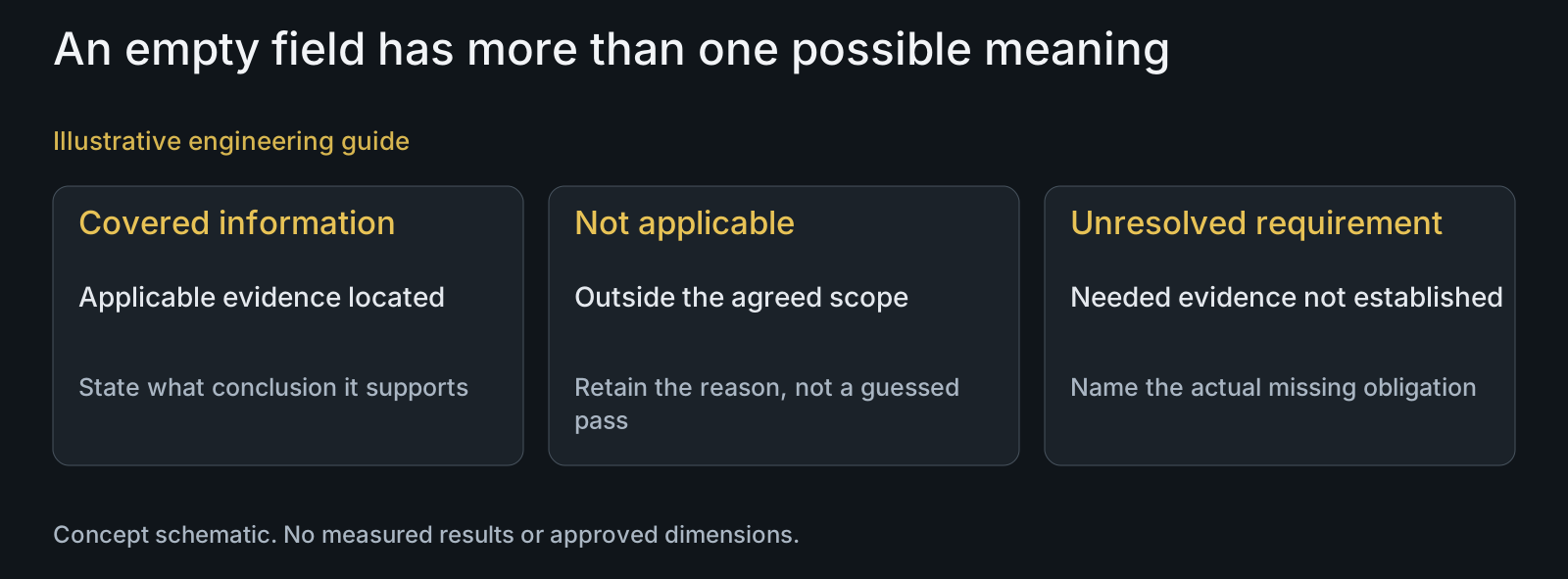
Use three distinct review states: the information is covered, it is not applicable to the agreed scope, or a required item remains unresolved. They are review conclusions based on requirements, not labels that can be assigned merely because a cell is filled or empty.
A generic request for an MTC does not itself specify NDT, a heat-treatment chart or every process record. If one of these is needed, name its required subject and evidence. Do not invent an unperformed test to populate the review sheet.
For a missing required result, ask which obligation it must satisfy and whether applicable evidence is available. For a non-applicable field, retain the reason. This makes a review more informative than a checklist in which every blank is automatically rejected.
Connect the document review to the right hardware item
The BOM identifies which material requirement belongs to which part. A kit's axle, sleeve and washer may need different evidence. Do not extend an axle's stock record to all components merely because the document arrived with the kit.
The stock-allocation guide addresses the connection into manufactured pieces; the inspection-document selection guide addresses type and validation requirements before purchase. Keep those tasks separate from reading the supplied fields.
Record the comparison outcome for the actual item and requirement. Unresolved material evidence should not be hidden by a conforming shoulder measurement, and a complete material review should not be presented as finished dimensional approval. Discuss relevant materials and manufacturing subjects separately.
Review a result-filled report with an empty additional-test line
Illustrative engineering example: assume an OEM receives a stock material document with chemistry and mechanical entries, but its local reading sheet has an empty NDT row. The order's additional-test scope has not yet been reconciled. No real certificate, numerical result or customer event is assumed.
The reviewer first checks whether an NDT requirement applies to the represented goods. If not, the local row can be marked non-applicable with a reason. If it is required and no relevant evidence is supplied, it remains unresolved; filling the other rows does not close it.
The same review distinguishes the reported condition and test subject from the finished pivot's acceptance needs. Use the drawing and BOM RFQ guide to state the evidence requirement clearly on the next order instead of asking a supplier to complete an undefined universal template.
Questions buyers need to confirm
Are these twelve fields mandatory on every MTC?
No. They are a review aid, not a universal layout. Use the actual product and order requirements to determine applicable information and record a reason for non-applicable entries.
Should I read the highest property value first?
No. Establish the represented goods, requirement and condition first. Then identify the property's units and test subject so the number answers the actual material question.
Can a specification limit be recorded as the supplied result?
No. Keep a stated limit and an actual reported result distinct. If the column meaning is unclear, ask the issuer or supplier for clarification rather than infer conformity.
Does a blank chemistry entry mean zero content?
Do not infer that. Determine what the record reports and what the requirement needs. An empty or unclear entry cannot establish an assumed value or close a required comparison.
Must an MTC include NDT and a heat-treatment chart?
Not merely because it is called an MTC. Identify whether those deliverables are required for the ordered product and scope; mark non-applicable fields with reasons and required missing evidence as unresolved.
Does a stock tensile result prove pivot fatigue performance?
No. It addresses its represented property and test subject, not the finished joint's service behavior. Define the component and assembly validation requirements separately.
Technical references and scope
SSAB inspection-document information. Manufacturer context for order/product/material/result fields, not a mandatory twelve-field layout or PremFixer policy.
ASTM E8/E8M-25 public significance and scope. Tension-test subject and limits of extending specimen results to end-product service behavior; no numerical result or method recipe borrowed.
Explore related component, material and sourcing decisions in the customer decision knowledge center. For a drawing review, use the Drawing/BOM RFQ path.
Make the material-review question specific
Send the drawing, STEP or sample reference and BOM with the material requirement, represented product, requested results and available document/lot links. Identify unclear or missing fields and their intended decision so PremFixer can discuss the actual evidence scope rather than an assumed universal MTC template.
Discuss the drawing and BOM