
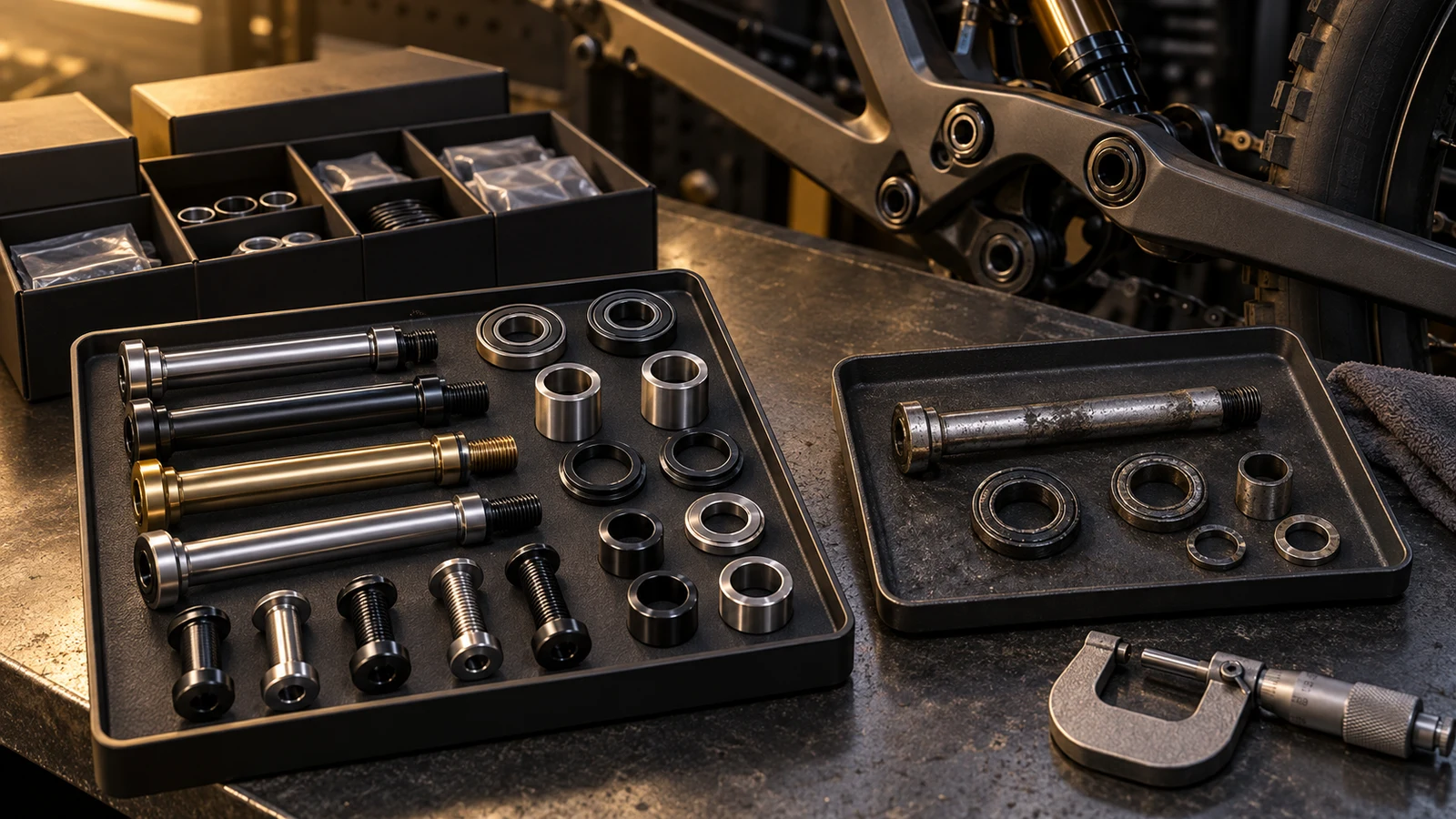
Do not assign every titanium, stainless or aluminum pivot bolt a fixed replacement age. The material name does not describe the component's geometry, loading, finish, wear contacts or assembly history. For an OEM or service-parts buyer, start with the applicable manufacturer's limits and condition criteria for the actual hardware. Keep a prescribed time limit separate from damage, abnormal events and wear that may require earlier action. A part that reaches a laboratory stopping point has not thereby earned a number of riding years. Where structural integrity or retention is uncertain, obtain the appropriate assessment rather than extend service from an alloy label.
Hero: concept illustration of example hardware and its application. It is not a factory photograph, tested component or approved production geometry.
Identify what a replacement interval actually means
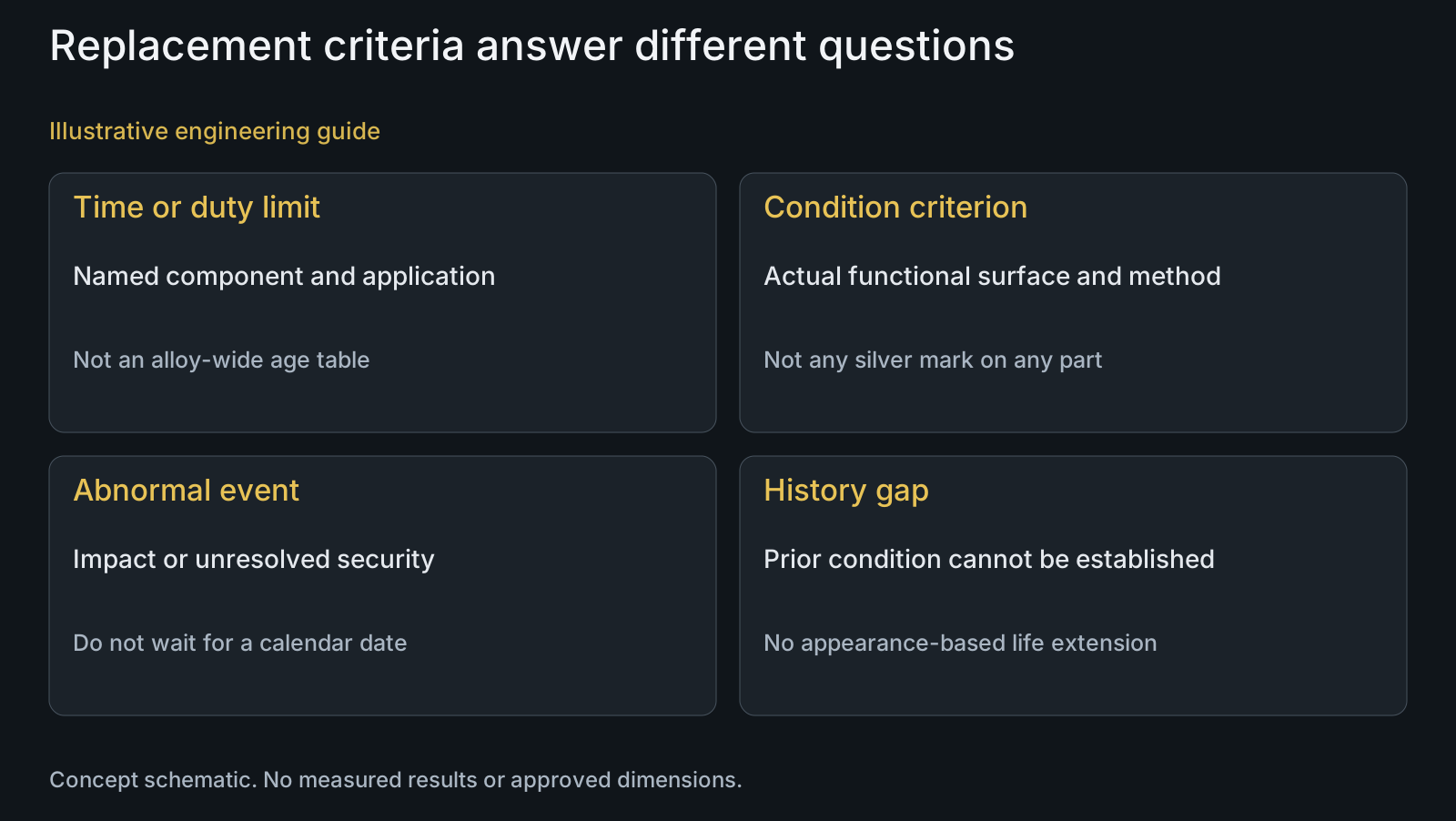
A calendar interval, operating-hours limit and condition-triggered replacement are different rules. State the part, application and authority behind the rule before comparing recommendations. A scheduled examination is also not the same as a mandatory replacement at that examination.
The component boundary matters. A bearing, axle, shield and locking element can have separate service criteria even within one pivot kit. Replacing a bearing does not automatically establish that its axle is acceptable, and replacing an axle does not address every condition in the receiver.
Keep the applicable model and hardware revision with the service instruction. The revision-compatibility guide explains why a familiar part name does not establish interchangeability. A replacement rule without a defined component cannot reliably specify the spare to order.
Keep wear criteria specific to the represented component
Santa Cruz's March 2026 support article distinguishes bearing assessment from pivot-axle replacement and gives a coating-wear criterion for its described black-anodized axles and shields. That is a manufacturer instruction for represented components, not a rule that every visible silver area on any bicycle means the same thing.
For another part, establish which surface is functional, what condition is permitted and how it can be examined. An intentionally bare seat, decorative coating and wear-indicator surface are not interchangeable. Color alone does not quantify dimensional wear or determine whether a different alloy is acceptable.
The routine-check guide separates accessible observation from hidden-feature acceptance. Do not convert a passing exterior observation into an extension of a prescribed replacement limit. If the relevant interface is inaccessible, use the applicable service assessment rather than invent a visible proxy.
| Input | Decision it supports | Limit or risk | Review needed |
|---|---|---|---|
| Applicable OEM time or duty limit | Action for the named component/application | Generalized to other parts or models | Exact model, hardware and instruction |
| Defined functional wear criterion | Disposition of the assessed feature | Appearance used as universal dimensional evidence | Surface role and prescribed assessment |
| Impact or abnormal assembly event | Assessment outside normal schedule | Young age treated as clearance | Event, location and manufacturer route |
| Material fatigue data | Defined material/specimen comparison | Years assigned without field-duty relationship | Geometry, finish and loading representation |
| Test reaches stopping count | Non-failure to that defined point | Unlimited life or riding years claimed | Stop, failure definition and validation basis |
| Unknown prior service history | Uncertainty requiring a disposition decision | Clean appearance treated as known history | Evidence gaps and correct spare configuration |
Separate fatigue evidence from a calendar promise
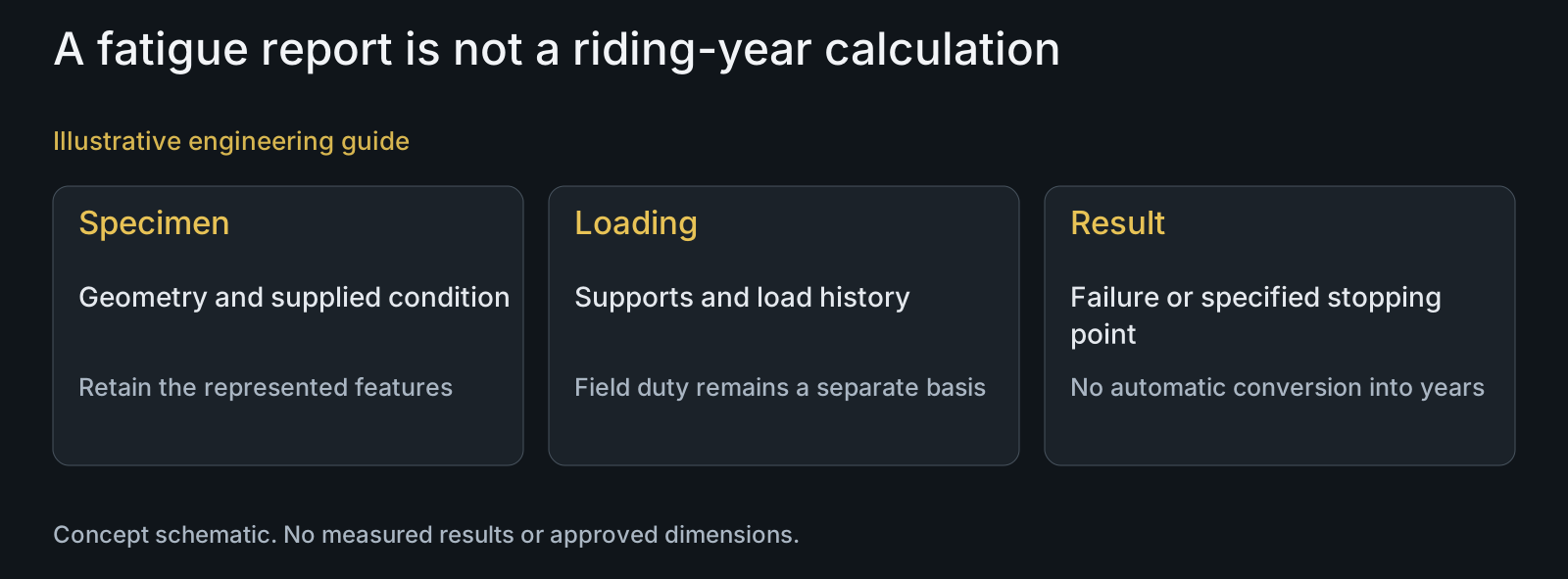
A fatigue result belongs to its specimen and loading conditions. Geometry, surface condition, mean load, supports and failure definition affect what it represents. Neither an alloy grade nor a headline fatigue strength identifies the complete pivot's service history.
ISO 3800's public scope notes that its axial fastener fatigue testing does not account for the compliance of clamped parts. That boundary illustrates why a specified fastener test and an installed pivot joint are not automatically equivalent. This article does not reproduce the paid test procedure or assert product compliance.
Use the axial and bending test discussion when defining the relevant evidence. Completed cycles must retain their load history and stopping criterion. Without a justified relationship to field duty, converting them into years adds an unsupported assumption rather than a service-life result.
Let events and unknown history change the decision
An impact, abnormal movement, damaged receiver or unapproved assembly change can require assessment outside the ordinary schedule. Preserve what is known about the event and component rather than wait for a calendar date. A young part is not automatically acceptable after a damaging event.
Unknown history is a separate uncertainty, not proof of either failure or safety. Identify whether prior overload, machining, polishing, treatment changes or repeated service interventions can be ruled out. Do not use the appearance of a replacement-looking bolt to infer an undocumented history.
If damage or structural security is unresolved, keep the affected assembly out of use pending the appropriate manufacturer or qualified service decision. Avoid an arbitrary tighter setting to compensate for uncertainty. The fracture review addresses preserving observations when failure evidence exists; it does not validate an intact part's remaining life.
Plan the replacement configuration, not just the spare bolt
A service-parts BOM should identify the axle, receiver arrangement, spacers, shields and supplied locking or surface state relevant to the released configuration. Specify which items are replaced together under the actual instruction. Do not impose universal kit-wide replacement or universal reuse.
A material substitution can change the design question even when thread size and overall appearance match. Review seats, shoulders, engagement and interfaces with the released assembly. A heavier or lighter replacement does not independently prove equivalent retention, wear behavior or fatigue performance.
For custom supply, separate manufacture of drawing-defined replacements from approval of the installed bicycle. PremFixer can discuss material, machining, specified finish and identification through manufacturing and materials. Availability, quantities and verification scope require project agreement; no universal ready-stock compatibility is assumed.
Review example: same alloy, different replacement decisions
Illustrative engineering example: assume two axles share an alloy designation. One has a known model-specific service record and no reported anomaly; the other has an uncertain removal history and damage at a locating contact. No measured wear, field failure or verified remaining life is supplied.
The shared alloy does not make their dispositions equal. The first still follows its applicable limits and examination criteria. The second requires assessment of the identified damage and unknown history; it cannot receive the same extended interval because its metal name matches.
The purchasing review prepares the correct released replacement configuration and records unresolved interface questions. It does not calculate fictitious years or assume the new spare repairs a damaged receiver. This example shows why disposition criteria and supply identity must be linked without conflating them.
Questions buyers need to confirm
How many years should a titanium pivot bolt last?
No universal number can be assigned from titanium alone. Use the actual component's design and manufacturer's criteria, with duty and service history. Damage or abnormal events can require action before a prescribed limit; an alloy name cannot extend that limit.
Does a recommended bearing inspection interval also replace the axle?
Not automatically. Bearing examination and axle replacement can have different criteria. Identify the applicable instruction for each component and its actual condition, including contacts, shields and receiver. Do not treat a check date as a universal kit replacement date.
Should every exposed silver patch on an anodized part trigger replacement?
Only apply the criterion of the responsible manufacturer to the represented component. Some surfaces may intentionally be bare or have a different finish function. Establish the surface role, acceptable state and assessment method rather than generalize a named brand's wear indicator.
Can a completed fatigue test establish a five-year interval?
Not without an appropriate validated relationship to the service application. Retain specimen, geometry, surface, load history and stopping/failure criteria. A laboratory cycle total alone does not describe rider duty or every installed joint condition.
Is replacing the bolt enough after an uncertain pivot event?
Not necessarily. The receiver, bearing supports and adjacent parts may require assessment. Use the applicable service route and correct replacement configuration; a new bolt does not accept unexamined mating damage or prove the original cause removed.
What inputs help procure the correct replacement kit?
Send released drawings or STEP, hardware and assembly revision, BOM and supplied finishes/treatments. Identify replacement versus reuse rules, mating interfaces and observed condition. Keep the manufacturer's service decision separate from the manufacturing quotation and flag unknown history.
Technical references and scope
Santa Cruz Bearing and Pivot Axle Maintenance, March 2026. Named manufacturer separates bearing assessment and wear-based replacement of described black-anodized axles/shields. No cross-model age or universal finish-wear criterion transferred.
ISO 3800:1993 Axial Load Fatigue Testing of Threaded Fasteners. Official public scope identifies the clamped-part-compliance boundary. No paid procedure, component compliance or riding-life calculation asserted.
Explore related component, material and sourcing decisions in the customer decision knowledge center. For a drawing review, use the Drawing/BOM RFQ path.
Define the correct service-part configuration
Provide the released hardware drawings or STEP, BOM, assembly views and applicable replacement criteria. Include mating components, material/finish state and any observed damage or revision changes. PremFixer can review drawing-based replacement manufacture and kit identification; remaining-life and complete-bicycle service acceptance require the responsible OEM's evidence and decision.
Discuss the drawing and BOM