
Review a custom pivot supplier against the hardware you intend to buy, not a generic list of desirable factory attributes. Use the same drawing revision, material condition, critical features and delivery scope for every candidate. The twenty questions below connect those requirements to relevant evidence and unresolved decisions. A supplier's equipment list, certificate or quick quotation does not answer all of them. Prioritise requirements that could block the proposed release, without turning missing information into an invented failure score. Any resulting approval should identify the producing site, part family, route and supplied condition it actually covers; it is not permission for every future design.
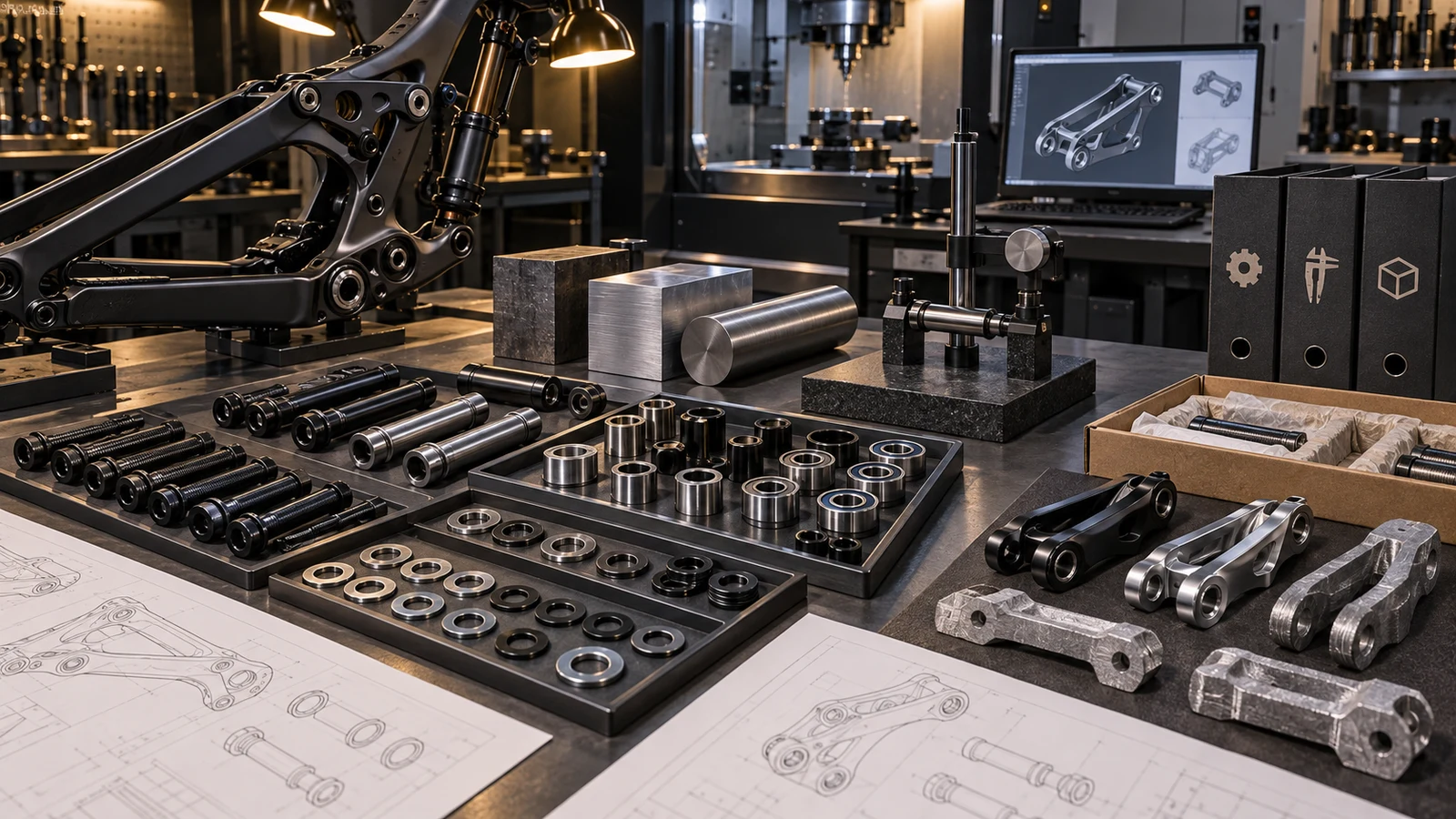
Hero: concept illustration of example hardware and its application. It is not a factory photograph, tested component or approved production geometry.
Start with a representative part and a consistent review scope
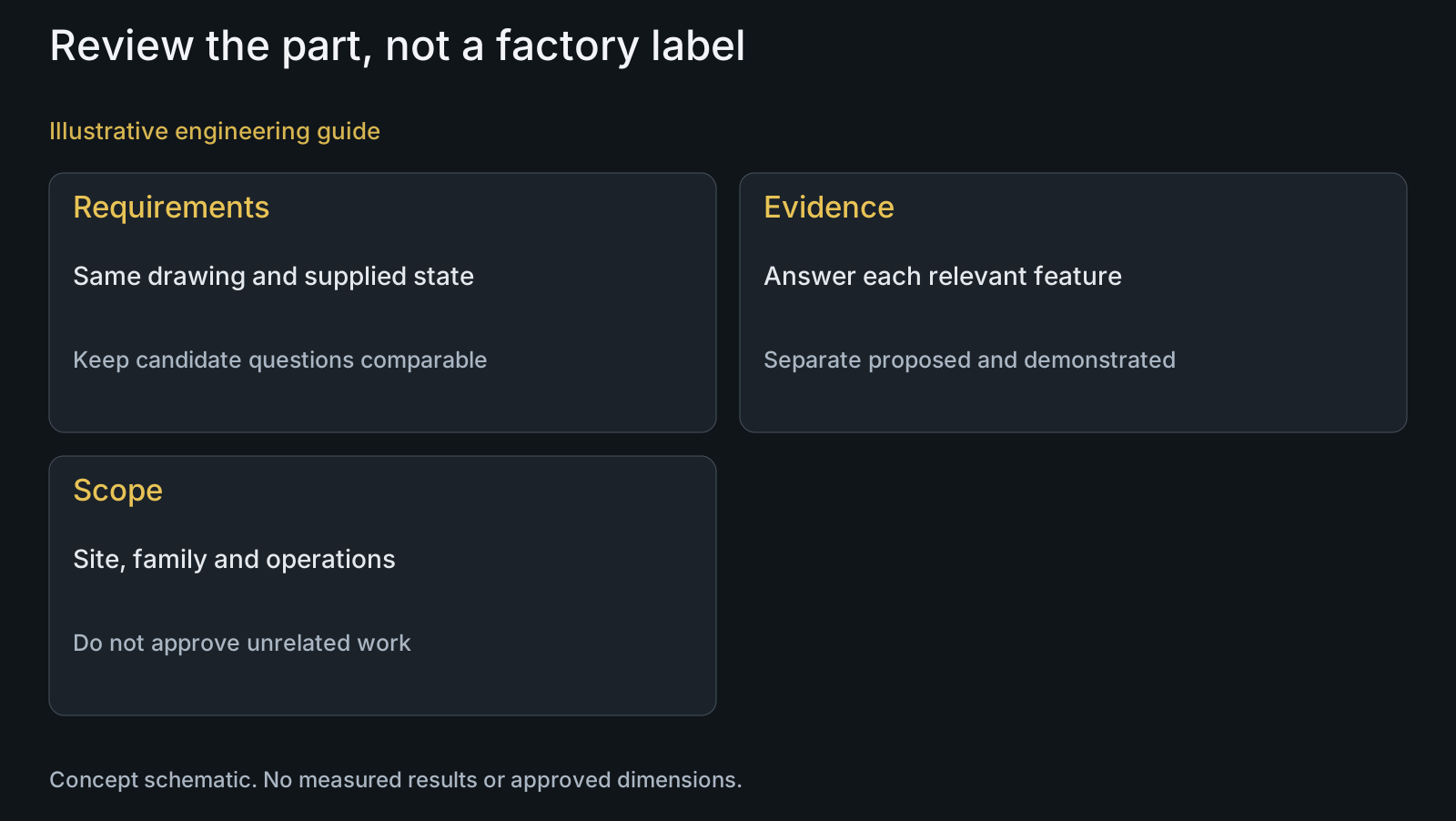
Select a drawing or family that represents the interfaces and operations the program needs. A simple threaded pin may not represent a hollow shoulder pivot with treated bearing seats. State what makes the selected part representative so the supplier and reviewers are answering the same question.
Send identical scope information to candidates: drawing revision, mating requirements, material and finish, intended quantity and supplied kit contents. Record exclusions. A supplier offering machining only should not be compared with another offering treated, inspected and packed kits as though their responsibility were identical.
The supplier-selection guide supports initial suitability decisions. This twenty-point review organises cross-functional qualification questions around a proposed part family. The fifteen-question audit guide separately develops an observed order trail during an execution audit.
Questions one to six define identity and the requirements
Confirm which entity and site will produce the work and which operations are included. A trading name, head-office address or group certificate is not automatically the identity of the proposed machining site. State where the offer's responsibility stops, including any partner work.
For drawing control, ask how the applicable revision reaches manufacturing and how unresolved interfaces are closed. A response saying the supplier can follow drawings is incomplete when the mating bearing or shoulder-location requirement has not been defined.
Material questions should distinguish specification from physical identity. The required grade, condition and product form define the purchase; the material-to-part relationship identifies what the eventual evidence represents. A material document detached from the proposed part scope cannot close both questions.
| Review question | Relevant basis | Risk to expose | Decision supported |
|---|---|---|---|
| 1. Who produces the work? | Entity and producing site | Another site is substituted | Applicable manufacturing identity |
| 2. What is included? | Part numbers and operations | Partner scope disappears | Supply responsibility |
| 3. How is revision controlled? | Applicable drawing distribution | Old instructions remain active | Current requirement use |
| 4. Which interfaces are open? | Mating parts and drawing questions | Fit is assumed | Interface definition |
| 5. What stock is specified? | Grade, condition and product form | Alloy name hides a difference | Material requirement |
| 6. How does lot identity follow parts? | Stock-to-part connection | Certificate loses applicability | Represented material coverage |
| 7. What route makes key features? | Operation and final-state proposal | Equipment replaces route detail | Feasible manufacturing approach |
| 8. How are relationships held? | Workholding and datum basis | Separate operations lose relation | Feature relationship control |
| 9. What triggers tool or setup checks? | Relevant change response | Change effect goes unexamined | Control after change |
| 10. How is treatment bounded? | Final state and protected features | Fit assessed before treatment only | Delivered-state scope |
| 11. What defines thread acceptance? | Requirement and inspection state | Generic thread label used | Applicable thread decision |
| 12. How is each key feature measured? | Method, datum and coverage | Result answers another feature | Relevant inspection basis |
| 13. Why is the setup suitable? | Equipment status and task basis | Calibration alone is overread | Measurement suitability |
| 14. What accompanies samples? | Purpose and evidence deliverable | Appearance proves serial capability | Sample conclusion |
| 15. What closes serial release? | Required decisions and conditions | Sample scope expands silently | Production authority |
| 16. What limits this order's output? | Mix, route and constraints | Machine total becomes promise | Order capacity basis |
| 17. What does the delivery date name? | Start conditions and endpoint | Dispatch equals usable receipt | Schedule boundary |
| 18. What does the price cover? | Tooling, tests, packing and logistics | Different offers seem equivalent | Commercial comparison |
| 19. What happens after change? | Deviation and stock disposition | Wrong revision enters kits | Configuration responsibility |
| 20. What could interrupt this supply? | Qualified risk review and fallback | Continuity claim lacks readiness | Bounded follow-up |
Questions seven to thirteen test the proposed technical route
Ask how the important geometry is produced through the route. Workholding, operation changes and tool checks matter where they affect a stated feature relationship. Machine categories alone do not explain how that relationship will be retained.
Review surface-processing and thread acceptance in the specified delivered state. A measurement or thread check before treatment may answer a different question from acceptance of the finished part. Identify protected features and responsibility for partner operations rather than presume every step is in-house.
Measurement review needs both method and suitability. Ask which characteristic, datum setup, processing state and coverage the result will represent. The CMM inspection guide develops feature-to-method questions; a calibration label or available CMM is not itself a complete inspection proposal.
Questions fourteen to twenty connect qualification to supply
Define what the first sample will demonstrate and what it will not. An appearance sample, dimensional exercise and production-route sample have different purposes. State the evidence required for the next decision before treating any sample as unrestricted serial approval.
Capacity and delivery answers should concern this order's mix, remaining operations and accepted-output endpoint. Compare those answers with the actual quoted scope for tooling, tests, packaging and logistics. A monthly factory total and a headline unit price do not establish complete-kit supply.
Finally ask how revisions, deviations and continuity concerns affect work and usable stock. The financial-resilience guide separates qualified finance review from buyer exposure. Do not turn this checklist into a credit rating, universal MOQ or guaranteed delivery promise.
Turn answers into a bounded qualification decision
Use evidence appropriate to each question: a relevant proposed route, identified document, agreed representative exercise or observed record. Distinguish what was demonstrated from what was only described. Explain restricted access without demanding another customer's confidential drawings.
ISO 19011:2026's public overview concerns management-system audit guidance and states that using it does not itself lead to certification. The twenty questions here are original project-review aids, not ISO clauses or proof of supplier certification.
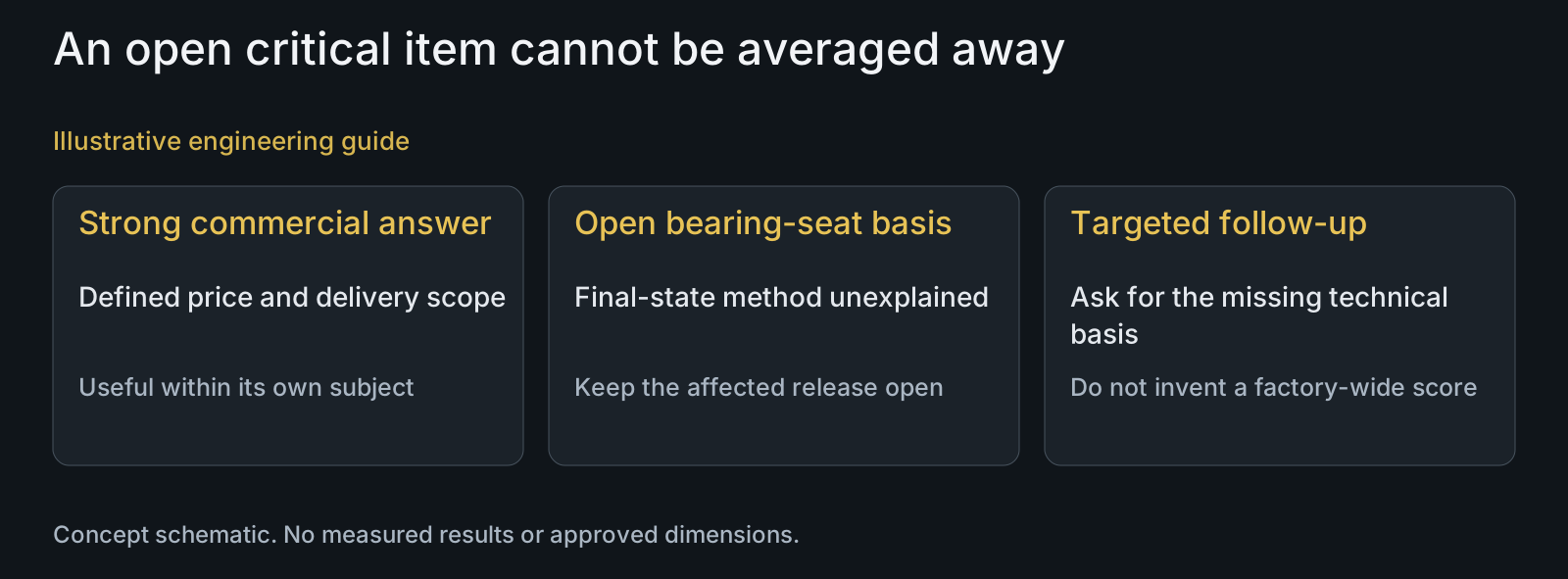
Record a critical unresolved item as a release constraint within its actual scope. Other satisfactory answers do not erase it, and the gap does not establish that every process is defective. State which site, parts, operations and final conditions the available evidence can support, and what change would require further review.
Illustrative review: a complete quotation, an open measurement question
Illustrative engineering example: assume two candidates quote the same treated hollow pivot and sleeve kit. One provides a detailed commercial breakdown and delivery plan but has not explained the final bearing-seat inspection basis. The other identifies that method but excludes finishing. No real candidates, measurements or approval results are assumed.
The reviewer does not total favourable responses and select a winner. It asks the first candidate to address the critical finished-feature evidence and asks the second to clarify who owns finishing and final acceptance. The responses become comparable only after these distinct supply boundaries are understood.
The decision may remain open for the affected work while unrelated findings retain their value. The manufacturing overview can frame a PremFixer route discussion, but the project-specific evidence must still answer this kit's requirements. A bounded conclusion is more useful than an invented twenty-point score.
Questions buyers need to confirm
Should all twenty questions receive equal weight?
No. Identify which requirements can block the proposed work and review those on their evidence. An unexplained critical interface cannot be compensated by favourable commercial answers. Do not invent numeric weights or a universal passing score without an agreed assessment basis.
Can a machine list close manufacturing qualification?
Not alone. Ask how the proposed route makes and evaluates the drawing's important relationships in the delivered state. Equipment availability is useful context, but workholding, operation changes and inspection applicability still need explanation for the representative part.
Must candidates receive the same drawing and quantity?
Yes, for a comparable review. Use the same revision, material, finish, kit scope and intended volumes, and expose exclusions. Different candidate responsibilities may be legitimate, but they should not be compared as identical complete offers.
Does a missing document prove a failed component?
No. Record the missing evidence and the decision it prevents. An unavailable inspection basis is not an invented dimensional failure. Keep observed deviations, unanswered questions and improvement suggestions distinct, with a defined follow-up for the affected scope.
Does review of one part approve all future designs?
No. State the site, part family, route and conditions represented. A changed interface, material, treatment or partner responsibility may fall outside that boundary. The review should explain the applicability rather than issue an unrestricted approved-factory label.
What should accompany a supplier-review inquiry?
Send a representative drawing or STEP file, mating requirements, BOM, material and finish, intended volumes and requested supply scope. Identify the critical features and evidence you need. Agree confidentiality and any representative exercise before treating the checklist as a completed audit.
Technical references and scope
ISO 19011:2026 public overview. Current public description concerns management-system audit guidance and its non-certification status; this original twenty-question project checklist is not ISO's normative text.
Explore related component, material and sourcing decisions in the customer decision knowledge center. For a drawing review, use the Drawing/BOM RFQ path.
Review a representative pivot program with a clear scope
Send the representative drawings or STEP files, kit BOM, critical interfaces and intended volumes through the Drawing/BOM RFQ path. Identify the operations and evidence you want reviewed. The discussion will map the proposed manufacturing and partner scope to the open technical and supply decisions, without pre-assigning supplier approval.
Discuss the drawing and BOM