

Evaluate a pivot hardware supplier price increase by identifying what changed, which supplied work it affects and which orders the proposal covers. A higher material reference does not by itself justify repricing machining, inspection and packing by the same amount. Compare the notice against the previous drawing, BOM, quantity and delivered condition before discussing responses. Relevant evidence can support a negotiation without proving the supplier's exact confidential cost. Preserve the functional and acceptance requirements when considering quantity consolidation, revised commercial terms or an alternative source; a lower price with missing kit components or evidence is not the same purchase.
Hero: concept illustration of example hardware and its application. It is not a factory photograph, tested component or approved production geometry.
Establish whether the purchase itself changed
Place the old and proposed offers beside one another with their configuration and assumptions. Identify material grade and condition, finish, kit contents, lot quantity, documents and delivery endpoint. A smaller release or added finish operation can change the purchase even when the part number stays unchanged.
Ask the supplier to distinguish specification changes from input-price movement and changed commercial assumptions. An explanation such as rising costs is too broad to identify an action. The cost breakdown guide helps locate the affected activity; it does not establish access to a supplier's complete accounts.
Test the relevance of the evidence
The BLS price-adjustment guide explains that producer price indexes describe selling-price movements rather than directly measuring production cost. A public index is therefore contextual evidence, not the invoice for a specific supplier's bar stock.
Check the claimed material's grade, supply form, market and comparison period. If the reference is only a proxy, identify that limitation. For a labor explanation, distinguish changed labor rates from more operations or smaller lots; for currency, identify the relevant transaction currency and exposure rather than applying a headline movement indiscriminately.
Request an explanation at a level appropriate to the commercial discussion. A supplier may provide element-level assumptions without disclosing proprietary margins or purchasing contracts. Record what remains unsupported instead of converting an incomplete explanation into either a confirmed increase or an accusation.
| Response | Useful condition | Main risk | Evidence to review |
|---|---|---|---|
| Discuss the stated increase | Unchanged scope with a relevant cause | Headline chart mistaken for actual cost | Affected elements, reference relevance and period |
| Consolidate demand | Real demand supports fewer releases | Inventory created to obtain a lower rate | Consumption, lot scope and storage responsibility |
| Evaluate a design alternative | Function can be reviewed independently | Unapproved substitution hides a requirement | Drawing, interfaces and changed evidence needs |
| Compare another source | Enough time exists to assess equivalent supply | Quoted parts not yet usable in the assembly | Same BOM, final condition and qualification dependencies |
| Define a temporary arrangement | Covered demand and review event can be agreed | Temporary treatment becomes indefinite | Order applicability and actual terms |
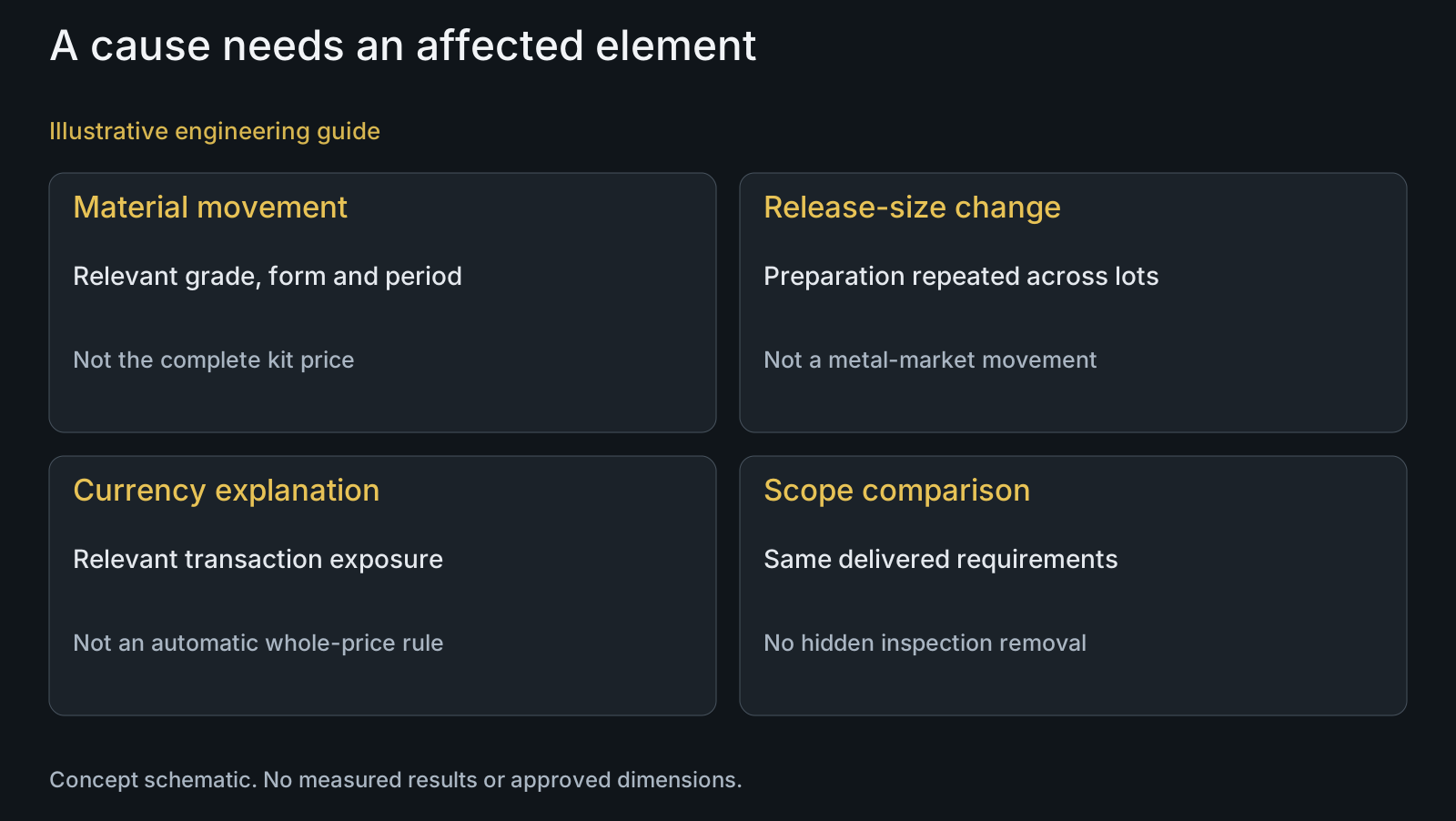
Connect each cause to its affected price element
A steel bolt, aluminium sleeve, treatment and kit packing do not necessarily share one price driver. Ask which elements are proposed to change and which remain unchanged. If several reasons are presented, clarify whether they overlap; the same material effect should not be counted twice under different labels.
Use the actual agreed mechanism where one exists. The index-linked pricing article covers how such an arrangement is defined; this review asks whether a particular notice is adequately explained. An official chart does not substitute for agreement on the affected share, period or releases.
Choose a response with its implementation burden visible
Accepting an explained increase, discussing a temporary commercial arrangement, consolidating demand or qualifying another source are different responses. Compare the full scope and dependencies of each. Consolidation can create inventory exposure, while source changes can require drawing clarification, interface review and new evidence before usable parts arrive.
Use manufacturing scope and surface-treatment requirements to keep necessary work in the comparison. Do not remove a bearing-seat condition or required inspection merely to meet an old price. If a design alternative is proposed, evaluate it separately rather than treating it as an unchanged purchase.
A time-limited response needs a stated review event and covered demand. It should not become an indefinite concession because a date was omitted. Binding terms and remedies belong with the appropriate commercial and legal reviewers; this article establishes no right to reject or retroactively impose a price.
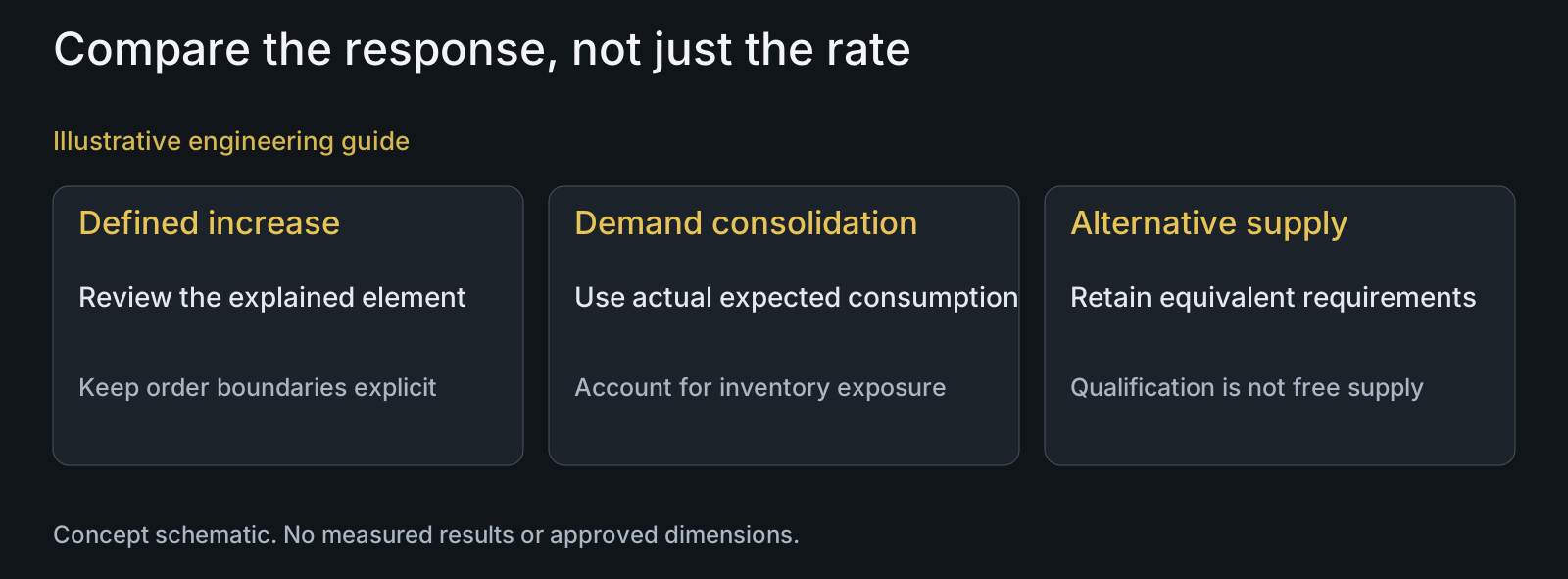
Review two causes without conflating them
Illustrative engineering example: assume a notice concerns a steel pivot bolt and aluminium spacer kit. It cites a metal-market movement and a switch from consolidated demand to smaller releases. No actual price, cost share, increase percentage or customer result is assumed.
The buyer first holds the drawing and final condition constant. It asks which purchased metal input the reference represents and which work changed because of release size. Combining the two causes into one unexplained percentage would conceal different remedies: an input-price discussion does not remove repeated lot preparation, and restoring consolidation does not prove metal prices are unchanged.
The comparison can retain the same kit scope while showing separate responses to the two causes. A proposed consolidated release remains subject to genuine demand and inventory acceptance. The example closes no negotiation; it makes the alternatives understandable without fabricated savings.
Keep order applicability separate from the explanation
A plausible cause does not determine which orders may be repriced. Identify unquoted demand, new offers, authorized releases and existing commitments separately. Review their actual terms and the notice's proposed effective event rather than applying one change to every open line.
The quotation-validity guide addresses offer and release boundaries. Keep the resulting decision tied to configuration, quantity and scope so engineering and purchasing are discussing the same supply. Related buyer decisions remain available in the knowledge center.
Questions buyers need to confirm
Does a rising metal index justify the entire increase?
No automatic conclusion follows. Identify the material form and period it represents, then the affected priced element. Machining, finishing and packing may have different drivers, and a market reference is not the supplier's exact purchase record.
Can I require complete supplier cost disclosure?
Do not assume such a right. Request the explanation needed for the actual discussion and review any agreed information obligations with qualified advisers. Element-level assumptions can be useful even when confidential purchasing and margin data are unavailable.
How should labor and smaller quantities be separated?
Ask whether the rate changed or whether more preparation and handling are required per supplied quantity. Compare release sizes, operation scope and lot-related work against the old offer; those are different causes with different response options.
Should the increase apply to all open orders?
Not by default. Identify each order's configuration, authorization and actual terms, plus the notice's proposed effective event. A plausible cost explanation does not independently determine retrospective commercial authority.
Is switching supplier the best response?
Only compare it after including equivalent supplied scope and the dependencies of qualification. Drawing clarification, final-condition evidence, interface compatibility and usable delivery matter; a lower unqualified offer is not proof of a lower usable supply cost.
Can we remove inspection to preserve the old price?
Do not silently remove a necessary acceptance requirement. Identify what the inspection establishes and whether another justified method is being proposed. Any changed evidence scope must be separately reviewed rather than concealed inside a price response.
Technical references and scope
BLS PPI price-adjustment guide. Public selling-price index scope and distinction between price elements and adjustment periods; no pivot-specific index or current market value asserted.
Explore related component, material and sourcing decisions in the customer decision knowledge center. For a drawing review, use the Drawing/BOM RFQ path.
Compare the changed offer on a defined manufacturing scope
Send the drawing and BOM revisions, quantities, delivered condition, inspection and packing requirements, and old versus proposed quotation assumptions through the Drawing/BOM RFQ path. Identify the stated cause and affected demand so PremFixer can discuss an equivalent manufacturing offer without assuming confidential costs or agreed commercial rights.
Discuss the drawing and BOM