
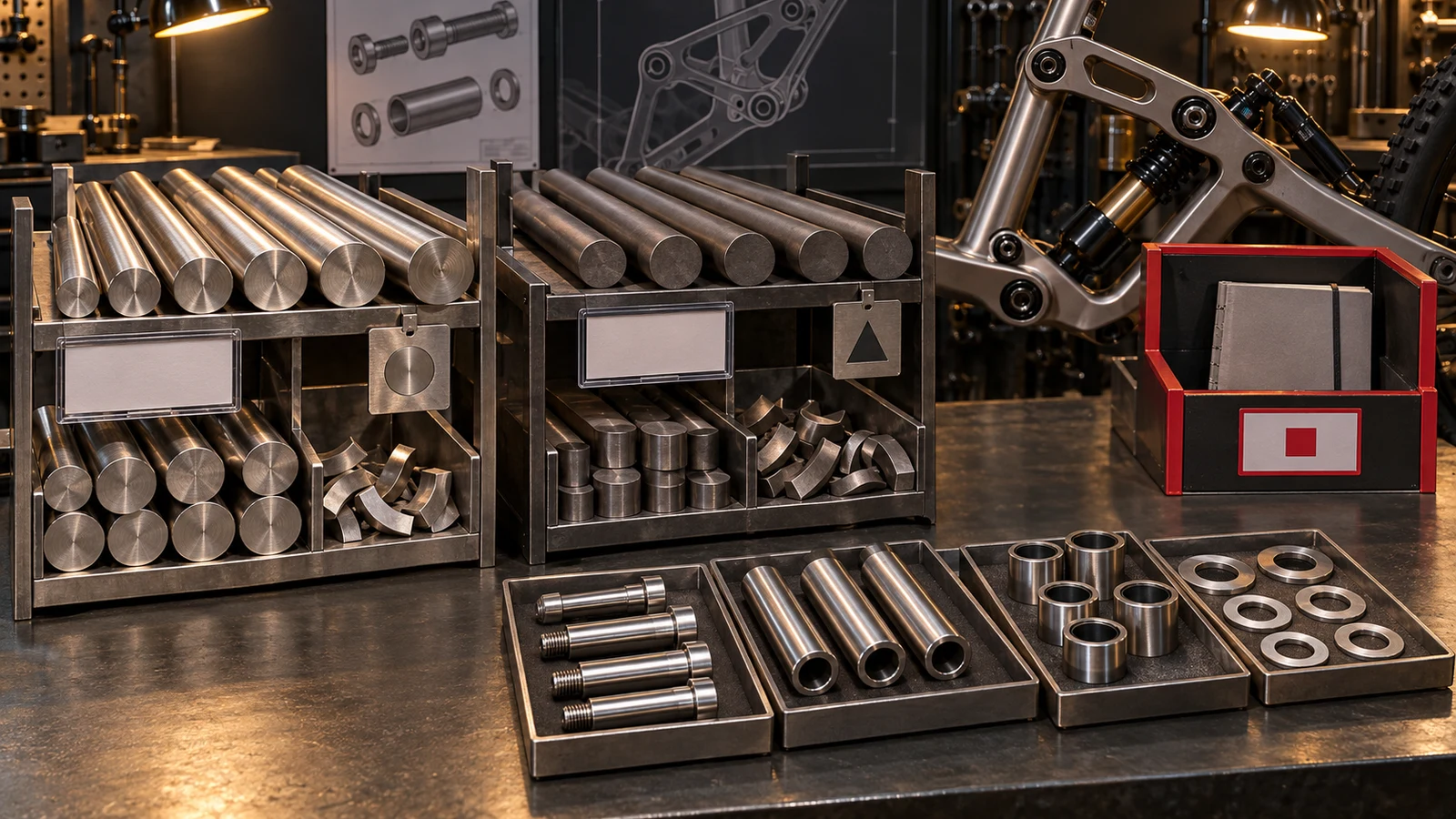
A raw-material handling audit for stainless or titanium pivots should establish which stock is eligible for the current drawing before reviewing how the warehouse rotates it. Check the specified grade, condition and product form, then connect the physical stock to its represented material evidence and permitted-use status. Follow that connection after cutting, splitting and returning remnants, where an original bar marking may no longer identify every piece. FIFO alone cannot authorise held stock or replace an unconfirmed material condition. Incoming chemistry can answer a defined composition question, but it cannot by itself recover origin, processing history or every required property of the material issued to the order.
Hero: concept illustration of example hardware and its application. It is not a factory photograph, tested component or approved production geometry.
Separate material identity from permission to use it
Start with the material requirement on the controlling drawing and purchase scope. An alloy name alone may leave the required condition or stock form unclear. Ask which received stock population meets that definition and which evidence supports the match.
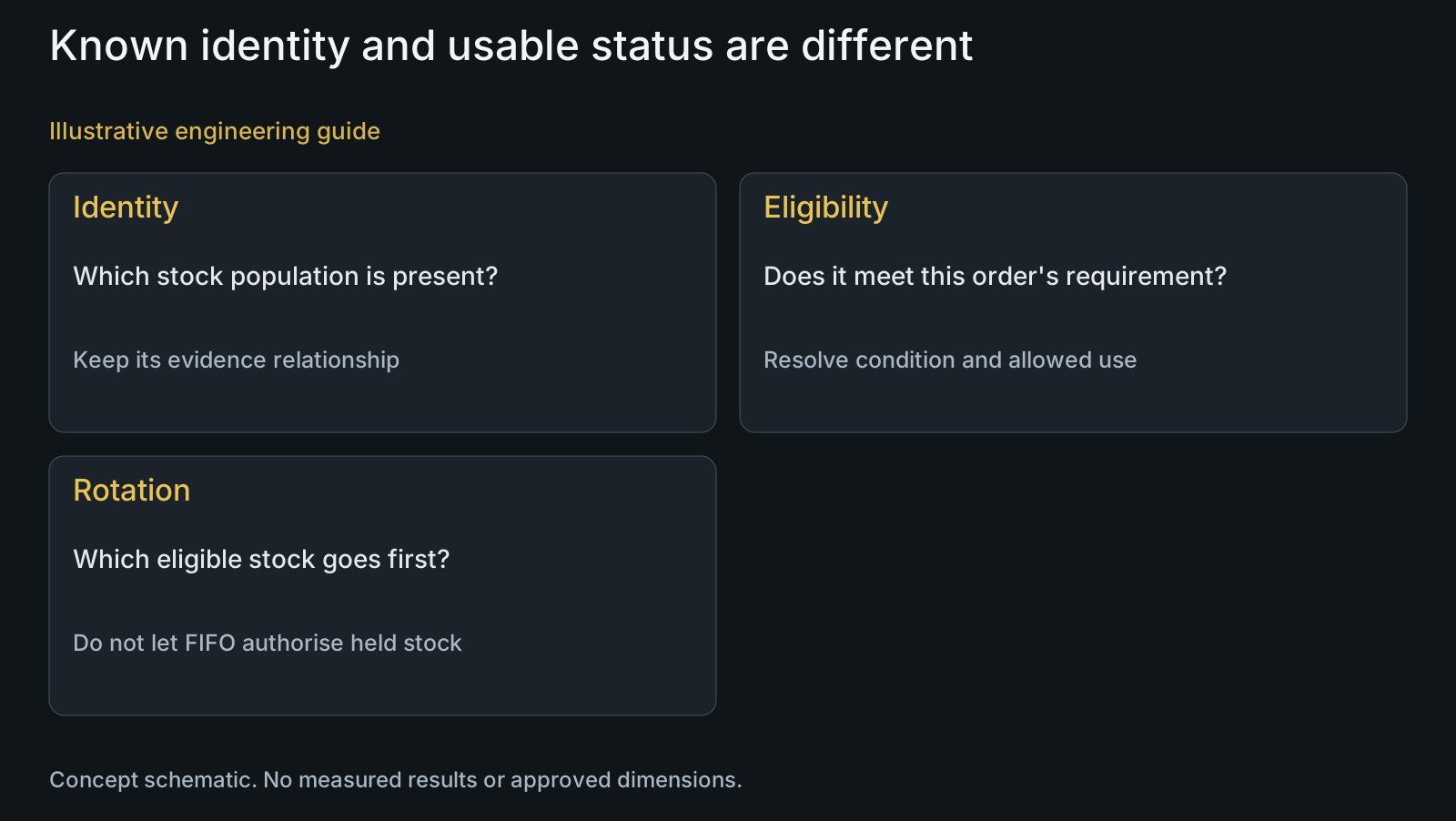
Identity answers which stock is present. Status answers what may happen to it. An identified lot can be awaiting evidence, reserved elsewhere or restricted from a particular use. Do not treat a visible heat reference as a release decision or an on-hand quantity as proof of availability for the proposed pivot.
Oracle's inventory availability explanation illustrates how reservations and material statuses can distinguish on-hand stock from usable transactions in its software. That is context for the distinction, not an assertion that PremFixer uses Oracle or follows its screen workflow.
At receipt, match evidence to the stock being assessed
Ask what the material document represents: issuer, material specification, condition, product form and supplied population. Then compare that subject with the received material identity. A correct document attached to an order folder does not establish that every nearby bar belongs to its represented population.
The titanium origin-traceability guide develops manufacturer, distributor and original-document relationships. This handling audit focuses on the later selection decision: whether identified material may be issued for the current requirement, including stock that remains physically available but restricted.
If incoming verification is requested, define its purpose and represented sample rather than ask for an unexplained spectrum. Keep document review, analytical verification and release authority distinct. A reviewer needs to know what the analysis could resolve and which questions would remain after it.
| Stock situation | Question to resolve | Shortcut to avoid | Relevant evidence |
|---|---|---|---|
| Received bar | Does this population meet the requirement? | Alloy label proves every property | Specification, condition and subject |
| Incoming analysis | Which material question was evaluated? | Chemistry proves origin and strength | Method, sample and scope |
| Cut blank population | Which received stock supplied these pieces? | Order number replaces material identity | Stock-to-blank relationship |
| Returned remnant | Does its identity and status remain known? | Appearance identifies the source | Retained relationship and permitted use |
| Oldest stored lot | Is it eligible for this drawing? | FIFO overrides a release restriction | Requirements and current status |
| Proposed substitute | What difference needs authority? | Similar chemistry means equivalent | Exact difference and approved-use basis |
Keep chemistry within its actual analytical scope
Hitachi's public technology explanation describes different metals-analysis methods, including OES for elemental composition. For an order, ask the provider which required elements, specimen state and preparation its actual method covers. Do not transfer a manufacturer's general instrument claims into a PremFixer equipment inventory.
A composition result does not by itself establish the required mechanical condition, original producer or every property called out by the purchase. Identify the other material evidence needed instead of declaring full specification compliance from a chemistry summary.
The stainless material-verification guide develops analytical questions separately. Here the handling concern is whether the result follows the stock actually issued. Even a useful analysis cannot support the wrong remnant or an unidentified mixed container merely because it is stored nearby.
Follow cut pieces and remnants without merging populations
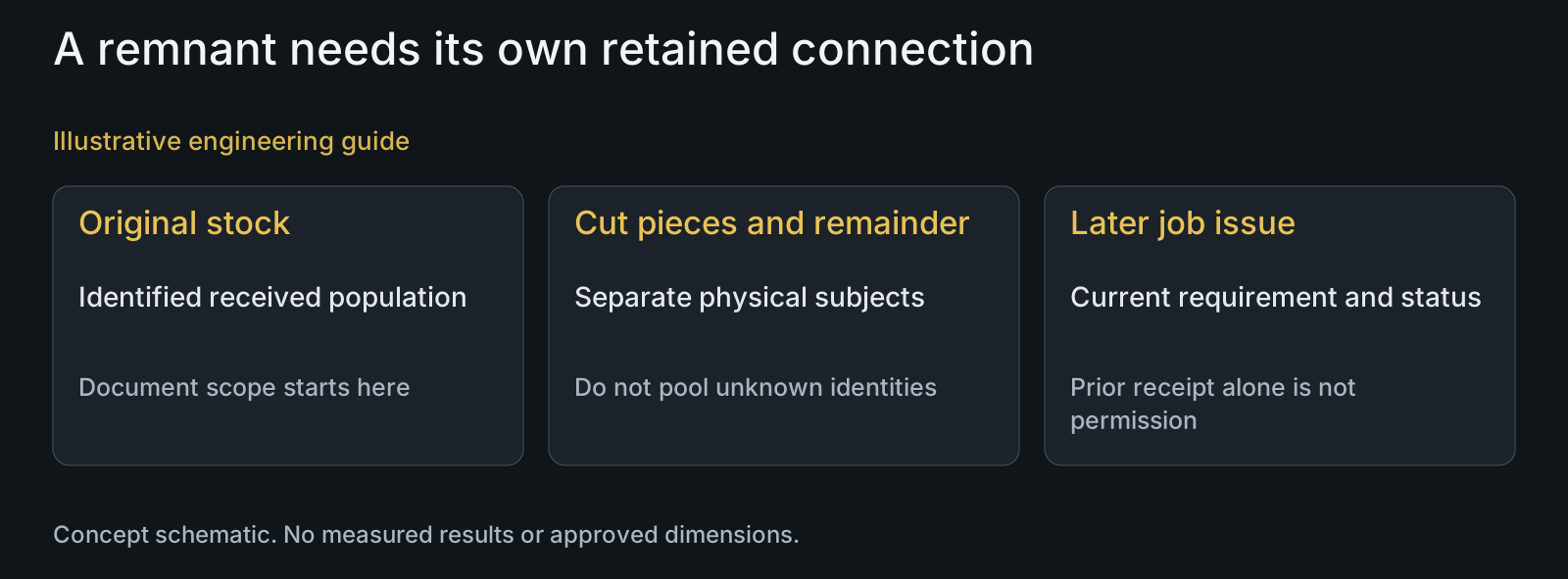
At cutting, ask how the received identity becomes the blank or job-lot identity and what happens to the remainder. The original marked end or packaging may no longer accompany each piece. The relationship must remain understandable when material returns to storage or serves another part family.
If several heats supply one commercial order, keep their represented relationships distinct. If one heat supplies several component batches, preserve those different issued identities without pretending that every later part belongs to one unexplained manufacturing lot.
A container relabel or transfer can preserve the physical count while obscuring its material subject. Use an authorised representative movement to ask which pieces the label covers. The factory-walkthrough guide addresses broader floor handoffs; this review concentrates on material eligibility through stock selection and reuse.
Apply rotation only after eligibility and substitution are resolved
A stock-rotation rule should operate within material that may legitimately serve the order. The oldest lot is not automatically correct if its identity, condition or permitted status is unresolved. Choosing a newer eligible lot need not be evidence that the supplier ignored material controls.
For a proposed replacement, identify the exact difference: source, specification, condition, product form or evidence package. Ask who can accept it and whether the order permits that substitution. An available bar with similar chemistry should not silently replace a protected requirement.
The materials overview supports specification discussions and the manufacturing overview frames the proposed route. Neither establishes a universal FIFO policy, incoming test coverage or substitution permission. Record the actual approved-use boundary rather than infer it from a capability description.
Illustrative stock issue: oldest, identified and still restricted
Illustrative engineering example: assume two stainless stock populations share a nominal alloy label. The earlier receipt has a retained identity but an unresolved required-condition record; a later receipt has evidence relevant to the current order. A returned offcut from the earlier stock is also available. No actual material failure or test values are assumed.
The reviewer first determines whether the earlier population and its remnant may be used, rather than issue them merely to satisfy FIFO. It separately checks the later material's requirement match and status. A chemistry recheck might inform composition, but it would not automatically settle the missing condition record or authorise substitution.
The outcome of the exercise is a defined stock-selection question and retained material relationships, not an accusation of inferior material or a claim that the newer receipt has passed every requirement. Actual release and use follow the supported evidence and agreed authority, with unresolved pieces kept outside the usable selection.
Questions buyers need to confirm
Does FIFO prevent the wrong material being used?
Not by itself. Apply rotation to stock that meets the current specification and permitted-use status. The earliest receipt can remain held or unsuitable for this requirement. Identity, condition and authority must be resolved before age determines selection.
Can identified stock still be unavailable for the order?
Yes. Its known population may be reserved, restricted or awaiting required evidence. Ask why it may not be used and which decision would change that status. A physical count and retained heat reference do not themselves establish usable availability.
Can a chemistry check establish full material compliance?
Not independently. Define the elements and specimen the method evaluates, then review condition, product form, origin and other required properties separately. Connect the result to the issued stock rather than extend one analysis to every bar or remnant.
What should happen when a bar is cut into several jobs?
Preserve the relationship from received stock to each issued population and the remainder. Keep later identities understandable even when the original marking is no longer on every piece. One shared source does not make all finished batches one unexplained lot.
Can similar material be substituted to keep production moving?
Only within the order's permitted scope and relevant authority. Identify the specification, condition, source or document difference and its implications. Available stock or similar chemistry alone does not authorise a change to a protected material requirement.
What should accompany a material-handling review request?
Send the drawings and BOM, full material and condition requirements, source or document restrictions and intended verification scope. Identify stock splits, remnant reuse and substitution questions you need reviewed. The evidence should support the material actually proposed for issue, not only a generic supplier folder.
Technical references and scope
Oracle: inventory availability and material status. Official software-specific examples distinguish on-hand inventory from reservations and material-status restrictions; no PremFixer Oracle deployment, screen flow or universal stock policy inferred.
Hitachi: metals-analysis method explanation. Manufacturer's public method overview identifies OES as elemental composition analysis; no equipment ownership, detection limit, performance guarantee or universal method coverage transferred to PremFixer.
Explore related component, material and sourcing decisions in the customer decision knowledge center. For a drawing review, use the Drawing/BOM RFQ path.
Define material eligibility for the stock your order will use
Send the drawings or STEP files, BOM and material requirements through the Drawing/BOM RFQ path. Include required condition, source evidence, analytical checks and substitution restrictions. The review will distinguish identity, verification and permitted-use questions along the proposed stock-to-part route.
Discuss the drawing and BOM