

A useful KPI scorecard for a bicycle pivot supplier keeps quality, delivery, technical service and comparable cost visible, then explains how each measure changes a buyer decision. Define the counted subject, event and period before assigning a score or weight. More importantly, keep unresolved critical requirements outside the averaging rule. A low kit price or quick acknowledgment cannot authorize an unapproved bearing interface. The OEM is deciding where to investigate, what improvement to request and whether the represented supply remains suitable. Targets are proposed requirements, not achieved performance; no universal quality percentage, response deadline or annual cost reduction is established here.
Hero: concept illustration of example hardware and its application. It is not a factory photograph, tested component or approved production geometry.
Decide what a score can and cannot authorize
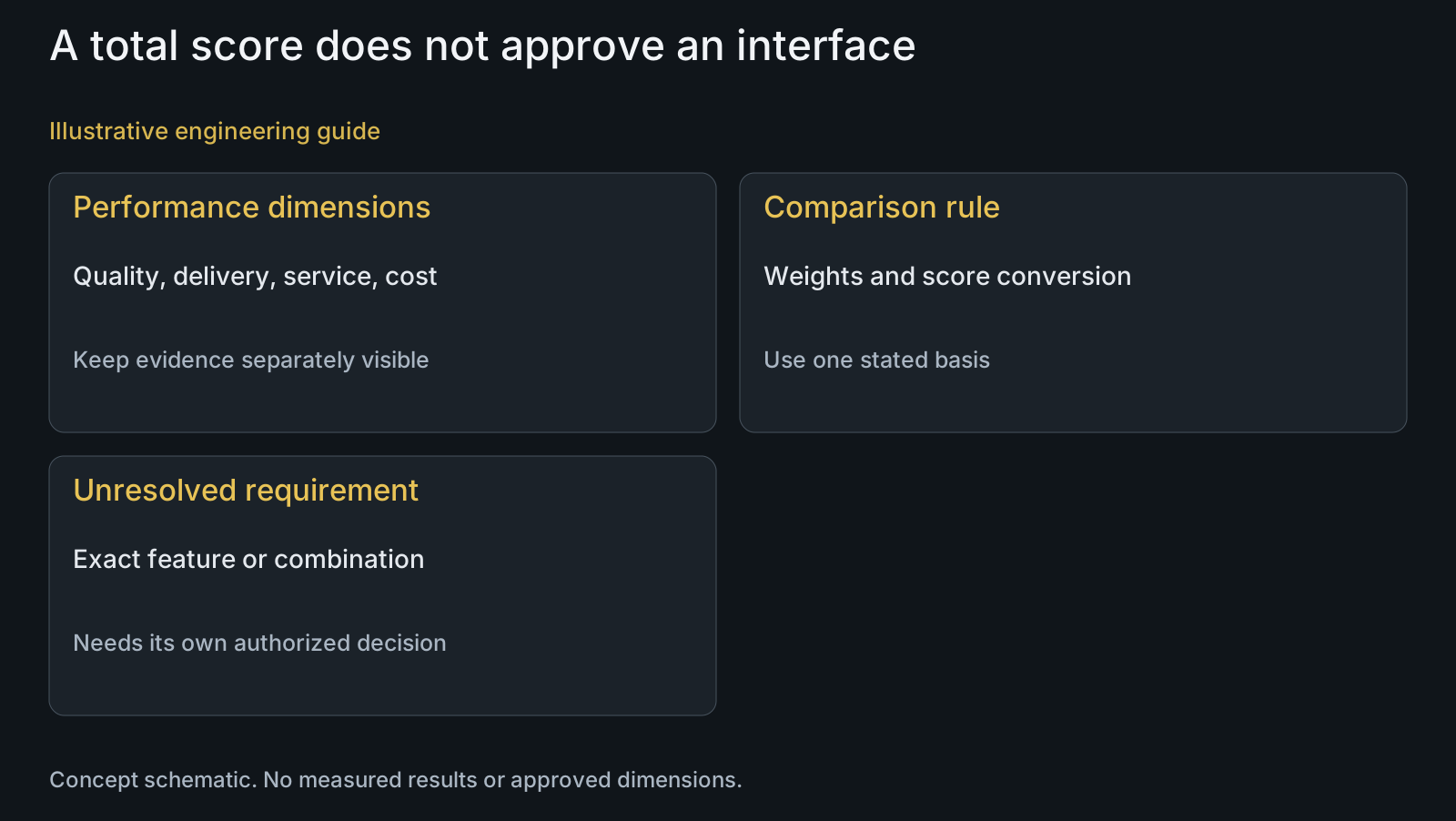
Name the scorecard's purpose: review an active program, compare a like-for-like supply scope or prioritize improvement effort. Do not let the same overall rating silently stand for initial technical qualification, permission to ship and future order allocation. Those decisions can require different evidence and authority.
Identify requirements that need a separate disposition, such as an unresolved drawing departure, uncertain kit configuration or critical interface concern. Label that issue clearly even if the remaining metrics look favorable. An arithmetic average has no mechanism for deciding whether the affected hardware may be used.
The supplier KPI denominator guide explains counting units and event definitions in detail. This scorecard adds the purchasing decision layer: how to combine interpretable measures without allowing the summary to override a requirement that still needs resolution.
Keep quality and complete delivery as distinct evidence
For quality, name the represented parts, required characteristics and inspected coverage. Separate initial departures, later disposition and recurrence categories. A supplier's recovered shipment can restore usable supply while still revealing a control problem that deserves attention. Do not erase the original issue because replacement arrived.
For delivery, state the accepted event and required kit content. Receipt of most pieces differs from availability of every required BOM position. Preserve the original commitment and any authorized change so a revised promise does not silently improve the reported outcome.
Read the two dimensions together without substituting one for the other. A timely shipment may have unresolved condition; conforming hardware may arrive too late for its intended assembly milestone. The packaging and logistics audit develops condition and receipt evidence for that boundary.
| Dimension | Decision it informs | Distortion to avoid | Focused follow-up |
|---|---|---|---|
| Quality | Investigate represented conformity and recurrence | Sorting erases the original departure | Review issue category and control evidence |
| Delivery | Assess availability at the agreed event | Partial pieces reported as complete kits | Reconcile BOM and original commitment |
| Technical service | Assess useful response and resolution | Acknowledgment counted as technical closure | Examine substantive answer and open scope |
| Comparable cost | Compare the defined supplied exchange | Removed scope called savings | Review configuration and responsibility |
| Weighted total | Summarize comparable dimensions | Different weights create an apparent ranking | Retain rules and individual measures |
| Critical unresolved issue | Determine separate permitted action | Good price cancels missing approval | Obtain the relevant disposition |
Measure useful service and comparable cost
For technical service, distinguish acknowledgment, a substantive answer and implementation of an agreed resolution. A prompt message that repeats the customer's question does not resolve an unclear shoulder definition. Track the milestone that matters and retain critical open requests separately from general response averages.
For cost, compare the same supplied configuration and responsibility. Material, finish, kit content, quantities, inspection evidence, packaging and delivery boundary can all change the exchange. A removed sleeve or report is not automatically a cost-improvement achievement for the original requirement.
Consider additional sorting, exceptional freight or changed receiving work where they are supported and relevant to the comparison. Do not invent a total-cost estimate from an unexplained unit price. The manufacturing discussion helps identify the work being compared, not a blanket annual price-reduction commitment.
Make weights and targets visible before comparing totals
SAP's supplier-evaluation lesson describes weighting criteria and cautions against comparing suppliers with different weighting keys. It is a software-specific example, not a required PremFixer system or an industry scoring formula. The general review lesson is to make the comparison rule visible.
Agree why each dimension receives its weight and how raw evidence becomes a score. A change in weighting can change the ranking without any change in delivered hardware. Retain the individual dimensions so the buyer can see which requirement or service difference drives the decision.
Targets such as 99.5 percent quality acceptance, 95 percent delivery attainment, response within 24 hours or annual cost reduction of 3 to 5 percent are not universal bicycle benchmarks or reported PremFixer results. If a customer proposes them, define the exact population, clock, calendar, supplied scope and authority before adopting them.
Use trends to select actions, not only colors
Oracle's performance-summary documentation requires defined factors, values and calculations within its system. No Oracle deployment is implied here. For a practical review, preserve the evidence basis alongside the displayed category so its meaning can be explained.
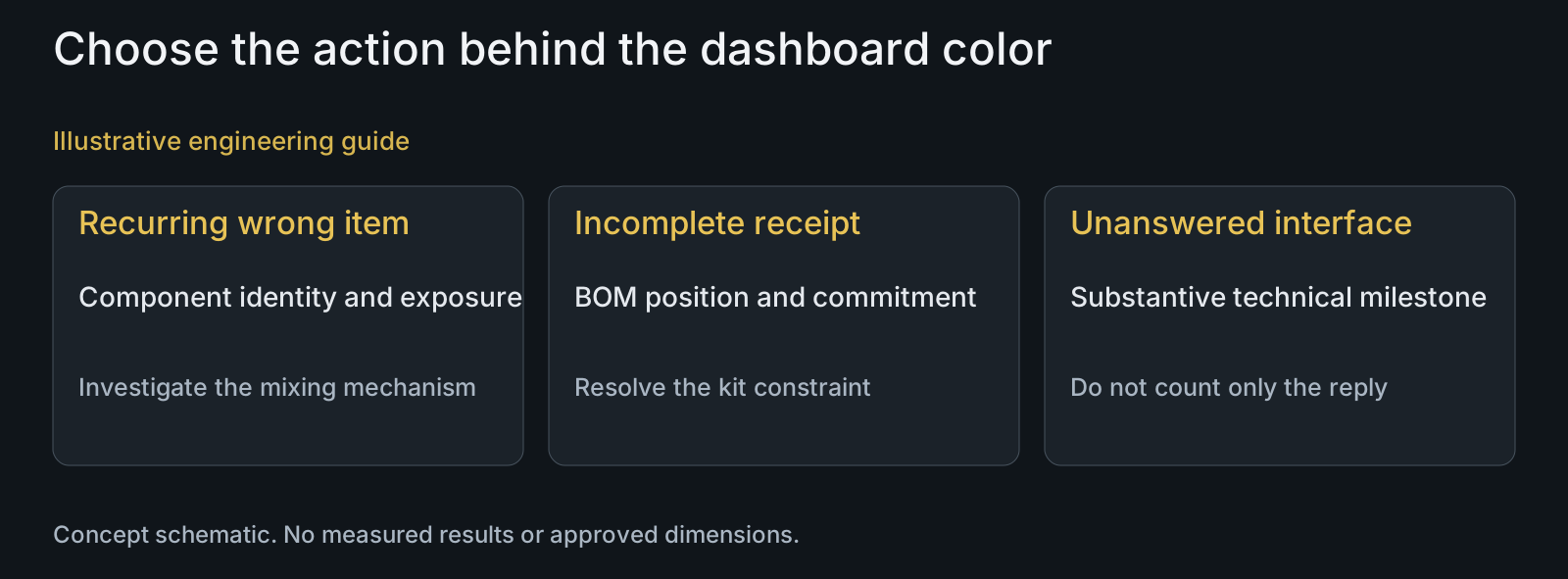
Look for repeated exception mechanisms and changes in exposure. A small-volume family with recurring wrong-spacer identity deserves its own discussion even when a large volume of unrelated bolts dominates the aggregate. Where the product mix changes, explain that boundary instead of describing the whole movement as improvement.
Choose an action appropriate to the signal: investigate a specific interface, examine a recurring partial-kit constraint or clarify a response handoff. A CAPA effectiveness review addresses cause-linked closure. A better dashboard color alone does not show that the underlying issue was resolved.
Illustrative review: favorable total, unresolved interface
Illustrative engineering example: assume a purchasing review gives favorable assessments to a pivot supplier's price and routine response behavior, while an identified sleeve-and-axle combination still lacks the required acceptance basis. No actual scores, weights, supplier records or failure results are supplied.
The reviewer keeps the unresolved combination outside the weighted ranking. Price and service information can still help compare the represented commercial scope, but they do not authorize that assembly. The relevant technical owner needs to resolve the combination before its use is permitted.
The review also names a follow-up milestone and retains the individual performance dimensions. This allows a later supported change to be understood without rewriting earlier results. The useful outcome is a bounded decision rule, not a claim that one supplier is superior or that a numeric target guarantees safe hardware.
Questions buyers need to confirm
Which KPIs belong in a pivot supplier scorecard?
Use interpretable quality, complete-delivery, technical-service and comparable-cost measures for the stated program. Keep the raw evidence basis and relevant open issues visible. Each measure should inform a named action rather than serve only as a supplier label.
Can a good overall score approve an unresolved pivot interface?
No. Keep the specific requirement and responsible disposition outside the averaging rule. Cost or service strengths do not provide missing assembly or conformity evidence. A scorecard summarizes performance; it does not create technical authorization.
Are the same weights required for every supplier?
No universal weights are prescribed. For a direct comparison, however, use a common justified basis or explain why the results are not comparable. Changing the weights can change a ranking without changing any underlying performance.
Are 99.5 percent quality and 95 percent delivery universal requirements?
No. They may be proposed customer targets, not industry-wide requirements or PremFixer results here. Define the population, event, period and exceptions first. A favorable aggregate rate also cannot dispose of a critical unresolved issue.
Does a 24-hour reply prove useful technical service?
Not by itself. Define whether the milestone is acknowledgment, a substantive answer or implemented resolution, along with calendar and necessary inputs. Retain critical open questions so routine fast replies cannot hide a missing interface decision.
How should cost reduction be reported fairly?
Compare the same supplied kit, requirements, quantities and responsibility. Identify removed work, one-time changes and supported extra costs separately. A lower quotation for a narrower exchange does not establish improvement for the original hardware scope.
Technical references and scope
SAP Learning, Evaluating Suppliers Using Logistics Information System. Official software-specific explanation of criterion weighting and caution about comparisons using different weights; no installed-system claim or numerical scoring rule adopted.
Oracle, Defining a Summary of Supplier Performance Information. Official software documentation requires identified performance factors and calculations; used for limited evidence-definition context.
Explore related component, material and sourcing decisions in the customer decision knowledge center. For a drawing review, use the Drawing/BOM RFQ path.
Agree a performance review for the actual pivot program
Share the drawing and BOM scope, required delivery event, quality evidence, response milestones and comparable supplied-cost basis through the Drawing/BOM RFQ path. Include the proposed scorecard and any critical open requirements so PremFixer can discuss reporting feasibility and decision boundaries without claiming historical targets or results.
Discuss the drawing and BOM