

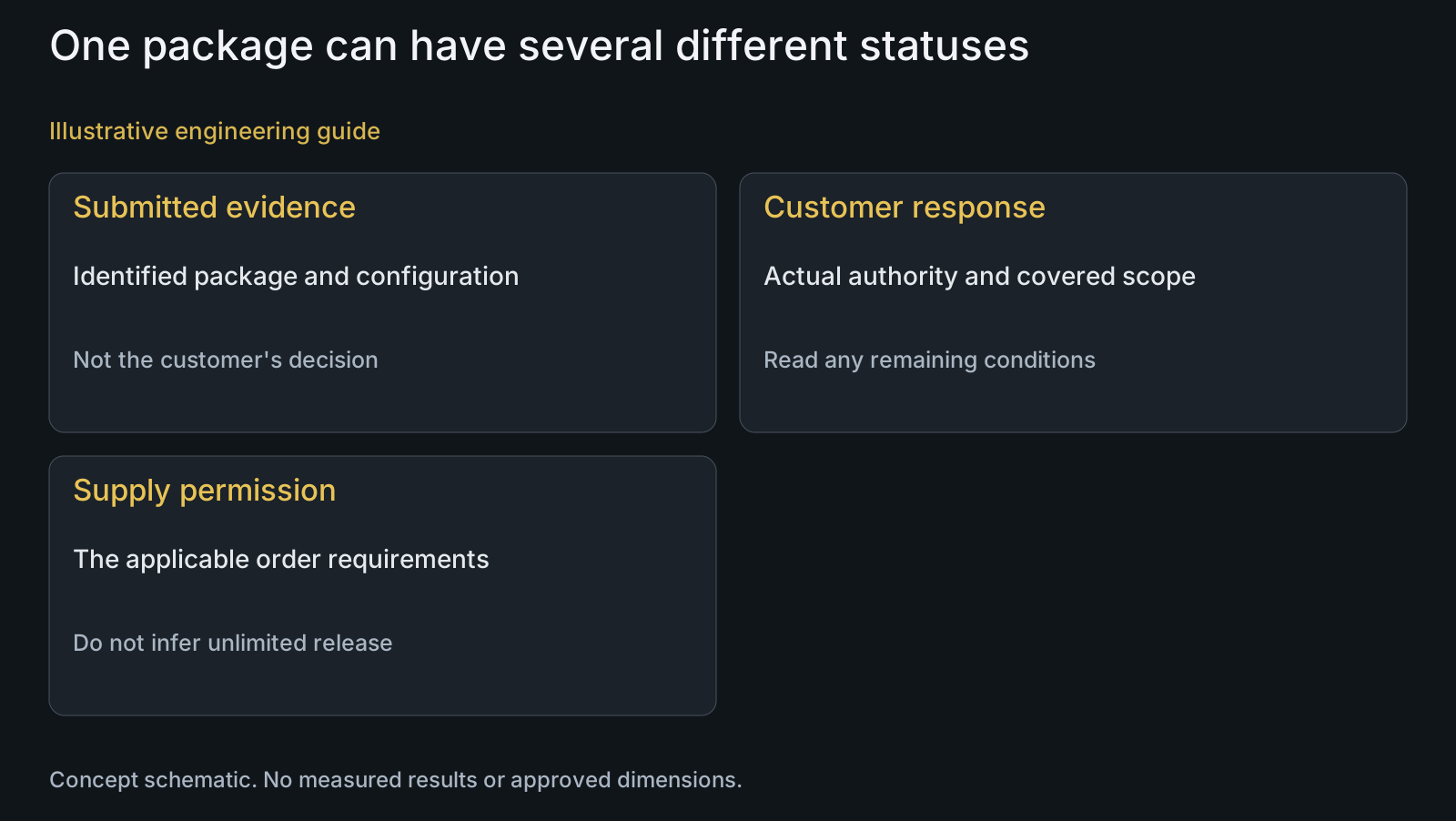
Sending a PPAP package for bicycle pivot hardware is not the same as receiving production or shipment approval. Identify the customer's actual decision, the part revision and production configuration it represents, and any limits on supply. A complete-looking folder or unanswered email cannot supply that authority. PPAP may be a customer requirement rather than a universal bicycle rule; the agreed requirements determine what must be submitted and how the response is used. For purchasing and SQE teams, the practical task is to keep submission, review, conditional permission and approved scope distinguishable, especially when launch timing or later changes create pressure to treat them as equivalent.
Hero: concept illustration of example hardware and its application. It is not a factory photograph, tested component or approved production geometry.
Give the submission and the decision different identities
Record which package was submitted, for which part revision and represented production route. Separately record the response from the authorized customer role. A file-transfer date establishes a delivery event, not a customer's acceptance of the represented production process.
AIAG's public PPAP overview relates production part approval to consistently meeting engineering design and specification requirements during actual production. It does not establish a project-specific approval merely because the supplier assembled named documents.
The PPAP submission guide explains linking the process flow, risk and controls. This article addresses the next decision: what the customer response authorizes and where its scope stops.
Read the represented part and process in the approval
Identify the approved part numbers, revisions and relevant production configuration in the customer's decision. An axle and sleeve can belong to one kit while requiring different evidence. Do not let a kit name conceal which items the response actually covers.
Check whether the reviewed samples represent the intended supplied state. A dimensional report for a prototype and an approval for production hardware are not automatically the same subject. Resolve any difference in material, finish or route through the applicable customer requirements rather than guess from appearance.
Keep documents and decisions retrievable together. The custom-order document guide distinguishes evidence types; it does not expand a declaration or report into an unrecorded customer authorization.
| Available record | What it establishes | Risk of overreading | Buyer confirmation |
|---|---|---|---|
| Submission receipt | The identified package was delivered | Receipt is described as approval | Find the actual customer response |
| Package under review | Evaluation is still in progress | An unanswered email authorizes shipment | Confirm the agreed decision and supply rules |
| Conditional supply decision | Only its documented scope and conditions | Limited permission becomes unrestricted production | Check covered items, limits and closure needs |
| Recorded approval | The represented approved configuration | Different kit items or revisions are included by assumption | Match part, revision and production scope |
| Unresolved result or departure | A specific evidence or disposition question | A generic pending label conceals the actual issue | Identify the missing evidence and responsible authority |
| Later production change | A new scope-review question | Earlier approval is treated as permanent coverage | Apply the actual customer notification and review requirements |
Treat conditional permission as a bounded decision
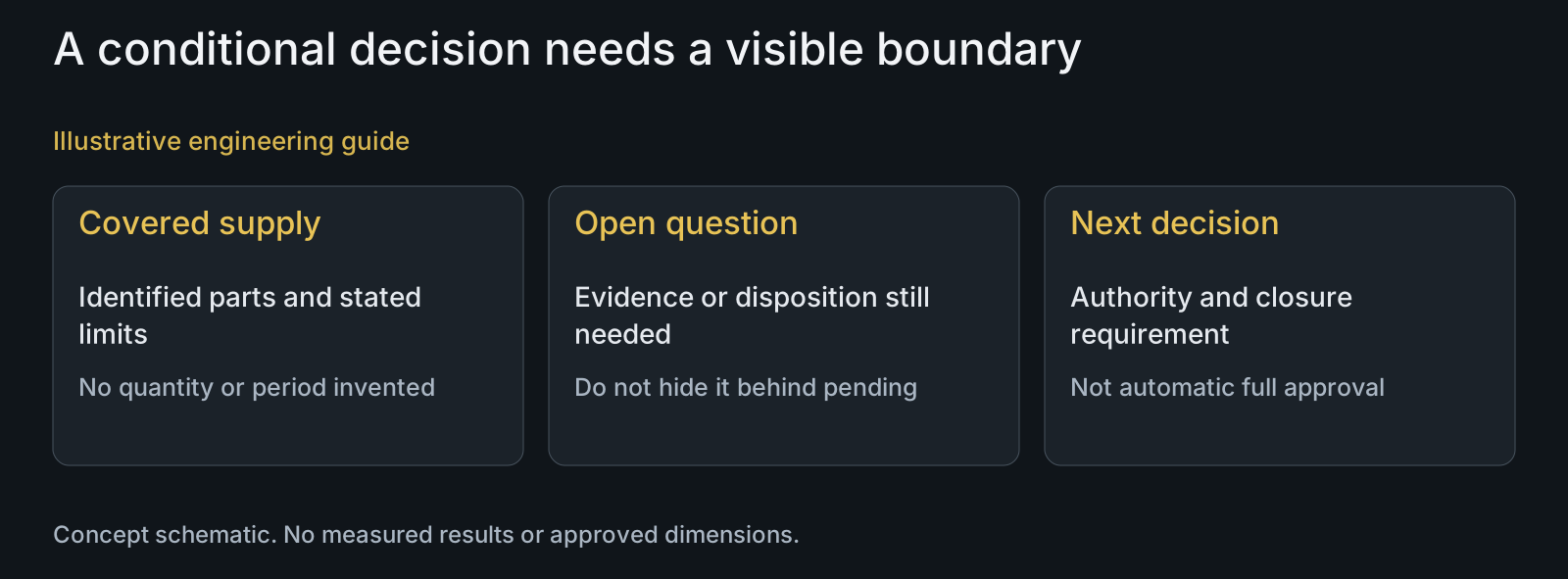
If the customer permits a defined supply while an issue remains open, record precisely what is permitted and what still needs closure. Confirm the relevant parts, quantities or period where specified, the conditions and the responsible decision-maker. Do not invent standard limits or assume every customer permits this route.
A public automotive example shows why the exact procedure matters: Ford's February 2025 PPAP customer-specific document distinguishes review roles and ties its interim shipment permission to a specific authorized alert. Those Ford mechanisms are not adopted as requirements for a bicycle order.
For the actual OEM project, ask which documented response constitutes supply permission and what happens at its limit. A conditional allowance is not automatically a revision to the drawing, permanent acceptance of a departure or approval of unlimited later deliveries.
Keep unresolved evidence and disposition visible
Distinguish an incomplete evidence package from a documented nonconformity. A missing result may leave a requirement unverified; an out-of-requirement result raises a disposition question. Do not collapse both into a generic pending status that hides the decision needed.
For a finished bearing seat, identify whether the open question concerns measurement coverage, final surface condition or a reported departure. The response should address that specific issue. A new material certificate cannot close a missing final-dimensional result solely because it increases the document count.
Name who may resolve or accept the issue under the order. The supplier should not create customer approval wording to fill an empty cell, and customer receipt of the file should not be described as acceptance by silence. No actual deviation or customer decision is reported here.
Illustrative engineering example: a limited supply is not a full launch approval
Illustrative engineering example: assume an OEM receives a pivot-axle submission but a final-condition report remains under review. The customer separately permits a specifically identified evaluation supply under written conditions. No actual permission, quantity, test result or customer relationship is assumed.
Purchasing should preserve the distinction between the submitted package, its unresolved question and the limited supply decision. It cannot interpret that allowance as approval of every later production shipment or extend it to a receiver part absent from the written scope.
The useful action is to identify the evidence needed for the next decision and confirm what closes the conditional scope. The scenario demonstrates a decision boundary; it does not endorse shipment of nonconforming hardware or claim that an interim procedure exists for every customer.
Revisit scope when the production configuration changes
After a recorded approval, compare proposed drawing, material, finish, tooling or route changes with the applicable customer notification and review requirements. The previous response does not silently approve a different configuration. Avoid claiming a universal resubmission trigger from a public overview.
Use the first-article change review to frame affected evidence, while keeping that framework distinct from the customer's PPAP obligation. Report the change and the earlier represented scope before asking what additional submission is required.
PremFixer can discuss a project-specific production-approval request within the manufacturing scope. Confirm the required package, provider responsibilities and customer review path; no automatic Level 3 capability, IATF certification or customer approval is established here. The knowledge center retains related engineering decisions.
Questions buyers need to confirm
Is PPAP a universal bicycle fastener requirement?
No universal requirement is established by the component name. Confirm the customer's contractual scope, applicable manual and instructions. A production-approval tool is not automatically a bicycle market-access certificate.
Does a PPAP submission receipt approve production?
No. It shows delivery of the identified package. Locate the authorized customer response and compare its represented part and process with the planned supply before treating it as an approval.
Does conditional permission cover unlimited future deliveries?
Do not assume that. Read its actual scope, limits, conditions and closure requirements. Confirm the authorized decision for the OEM project rather than inventing a universal quantity or validity period.
Can one kit approval automatically cover every component?
Not without the defined scope. Identify the axle, receiver and spacer revisions and their represented evidence. A shared kit name cannot establish that the customer reviewed every component or route.
Does an old approval cover a later finish or process change?
Not automatically. Compare the changed configuration with the represented approval and apply the customer's notification and review requirements. Describe affected evidence rather than assume either no action or one universal resubmission rule.
What should a PPAP approval-scope RFQ include?
Provide part revisions, BOM, proposed route, required submission and customer instructions. Include any previous response, open issue or conditional scope so PremFixer can discuss the actual deliverables without promising unrecorded approval.
Technical references and scope
AIAG: Production Part Approval Process public overview. Original public purpose connecting production approval with design and specification requirements. Not the complete licensed manual or proof of project approval.
Ford: February 2025 PPAP customer-specific requirements. Dated manufacturer example of defined review roles and specific interim authorization. No Ford portal, alert, approval mechanism or mandatory terms transferred to bicycle projects.
Explore related component, material and sourcing decisions in the customer decision knowledge center. For a drawing review, use the Drawing/BOM RFQ path.
Define the production-approval decision your project needs
Send the drawings, BOM, proposed manufacturing route and customer PPAP requirements. Include existing submissions or responses and any open conditions so PremFixer can discuss the evidence package, represented scope and responsibilities for the next review decision.
Discuss the drawing and BOM