

When asking PremFixer for a response time, identify the event and expected output: receipt confirmation, technical clarification, a scoped quotation or a defined complaint action. These are different commitments. A fast reply can be useful without resolving the engineering issue, and a clarification may be the correct next response when a drawing omits the mating condition. Agree the relevant inputs and timing basis for your request. Do not treat acknowledgement as design approval, a planning estimate as a complete quote, or investigation start as verified correction. No universal hourly quotation, support or complaint-resolution deadline is established by this guide.
Hero: concept illustration of example hardware and its application. It is not a factory photograph, tested component or approved production geometry.
Name the question and expected response event
A new-part quotation request, a question about an existing drawing and an issue with delivered parts need different context. State which request is being made and what the next reply should contain. A single general question such as 'Please support urgently' does not define the needed output.
For a new pivot, specify the available drawing, quantities and supplied condition. For a technical question, mark the feature and the decision it affects. For a delivery issue, identify the represented order, part and observed condition rather than assume the supplier can infer them from a photograph.
If several matters share one email, keep their references separate. A quoted new revision may not be the revision involved in an earlier complaint. Replying to one subject should not make the others appear resolved.
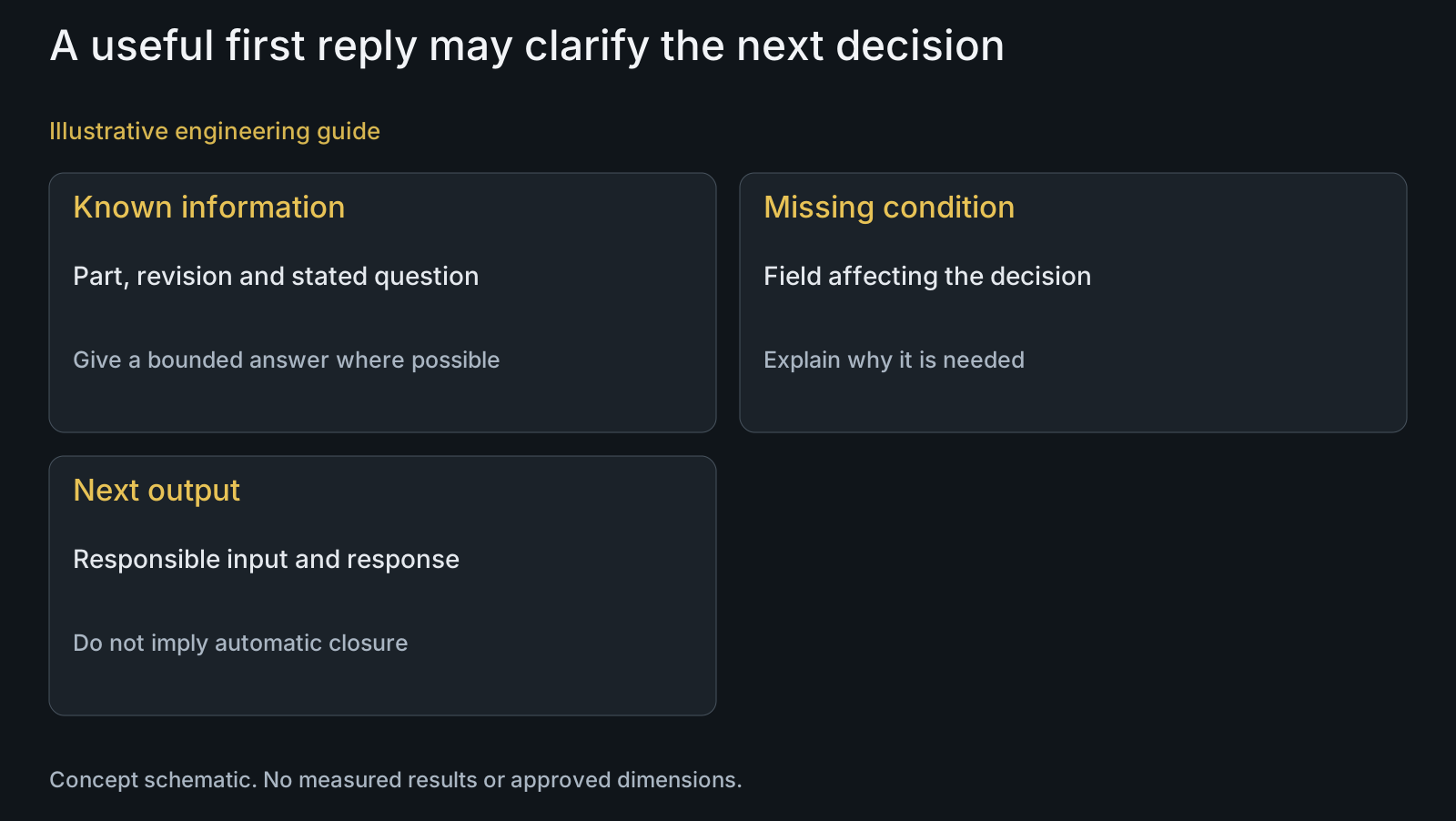
Recognize when a clarification is a useful first answer
If a locating-seat question lacks the mating sleeve requirement, a precise request for that information can be more useful than a guessed fit recommendation. The response should explain why the missing field matters and which decision it prevents. 'Send more details' alone does not provide that explanation.
A reply can also state a bounded conclusion from the available information while retaining a separate open question. Do not force every response into either a complete answer or no progress. Identify what the current evidence supports and what the responsible team still needs to evaluate.
The engineering-support guide explains connected manufacturing inputs. Technical advice remains a proposal within its scope, not permission to change a released interface or an assurance of universal frame compatibility.
| Received response | Useful information | Still unresolved | Buyer next question |
|---|---|---|---|
| Receipt acknowledgement | Request reference and intended handling | Technical or commercial conclusion | What output is expected next? |
| Targeted clarification | Missing field and why it matters | Decision dependent on that field | Which drawing or mating input closes it? |
| Planning estimate | Assumptions and approximate scope | Complete offered deliverable | What remains assumed or excluded? |
| Scoped quotation | Revision, quantity and offered work | Design or application approval | Does it cover the requested condition? |
| Complaint containment proposal | Immediate exposure and proposed action | Verified cause and lasting correction | Which population and evidence apply? |
| Investigation update | Supported findings and remaining questions | Final agreed resolution where still open | What evidence supports closure? |
Separate quotation completeness from speed of acknowledgement
An acknowledgement confirms a received request; a quotation defines the offered work and terms. If geometry, finish or kit contents remain assumed, the commercial response should make those assumptions visible. A quick price is not necessarily a complete offer for the required part.
Ask whether the reply is a planning estimate or a quotation against the identified revision and quantity. Clarify exclusions and alternative proposals rather than interpret apparent precision as certainty. The quotation-validity guide addresses its commercial basis separately.
Agree the timing basis for the actual request, including any prerequisite inputs and relevant working periods. Do not convert a general response target into an automatic order acceptance, reserved production slot or confirmed sample arrival. The sample milestone guide treats delivery dates separately.
Distinguish a complaint response from a verified resolution
A first complaint response can identify the reported issue, request missing context and discuss an immediate containment question. It should not invent a cause before the evidence is reviewed. State what is known about the affected part and what remains uncertain.
The ASQ 8D explanation separates interim containment, verified root causes and corrective-action validation. It does not prescribe a universal hourly closure deadline. Starting an investigation or filling a report heading does not demonstrate that correction has been verified.
Use the corrective-action article for the investigation process and after-sales resolution guide for the agreed remedy boundary. A service response does not establish a default refund, warranty result or accepted diagnosis.
Review a mixed inquiry without closing the wrong issue
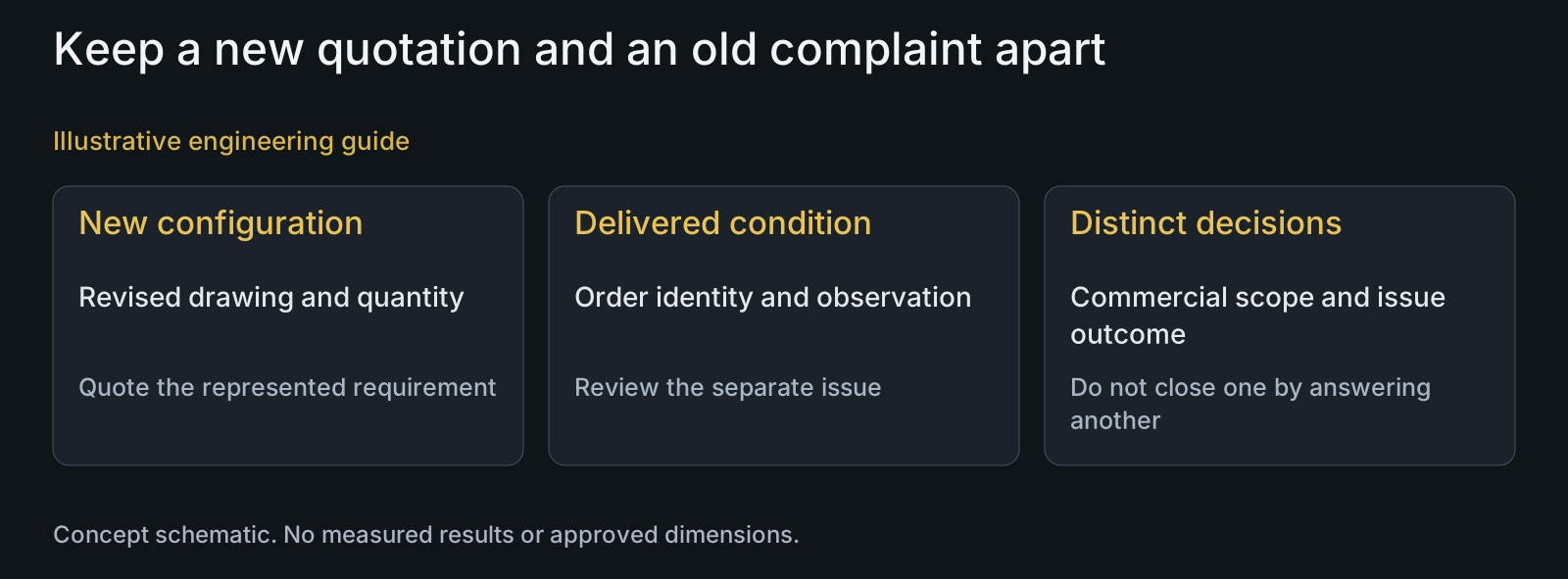
Illustrative engineering example: assume an OEM sends a revised sleeve drawing for quotation in the same message as a photograph of a previously delivered pivot that needs review. No actual complaint, manufacturing error, quotation or customer result is assumed.
A useful response separates the new drawing's scope from the delivered part's identity. It may ask for a missing mating field for the quotation and an order or lot reference for the reported condition. Neither clarification is a claim that the customer is at fault or that the part is defective.
If the quotation question is later answered, the complaint remains open until its own agreed decision is supported. Conversely, an immediate action on the delivered part does not authorize manufacture of the revised drawing. Keeping the two events distinct prevents a quick reply from concealing an unresolved task.
Keep the next output and its owner visible
Agree what information will return next and which party provides the remaining input. A project contact can coordinate the response without replacing the designer, quality reviewer or commercial decision-maker. The project-contact comparison addresses that communication model.
If the scope or information changes, explain what that changes about the response milestone. Do not restart every unrelated matter or preserve an obsolete promise silently. The customer should be able to identify the current question without reconstructing the full message history.
Provide relevant material requirements, manufacturing context and the intended bicycle application for a technical request. Agree any separate development work. No unlimited redesign service, permanent staffing coverage or unconfirmed hourly commitment is implied.
Questions buyers need to confirm
How quickly will PremFixer reply to a technical request?
Agree the response event and timing basis for the actual request. Identify whether you need acknowledgement, clarification, quotation or an issue action and provide the relevant inputs. No universal hourly commitment or complete-resolution deadline is established here.
Is asking for missing information a meaningful technical response?
Yes, when it identifies the field, explains its effect and names the decision it prevents. For example, a mating sleeve condition can be necessary to review a locating interface. A vague request for details without that connection is less useful.
Does a fast price mean the quotation is complete?
No. Check the represented revision, quantities, supplied condition, assumptions and exclusions. A planning estimate can be useful without being the final offered scope. Speed alone does not resolve missing technical or commercial fields.
Does starting an 8D report mean the complaint is solved?
No. Investigation start, containment, verified causes and corrective-action validation are distinct outputs. Ask which evidence supports the represented stage and what remains open. A report heading or early reply does not establish final resolution.
Can one email cover a new drawing and a delivered-part issue?
Yes, but keep their identities and expected outputs separate. Provide the new revision and quotation scope, plus the affected order and observed condition for the issue. Answering one subject must not make the other appear closed.
Does technical support approve my revised frame interface?
No. Manufacturing advice can clarify a proposal, but the responsible customer designer retains the design decision and application validation. Keep the original baseline visible until the applicable change is authorized.
Technical references and scope
ASQ: Eight Disciplines 8D. Distinct containment, verified cause and validated correction activities; not a universal deadline, PremFixer service policy or actual complaint outcome.
Explore related component, material and sourcing decisions in the customer decision knowledge center. For a drawing review, use the Drawing/BOM RFQ path.
State the response your next decision needs
For a new inquiry, send the drawing or STEP, BOM, material/finish definition and quantity. For an existing-part question, include the order, part revision and observed condition. Name the technical or commercial decision needed so PremFixer can discuss the relevant response scope and next input.
Discuss the drawing and BOM