
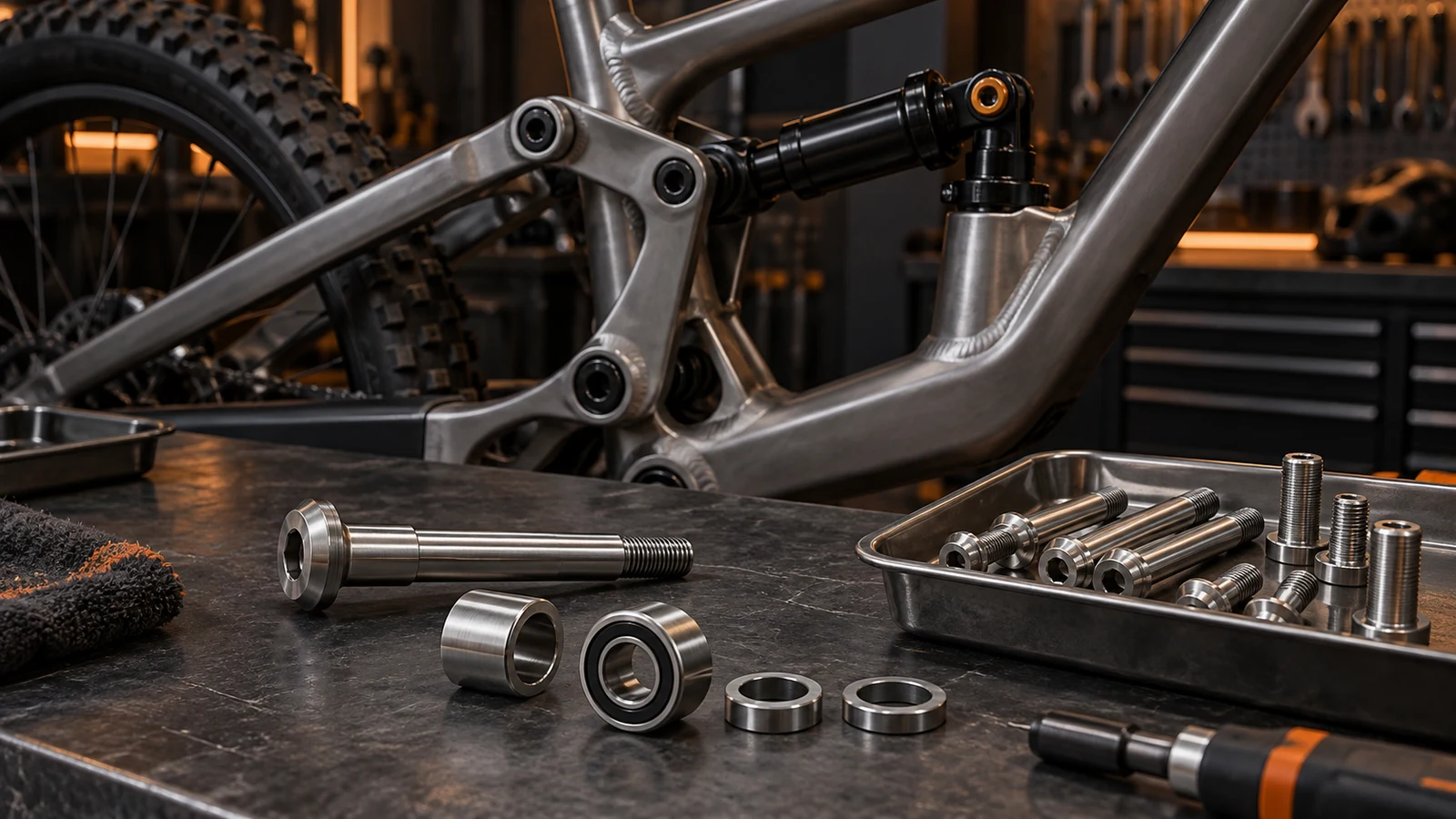
Corrosion on a stainless pivot bolt near a frame weld does not establish intergranular corrosion. First determine whether the bolt itself experienced a relevant thermal cycle during manufacture, frame fabrication or repair. A removable bolt installed after welding and cooling was not exposed to that earlier weld cycle. Its own material and processing history still matter. Intergranular attack requires a specific metallurgical and environmental explanation; surface staining or a nearby weld is insufficient evidence. Review the affected component, damage location and process sequence before selecting a low-carbon grade, a surface correction or a different joint arrangement.
Hero: concept illustration of example hardware and its application. It is not a factory photograph, tested component or approved production geometry.
Put the removable bolt on the manufacturing timeline
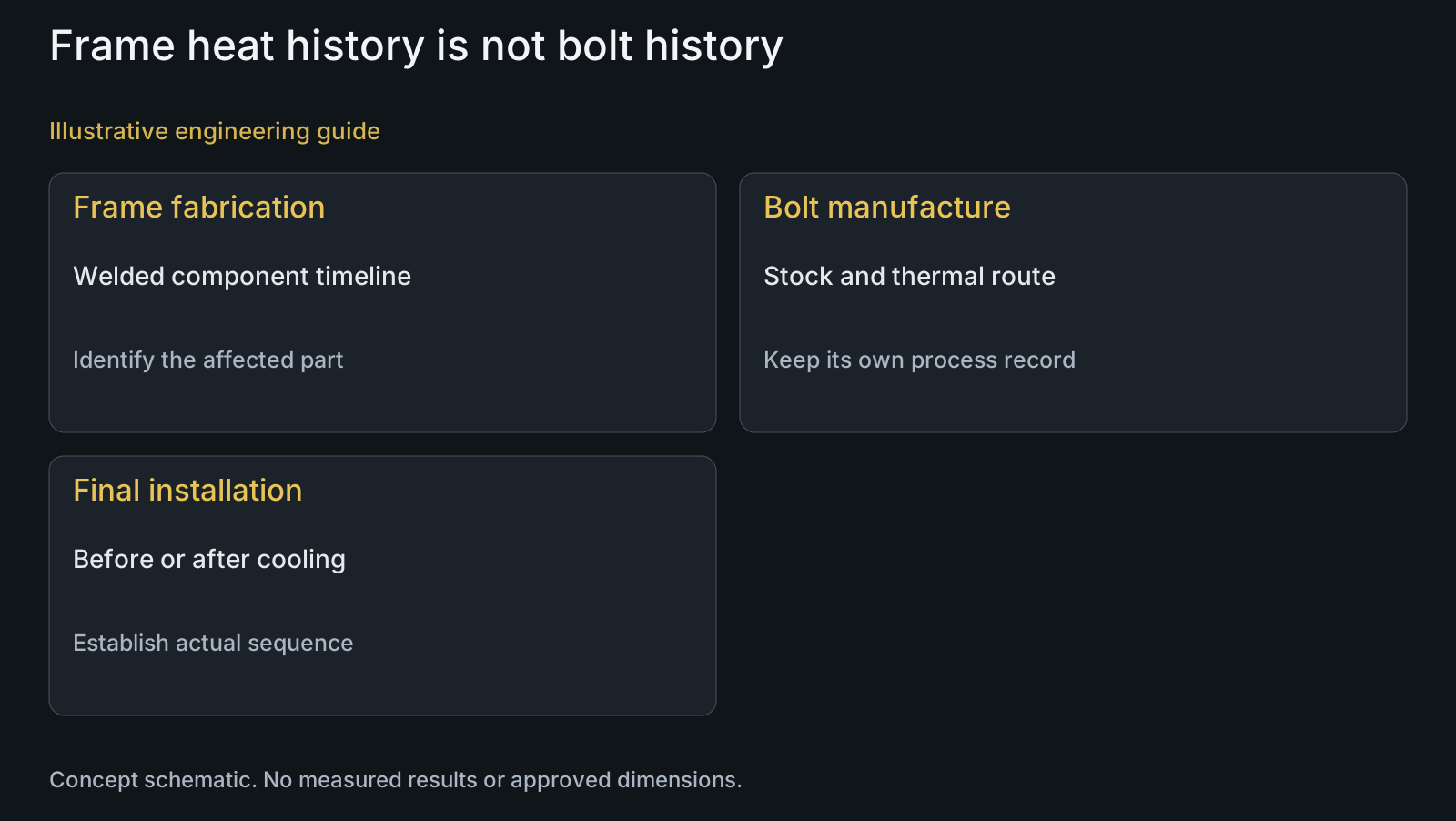
Identify the component under discussion. A welded frame insert, an embedded nut and a removable shoulder bolt have different manufacturing histories even when they share one drawing view. Record which part was present during welding, what happened afterward and when final hardware was installed. Do not transfer a frame heat-affected-zone description to every nearby part.
For the bolt, ask about stock condition and any subsequent hot operation or thermal process. If it was present during frame repair, establish what exposure information exists. Distance from a weld alone does not describe the bolt's temperature and duration. An unknown exposure should remain unknown until supported; a frame welding procedure does not automatically document the temperature of an attached fastener.
Separate chronology from contamination. A bolt fitted after cooling can still encounter fabrication debris or deposits. Those are alternative investigation directions, not evidence that the bolt experienced welding sensitization. Preserve the material and processing records before choosing which question a laboratory assessment should answer.
Understand the proposed grain-boundary mechanism
Outokumpu describes sensitization as chromium-rich carbide precipitation at grain boundaries with adjacent chromium depletion after relevant thermal exposure. Lower carbon content can reduce the precipitation concern. That mechanism connects composition, thermal history and the environment capable of attacking the affected material. It does not establish a universal corrosion reduction for any bolt labeled 316L.
Use the mechanism to ask a specific question: is there evidence that this material and thermal route created the susceptibility being alleged? An alloy certificate helps identify composition, but it does not by itself describe every operation performed on the finished bolt. Conversely, a processing history does not replace material identity. Keep both inputs available to the responsible materials specialist.
A corrosion-grade change and a mechanical-condition change also need separate treatment. If the project proposes 304L or 316L, define the required finished-component properties and geometry as well as the corrosion objective. Review 304 specification inputs when the purchase description contains only an alloy-family name.
| Known condition | What it establishes | Open concern | Appropriate next evidence |
|---|---|---|---|
| Bolt installed after frame welding and cooling | No exposure to that earlier weld cycle | Its own manufacture and service exposure | Stock/process identity and affected-region observations |
| Bolt present during a repair weld | Possible exposure needs reconstruction | Actual temperature/time unknown | Repair sequence and materials assessment |
| Brown deposit near a weld | A visible surface observation | Mechanism unconfirmed | Preserved part and contamination/damage assessment |
| Identified susceptibility-test result | Result for the selected specimen/method | Applicability to the finished part | Traceable material condition and specimen scope |
Distinguish a susceptibility test from a failure diagnosis
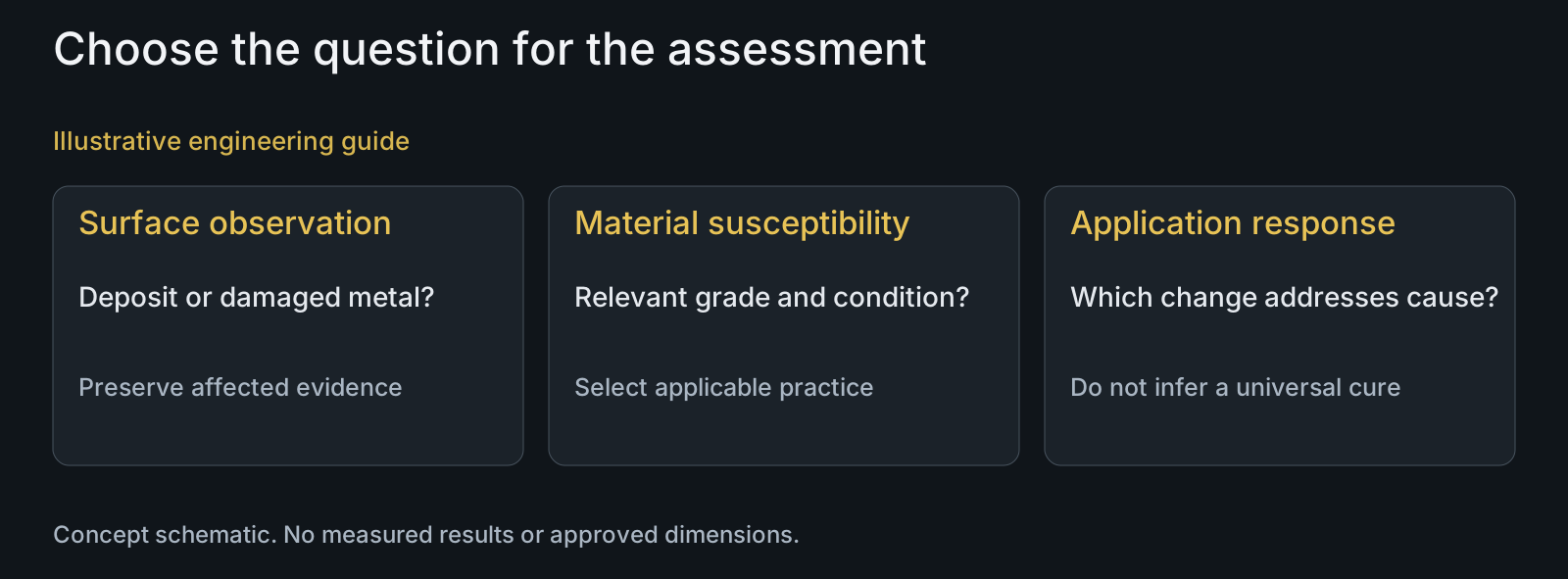
ASTM A262 provides practices for detecting susceptibility to intergranular attack in austenitic stainless steels. Its public scope distinguishes methods and their applicable materials. The materials specialist should select the relevant practice and specimen condition. A general request for corrosion testing leaves the question and applicability unresolved.
Testing material susceptibility and diagnosing damage in a returned joint are different tasks. A susceptibility result must remain tied to the specimen and selected method. Investigation of a damaged bolt may also need observations from the actual affected region. Do not label a photograph of a brown surface as a grain-boundary assessment or use a test on unrelated stock as proof of a finished component's condition.
Retain observations that suggest other mechanisms, including whether damage is confined to a sheltered contact or follows deposits. The 316L staining guide addresses that initial surface distinction; the stainless/aluminum interface guide addresses mixed-metal paths. Neither question should be replaced by a welding explanation solely because a seam is nearby.
Compare two installation histories in a review
Illustrative engineering example: assume a project reports discoloration on a removable stainless pivot bolt beside a welded frame junction. One proposed explanation is welding sensitization. In the first scenario, records show the bolt was installed only after the frame cooled. In the second, the hardware remained fitted during a repair weld, but its thermal exposure was not recorded. No metallurgical result is assumed in either scenario.
For the first scenario, that earlier frame-welding cycle is excluded from the bolt's heat history by the installation sequence. Review its prior manufacturing route and the local exposure instead. For the second, request the repair details and preserve the affected part for an appropriate assessment. The unknown cycle supports further investigation, not a confirmed diagnosis or a fixed percentage increase in risk.
If an assessment identifies a material/process concern, compare a different installation sequence, a suitable material condition or another approved process route against that finding. Do not apply a high-temperature corrective treatment to finished hardware without reviewing its mechanical properties, geometry and complete manufacturing definition. A corrosion remedy can create a separate component-conformity question.
Specify the corrective supply scope without promising a cure
Separate the returned-part decision from the next production proposal. Follow the component owner's disposition requirements for damaged safety-critical hardware; visual appearance alone does not establish remaining capacity. For new supply, identify the selected alloy, condition, allowed process route and any additional material assessment required by the project.
PremFixer can review drawing-led hardware manufacture and coordinate specified partner testing or thermal operations. The manufacturing overview is the appropriate starting point for that scope. Manufacturing review does not substitute for a qualified failure diagnosis, authorize a frame repair or certify a bicycle system. No corrosion-reduction percentage or successful field repair is claimed here.
Provide the installation timeline alongside the drawing and BOM so the review addresses the relevant part. When comparing quotations, identify whether additional specimen preparation, a specified susceptibility assessment or a changed material condition is included. An alloy-name substitution without those inputs can leave the original failure hypothesis unanswered.
Questions buyers need to confirm
Can frame welding affect a bolt installed afterward?
That earlier weld cycle did not heat a bolt that was absent. Confirm installation after cooling and separately review the bolt's own prior thermal route. Nearby fabrication deposits are a different possible concern.
Does a 316L label guarantee freedom from intergranular corrosion?
No blanket guarantee follows from the label. Low-carbon selection addresses a precipitation concern, while exact composition, processing history and exposure determine the assessment. The component must also meet its specified mechanical condition.
Can passivation reverse a sensitized microstructure?
Do not treat it as a metallurgical correction. A surface-treatment specification and a material-susceptibility concern require different assessments. Ask the materials specialist to establish the cause before proposing a process change.
Is a salt-fog comparison enough to diagnose grain-boundary attack?
It does not by itself establish that mechanism. Define the damage question and select evidence suited to it. ASTM A262 addresses susceptibility practices; a returned-part diagnosis still needs its own material and affected-region context.
What should accompany a bolt sample for review?
Send material identification, stock and finished condition, known thermal operations, frame fabrication/repair sequence, installation timing and damage photographs with location. Keep the part's identity traceable and avoid treating missing heat records as measured exposure.
Technical references and scope
Outokumpu: corrosion resistance and sensitization. General sensitization mechanism and low-carbon context; no percentage improvement or component diagnosis is inferred.
ASTM A262 public scope. Susceptibility practices for austenitic stainless steels; public scope only, not a claim of performed testing or full paid-standard review.
Explore related component, material and sourcing decisions in the customer decision knowledge center. For a drawing review, use the Drawing/BOM RFQ path.
Review the bolt's material and process history
Share the hardware drawing, material condition, known thermal route, installation or repair sequence and affected-part information. PremFixer can review the manufacturing inputs for a scoped replacement or future supply proposal while the responsible specialist assesses the corrosion mechanism.
Discuss the drawing and BOM