
A titanium pivot can give different geometric observations while clamped and after removal, but that difference does not identify the cause by itself. First confirm that the same feature is being compared using a coherent reference and stated part condition. Restraint, supported geometry, material-removal sequence and temperature are relevant review areas; stock and process history may also need investigation. For the OEM, acceptance belongs to the drawing's required final state, not the most convenient intermediate reading. Do not convert an illustrative distortion value into a general supplier capability. The useful review separates observed shape changes, plausible mechanisms and the evidence needed to choose a manufacturing response.
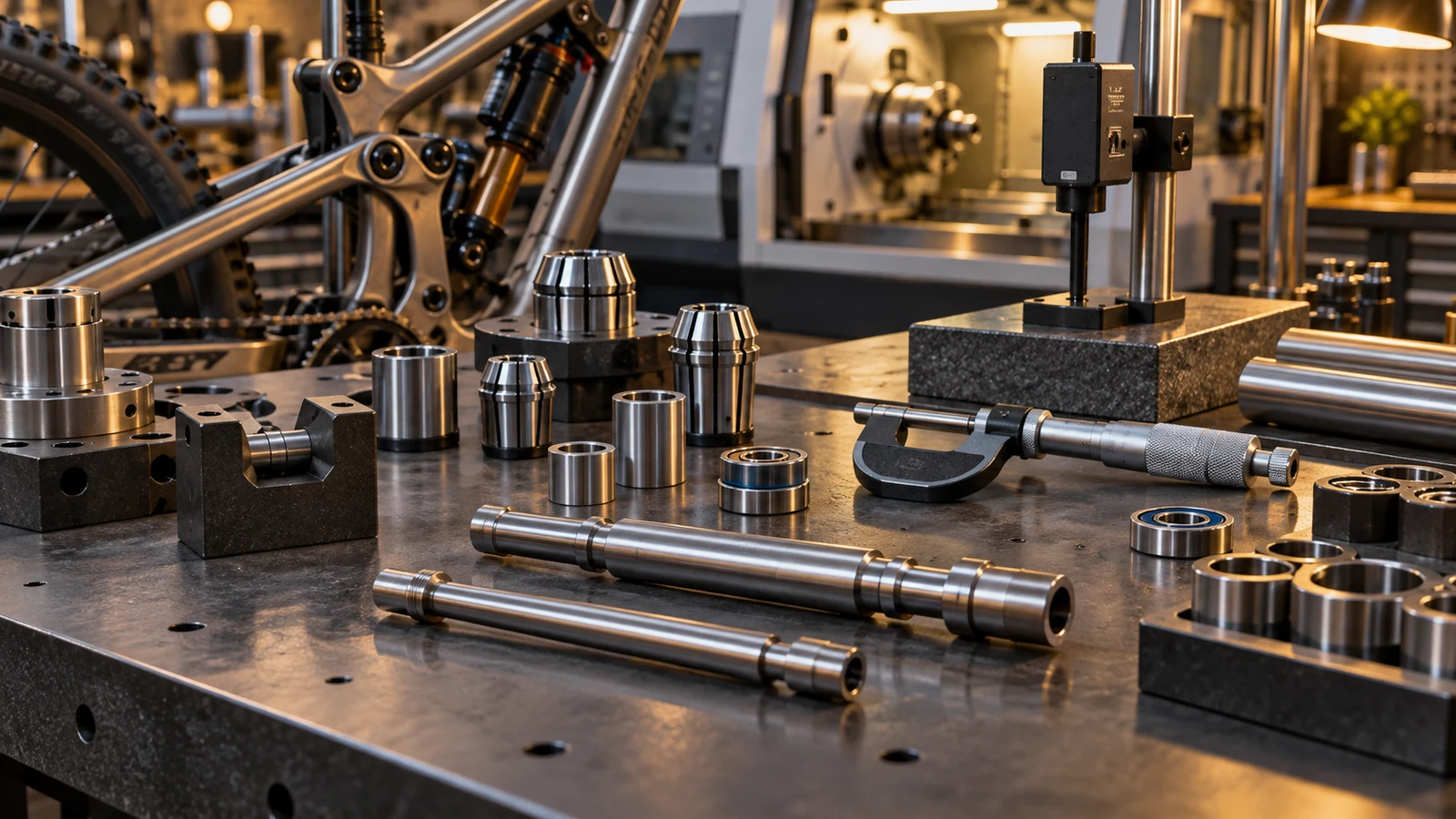
Hero: concept illustration of example hardware and its application. It is not a factory photograph, tested component or approved production geometry.
Compare like observations before diagnosing distortion
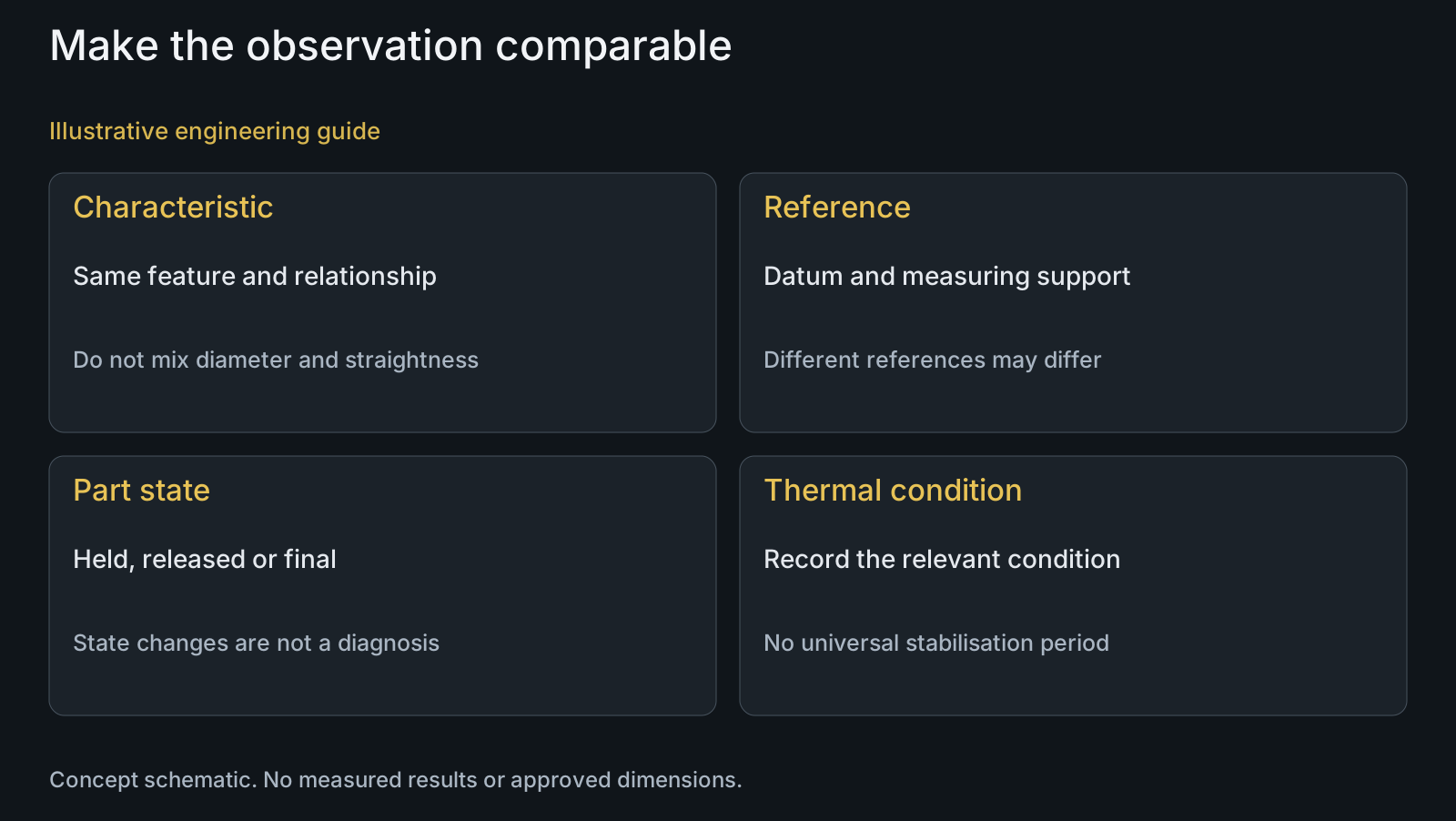
State the measured characteristic and reference for each observation. A machine-referenced indication during machining and a released-part check on a different support may not evaluate the same relationship. A numerical difference is useful only after its meaning and comparison basis are understood.
Record whether the part is held, released, carrying allowance or in its specified final state. Also identify the relevant temperature condition and method. If several of these change together, do not assign the entire difference to unclamping simply because that event occurred between the readings.
Define what the drawing actually controls. Diameter, straightness and a relationship between a bore and outside feature are different questions. A part should not be described as distorted without identifying the characteristic and required acceptance state that motivated the concern.
Support and part geometry must be considered together
TIMET's fabrication handbook identifies titanium's lower elastic modulus as relevant to machining deflection and support. That mechanism supports reviewing a slender or hollow feature; it gives no universal deflection ratio or finished-pivot limit.
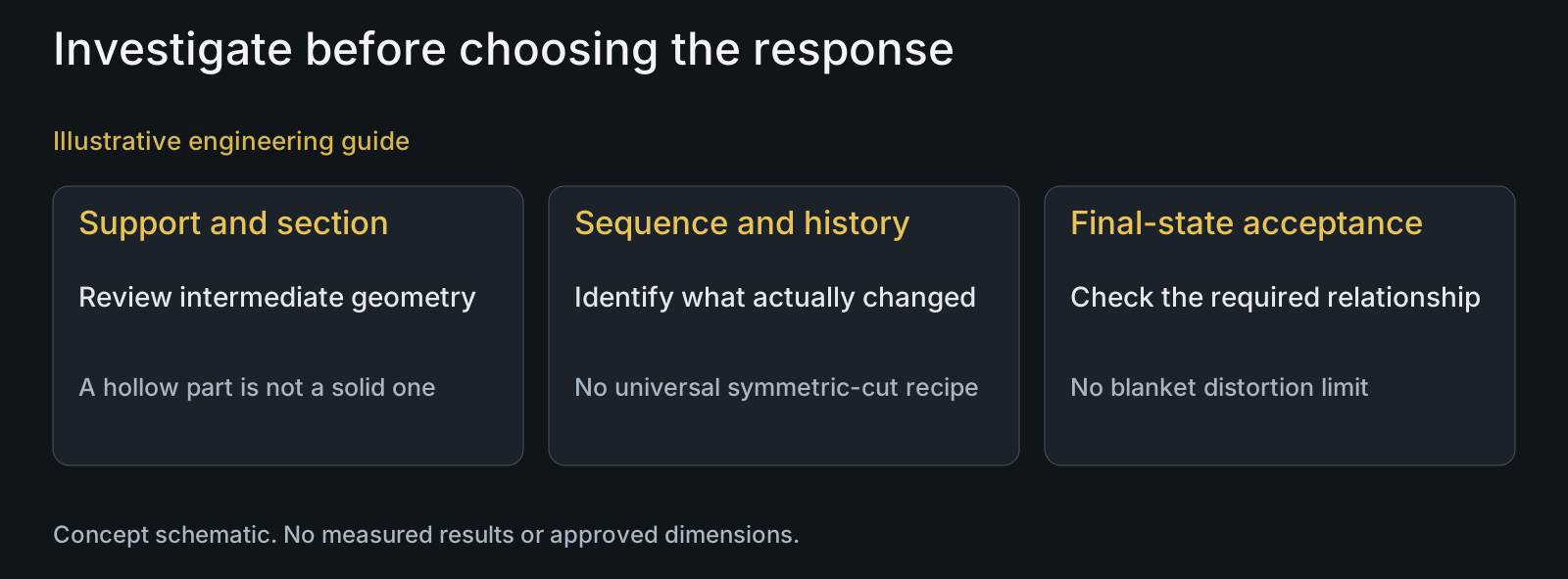
For the actual axle, identify the supported regions, unsupported length and remaining wall or section during each operation. The finished outside envelope alone does not show the support available while an internal feature is being machined. A solid and hollow proposal can therefore require different route reviews.
Ask how the proposed fixture both restrains the part and permits the required operation. Do not solve an observed geometry difference by casually lowering clamp force. Secure workholding and equipment-specific instructions remain the responsibility of the manufacturing team; fixture names alone do not prove acceptable released geometry.
| Observed difference | Condition to compare | Premature conclusion | Useful review evidence |
|---|---|---|---|
| Held versus released reading | Same characteristic, reference and stated state | Unclamping proves residual stress | Comparable measurement and restraint basis |
| Before versus after bore creation | Remaining section and support at each stage | Same outside shape means same process behavior | Actual intermediate geometry and sequence |
| Immediate versus later check | Defined thermal and measurement condition | Time difference proves permanent distortion | Method and condition attached to observations |
| Different fixture or support | Which reference and restraint each establishes | Fixture label proves a better part | Required geometry in the accepted condition |
| Difference remains unexplained | Stock and complete process history | Add heat treatment as an automatic cure | Purpose-specific investigation and route assessment |
The removal sequence changes the intermediate component
As engineering analysis, compare what material remains when each functional feature is finished. Creating a bore, reducing an outside region or machining a local feature changes the intermediate component. Review those states instead of treating all operations as acting on the final CAD model from the start.
Symmetrical removal, staged work or a different supported sequence may be proposals for evaluation, not guaranteed solutions. The appropriate choice depends on the actual geometry and process. More passes do not independently prove less final variation, and symmetry is not permission to change a required interface.
Identify where a proposed support feature or temporary allowance is removed. Its use must be compatible with the approved delivered component. Keep the functional drawing unchanged unless the responsible design owner approves a distinct revision, and evaluate any route proposal against that required output.
Keep thermal condition and residual-stress hypotheses separate
TIMET's machining discussion also identifies cutting-zone heat and tooling condition as relevant process concerns. Its handbook discusses residual-stress-related distortion in a fabrication and heat-treatment context. These are reasons to ask about the actual process history, not evidence that a particular pivot has a diagnosed residual-stress problem.
A part-state difference should prompt a defined comparison, not an automatic stress-relief order. Determine which observations remain different under the agreed measurement condition, then consider what additional history or specialist evidence would help discriminate causes. A shape observation is not a direct residual-stress measurement.
If a thermal operation is proposed, review its purpose, alloy condition and downstream requirements with the responsible team. Do not borrow a fabrication-handbook heat-treatment recipe for an unidentified axle. The required material state, later processing and acceptance still belong to the agreed manufacturing scope.
A hollow axle illustrates a cause-isolation problem
Illustrative engineering example: assume a titanium axle receives a bore after an outside reference feature is machined. The team observes a difference between a held indication and a released check made on another support. There are no actual readings, measured stresses or qualified fixtures in this example.
The team first asks whether both observations evaluate the same feature and datum relationship. It records restraint and thermal condition, then reviews the remaining section and support at each operation. Because several conditions changed, it does not label the difference as proven residual-stress release.
A revised support or sequence can then be evaluated against a coherent final-state check. If a difference remains unexplained, further investigation is identified rather than hidden by a corrected offset or added thermal step. The example demonstrates a diagnostic sequence, not a successful distortion correction or a numerical capability.
Provide observation conditions with the drawing
Send the drawing, STEP, alloy and stock condition, quantities and affected-feature notes to the CNC manufacturing review. If samples are available, explain how and when the concern was observed; an unlabeled before-and-after photograph cannot establish the comparison conditions.
The workholding surface guide separately addresses permitted contact and local damage. The titanium coolant guide addresses delivery and fluid condition, while the TC4 thermal-scope guide explains why optional thermal work needs a defined purpose.
PremFixer manufactures to the customer's agreed component and supplied-state definition. A distortion review should connect the concern to that definition and the actual route. It does not establish in-house residual-stress measurement, a standard stress-relief operation or a universal titanium accuracy promise.
Questions buyers need to confirm
Does a geometry change after unclamping prove residual stress?
No. Confirm the same characteristic and reference, restraint and thermal conditions first. A difference is an observation; residual stress remains a hypothesis unless suitable evidence supports that diagnosis.
Why does an internal bore matter to a distortion review?
It changes the intermediate section and can change support needs. Show bore geometry, sequence and the material remaining when functional features are finished rather than assessing only the outside envelope.
Does more symmetric removal guarantee a straight titanium pivot?
No universal guarantee follows. It can be a route proposal for the actual geometry, but support, sequence, material history and final-state evidence still matter. Preserve the approved interfaces.
Can lowering clamp force solve the problem safely?
Do not assume that. Secure restraint and the actual operation require manufacturing assessment under applicable equipment instructions. Review an appropriate support arrangement without prescribing a universal reduced setting.
Should every titanium axle receive stress relief?
No automatic rule is established. Define the proposed thermal purpose, actual alloy condition and required supplied state. A geometry observation alone does not justify a thermal recipe or approve the resulting component.
What helps PremFixer review a suspected shape change?
Send drawing and STEP, material condition, affected characteristic, operation history and the method, reference, restraint and thermal state of each observation. Include quantities and final acceptance requirements so a route proposal addresses the actual concern.
Technical references and scope
TIMET: Titanium design and fabrication handbook. Machining page16 and fabrication/thermal discussion35–36 read. Lower-modulus support, heat/tool concerns and fabrication residual-stress context only; no coolant chemistry, cutting data, heat-treatment recipe, numerical distortion or factory capability transferred.
Explore related component, material and sourcing decisions in the customer decision knowledge center. For a drawing review, use the Drawing/BOM RFQ path.
Review the geometry state of your titanium pivot
Send the drawing, STEP, stock condition and affected-feature notes, with samples or observations labeled by measurement method and part state. PremFixer will review the manufacturing and acceptance scope to separate comparison differences from cause hypotheses and identify the relevant support or sequence questions.
Discuss the drawing and BOM