

Tray packing is not automatically cheaper than a bulk bag. It becomes the better engineering choice only when verified downstream value exceeds the full packaging and logistics premium for the defined part, station, order and route.
1. Start with the receiving operation, not the container
A packaging specification often begins with the supplier-side object: bag, tray, carton, pallet. The better starting point is the next controlled position in the customer’s process.
Before a precision component reaches that position, someone or something may need to find it, separate it, establish its orientation, inspect a surface, transfer it into a nest, or recover from an exception. Those activities can be trivial, or they can become meaningful work when repeated across a large order.
An oriented tray can be designed to hold and present parts in defined cavities. Packaging suppliers also treat locating features, structural stability, material choice and equipment interfaces as application-specific design inputs.[4] That makes tray presentation a legitimate production-interface option—not proof that it is the best option.
Bulk presentation remains a credible baseline. It may offer higher packing density, lower packaging complexity and less supplier-side orientation work. Manual random pick may be entirely adequate. For automation, random-bin picking is also a real architecture built around a coordinated robot, gripper and 3D-vision study.[6]
The decision is therefore between complete operating systems, not between a “basic bag” and a “better tray.”
2. Keep takt separate from work content
Takt time is available production time divided by customer demand.[1][3] A package does not change either input by itself.
Packaging may change a measured work element or station cycle margin. For example, a repeatable pose may reduce search or reorientation in a defined pick step. That should be described as a change in manual work content or observed cycle time—not a change in takt.
The distinction matters because a shorter non-bottleneck activity does not automatically raise line throughput. A useful comparison should first define the work sequence and separate manual time, walking, machine or vision time, in-process inventory, tray change, replenishment, retries and recovery. Lean Enterprise Institute’s standardized-work framework provides that structure, but it supplies no tray-versus-bulk time advantage.[2]
Use the same part revision, work boundary, station, tools, operator or cell configuration and exception rules for both modes. Retain the raw observations. Only then does a percentage comparison have meaning.
3. What a small measured difference means at 100,000 pieces
Before a time study exists, a sensitivity calculation can show scale without pretending to predict a result.
Let:
Q = 100,000 pieces;Δt = bulk manual presentation-and-pick time − tray manual presentation-and-pick time, in manual seconds per piece;H_gross = gross manual work-hours corresponding to that difference.
The calculation is:
H_gross = Q × Δt ÷ 3,600
| Manual seconds saved per part | Gross manual work-hours across 100,000 parts |
|---|---|
| 0.00 | 0.00 |
| 0.25 | 6.94 |
| 0.50 | 13.89 |
| 1.00 | 27.78 |
| 1.50 | 41.67 |
| 2.00 | 55.56 |
| 3.00 | 83.33 |
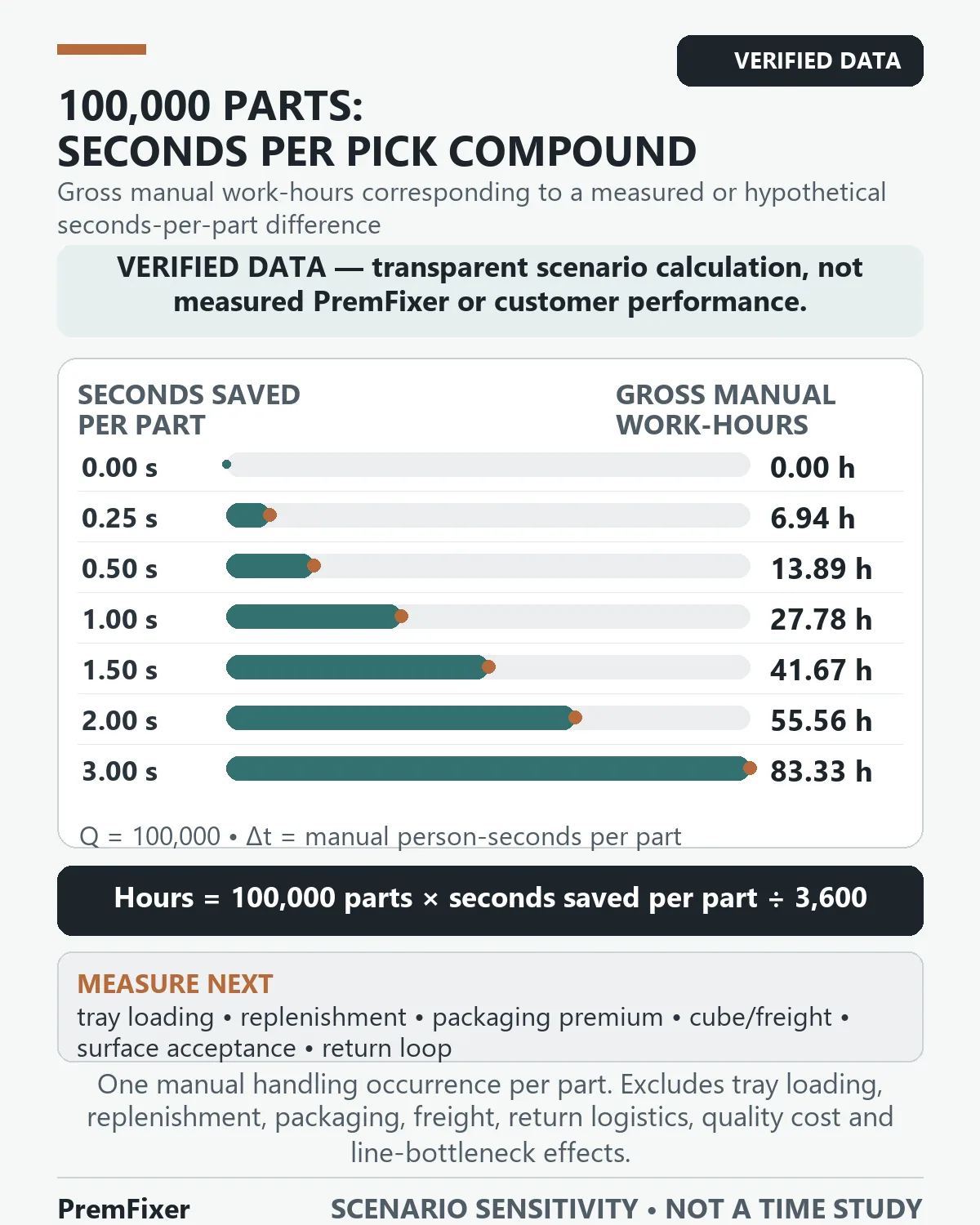
At one measured manual second per part, the arithmetic produces 27.78 gross manual work-hours. It does not produce a wage saving, headcount change, throughput increase, capacity release, ROI or payback. It also does not include the work required to orient and load the tray at the supplier, replenish it at the customer, handle exceptions or manage empty packaging.
If measured Δt is negative, the tray uses more manual time in the defined element. The calculation must be allowed to show that result too.
4. Compare bulk and tray as complete presentation systems
An oriented tray can reduce pose variability. A bulk system can avoid the tray’s cavity, loading, stack and return constraints. The right comparison follows both systems from supplier pack-out through the next controlled customer position.
Bulk presentation questions
- Does the operator need to search, separate or reorient parts?
- Can parts nest, tangle or obscure the required pickup feature?
- Does a machine-vision workflow need to detect the part, calculate pose and return position and rotation to the robot?[5]
- If random-bin automation is considered, what robot, gripper, sensor, collision and recovery study is required?[6]
- Is the density advantage significant in the actual carton, pallet and freight lane?
Tray presentation questions
- Who or what loads every pocket, and how is wrong orientation controlled?
- What cavity contact points and clearances protect functional and cosmetic zones?
- What tray datum, dimensional stability, stack pitch and denesting behavior does the cell require?
- How are empty pockets, warped trays, damaged trays, jams and restart conditions handled?
- What line-side space, replenishment work and empty-pack flow are added?
The automation question is not “robot or no robot.” Vision-guided picking uses image acquisition, feature detection, calibration and pose training.[5] Random-bin picking uses its own coordinated pre-study.[6] A tray-fed cell replaces some pose uncertainty with tray-location, flatness, stack, gripper-access and empty-pocket requirements. Both architectures must be qualified for the actual part.
5. Replace surface promises with an acceptance plan
Separated cavities may limit direct part-to-part contact. That is an engineering possibility, not a surface-result claim.
Marks can originate during part loading, from cavity rub, debris, incompatible tray material, stacked-tray movement, secondary packaging, transport, unloading or inspection handling. A meaningful comparison therefore needs:
- a map of critical functional and cosmetic surfaces;
- a defect taxonomy such as scratch, rub, dent, coating chip or contamination;
- agreed lighting, viewing angle, distance, cleaning state and magnification;
- pre-pack inspection to separate existing marks from packaging effects;
- a complete product-plus-package configuration;
- representative pre/post records and a declared acceptance rule.
ISTA advises matching the procedure to the shipment type and intended test outcome, and defining damage or degradation criteria for interpretation.[7][8] ASTM D4169 provides a laboratory framework for anticipated distribution hazards, while ISO 4180 gives rules for compiling performance-test schedules for complete, filled packages.[9][10] These are frameworks, not evidence that a particular tray or shipment has passed.
The selected schedule must match the actual distribution environment. The tested configuration—and the changes that trigger review or retest—must be retained.
6. Put every economic term on the same page
The sensitivity chart covers one manual work element. A real economic model has more terms:
Net tray value per order = verified downstream manual-work value + verified avoided quality/rework value + verified automation/flow value − incremental tray/tooling/secondary-pack cost − supplier tray-loading work − added cube/freight cost − customer replenishment/empty-tray work − return/cleaning/inspection/loss cost − disposal/end-of-life cost
Do not populate that equation until measurements and quotes exist. Keep each term visible rather than hiding loading, freight or return handling inside one “packaging premium.”
A defensible break-even review needs at least:
- the same-boundary work study for both presentation modes;
- tray tooling, prototype, unit, lidding/interleaf and carton quotes;
- supplier tray-loading and inspection work;
- parts per tray, trays per carton, cartons per pallet, pallet height/mass and freight lane;
- customer replenishment, empty handling and storage work;
- approved surface-acceptance and transport-validation evidence;
- a bottleneck check before assigning any automation or throughput value.
Bulk wins whenever its lower packaging and logistics burden exceeds the verified downstream advantage of the tray. Tray wins only for the defined conditions in which the opposite is true.
7. Treat returnable packaging as a loop
A durable tray is not automatically a reusable system. The Reusable Packaging Association describes reuse as a system that recovers and returns packaging, with inspection, repair where needed, reissue and end-of-life handling.[11]
A returnable-tray proposal therefore needs an owner, fleet size, loop time, return route, cleaning and inspection standard, loss/damage rule, storage plan and end-of-life route. Open-loop freight or long loop times can change both the required fleet and the economics.
If the tray is disposable, the review still needs material, secondary pack, disposal responsibility and configuration controls. Either route should be evaluated as a system rather than an isolated unit price.
ESD material should enter the specification only when the item or receiving process has an ESD-sensitive requirement. ANSI/ESD S541-2026 is scoped to packaging for ESD-sensitive items; it is not a generic quality upgrade for ordinary metal hardware.[12]
8. A practical decision sequence
Use the following order before releasing a tray specification:
- Define the next controlled position. State what must happen before the part reaches it.
- Map the actual receiving architecture. Manual fixed-pose pick, vision-guided pick, random-bin automation or another qualified route.
- Define identical work boundaries. Include manual, walking, machine/vision, replenishment and exception work.
- Measure both modes. Retain raw observations, variability, retries, jams, empty pockets and tray changes.
- Define surface acceptance. Map zones, defect categories, inspection method and approval limits.
- Engineer the tray interface. Cavity orientation, contact, datum, flatness, stack/denest, pickup clearance and recovery.
- Compare density and logistics. Use the actual pack, pallet and lane.
- Choose disposable or returnable deliberately. Price the complete life cycle.
- Validate the complete pack. Select the plan from the real distribution environment.
- Calculate net value. Use approved measurements and quotes, with no hidden terms.
This sequence permits either outcome. That is the point of the model.
9. Where PremFixer fits—and where the evidence stops
PremFixer’s current website says an RFQ may start from a drawing, sample or OEM BOM. It also invites order-specific quantity, mating/assembly, inspection, packing, labeling, kit-packing and traceability requirements.[13][14]
That supports bringing packaging into the drawing-led order scope when it affects the receiving or assembly process.
It does not establish a thermoforming service, tray-design capability, automated tray line, customer outcome, surface result, packaging price or economic result. Those questions remain project-specific and require separate approved evidence.
For a real RFQ, the useful inputs are the part definition, quantity and lot plan; receiving method; surface acceptance; desired presentation and count; equipment interfaces; distribution route; validation plan; and the cost structure for both bulk and tray alternatives.
Conclusion
At 100,000 pieces, small work-element differences can compound. The transparent calculation makes that scale visible, but it does not decide the package.
The decision comes from the complete system: supplier loading, part presentation, receiving work, equipment interfaces, surface acceptance, packaging density, replenishment, transport validation and any return loop.
Measure the work. Quote the full pack. Validate the actual route. Then let the evidence decide whether tray or bulk is the better architecture for the defined order.
Author & Contact
Kang Wang PremFixer https://premfixercnc.com/
References
All links were verified by Research on 2026-08-21.
- Lean Enterprise Institute, Takt Time.
- Lean Enterprise Institute, Standardized Work.
- National Institute of Standards and Technology, Manufacturing Extension Partnership, Continuous Improvement Activities for Food Processing Line.
- Prent Corporation, Thermoformed Automation Trays.
- Cognex, Guided Pick or Place Application.
- ABB, FlexLoader FP800 RBP is a dedicated Function Package for Random Bin Picking.
- International Safe Transit Association, Test Procedures.
- International Safe Transit Association, Getting Started with Design & Testing.
- ASTM International, ASTM D4169-23e1, Standard Practice for Performance Testing of Shipping Containers and Systems.
- International Organization for Standardization, ISO 4180:2019, Packaging — Complete, filled transport packages — General rules for the compilation of performance test schedules.
- Reusable Packaging Association, What is Reusable Packaging?.
- EOS/ESD Association, Inc., ANSI/ESD S541-2026.
- PremFixer, Custom CNC Fasteners Manufacturer for Bicycle Frame & Component Hardware.
- PremFixer, Bicycle Fastener Catalog & Drawing-Led Product Index.
Claim-to-Source Map
| Claim ID | Type | Article claim | Evidence | Boundary |
|---|---|---|---|---|
| C1 | Source fact | Takt is available production time divided by customer demand. | References 1, 3 | Do not relabel work-element or cycle time as takt. |
| C2 | Source fact | Standardized work separates sequence, manual time, walking, machine time and in-process inventory. | Reference 2 | No packaging time advantage is supplied. |
| C3 | Source fact | Thermoformed trays can be designed to hold/orient parts and interface with equipment. | Reference 4 | Actual tray design and benefit remain unverified. |
| C4 | Source fact | Vision-guided pick/place requires image acquisition, feature detection, calibration and pose handling. | Reference 5 | No universal time or cost conclusion. |
| C5 | Source fact | Random-bin picking is a viable architecture using coordinated robot, gripper and 3D vision. | Reference 6 | Suitability for this scenario is open. |
| C6 | Source fact | Distribution validation must match the actual packaged product and distribution environment. | References 7–10 | Frameworks are not package pass results. |
| C7 | Source fact | Damage criteria and inspection method should be defined before test interpretation. | Reference 8 | No surface criterion or result is supplied here. |
| C8 | Source fact | Reusable packaging needs recovery, inspection and reissue as a managed system. | Reference 11 | No automatic cost or sustainability conclusion. |
| C9 | Source fact | ANSI/ESD S541-2026 applies to ESD-sensitive items. | Reference 12 | Omit unless the project creates an ESDS requirement. |
| C10 | Company context | PremFixer’s RFQ route can start from a drawing, sample or BOM and include packing/inspection inputs. | References 13–14 | No tray capability or outcome claim. |
| T1 | Transparent calculation | One manual second per part equals 27.78 gross manual work-hours at 100,000 pieces. | 100,000 × 1 ÷ 3,600 | Scenario only; one occurrence; excludes all offsets and cost. |
| I1 | Engineering inference | Oriented presentation may reduce pose search, reorientation or direct part contact. | C2–C5, C7 | Only a controlled comparison can establish benefit. |
| I2 | Engineering inference | Tray packing pays only when verified avoided burden exceeds all incremental tray-system burdens. | Symbolic net-value model | Requires actual measurements and quotes. |
| I3 | Engineering inference | A non-bottleneck work reduction may not increase throughput. | C1–C2 | Throughput requires line and constraint evidence. |
| I4 | Engineering inference | Bulk may remain superior when density, simplicity or a qualified random-bin route dominates. | C5 plus project economics | No universal ranking. |
Suggested Hashtags
#ManufacturingEngineering #PackagingEngineering #IndustrialAutomation #StandardizedWork #SupplierQuality #PrecisionHardware #BicycleComponents #RFQ #PremFixer
Start With the Actual Interface
Send the drawing or sample and the application context so the discussion stays tied to the approved part and its joint.
Send a Drawing or Sample