
A Grade 5 or TC4 note is not a complete purchase requirement for titanium pivot stock. State the governing standard and edition, product form, supplied condition and required evidence before comparing quotes or accepting an alternative label. ASTM B348/B348M covers specified annealed titanium bars and billets; its Grade 5 designation does not by itself approve a custom bolt's geometry, surface or assembly use. For an OEM drawing, resolve whether the named material is mandatory or an alternative may be proposed. PremFixer manufactures to agreed customer requirements, not an assumed equivalence hidden behind the phrase 'aerospace titanium.'
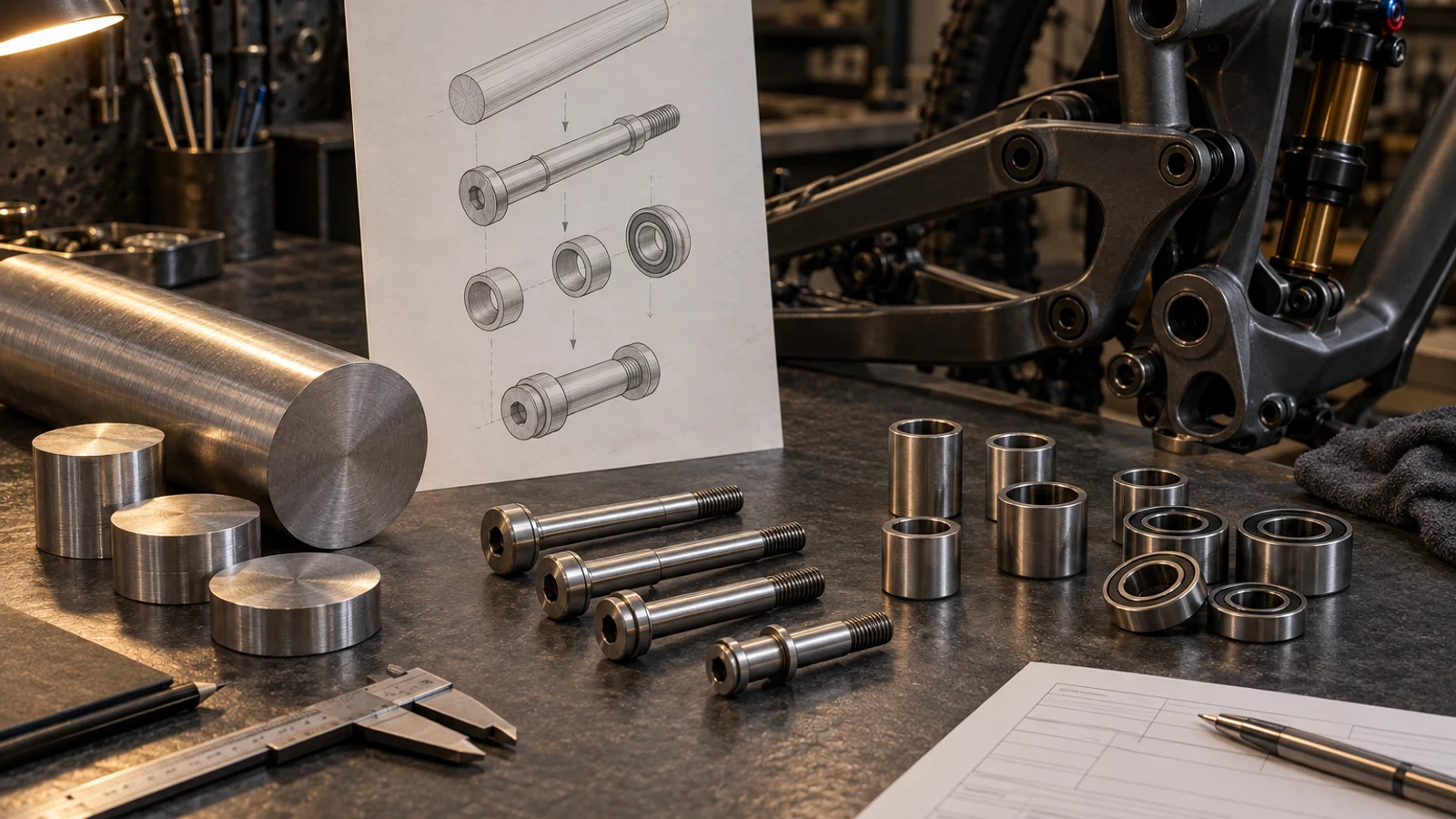
Hero: concept illustration of example hardware and its application. It is not a factory photograph, tested component or approved production geometry.
Make the purchase basis explicit
The ASTM B348/B348M-25 public scope identifies annealed titanium bars and billets and lists Grade 5 as UNS R56400. That is a defined stock-specification context, not a general approval for every part described as titanium.
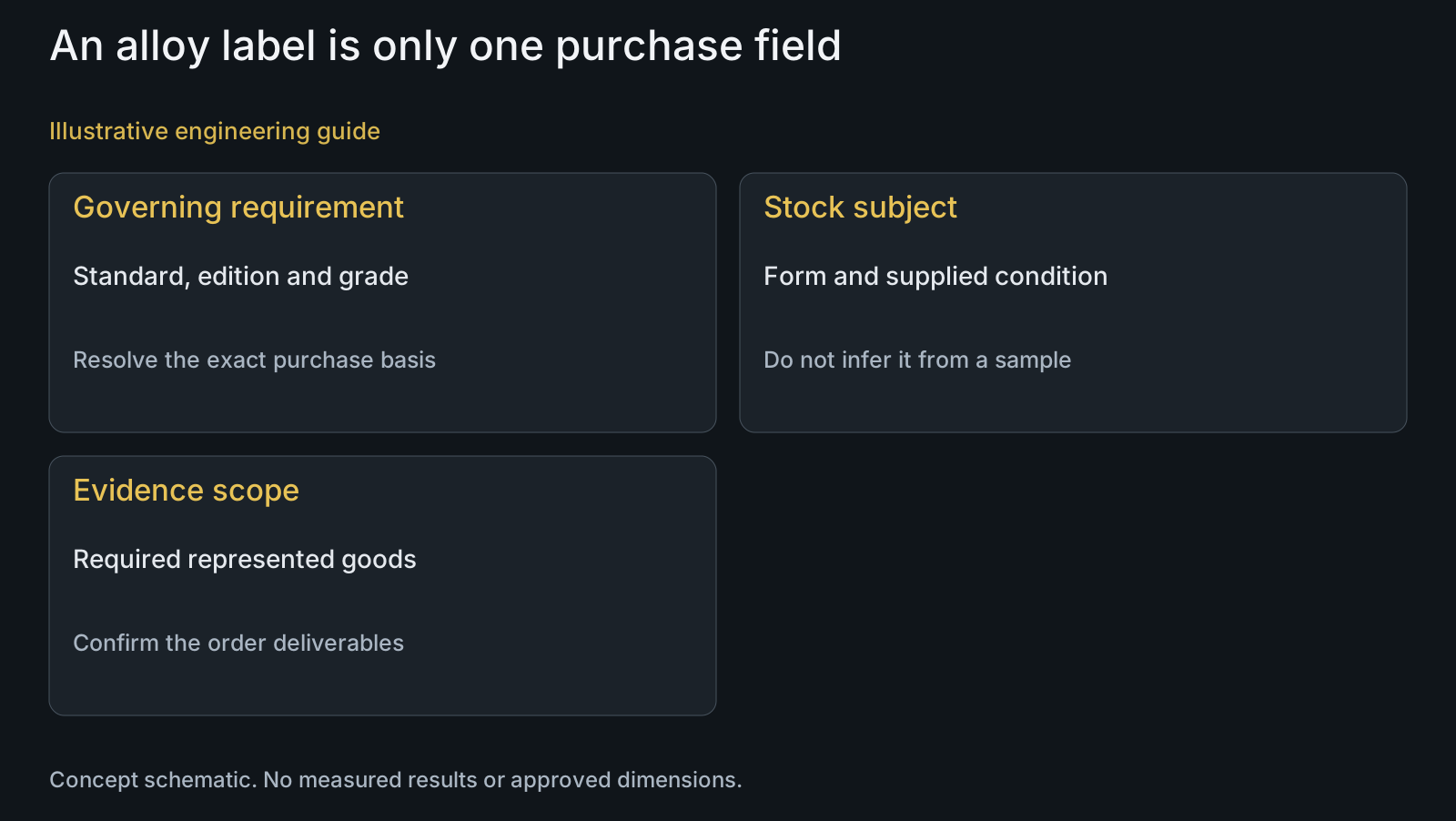
Separate the alloy designation from the requirement that governs the ordered material. Add the edition, relevant product form and condition, then state the document deliverables. A drawing note and a quotation should identify the same purchase basis rather than rely on matching keywords.
The stock-form comparison addresses selecting the appropriate material subject. This review asks a narrower procurement question: what exactly must the quoted titanium stock meet?
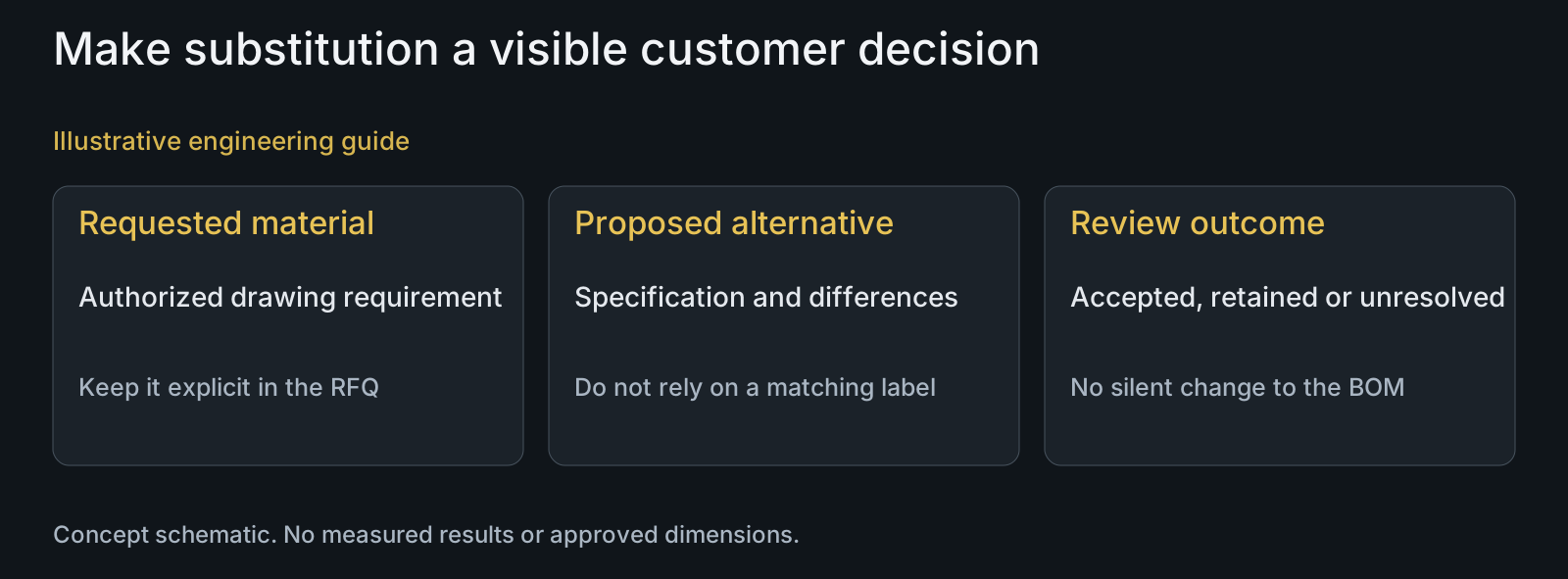
Treat an alternative label as a proposal, not permission
If a supplier proposes TC4 against a requirement expressed through another designation, ask for the proposed governing specification, grade and condition. Do not let an informal cross-reference silently replace the actual drawing requirement.
A substitution review must identify the fields being compared and any differences or unresolved evidence. Shared alloy-family wording cannot establish complete equality of chemistry limits, material properties, product-form requirements and document scope. This article does not assert full TC4 equivalence.
Keep the outcome explicit: the original requirement remains, a defined alternative is approved by the responsible customer, or the proposal remains open. An alternative mentioned in a quote is not automatically an authorized change to the BOM.
| RFQ wording | Missing decision | Risk | Useful resolution |
|---|---|---|---|
| Titanium only | Which governing grade and requirement? | Unspecified material priced as equivalent | Name standard, edition and grade |
| Grade 5 only | What product form and condition? | Alloy label treated as full purchase basis | Define the intended stock subject |
| TC4 proposed | What substitution is being requested? | Informal label changes the BOM silently | Compare actual specifications and obtain approval |
| Aerospace quality | Which specific obligation applies? | Marketing term replaces an evidence requirement | Name applicable material and document scope |
| Material document included | Which goods and requirements are represented? | Document title mistaken for complete conformity | Confirm represented subject and agreed deliverables |
| Finished sample matches | What material history is established? | Appearance treated as stock evidence | Resolve stock basis separately from geometry |
Remove ambiguous aerospace claims from the RFQ
'Aerospace grade' does not tell the buyer which requirements will be applied. Ask for the actual specification, edition and represented goods instead of using the adjective as a substitute for a material note or supplier qualification.
If the project genuinely requires an aerospace material specification, identify it separately. The AMS 4928 and ASTM B348 guide addresses alternative or combined requirements; neither a marketing label nor one specification number establishes conformity to another.
Do not request extra document titles without a decision they must support. Define the required material evidence, its represented stock and any necessary order relationship. Availability and scope must be confirmed rather than promised for every titanium order.
Keep stock requirements separate from finished design choices
A stock selection does not establish the custom shoulder's fit or authorize a machining allowance. Put the finished geometry and surface requirements on the component drawing. An intended material condition should not be inferred from the appearance of a finished sample.
A sample may help identify an interface, but it cannot independently establish the original stock standard or material history. Where the drawing is incomplete, identify the missing material decision alongside the dimensional review rather than convert the sample into an unsupported specification.
Discuss CNC turning, materials and the finished-property guide as distinct subjects. Do not infer a finished strength, service life or universal torque from the bar designation.
Compare quotes on the same material obligations
Put each supplier's declared purchase basis beside the requested requirement. A quote that states only 'titanium' leaves the grade unresolved; a quote that repeats Grade 5 but omits the governing requirement may still assume a different evidence scope.
Ask the supplier to identify exclusions and proposed alternatives, not merely confirm that the label appears on a price sheet. Resolve document availability, stock form and condition before deciding whether the offers are comparable. No price advantage or lead-time penalty is assumed here.
Once the requirement is agreed, the raw-material traceability guide addresses connecting the represented stock to manufactured pieces. This article establishes the purchase basis before that allocation question arises.
Review a drawing note and a proposed alternative
Illustrative engineering example: assume an OEM drawing specifies a titanium bar requirement while a quotation lists TC4 and the phrase 'aerospace quality.' The geometry is unchanged, but the quotation does not identify the proposed material specification or condition. No actual supplier, certificate or test result is assumed.
The buyer asks for the missing purchase fields and an explicit substitution proposal. Matching the alloy-family description is only a starting point; the responsible reviewer must assess the applicable requirements and unresolved differences. Until that review is resolved, the material change is not treated as accepted.
If the original requirement is retained, the quote must address it. If a defined alternative is accepted, update the authorized material basis without implying that all standards or service results became equivalent. Use the drawing and BOM RFQ guide to make that decision visible.
Questions buyers need to confirm
Can I specify only Grade 5 on the pivot drawing?
It leaves important purchase fields unresolved. Identify the governing standard and edition, form, condition and requested material evidence so the quotation and drawing share a defined requirement.
Can TC4 automatically replace the requested titanium material?
No automatic permission is implied. Request the proposed specification, grade and condition, identify differences against the authorized requirement, and obtain the responsible customer's substitution decision.
Does the phrase aerospace grade establish material conformity?
No. Ask which specific requirement and evidence are being offered. An adjective does not define the purchase basis, qualify the supplier or approve the finished bicycle component.
Does a matching sample establish the original stock specification?
No. It may help with interface review, but its appearance does not establish material history. Resolve the material requirement and evidence separately from the sample's geometry.
Can I compare two quotes with different material notes?
Only after the differences are visible and resolved for the intended comparison. Check declared requirements, proposed substitutions and document scope instead of comparing price on the assumption that the labels mean identical obligations.
What should I send for a titanium pivot material review?
Provide the drawing, STEP or sample reference and BOM, with the required stock specification, edition, grade, form, condition and evidence. Identify any permitted alternatives and who can approve them; these fields change the quotation basis.
Technical references and scope
ASTM B348/B348M-25 official public scope. Annealed titanium bars/billets and Grade 5 designation; no finished-pivot certification, full TC4 equivalence or aerospace qualification inferred.
Explore related component, material and sourcing decisions in the customer decision knowledge center. For a drawing review, use the Drawing/BOM RFQ path.
Give the titanium quotation an explicit material basis
Send the drawing, STEP or sample reference and BOM with the required titanium standard, edition, grade, form, condition and documents. State whether alternatives may be proposed so PremFixer can review the material purchase basis alongside the manufactured interface.
Discuss the drawing and BOM