

Use a pivot hardware quality-agreement template as a structured way to complete actual supply decisions, not a universal contract that can be signed unchanged. Identify the components and revisions, finished requirements, evidence, exceptions and responsible authorities, then reconcile the related attachments with the main agreement. Leave no unexplained default AQL, Cpk, retention or warranty values in place. A filled field can still conflict with another field about the supplied state or accepted quantity. The table below is a discussion structure for OEM engineers, purchasing and SQE, not legally reviewed terms, an acceptance approval or a claim that any listed service is automatically supplied.
Hero: concept illustration of example hardware and its application. It is not a factory photograph, tested component or approved production geometry.
Use one identified product scope across the schedules
Begin with the actual parties, producing scope, part numbers, revisions and kit quantities. Keep the technical drawing and BOM references consistent with the quotation and proposed quality attachment. A kit described commercially as pivot hardware may contain components with separate material and evidence requirements.
For each row in the table, record the project answer, relevant document and responsible decision role. Identify an unanswered question explicitly rather than inserting a familiar default. The quality agreement guide explains the different evidence subjects; this template helps complete and reconcile their project-specific connections.
Complete the acceptance fields without borrowing thresholds
For a characteristic, identify its requirement, method, datum or setup where relevant, units and examined process state. For sampling, specify the represented population and complete agreed plan. For capability evidence, name the feature, process and analysis basis. These fields change what conclusion the resulting document can support.
NIST's acceptance-sampling introduction distinguishes a lot-disposition decision from estimating lot quality. A sampling entry does not establish every unit's conformity. Complete the population and plan using the sampling guide, and define process-characteristic evidence separately using the capability-requirement guide.
| Subject | Project answer to complete | Risk if left ambiguous | Connection to check |
|---|---|---|---|
| 1. Parties and scope | Entities, sites, operations and decision roles | Another site assumed covered | Main agreement and route |
| 2. Product definition | Part/BOM revisions and supplied condition | Mixed or obsolete definition | Drawings, models and quote |
| 3. Characteristics | Requirement, method, datum, units and state | Result answers another feature | Inspection attachment |
| 4. Sampling and capability | Population/plan and separate study basis | One number becomes all approval | Applicable evidence subjects |
| 5. Sample and release | Purpose, deliverables and decision authority | Prototype silently releases production | Sample versus later goods |
| 6. Traceability and records | Identity links, access, basis and owner | Files cannot represent supplied parts | Lot and retained context |
| 7. Nonconforming goods | Affected scope, response and authorization | Informal concession or mixed stock | Disposition and cause status |
| 8. Changes and old stock | Affected revisions and existing-state treatment | Old stock enters new configuration | BOM mates and authority |
| 9. Packing and shipment | Contents, count unit, protection and labels | Piece total treated as complete sets | Actual receiving unit |
| 10. Service and legal terms | Warranty/audit subjects for qualified review | Contradictory duties or remedies | Main agreement and applicable framework |
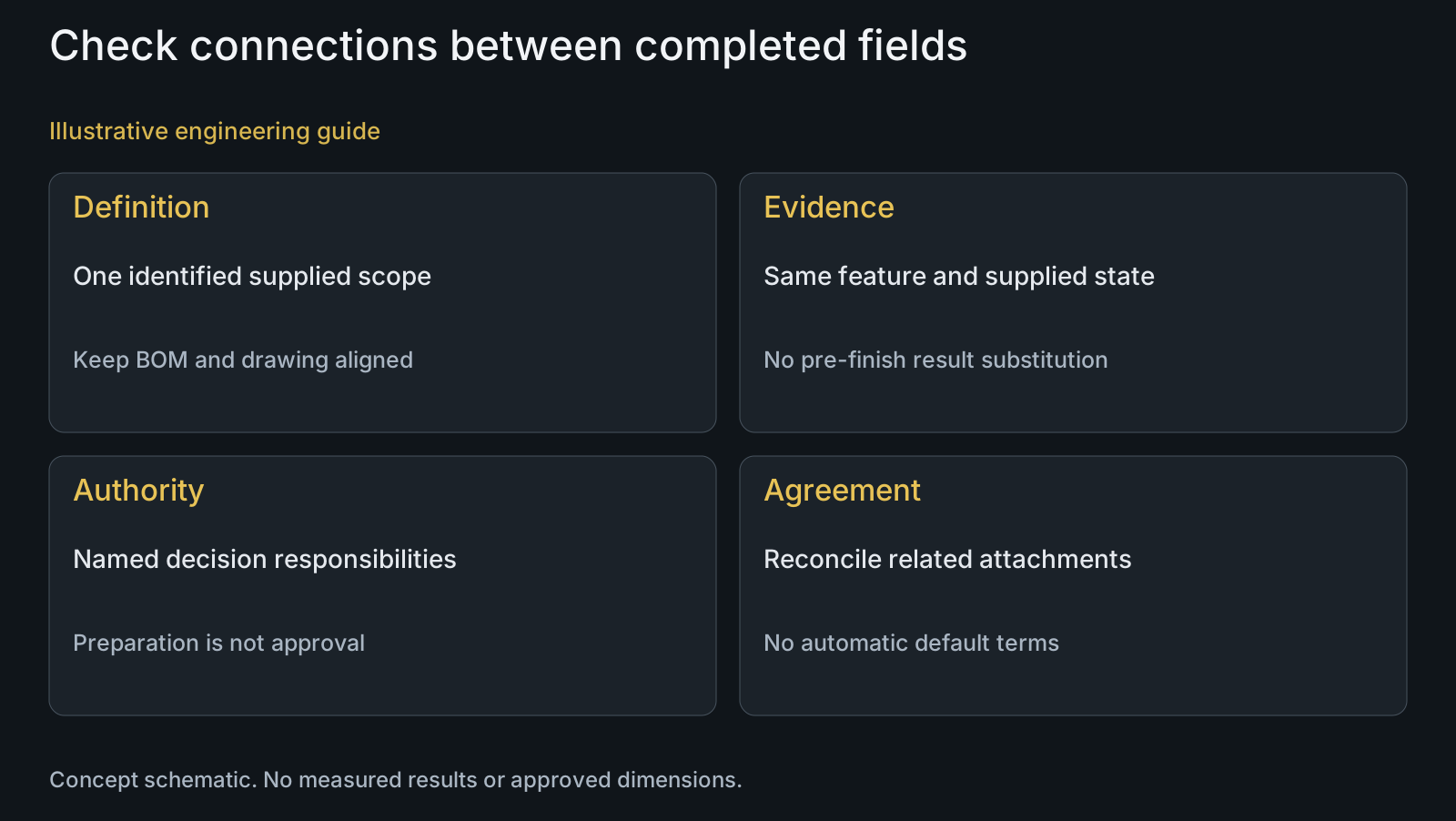
Make the authority fields actionable
Distinguish who prepares evidence, who reviews it and who can authorize a disposition, change or release. A department name alone may not identify the relevant decision. Align authority with the actual contract and organizational arrangements instead of implying the manufacturer can approve every customer's application.
For deviations, identify affected stock, notification and the permitted decision pathway. For changes, identify old and new configurations, related mates and existing states. A concession for one population should not silently become a new drawing definition. Cross-reference the disposition guide rather than equating supply recovery with investigation closure.
Reconcile records, packaging and the supplied identity
Connect report scope to the parts that will be packed. A document covering one axle group cannot automatically represent another component or a replacement subgroup. Define which identities and documents must remain usable at receiving and afterward, and what access and retention are actually agreed.
Check the quantity unit throughout: pieces, bags and complete kits differ. A packing clause that counts pieces can contradict a receiving clause expecting complete BOM-defined sets. Use the packaging acceptance guide to reconcile that physical boundary, not merely rename the label.
Coordinate service terms with the main agreement
Warranty, audit access, payment, delivery, liability and dispute subjects should not acquire contradictory definitions in separate attachments. Have the appropriate commercial and legal reviewers determine incorporation, document priority and actual rights. This article does not prescribe legal wording or decide which regime governs the order.
The UN's CISG introductory note describes the convention's applicability and scope. Have qualified advisers determine the transaction's legal framework and actual terms. For the technical scope, compare the proposed work with manufacturing and materials, retaining customer design authority.
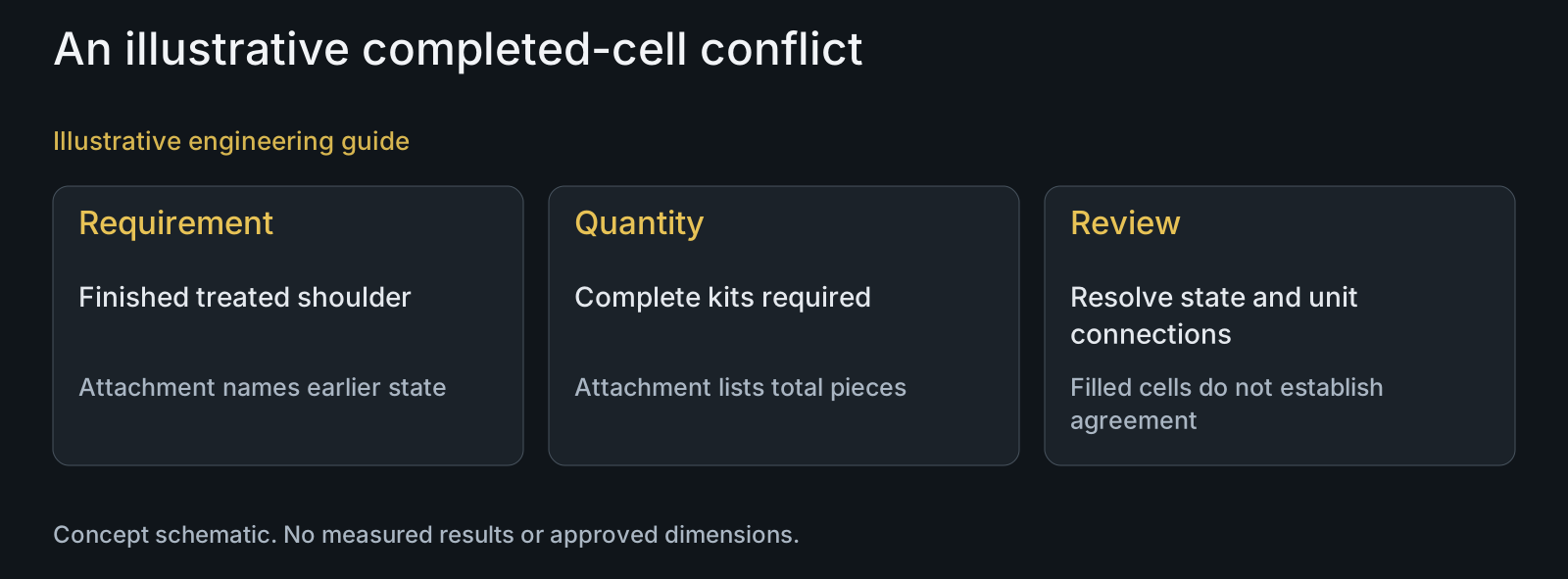
Review example: every row is filled, but the states conflict
Illustrative engineering example: assume a hypothetical quality worksheet identifies a finished treated shoulder, while its inspection attachment names measurements before treatment. The packing row describes complete kits, but the quantity attachment lists only an aggregate piece count. No actual agreement, measurement or acceptance outcome is supplied.
The reviewer follows the state and quantity connections between rows. It asks which evidence addresses the finished interface and how component quantities establish complete sets, then identifies the responsible decision roles and related documents. The template cannot be treated as resolved merely because every cell contains text. The example demonstrates a consistency review, not approved terms or an accepted shipment.
Questions buyers need to confirm
Is this a ready-to-sign quality contract?
No. It is a fillable decision structure. Complete project inputs, reconcile attachments and obtain qualified review of commercial and legal terms before relying on the actual agreement.
Can the template provide default AQL and Cpk values?
Do not use unexplained defaults. Define the population and sampling plan separately from the named process-characteristic study and analysis basis. Numerical requirements need the actual project decision.
Why are authority and document references needed in each row?
They connect a statement with its evidence and permitted decision. A filled cell without those connections may leave conflicting responsibilities or an unsupported acceptance subject.
Does a pre-treatment report satisfy a finished-interface row?
Not automatically. Identify the represented state and whether subsequent operations affect the required feature. Resolve the final-condition evidence instead of silently extending the earlier result.
Can a total piece count satisfy a complete-kit requirement?
Only with the required components and variants reconciled to the BOM. State the counting unit and contents; an aggregate total alone does not establish usable complete sets.
Which terms need coordination with the main agreement?
Review delivery, payment, warranty, audit access, liability and dispute subjects through the appropriate advisers. Avoid conflicting definitions and remedies across attachments; no universal legal allocation is supplied here.
Technical references and scope
NIST/SEMATECH, What is Acceptance Sampling?. Limited lot-disposition versus lot-quality-estimation distinction; no prescribed AQL or plan tables.
United Nations Audiovisual Library, CISG introductory note. General applicability and scope boundary only; no transaction-specific legal terms prescribed.
Explore related component, material and sourcing decisions in the customer decision knowledge center. For a drawing review, use the Drawing/BOM RFQ path.
Complete and reconcile the project-specific fields
Send the drawings, STEP model, kit BOM, proposed quality attachment and related quotation through the Drawing/BOM RFQ path. PremFixer can clarify manufacturing and evidence scope, identify mismatched technical inputs and support a focused review; legal and acceptance authority remain with the appropriate parties.
Discuss the drawing and BOM