

Global delivery of custom pivot kits needs an information and responsibility handoff as well as a transport booking. Identify the importer arrangement, required destination documents, actual packed contents and the person who can answer clearance questions. Door delivery does not automatically resolve those tasks. Keep kit quantities, individual components and cartons distinguishable, and align the shipment data before dispatch. Then separate customs release, carrier delivery and plant receipt. For an OEM assembly team, the useful endpoint is identifiable hardware in the required configuration, not simply a tracking event showing that several boxes reached the destination area.
Hero: concept illustration of example hardware and its application. It is not a factory photograph, tested component or approved production geometry.
Identify who handles the clearance question
Agree the delivery scope, named place and responsible importer arrangement before shipment. Ask which party supplies the destination information, works with the broker and responds when a classification, value, origin or product-description question arises. A courier name does not answer those questions.
CBP's guidance for new importers states that the importer of record retains responsibility for correct entry documentation and applicable charges even when using a broker. That is a U.S. context, not a universal legal determination for every destination or transaction.
Have the responsible importer or broker establish the applicable local requirements and authority. Operational coordination can be assigned, but a marketing phrase such as door delivery should not be treated as a complete description of customs obligations or a promise that every destination arrangement is available.
Describe the goods and quantities at the correct level
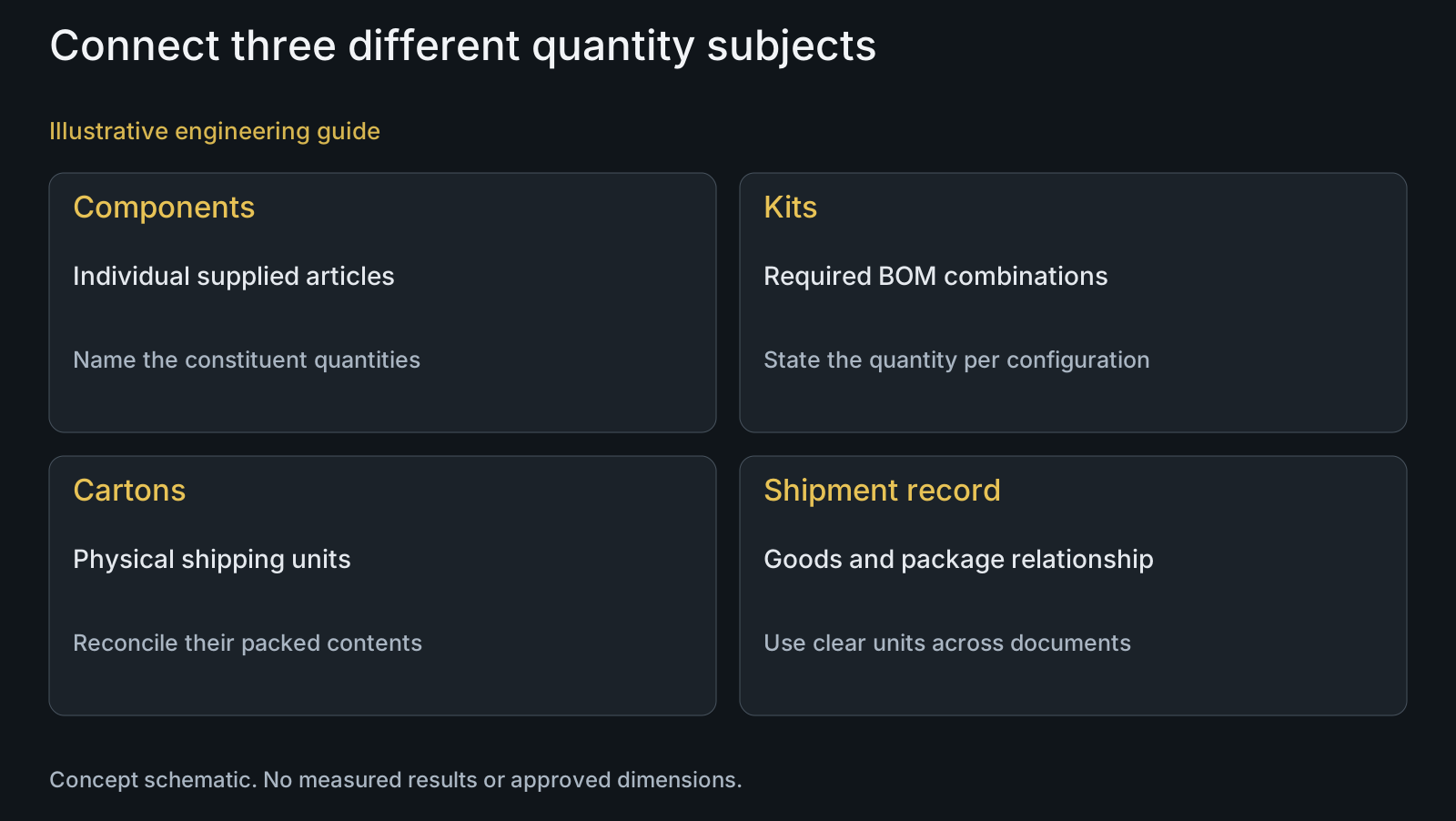
A kit is a supplied configuration, a component is an individual article and a carton is a package. State which unit each quantity represents. An internal purchasing kit name may not explain the materials and constituent items to someone preparing shipment information.
Identify the relevant goods, actual supplied materials, component quantities and packed units in the agreed document format. Reconcile those data with the BOM and the physical consignment. Do not invent a customs description or alter a value merely to avoid a question.
The pivot tariff-classification guide addresses classification and duty scope separately. This handoff guide concerns accurate available inputs and responsibility, not a universal code or tariff for every pivot kit.
| Situation | What it means | Risk of the wrong inference | Useful action |
|---|---|---|---|
| Hardware is packed | Physical consignment exists | Shipment data assumed ready | Reconcile current contents and package units |
| Courier service is booked | Transport arrangement exists | Importer tasks assumed transferred | Confirm importer and clearance contact |
| Invoice and packing list use different units | Counts describe different subjects | Kit count mistaken for component count | Explain constituent quantities and units |
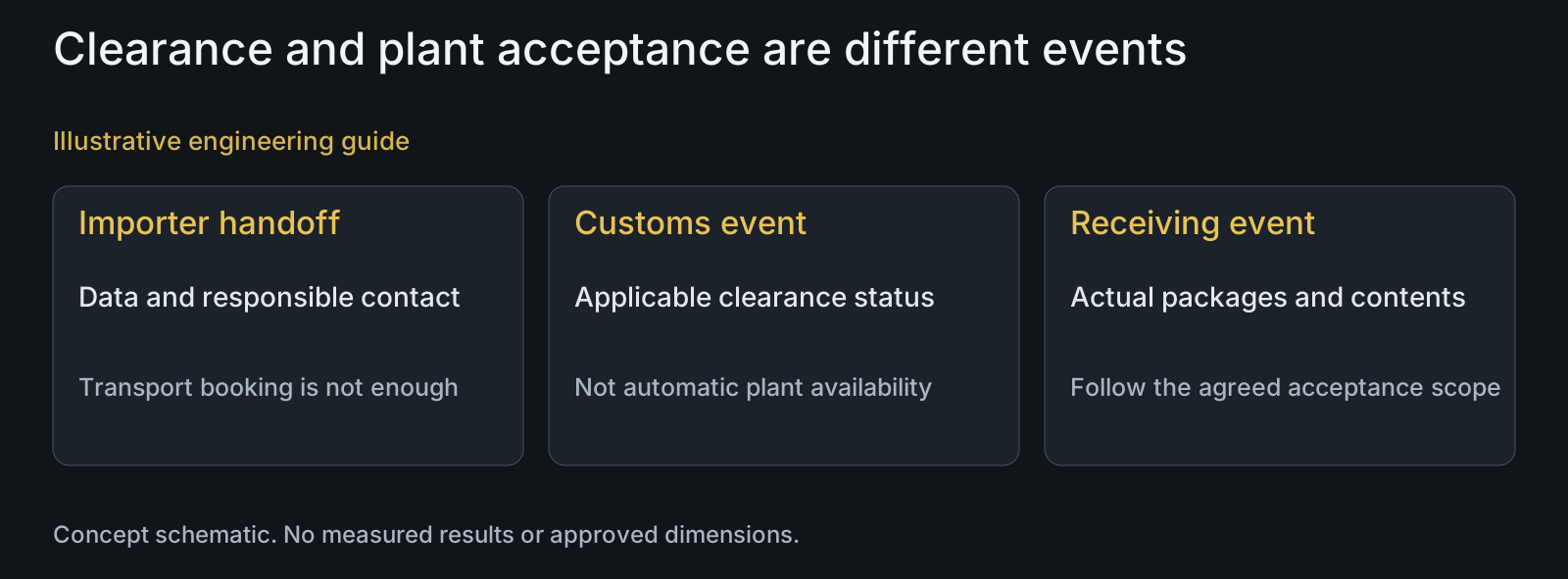
| Customs release is recorded | A clearance milestone is reached | Plant receipt assumed complete | Confirm onward leg and receiving event |
| Carrier delivery is recorded | Packages reached a stated point | Complete accepted kits assumed available | Reconcile package identity and supplied contents |
Keep commercial and packing information consistent
Trade.gov's common-document guide distinguishes commercial invoices, packing lists and transport documents. It explains that a packing list does not replace the commercial invoice and that their represented shipment information should be consistent. Destination-specific requirements still need confirmation.
For a split order, identify which part quantities are in this consignment rather than copy the total purchase-order quantity into every shipment record. If cartons are reorganized after the data is prepared, update the affected package relationships before dispatch.
Keep technical acceptance evidence separate from commercial shipment data. A dimensional report or material certificate may be requested for the order, but it does not substitute for the invoice or the actual packing description. The custom-order document guide explains the technical-document subjects.
Preserve kit identity through packing and receiving
Use protection appropriate to the exposed locating surfaces, threads and finishes, while keeping the supplied item identity visible. Review the transport-protection guide for that physical requirement. Protection and information must work together; an unmarked padded box can still leave the receiver uncertain about its configuration.
Agree how individual part identities, kit identity and carton marks relate. The package-labeling guide distinguishes these subjects. Do not assume the same number should appear as the part, kit and transport-unit identifier.
At receipt, record the actual packages and contents needed for the buyer's acceptance process. Preserve the packaging and identifiers if damage or a discrepancy needs investigation. Physical delivery does not itself establish dimensional conformity or an approved combination with the customer's frame.
Review a kit-count discrepancy without changing the goods
Illustrative engineering example: assume one kit contains two bolts and one sleeve, and the planned consignment contains 100 kits. That assumed configuration contains 300 individual components. These figures are explanatory arithmetic, not an actual order, declared value or customs classification.
If one record states 100 kits and another states 300 components without describing the relationship, the data can appear inconsistent even when the physical contents are the same. The reviewer explains the unit and constituent quantities, then checks the packed carton distribution against that configuration.
The correction is clarity about the represented goods, not an invented shipment count or altered invoice value. Whether and how the destination requires separate lines or classifications belongs to the responsible importer or broker's assessment of the actual articles.
Track distinct events instead of one ambiguous delivered status
Identify manufacturing readiness, carrier handover, any clearance action, delivery to the agreed location and receiving acceptance as distinct events. When a shipment stalls, ask which event is unresolved and which party can act. Repeating a carrier estimate does not close missing importer information.
The global shipping guide compares transport offers and receiving endpoints in more detail. Obtain current route-specific estimates there; no general courier or ocean duration establishes this shipment's arrival date.
For the actual manufacturing scope, state which documents must be available before dispatch and the contact for open shipment-data questions. PremFixer manufactures to agreed customer inputs; logistics, importer and receiving responsibilities must be defined for the destination and consignment.
Questions buyers need to confirm
Does courier delivery eliminate importer responsibility?
Do not infer that. Confirm the responsible importer and broker arrangement for the destination. In the U.S., CBP states that use of a broker does not remove the importer of record's responsibility for correct entry information and applicable charges.
Can a packing list replace the commercial invoice?
No. They represent different shipment information and must be consistent where they describe the same goods. Confirm the destination's required content and format with the importer or freight forwarder.
Should the documents count kits or individual parts?
Make the represented unit explicit and explain the constituent quantities. The appropriate document lines depend on the actual goods and destination requirements. An internal kit count without its relationship to components can be misleading.
Does a sample shipment need no customs data because it is small?
Do not assume that. Describe the actual articles and obtain the applicable shipment requirements from the responsible importer or broker. Sample purpose does not justify an invented value or an unsupported clearance exemption.
Is customs release the same as accepted hardware at our plant?
No. Check the onward transport and receiving event, then reconcile the supplied configuration under the buyer's acceptance process. Clearance, carrier delivery and technical acceptance are different decisions.
What should we provide for a shipment-handoff review?
Provide the delivery location, importer arrangement, contact, actual BOM quantities, proposed packed units and required documents. State the receiving milestone and any split shipment so responsibility and data can be aligned before dispatch.
Technical references and scope
CBP tips for new importers and exporters. Official indexed U.S. importer-of-record responsibility guidance; not a determination for every destination or transaction.
Trade.gov common export documents. Document distinctions and invoice/packing consistency; U.S. export filing thresholds are not generalized to Chinese-origin hardware.
Explore related component, material and sourcing decisions in the customer decision knowledge center. For a drawing review, use the Drawing/BOM RFQ path.
Prepare an information-ready pivot consignment
Send the supplied BOM, component and kit quantities, destination and receiving contact, proposed importer arrangement, required delivery milestone and document requirements. The review will reconcile the physical consignment with its shipment data and identify the remaining manufacturing, clearance and receiving handoffs.
Discuss the drawing and BOM