

To detect export-compliance mistakes in a custom bicycle fastener order, question what each document is supposed to prove. Identify the actual supplied goods, destination, requirement basis, relevant date and responsible party before accepting a shipment commitment. A bolt report does not assess a complete bicycle, a material grade does not cover every chemical requirement, and a previous shipment file may no longer represent a changed finish or kit. The ten questions below expose different decision gaps rather than demand ten extra certificates. They support procurement review, not a guarantee of market access, regulatory acceptance or customs clearance.
Hero: concept illustration of example hardware and its application. It is not a factory photograph, tested component or approved production geometry.
1. Confusing the component with the finished product
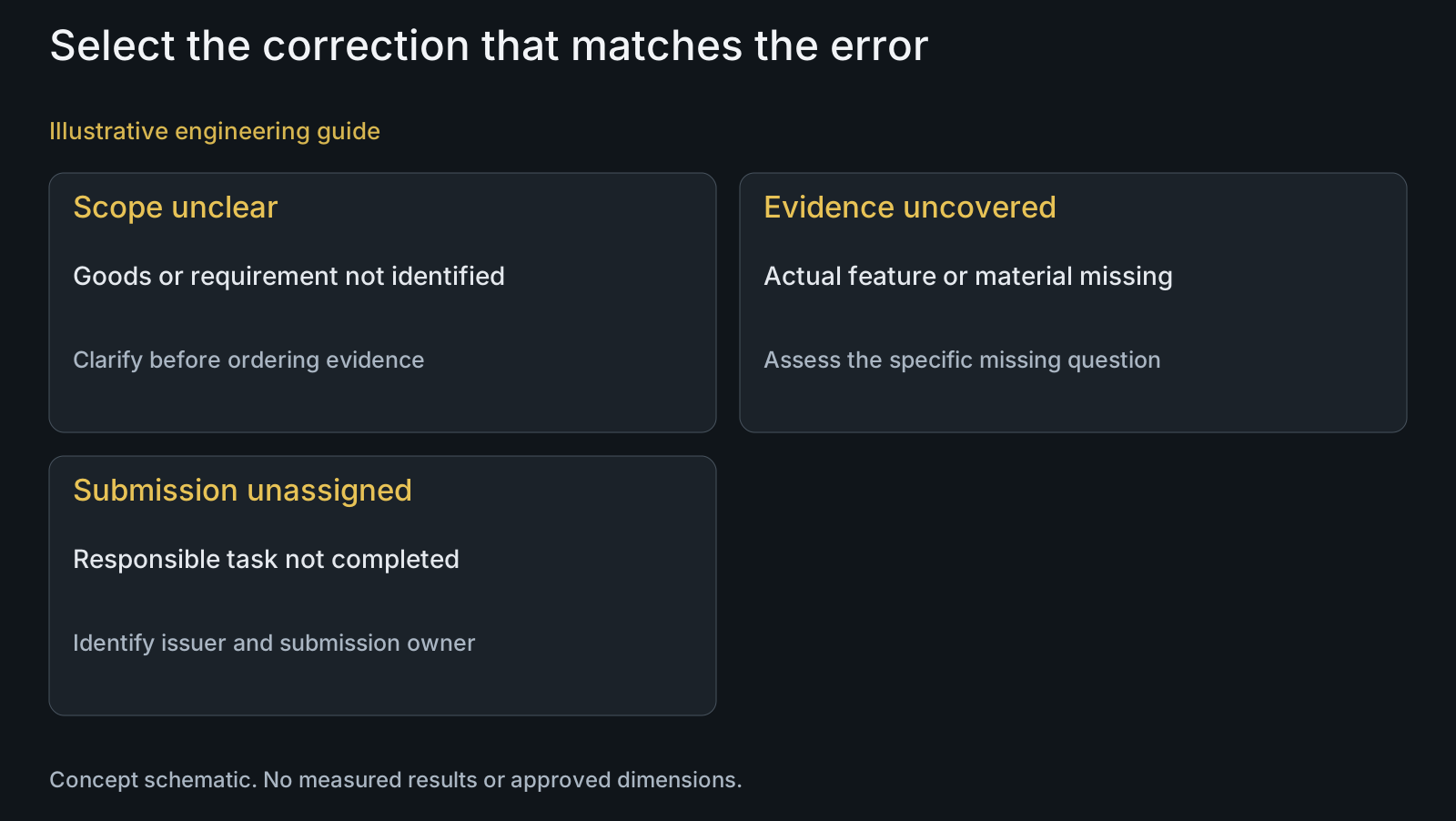
Ask: Which supplied object does this requirement cover? Distinguish a loose shoulder bolt, a pivot kit and a complete bicycle. Evidence about a bolt's material or size may support a product assessment, but it does not become evidence that the complete bicycle meets every applicable requirement.
Show the supplied BOM and intended use. A kit containing a receiver and spacers needs an accurate description, not the same line used for a single screw. The export-document guide organises destination handoffs; this article diagnoses the assumptions that can make that handoff inaccurate.
2. Treating a region as one import route
Ask: Which destination authority and importer path are we actually addressing? A shared technical reference does not define every country's import tasks. Keep destination-specific requirements separate even when the underlying component drawing is unchanged.
The Saudi and Gulf guide illustrates why regional marking and a national shipment service need different questions. Do not copy another market's document names into the new order without confirming the actual supplied form and importer responsibilities.
| Mistake | Buyer question | Risk | Responsible verification |
|---|---|---|---|
| 1. Wrong product level | Which supplied object is covered? | Bolt evidence used for complete bicycle | Product owner checks BOM and scope |
| 2. Regional shortcut | Which destination path applies? | One country's file reused elsewhere | Importer confirms national tasks |
| 3. Incomplete reference | Which edition and features? | Hidden geometry or thread changes | Engineering resolves actual requirements |
| 4. Unclear obligation | Legal, contractual or optional? | Wrong certificate requested | Compliance and buyer identify basis |
| 5. Unsupported mark | What permits this product mark? | Logo mistaken for approval | Responsible reviewer verifies route |
| 6. Grade-only evidence | What supplied materials are covered? | Finish or compound omitted | Substance reviewer checks coverage |
| 7. Wrong document type | What conclusion does it support? | Sample report called certification | Buyer compares claim and actual scope |
| 8. Origin assumption | Which rule and claim are supported? | Unsupported tariff preference | Trade reviewer checks origin conditions |
| 9. Missing owner | Who issues or submits this? | PDF mistaken for completed filing | Importer and product owner assign tasks |
| 10. Unreviewed change | Which conclusion has changed? | Old evidence used for new configuration | Relevant owner reassesses affected inputs |
3. Using a familiar number without its edition
Ask: Which edition, amendment and ordered features does this reference mean? A legacy name or a supplier cross-reference can locate a related product document without proving identical dimensions, thread requirements or material provisions.
If the drawing and purchase note cite different references, establish precedence for the affected features. The five-system comparison separates related references from project-authorised substitutes. Do not let purchasing change a custom bearing shoulder by silently translating the head-standard number.
4. Calling every buyer request a legal requirement
Ask: Is this an applicable statutory obligation, a contract term or optional evidence? These categories can require different issuers, decisions and costs. A customer's requested report can be important without being a universal border requirement for every fastener.
Ask the responsible reviewer to identify the basis and covered goods. Do not invent a compulsory certificate because a prior buyer requested it, or dismiss a real obligation because the supplier's usual document pack omits it. Clarifying the requirement is the next action; buying an unrelated certificate is not.
5. Applying a mark before establishing its basis
Ask: What permits this mark on this supplied product? Your Europe states that CE marking depends on specific applicable harmonised EU rules and must not be used where no such requirement exists. A request to print CE on an unidentified pivot should trigger a scope review, not automatic artwork preparation.
For other schemes, likewise identify the actual certification or conformity route and covered product. A material report or quality-system certificate does not by itself grant a product mark. Keep proposed marking locations separate from engineering review of bearing seats, clamp faces and finish-sensitive surfaces.
6. Treating a material grade as complete substance evidence
Ask: Does this evidence cover the supplied substrate, finish and relevant added materials against the stated substance request? A bare-metal grade name does not establish the composition of a coating, locking compound or another supplied kit component.
ECHA explains that Candidate List substances in articles can trigger obligations under defined conditions. Do not turn that explanation into a universal named laboratory test for every bolt. The material-compliance document guide helps define the actual evidence question; assess applicable obligations with the responsible substance reviewer.
7. Substituting the wrong document type
Ask: Which exact conclusion does this document support? Distinguish measurements, sample tests, declarations and management-system certificates. Their headings do not make them interchangeable, and a report about one sample or characteristic cannot silently cover every finished part requirement.
SABS specifically distinguishes a sample test report from product certification. The South African acceptance guide shows how to map ordered features to evidence. If the request concerns finished shoulder geometry, a raw-material certificate leaves that question unanswered even when it is genuine.
8. Assuming dispatch country or a document guarantees preference
Ask: Which origin rule and claim does this shipment evidence support? The Commission's Access2Markets explanation connects preferential treatment to the relevant origin conditions. An envelope called certificate of origin is not, by itself, proof that a particular tariff preference applies.
Give the responsible trade reviewer the actual goods, manufacturing facts and destination. Use the origin-document guide for the separate handoff. Do not relabel origin from a shipping address, or promise duty savings before the applicable arrangement and evidence have been established.
9. Leaving the submission owner undefined
Ask: Who must issue, submit or accept this information? The party making a component, the importer and the responsible finished-product manufacturer can have different tasks. A supplier PDF does not automatically complete an importer's required electronic submission.
CPSC's current certificate guidance describes eFiling for imported consumer products subject to its certification requirement, with effective dates distinguished by import scenario. Confirm actual applicability and submission responsibility instead of treating every loose pivot as a regulated finished product or assuming the old PDF workflow remains sufficient.
10. Reusing the file after a relevant change
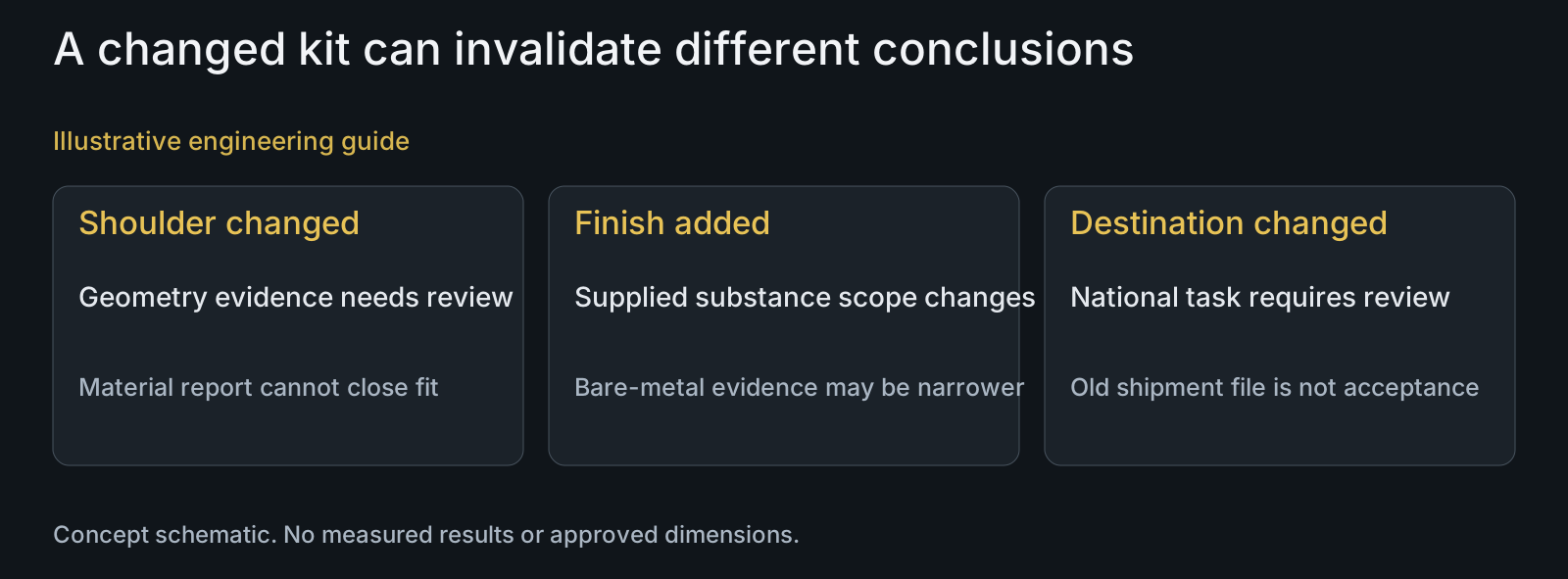
Ask: What changed since the evidence was prepared, and which conclusion does that affect? Compare drawing revision, material, finish, supplied BOM, destination, responsible party and relevant requirement date. A changed finish may affect substance evidence while a changed shoulder affects geometry evidence.
Illustrative engineering example: assume an OEM changes a bare shoulder pivot to a finished kit with a receiver and locking compound for a new destination. The old file contains a raw-material report and a bolt-only drawing. No real customer, compliance finding or shipment result is assumed.
The reviewer separates the gaps: identify the kit and revised interfaces, evaluate coverage of added materials, then ask the new importer about applicable tasks. Retain useful evidence within its actual scope. The decision is not to order ten more certificates, but to close the changed questions with appropriate inputs and owners.
PremFixer can discuss manufacturing information through manufacturing and surface treatment. Keep the customer decision knowledge centre available for the deeper question behind each error. No checklist substitutes for the actual product and transaction review.
Questions buyers need to confirm
Are these the ten statistically most common export mistakes?
No frequency ranking is claimed. They are ten distinct procurement scope errors selected to help buyers question product identity, evidence and responsibility. No real inquiry dataset or measured error rate is represented.
Should I request every certificate to avoid missing one?
No. Identify the applicable requirement and document purpose first. A larger folder cannot resolve the wrong product scope or unassigned importer task. Request evidence that answers a defined question and show what remains unresolved.
Does CE belong on every bicycle fastener exported to the EU?
Do not assume that. Specific applicable EU rules determine CE marking, and Your Europe says it must not be used without that basis. Identify the actual supplied product and relevant route before preparing a mark.
Does a material grade remove the need to review the finish?
No. It does not describe every coating, locking compound or kit material. Compare the supplied configuration with the requested substance scope and relevant obligations, then identify evidence for any uncovered material.
Can the supplier's PDF complete a US importer's certification task?
Not automatically. CPSC guidance distinguishes relevant certificate and electronic filing responsibilities. Confirm whether the actual goods are subject to the requirements, the import scenario and the responsible submitter; do not generalise from a finished-product workflow to every loose component.
What should I send to review an export evidence gap?
Send the current drawing and BOM, supplied material and finish, destination, intended use and importer instructions. Include the disputed document or claim and what changed so the responsible reviewer can address a specific gap rather than generate an unrelated certificate pack.
Technical references and scope
Your Europe: CE marking. Public applicability, manufacturer responsibility and update explanation. No actual pivot classification or CE approval.
ECHA: Candidate List substances in articles. Agency explains that inclusion can trigger article notification and communication obligations under conditions. Not a universal test prescription.
CPSC: certificate and eFiling update. Current public certification-related eFiling responsibilities and scenario-specific effective dates. No classification of the example kit.
Access2Markets: preferential origin concepts. Preference depends on applicable origin conditions. Does not establish an agreement, preference or origin for a PremFixer shipment.
SABS: certification versus a sample test report. Primary explanation distinguishes tested sample reports and product certification. No actual supplier permit or product test is claimed.
Explore related component, material and sourcing decisions in the customer decision knowledge center. For a drawing review, use the Drawing/BOM RFQ path.
Bring the specific evidence question to the RFQ review
Send drawings or STEP, the supplied BOM, material and finish, destination and importer requirements. Identify the document or assumption in question and any recent change. PremFixer can discuss manufacturing inputs and evidence scope without guaranteeing certification, tariff preference or customs clearance.
Discuss the drawing and BOM